
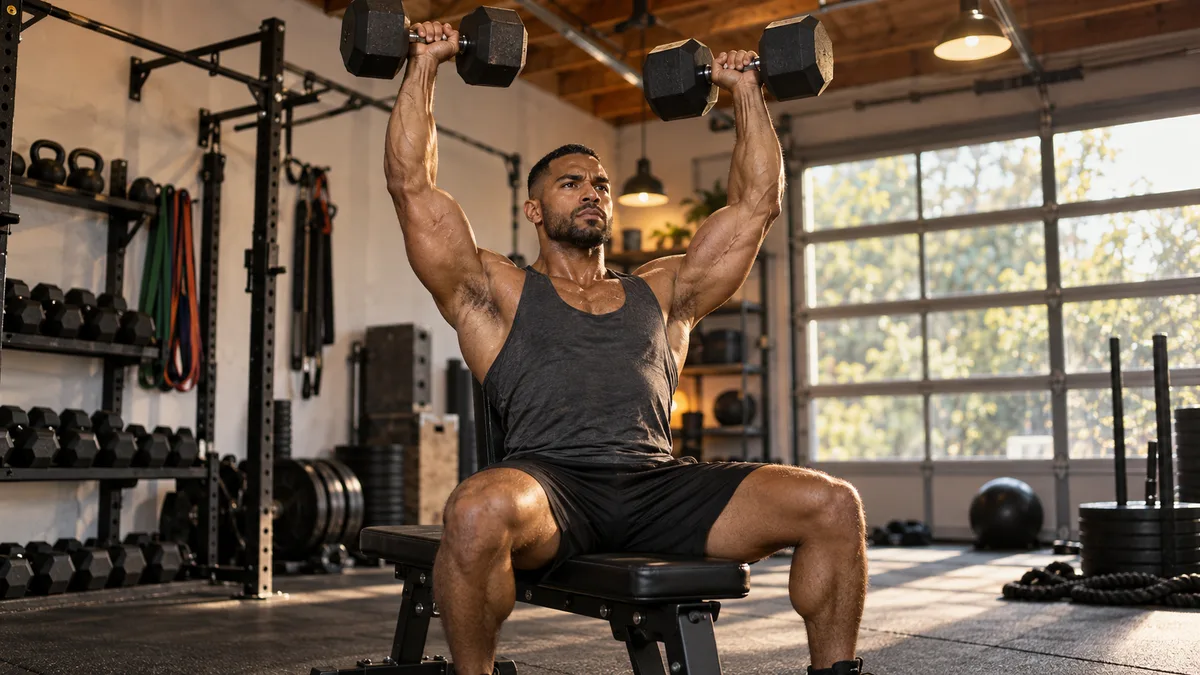
Your upper body is basically your business card. It’s the first thing people notice, whether you’re reaching for something on a high shelf, carrying groceries like a pack mule, or just standing tall with confidence. And yet, so many people skip upper body training or treat it like an afterthought. That changes today.
I’ve spent years experimenting with upper body routines, some brilliant, some absolutely terrible, and I’ve landed on a plan that works whether you’re training at home with minimal equipment or crushing it at a fully loaded gym. No fluff, no complicated periodization schemes, just exercises that build real strength and visible definition.
Ready to build a stronger chest, sculpted shoulders, and arms that finally fill out your sleeves? Good. Here’s the plan.

Why your upper body deserves more attention
Here’s something most people don’t think about: your upper body muscles support almost everything you do daily. Picking up your kids, pushing a heavy door, even maintaining good posture at your desk. It all requires upper body strength. Neglect it, and you’ll feel it everywhere.
Beyond the functional benefits, training your upper body creates that balanced, athletic look. Ever notice how someone with strong shoulders and a defined back just *carries themselves* differently? That’s not an accident. That’s training.
And if you’re worried about “getting too bulky,” I promise you won’t. Building significant muscle mass requires very specific caloric surpluses and years of progressive training. What you WILL get is lean muscle definition, better posture, and the kind of strength that makes everyday life feel easier. According to the American Council on Exercise, compound upper body exercises also boost your metabolic rate significantly, meaning you burn more calories even at rest.
The muscles you’re training
Before you start pressing and pulling everything in sight, it helps to understand what you’re working with. Your upper body contains several major muscle groups, and a solid plan hits ALL of them, not just the mirror muscles.
The front: chest and shoulders
Your pectorals (chest muscles) handle pushing movements. Your deltoids (shoulders) have three heads: front, lateral, and rear. Each one needs attention. Most people hammer the front delts through pressing but completely ignore the rear delts. Don’t be that person.
The back: lats, traps, and rhomboids
Your back is a powerhouse. The latissimus dorsi gives you that V-taper shape, while your trapezius and rhomboids keep your shoulders pulled back and your posture on point. A strong back is the secret weapon of any impressive physique.
The arms: biceps, triceps, and forearms
Your biceps flex the elbow, your triceps extend it. Fun fact: your triceps make up roughly two-thirds of your upper arm mass. So if you want bigger arms, stop doing endless curls and start pressing. Your forearms get plenty of work from gripping during compound movements.
The core connection
Your core stabilizes everything during upper body exercises. A weak core means weak lifts. Period. Every overhead press, every push-up, every row demands core engagement. This is why a good upper body workout plan secretly trains your abs too.
The complete upper body workout plan
This plan works on a two-day upper body split: one day focused on pushing movements (chest, shoulders, triceps), and one focused on pulling movements (back, biceps, rear delts). You’ll train each session once or twice per week depending on your overall program. If you’re following a 5-day workout split, these sessions slot in perfectly.
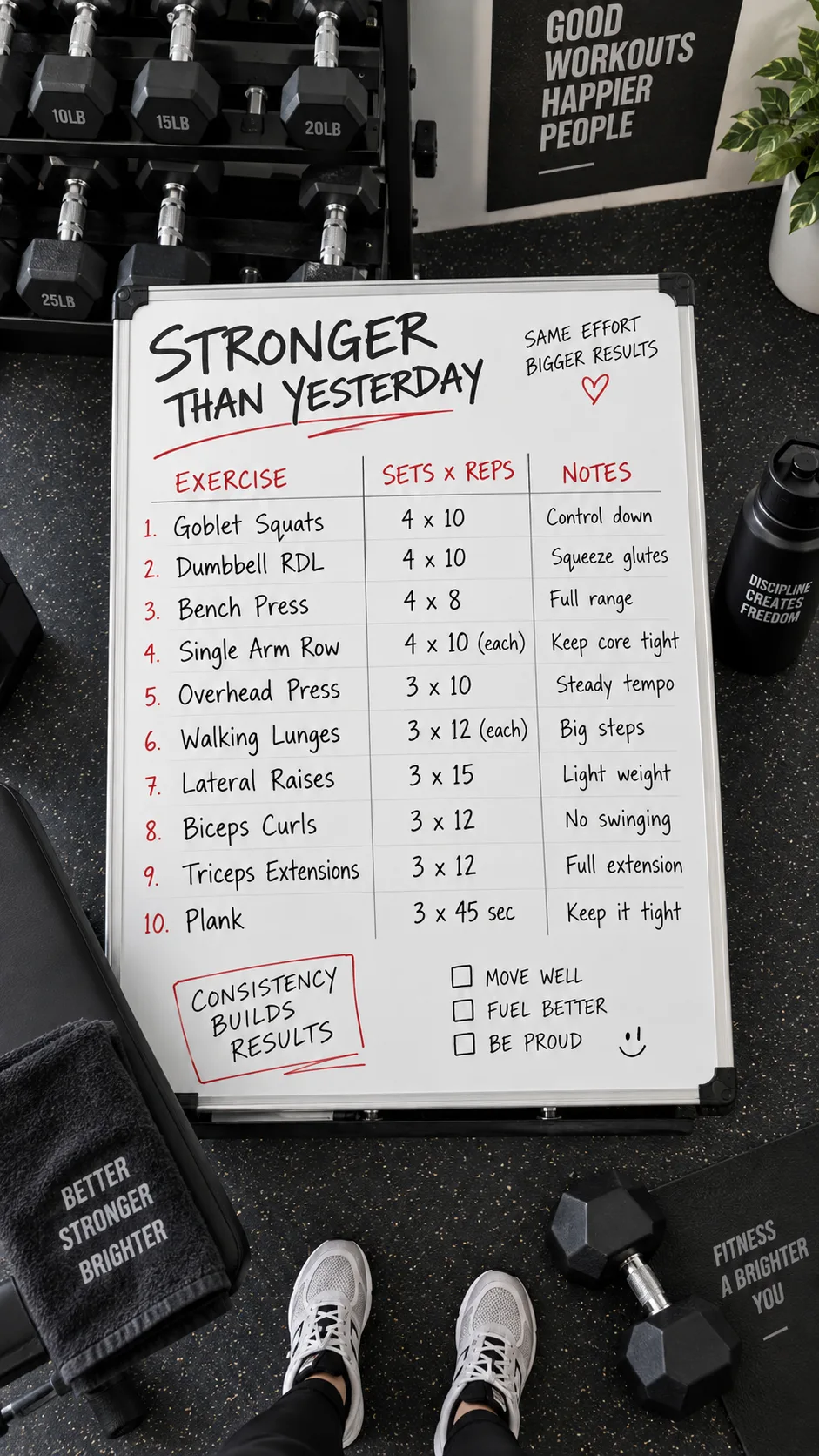
Day 1: Push day (chest, shoulders, triceps)
This session focuses on all the muscles responsible for pressing and pushing. Start with compound movements when you’re freshest, then move to isolation work.
- Barbell Bench Press (or Floor Press at Home), 4 sets x 6-8 reps
- Overhead Dumbbell Press, 3 sets x 8-10 reps
- Incline Dumbbell Press, 3 sets x 10-12 reps
- Lateral Raises, 3 sets x 12-15 reps
- Tricep Dips (or Bench Dips), 3 sets x 10-12 reps
- Overhead Tricep Extension, 3 sets x 12-15 reps
- Push-Ups to Failure, 2 sets
Rest 60-90 seconds between sets for compound lifts, and 45-60 seconds for isolation exercises. If you’re training at home without a barbell, swap the bench press for weighted push-ups or resistance band chest presses.
Day 2: Pull day (back, biceps, rear delts)
Pull day is where the magic happens for posture and that coveted back definition. These movements counterbalance all the pressing from Day 1.
- Pull-Ups or Lat Pulldowns, 4 sets x 6-8 reps (use a band for assisted pull-ups at home)
- Bent-Over Barbell Row (or Dumbbell Rows), 4 sets x 8-10 reps
- Seated Cable Row (or Resistance Band Rows), 3 sets x 10-12 reps
- Face Pulls, 3 sets x 15-20 reps
- Barbell or Dumbbell Bicep Curls, 3 sets x 10-12 reps
- Hammer Curls, 3 sets x 12-15 reps
- Reverse Flyes, 2 sets x 15 reps
Face pulls are non-negotiable, in my opinion. They target the rear delts and rotator cuff muscles that keep your shoulders healthy. Skip them at your own risk.
How to modify this plan for home workouts
No gym? No problem. I trained at home for an entire year during lockdown and made some of my best upper body gains during that stretch. The trick is knowing how to substitute effectively.
Here’s what you need at home (and it’s not much):
- A set of adjustable dumbbells (or a few fixed pairs ranging from light to heavy)
- Resistance bands with varying tensions
- A pull-up bar (doorframe versions work great)
- A sturdy chair or bench for dips and incline work
For every barbell exercise listed above, swap in the dumbbell version. Can’t do pull-ups yet? Use a resistance band looped over the bar for assistance, or do inverted rows under a sturdy table. Sounds ridiculous, but it works incredibly well. If you want a dedicated arm routine without any equipment at all, check out this bodyweight arm workout that complements this plan perfectly.

Progressive overload: the one rule you can’t ignore
Here’s the honest truth. If you’re doing the same weight for the same reps every single week, you’re not building anything. You’re maintaining. Progressive overload is the fundamental principle behind muscle growth and strength gains.
What does that look like in practice? It’s simpler than you think:
- Add weight, even 1-2 pounds per session adds up fast over months
- Add reps, if you hit 8 reps on bench last week, aim for 9 this week
- Add sets, once your current volume feels manageable, tack on another set
- Slow the tempo, 3-second eccentrics make the same weight feel significantly harder
- Reduce rest times, compressing rest periods increases training density
Track everything. Use a notebook, a phone app, whatever works. Just WRITE IT DOWN. Research published in the Journal of Strength and Conditioning Research consistently shows that progressive overload is the single most important variable for hypertrophy. You can’t out-program this principle.
Common upper body training mistakes (and how to fix them)
I’ve made every single one of these mistakes. Learn from my suffering.
Mistake #1: All push, no pull
Most beginners hammer chest and shoulders because those are the “show” muscles. But training push movements without equal pulling creates muscle imbalances, rounded shoulders, and eventually, injuries. Your pulling volume should match or slightly exceed your pushing volume.
Mistake #2: Ignoring the warm-up
Walking into the gym and immediately loading the bench press is a recipe for a shoulder impingement. Spend 5-10 minutes on light band pull-aparts, arm circles, and some light sets before your working weight. Your joints will thank you in ten years.
Mistake #3: Ego lifting
Ever seen someone swinging their entire body during a bicep curl? That’s ego lifting, and it transfers the load away from the target muscle to basically everything except the target muscle. Drop the weight, control the movement, and feel the muscle working. You’ll grow faster. I promise.
Mistake #4: Neglecting the mind-muscle connection
This sounds woo-woo, but it’s backed by real science. Focusing your attention on the muscle you’re training, really squeezing it during each rep, increases muscle activation by up to 20% according to research from the European Journal of Applied Physiology. Think about your lats pulling during rows. Feel your chest pressing during bench. It makes a genuine difference.

How often should you train upper body?
This depends on your overall weekly structure, but here’s the sweet spot for most people:
- Beginners: 2 upper body sessions per week (1 push, 1 pull) with at least 48 hours rest between them
- Intermediate lifters: 2-3 sessions per week, potentially adding a dedicated arm/shoulder day
- Advanced: 3-4 sessions with higher volume splits and specific weak point training
More isn’t always better. Muscles grow during recovery, not during the workout itself. If you’re training upper body four days a week but sleeping five hours a night, you’re shooting yourself in the foot. Prioritize 7-9 hours of sleep and adequate protein intake (0.7-1g per pound of body weight daily) before adding more training days.
For a balanced approach that also covers your lower half, pair this plan with a solid full body workout routine or dedicated leg days.
Nutrition tips that support upper body gains
You can follow the perfect workout plan, but if your nutrition is garbage, your results will be garbage too. Here’s what matters:
- Protein at every meal, aim for 25-40 grams per sitting from sources like chicken, fish, eggs, Greek yogurt, or plant-based alternatives
- Enough total calories, you can’t build muscle in a severe calorie deficit. Eat at maintenance or slightly above if building muscle is the goal
- Carbs around training, carbohydrates fuel intense lifting sessions. Don’t fear them. A sweet potato or bowl of oats before training works wonders
- Stay hydrated, dehydrated muscles perform worse and recover slower. Even a 2% drop in hydration reduces strength output
- Don’t skip post-workout nutrition, a protein-rich meal within 2 hours of training supports recovery and muscle protein synthesis
You don’t need fancy supplements. A basic whey protein powder helps if you struggle to hit your daily protein target through food alone, but it’s a supplement, not a replacement for real meals.
How to track progress and stay motivated
Progress photos beat the scale every time for upper body training. Take them monthly, same lighting, same angle. You’ll notice changes in your shoulders, arms, and back definition that a number on a scale will never show you.
Strength benchmarks keep you motivated too. Set tangible goals: your first unassisted pull-up, a bodyweight bench press, or a set of 20 perfect push-ups. When you hit a milestone, celebrate it. Then set a new one.
And on the days you don’t feel like training? Show up anyway and do the warm-up. Nine times out of ten, once you start moving, you’ll finish the whole session. The hardest rep is always the one that gets you off the couch.

Sample weekly schedule
Here’s how a complete week might look if you’re combining this upper body plan with lower body training:
- Monday: Upper Body Push Day
- Tuesday: Lower Body (quads, glutes, calves)
- Wednesday: Rest or light cardio/mobility
- Thursday: Upper Body Pull Day
- Friday: Lower Body (hamstrings, glutes, posterior chain)
- Saturday: Active recovery, walk, yoga, light stretching
- Sunday: Full rest
This upper/lower split hits every muscle group twice per week with adequate recovery. It’s one of the most effective and time-efficient structures for building both strength and definition, whether you’re training at home or in a gym.
When to change your workout plan
Don’t change your program every two weeks because you saw a new routine on Instagram. Stick with this plan for a minimum of 8-12 weeks before considering changes. Your body needs consistent stimulus to adapt and grow.
Signs it’s time to switch things up:
- You’ve plateaued on multiple exercises for 3+ weeks despite proper recovery
- You’re experiencing joint pain or recurring discomfort (not to be confused with normal muscle soreness)
- You’ve achieved your initial goals and need a new challenge
- Training feels mentally stale and you’re losing motivation despite trying to push through
When you do change, keep the core compound movements (press, row, pull-up) and swap out assistance exercises. The fundamentals never stop working. You just need fresh ways to apply them.
Wrapping it up
Building a strong, defined upper body isn’t complicated. It requires the right exercises, progressive overload, consistency, and patience. This plan gives you a clear framework: push day, pull day, compound movements first, isolation work second. It works whether you’re lifting in a commercial gym or your garage.
Start where you are. Use whatever equipment you have. Focus on proper form before chasing heavy weights. Track your progress. Eat enough protein. Sleep like it’s your job. Do those things consistently for three months, and you’ll build upper body strength and definition that you can see and feel.
Now stop reading and go do your first session. The version of you with broader shoulders and confident posture is waiting on the other side of that first workout.
