
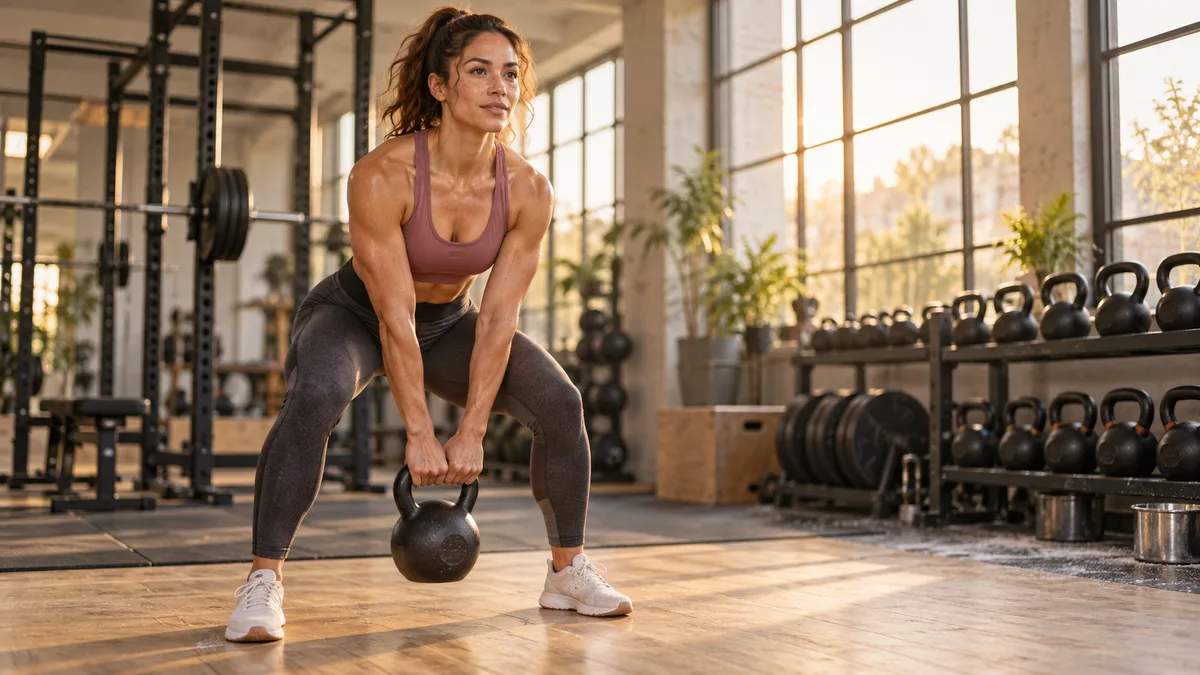
You’ve seen them sitting in the corner of the gym. Those cannonball-looking weights with handles that seem like they belong in a medieval workout dungeon. And you’ve probably walked right past them. I get it. Kettlebells can look intimidating when you’ve never picked one up. But they might be the single best piece of equipment for women who want to build strength, burn fat, and feel powerful in their own skin.
I remember my first kettlebell session. I grabbed one that was way too heavy, swung it with zero technique, and nearly took out a mirror. Graceful? Not even close. But once I learned proper form and started with the right weight, everything changed. My posture improved, my core got stronger, and I stopped dreading workouts entirely.
This guide walks you through a complete beginner kettlebell workout for women, from choosing your first weight to executing a full-body routine you can do anywhere. Real moves that work, explained without complicated jargon.
Why kettlebells work so well for women
I want to clear something up right away: kettlebells will NOT make you bulky. That myth needs to retire permanently. Kettlebells build lean muscle, torch calories, and improve functional strength. The kind of strength that helps you carry groceries, pick up your kid, or rearrange furniture without calling for backup.
Unlike dumbbells, kettlebells have an offset center of gravity. That means your stabilizer muscles work overtime during every single rep. Your core stays engaged whether you’re pressing, swinging, or squatting. It’s sneaky-effective conditioning that you won’t get from a standard dumbbell routine.
The science-backed benefits
Research from the American Council on Exercise (ACE) found that a kettlebell workout can burn up to 20 calories per minute. That’s equivalent to running at a 6-minute mile pace. Except you don’t have to run. You’re welcome.
A study published in the Journal of Strength and Conditioning Research also showed that kettlebell training significantly improves cardiovascular fitness, grip strength, and dynamic balance. For women specifically, these benefits translate to better bone density and reduced injury risk as we age.
- Full-body conditioning in less time than traditional split routines
- Improved posture, especially important if you sit at a desk all day
- Better hip mobility and posterior chain strength (hello, glutes!)
- Compact equipment that replaces an entire rack of dumbbells for beginners
- Cardiovascular and strength training combined into one efficient session
How to choose your first kettlebell weight
This is where most beginners go wrong. Pick something too light and you’ll feel nothing. Pick something too heavy and your form collapses, and that’s when injuries happen. The sweet spot for most beginner women falls between 8kg (18 lbs) and 12kg (26 lbs).
If you’ve never done any resistance training, start with 8kg. If you’ve been doing some arm workouts with weights or bodyweight exercises for a while, you can likely handle 12kg for lower-body movements and 8kg for upper-body ones.
Quality matters more than you think
Don’t grab a vinyl-coated kettlebell from the bargain bin. Seriously. Those smooth coatings get slippery when your hands sweat, and the last thing you want is a cannonball flying across your living room. Cast iron or competition-style kettlebells with a textured handle give you a much better grip. The Kettlebell Kings brand and Rogue Fitness both make excellent options for home use.
One kettlebell is genuinely all you need to start. You can always add a second, heavier bell as you progress. But for the next 4-8 weeks? A single kettlebell will challenge you more than enough.
Essential form tips before you start swinging
Before we get into the workout itself, we need to talk about the stuff that keeps you safe and makes every rep count. Skipping this section would be like skipping the tutorial in a video game. Technically possible, but you’ll regret it.
The hip hinge: your most important movement
Almost every kettlebell exercise starts with a hip hinge. This isn’t a squat. You push your hips BACK, not down. Think about closing a car door with your butt. Your shins stay nearly vertical, your spine stays neutral, and the movement comes from your hips and hamstrings.
Practice this without any weight first. Stand about a foot away from a wall, facing away from it. Push your hips back until your butt touches the wall. That’s a hip hinge. Master this and you’ve already won half the battle.
Core bracing
Every kettlebell rep requires you to brace your core. Not “suck your stomach in,” because that’s different. Brace like someone is about to poke you in the belly. Your abs, obliques, and lower back all tighten simultaneously. This protects your spine and makes you stronger in every movement.
Grip and wrist position
Grip the handle firmly but don’t death-grip it. Your wrists should stay neutral, not bent backward. During swings, the handle sits in the hook of your fingers, not deep in your palm. This prevents those gnarly blisters that make you reconsider your life choices.
The full-body beginner kettlebell workout for women
Here’s your complete routine. It targets every major muscle group, takes about 25-30 minutes, and you can do it 3 times per week with rest days in between. Warm up for 5 minutes first with bodyweight squats, hip circles, and arm swings.
1. Kettlebell deadlift, 3 sets of 10 reps
This is your hip hinge in action. Place the kettlebell between your feet. Hinge at the hips, grab the handle with both hands, and stand up by driving your hips forward. Squeeze your glutes hard at the top. Lower it back down with control.
This move lights up your hamstrings, glutes, and entire posterior chain. It also teaches you the foundational movement pattern for the kettlebell swing. Think of it as Swing School 101.
2. Kettlebell goblet squat, 3 sets of 10 reps
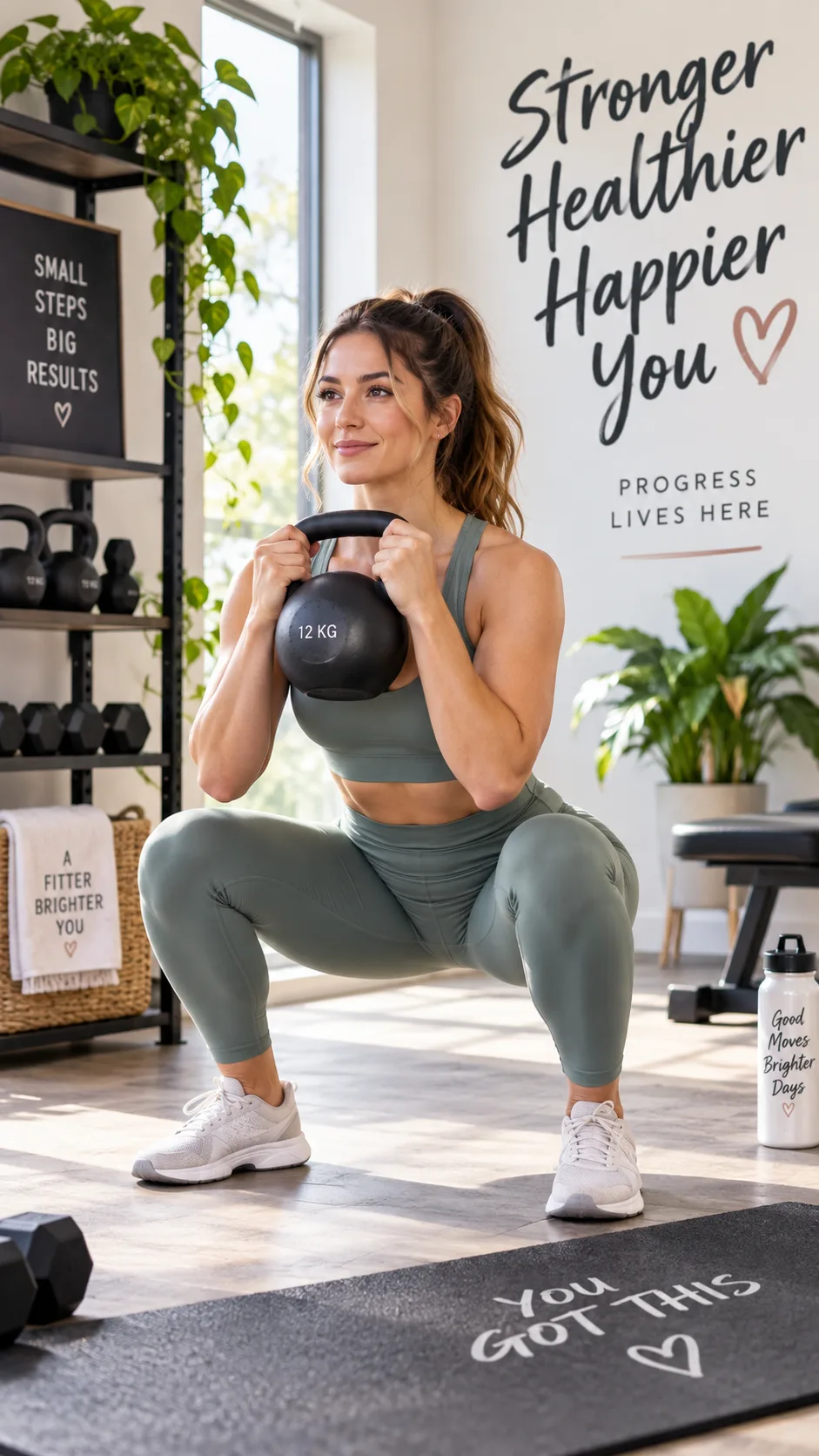
Hold the kettlebell by the horns (the sides of the handle) at chest height. Keep your elbows tucked and your chest proud. Squat down until your thighs reach parallel, or below if your mobility allows, then drive back up through your heels.
The goblet position forces you to stay upright, which makes it nearly impossible to develop the bad squat habits you’d pick up with a barbell. If you enjoy this movement, you’ll love pairing it with a dedicated leg and glute routine later on.
3. Kettlebell swing, 3 sets of 12 reps
The queen of kettlebell exercises. Ever wondered why CrossFitters and trainers obsess over this movement? Because it works everything. Hinge at the hips, swing the bell back between your legs, then snap your hips forward to drive it up to chest height. Your arms just guide it. They don’t lift it.
This is NOT a squat-and-front-raise combo. The power comes entirely from your hip snap. Keep your core braced, your lats engaged, and let your hips do the talking. Start with sets of 12 and focus on crisp form over speed.
4. Kettlebell overhead press, 3 sets of 8 reps per arm
Clean the kettlebell to the rack position (resting against your forearm at shoulder height). Press it straight overhead until your arm locks out. Lower it with control. Switch sides after 8 reps.
This move builds serious shoulder and tricep strength. Keep your ribs pulled down and avoid arching your lower back. If you can’t press it without leaning, the weight is too heavy. Drop down and nail the form first.
5. Kettlebell row, 3 sets of 10 reps per arm
Place one hand on a bench or sturdy chair. Hinge forward at about 45 degrees. With your free hand, row the kettlebell toward your hip, squeezing your shoulder blade at the top. Lower slowly.
Your back muscles are probably the most neglected group in most beginner programs. This exercise fixes that. A strong back means better posture, less neck pain, and a physique that looks balanced from every angle.
6. Kettlebell Romanian deadlift (single-leg), 2 sets of 8 reps per leg
Hold the kettlebell in one hand. Balance on the opposite leg. Hinge forward, letting the kettlebell drop toward the floor while your free leg extends behind you. Return to standing.
Yes, you’ll wobble. Everyone does at first 🙂 This exercise builds incredible single-leg stability, hamstring strength, and balance. Touch a wall lightly with your free hand if you need help staying upright. No shame in that.
7. Kettlebell halo, 2 sets of 8 reps each direction
Hold the kettlebell upside down by the horns at chest level. Circle it around your head, keeping it close to your skull. Reverse direction after 8 reps. This mobilizes your shoulders, strengthens your rotator cuff muscles, and makes for a fantastic finisher.
Your weekly schedule
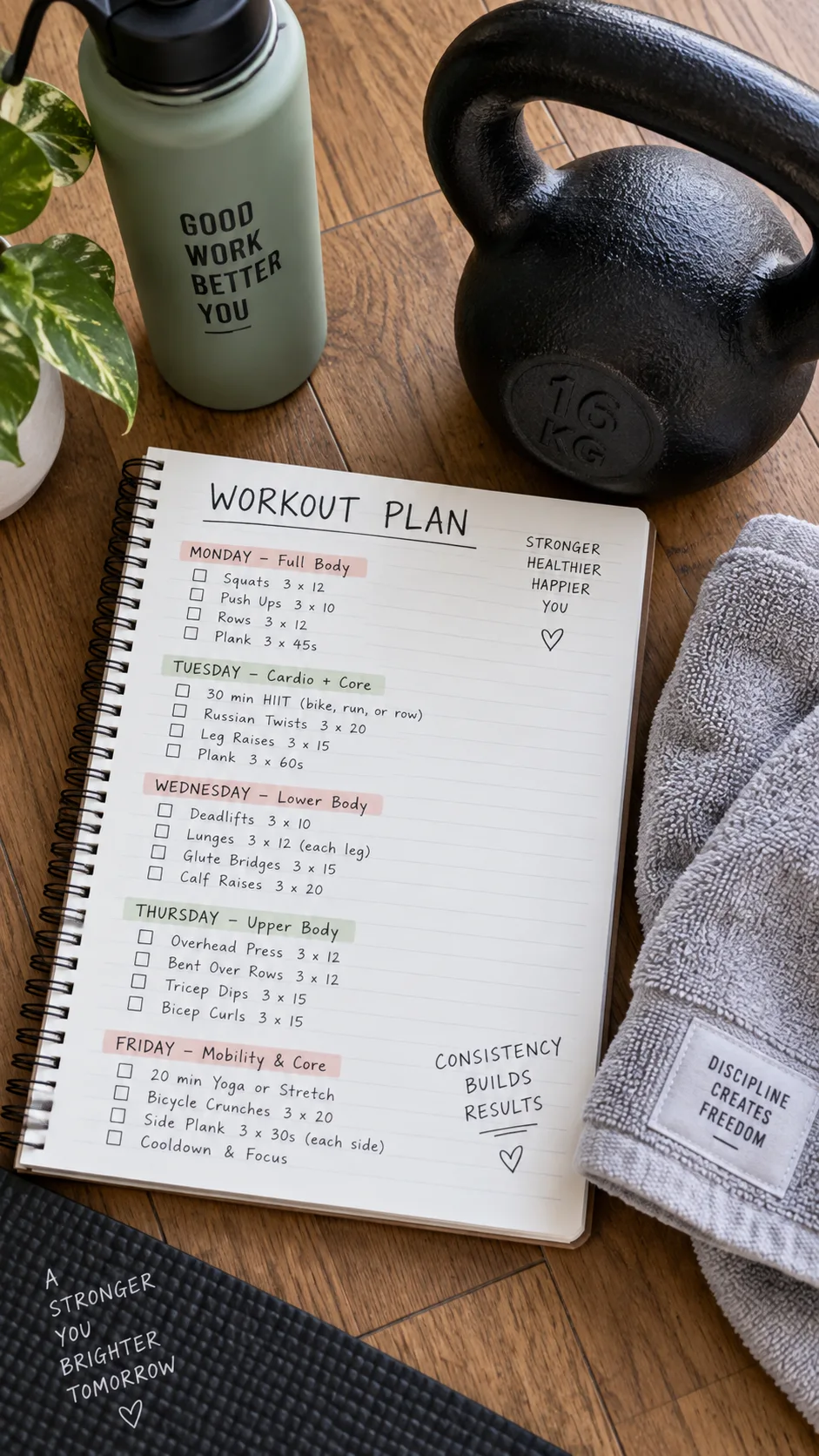
Consistency beats intensity every time. Here’s how to structure your week for the best results without burning out:
- Monday: Full kettlebell workout (the routine above)
- Tuesday: Rest or light mobility work. Try a mat Pilates session for active recovery
- Wednesday: Full kettlebell workout
- Thursday: Rest or 20-minute walk
- Friday: Full kettlebell workout
- Saturday & Sunday: Rest, stretch, live your life
After 4 weeks, increase your reps by 2 per set. After 6-8 weeks, consider moving up in kettlebell weight by 4kg. Progressive overload (gradually increasing the challenge) drives real results. Don’t stay comfortable.
Common mistakes that slow your progress
I’ve made most of these mistakes myself, so consider this section a shortcut through my trial-and-error phase. Some of these seem obvious, but they trip up nearly every beginner.
- Using your arms to swing: The kettlebell swing is a HIP exercise. Your arms are just along for the ride. If your shoulders burn after swings, your form needs work.
- Rounding your back: During deadlifts and swings, your spine stays neutral. Film yourself from the side. If your back looks like a question mark, reset immediately.
- Going too heavy too fast: Ego lifting isn’t just a guy thing. Increase weight only when you can complete all sets with perfect form.
- Skipping the warm-up: Five minutes of warming up prevents weeks of nursing an injury. Just do it.
- Neglecting rest days: Your muscles grow DURING rest, not during the workout itself. Overtraining leads to fatigue, poor form, and eventually injury.
What results can you realistically expect?
I’ll be straight with you. You won’t see a dramatic transformation after one week. Anyone promising that is selling something. But here’s what most women notice within the first month of consistent kettlebell training:
Weeks 1-2: You feel more comfortable with the movements. Soreness decreases. Your grip gets stronger. You start understanding what “hip hinge” means in your body, not just as a phrase you read online.
Weeks 3-4: Your energy levels climb. Clothes start fitting differently. Maybe not lighter on the scale, but your shape shifts. Your posture visibly improves.
Weeks 5-8: You need a heavier kettlebell. You notice genuine strength gains when carrying bags, climbing stairs, and moving through daily life. And IMO, this is where confidence really takes root. Not because of how you look, but because of what you can DO.
According to the National Strength and Conditioning Association (NSCA), beginners can expect to see measurable strength improvements within 4-6 weeks of consistent resistance training. Kettlebells are no exception.
Pairing your kettlebell routine with the right nutrition
You can’t out-train a terrible diet. I know nobody wants to hear that. But fueling your body properly makes the difference between “meh” results and “wow” results.
You don’t need a complicated meal plan. Focus on adequate protein (aim for 0.7-1g per pound of bodyweight), complex carbs for energy, and healthy fats to support hormone function. If you’re exploring different eating approaches, a whole-food approach like the paleo framework works well alongside strength training.
Stay hydrated, especially during kettlebell workouts. These sessions generate more sweat than you’d expect from 25 minutes of work. Keep a water bottle within arm’s reach.
Equipment you’ll want beyond the kettlebell
You need very little to get started, but a few extras make the experience significantly better:
- A yoga mat or rubber floor tiles to protect your floor and give you a non-slip surface
- Chalk or liquid grip to keep your hands dry and prevent slipping
- Flat-soled shoes or bare feet because running shoes with cushioned heels throw off your balance during hinges
- A timer app for tracking rest periods between sets (60-90 seconds works for beginners)
That’s it. One kettlebell and a few square feet of space put a legitimately effective full-body workout within reach. No machines, no cable systems, no gym membership required.
When should you level up?
You’ll know you’re ready to progress when the routine feels manageable, when you finish your last set thinking “I could do more” instead of “I might die.” Here are clear signs it’s time to step things up:
- You complete all prescribed sets and reps with excellent form
- Your rest periods feel too long
- The kettlebell feels noticeably lighter than it did a few weeks ago
- You’re no longer sore the next day (some soreness is fine, but zero means insufficient challenge)
Level up by increasing weight first, then volume. Jump to a 12kg or 16kg bell before adding extra sets or reps. And once you’ve built a solid foundation with kettlebells, you might feel ready to explore other gym equipment with far more confidence than if you’d started there.
The confidence factor nobody talks about
Here’s what surprised me most about kettlebell training. It wasn’t the physical changes that hooked me. It was the mental shift. There’s something deeply empowering about swinging a chunk of iron with precision and power. You stop thinking of yourself as “not a gym person” and start thinking of yourself as someone who’s genuinely strong.
Confidence doesn’t come from looking a certain way. It comes from proving to yourself, rep by rep, that you can do hard things. That first time you press a kettlebell overhead with one arm? You’ll remember that moment. It rewires how you see yourself.
And that’s worth way more than any number on a scale.
Final thoughts: just start
The best beginner kettlebell workout for women isn’t the fanciest program with the most exercises. It’s the one you DO consistently. This routine gives you seven foundational movements that build total-body strength, improve your posture, and burn serious calories, all in under 30 minutes.
Grab an 8-12kg kettlebell. Learn the hip hinge. Follow this routine three times a week. In two months, you’ll move differently, feel differently, and carry yourself with a quiet confidence that no amount of cardio-only training ever gave you.
Your future strong self is waiting. She’s just a few swings away.
