
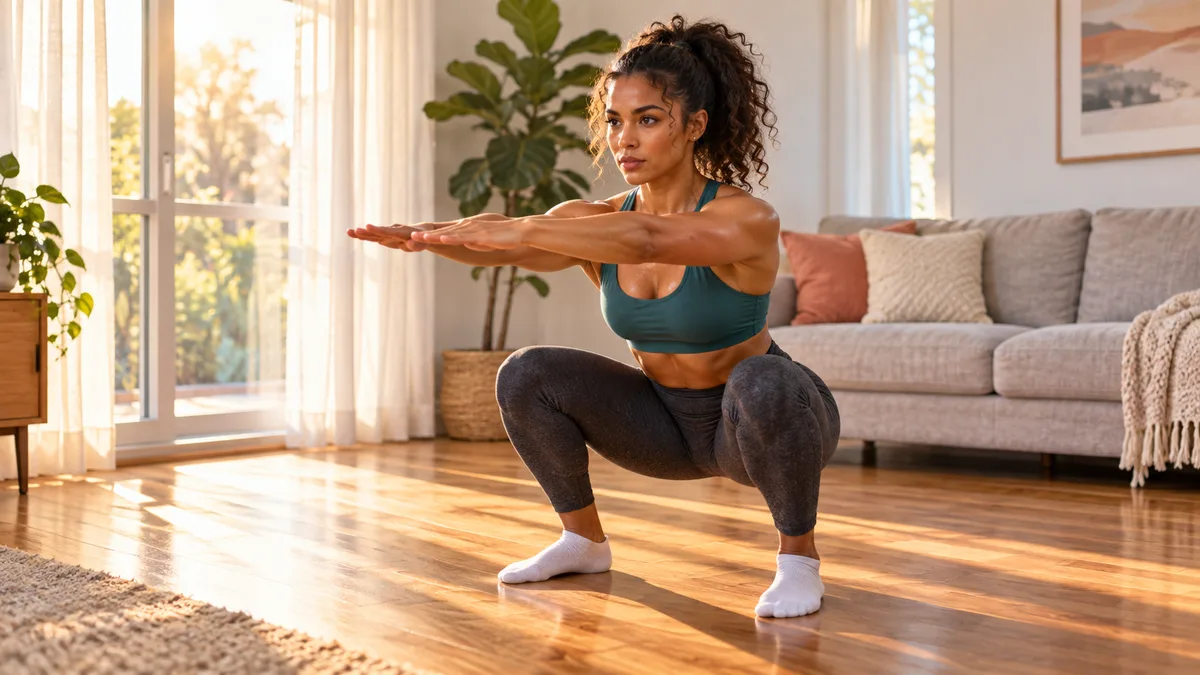
You don’t need a gym membership, a rack of dumbbells, or even a resistance band to build real strength. You just need your body, a little floor space, and about 30 minutes. That’s it. No excuses, no equipment shopping list, no driving to a crowded gym where someone’s hogging the squat rack.
I spent years thinking home workouts were somehow “less than,” like they were the participation trophy of fitness. Then I committed to a structured full body at home workout for six weeks straight, and I’ll be honest: my body changed faster than it did during months of half-hearted gym sessions. Why? Because I did the workouts consistently. Consistency beats perfection every single time.
This routine targets your arms, shoulders, back, core, glutes, and legs using nothing but bodyweight exercises. Whether you’re a total beginner or someone who’s been training for years, this workout scales to your level.
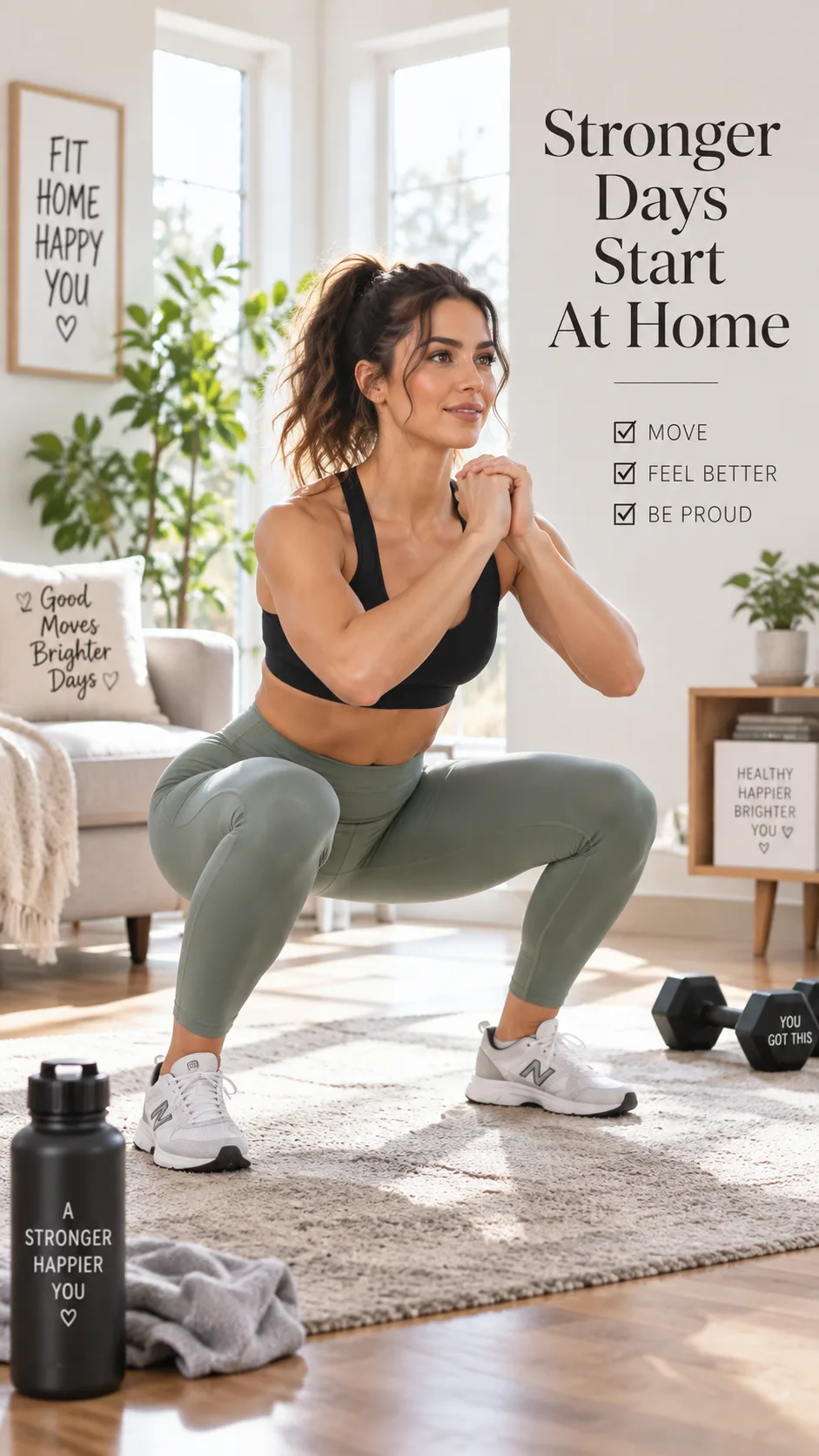
Why bodyweight training works (and works well)
There’s a stubborn myth floating around that you NEED weights to build muscle. You don’t. Research from the Journal of Strength and Conditioning Research has shown that bodyweight exercises can produce comparable muscle activation and strength gains to weighted exercises, especially for beginners and intermediates.
Your body is the equipment. A push-up forces you to press roughly 60-70% of your bodyweight. A single-leg squat demands serious quad and glute strength. A plank challenges your entire core stabilization system. These aren’t “easy” movements. They’re foundational ones.
The biggest advantage? You eliminate every barrier to starting. No commute, no waiting for equipment, no intimidation factor. You roll out of bed, clear a patch of floor, and you’re training. That accessibility is exactly why at home workouts for women have exploded in popularity, and why they deliver results when you follow through.
The warm-up: don’t skip this (seriously)
I know, I know. Warming up feels like the vegetables of exercise: necessary but boring. But skipping your warm-up is the fastest way to pull something and bench yourself for two weeks. Five minutes now saves you from a lot of frustration later.
Your 5-minute dynamic warm-up
- Arm circles: 30 seconds forward, 30 seconds backward. Gets your shoulders mobile and ready.
- Leg swings: 15 per leg, front to back. Hold onto a wall or chair for balance.
- Hip circles: 10 per direction. Your hips will thank you during squats.
- High knees: 30 seconds. Elevates your heart rate and wakes up your nervous system.
- Inchworms: 5 reps. Walk your hands out to a plank, then walk them back. This stretches your hamstrings and activates your core at the same time.
Total time: roughly five minutes. Now your muscles are warm, your joints are lubricated, and you’re mentally in the zone. Time to train.
The full body at home workout: your complete routine
This workout follows a circuit-style format. You’ll perform each exercise for the prescribed reps, rest 15-30 seconds between movements, and rest 60-90 seconds between rounds. Complete 3-4 rounds total depending on your fitness level.
Expect the full session to take 25-35 minutes including your warm-up. That’s shorter than most Netflix episodes. You have time for this.
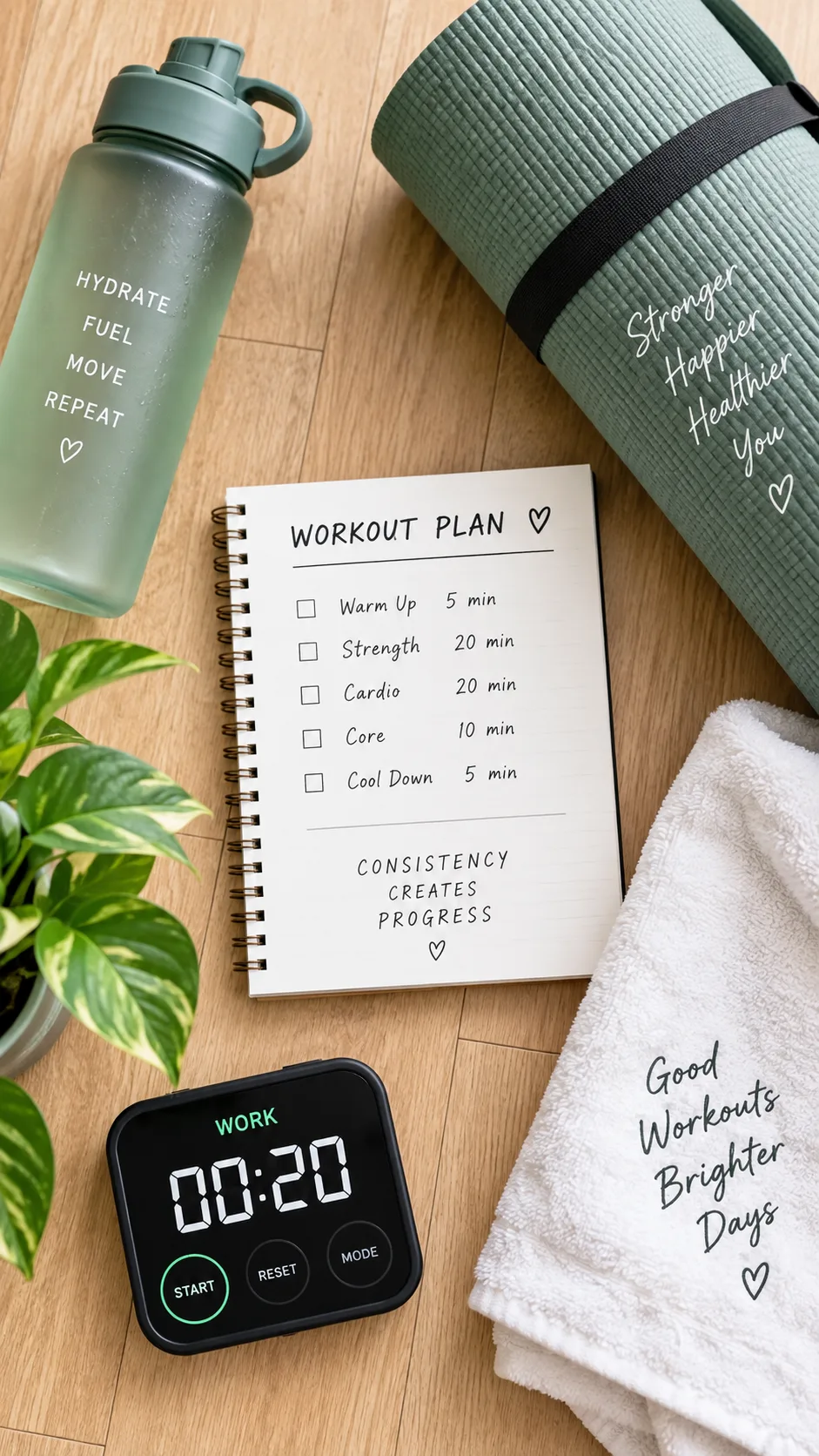
Exercise 1: Squat to calf raise (lower body)
Targets: quads, glutes, hamstrings, calves
Stand with your feet shoulder-width apart. Lower into a squat, aiming for thighs parallel to the floor. As you stand back up, rise onto your toes for a calf raise at the top. That’s one rep.
Reps: 15
This combo move hits your entire lower body in one fluid motion. Keep your chest up and your weight in your heels during the squat portion. The calf raise at the top adds a sneaky burn that most squat variations completely miss. If you’re looking for more lower body work, check out this beginner leg and glute routine for gym days.
Exercise 2: Push-ups (chest, shoulders, triceps)
Targets: chest, anterior deltoids, triceps, core
Hands slightly wider than shoulder-width, body in a straight line from head to heels. Lower your chest toward the floor, then press back up. If full push-ups aren’t happening yet, drop to your knees. There’s zero shame in that. Progress happens at YOUR pace.
Reps: 10-15
Push-ups remain one of the single best upper body exercises in existence. The American Council on Exercise consistently ranks them among the top chest and tricep activators. Want to make them harder? Slow down the lowering phase to a 3-second count. You’ll feel the difference immediately.
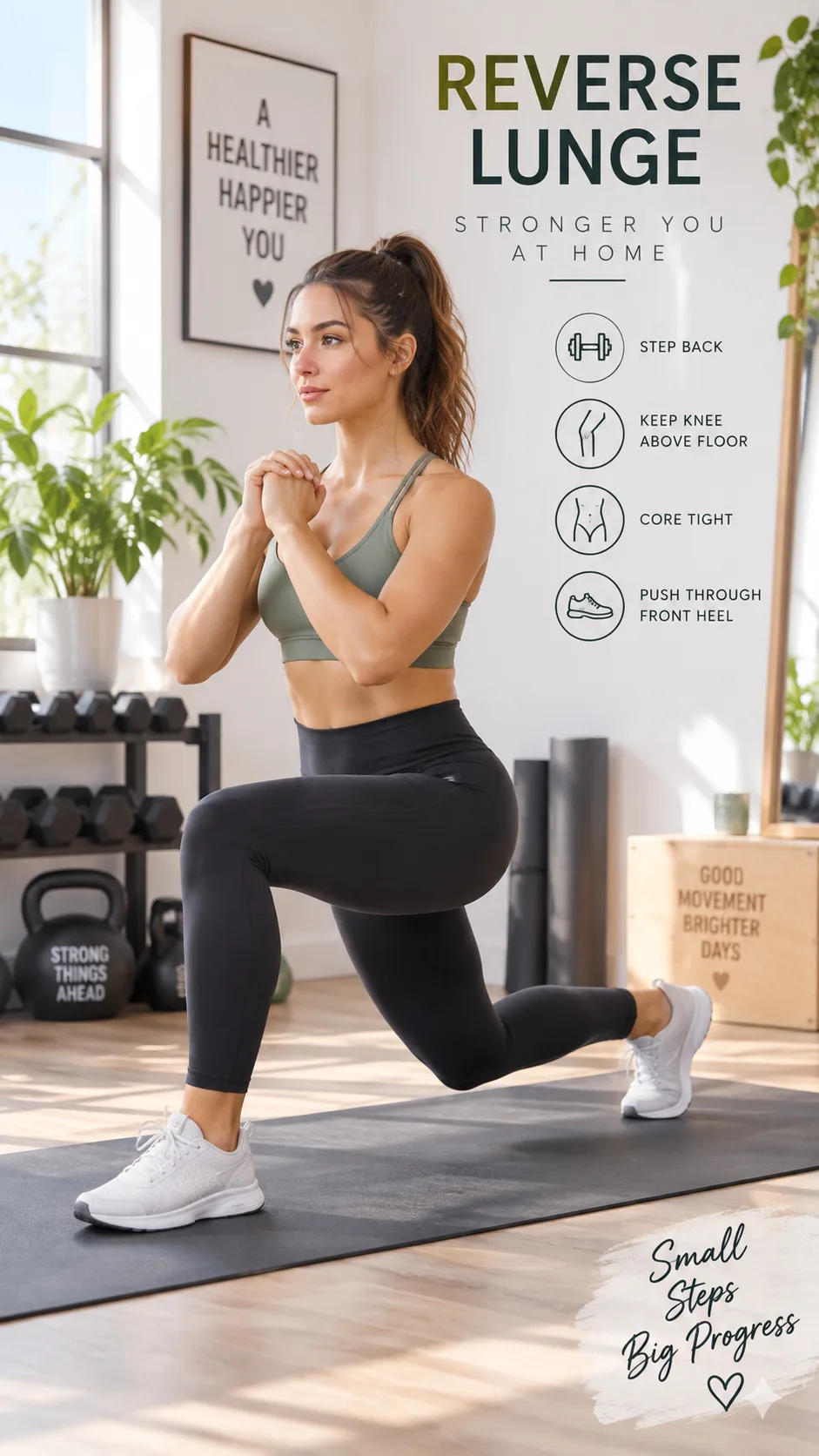
Exercise 3: Reverse lunges (lower body)
Targets: glutes, quads, hamstrings, hip stabilizers
Step one foot backward and lower your back knee toward the floor. Your front thigh should reach parallel. Push through your front heel to return to standing. Alternate legs each rep.
Reps: 12 per leg
Why reverse instead of forward lunges? They’re significantly easier on your knees because you’re decelerating backward rather than loading forward. They also place more emphasis on your glutes, which is exactly what most women are after.
Exercise 4: Plank shoulder taps (core + shoulders)
Targets: core, shoulders, obliques, hip stabilizers
Get into a high plank position. Lift your right hand and tap your left shoulder, then switch. The goal: keep your hips completely still. No rocking, no swaying, no wiggling like a fish out of water.
Reps: 20 total (10 per side)
This exercise is sneakily brutal. Your core has to work overtime to prevent rotation while your shoulders handle the load of supporting your bodyweight on one arm. If your hips are swinging all over the place, widen your stance for more stability.
Exercise 5: Glute bridges (posterior chain)
Targets: glutes, hamstrings, lower back, pelvic floor
Lie on your back with knees bent, feet flat on the floor. Drive your hips toward the ceiling by squeezing your glutes. Hold the top position for a full second before lowering back down. That squeeze at the top matters. It’s where the real work happens.
Reps: 15
Glute bridges belong in any full body workout for women at home. They strengthen your posterior chain, support your lower back, and they’re one of the best exercises for strengthening your pelvic floor. Want more challenge? Try single-leg glute bridges. They’ll humble you fast.
Exercise 6: Tricep dips (arms)
Targets: triceps, anterior deltoids, chest
Sit on the edge of a sturdy chair or couch. Place your hands beside your hips, fingers forward. Slide your hips off the edge and lower your body by bending your elbows to about 90 degrees. Press back up. Make sure whatever you’re using is stable. Sliding off a couch mid-rep is not the vibe.
Reps: 12
These are the secret weapon for toned arms without equipment. Your triceps make up roughly two-thirds of your upper arm, so if you want arms that look defined, these deserve your attention. For more arm-sculpting moves, here’s a solid arm workout for women with no equipment needed.
Exercise 7: Superman hold (back + core)
Targets: erector spinae, glutes, rear deltoids, upper back
Lie face down with arms extended overhead. Lift your arms, chest, and legs off the floor at the same time. Hold for 2-3 seconds at the top, then lower with control. You should feel this along your entire posterior chain.
Reps: 12
This exercise counterbalances all the forward-flexion we do throughout the day (hello, desk posture). A strong back reduces pain, improves posture, and just makes you look more confident. It’s the exercise nobody thinks about but everybody needs.
Exercise 8: Mountain climbers (full body cardio)
Targets: core, hip flexors, shoulders, cardiovascular system
Start in a high plank. Drive one knee toward your chest, then quickly switch legs. Keep your hips level and maintain a steady, controlled pace. This isn’t about going as fast as humanly possible. Controlled speed beats sloppy speed every time.
Reps: 30 seconds
Mountain climbers pull double duty as a core exercise and a cardio burst. They spike your heart rate, burn calories, and keep the metabolic effect of this workout going long after you’ve finished. They’re basically the Swiss Army knife of bodyweight exercises.
The complete workout at a glance
Here’s your entire routine summarized so you can screenshot it or bookmark this page for your next session:
- Squat to Calf Raise: 15 reps
- Push-Ups: 10-15 reps
- Reverse Lunges: 12 reps per leg
- Plank Shoulder Taps: 20 total
- Glute Bridges: 15 reps
- Tricep Dips: 12 reps
- Superman Hold: 12 reps
- Mountain Climbers: 30 seconds
Rest 15-30 seconds between exercises. Rest 60-90 seconds between rounds. Complete 3-4 rounds.
How to progress when this gets too easy
Your body adapts. That’s literally its job. So after a few weeks of this routine feeling manageable, you need to increase the challenge. Here’s how, without buying a single piece of equipment.
Method 1: Slow down the tempo
Take 3-4 seconds on the lowering phase of every exercise. A slow-tempo push-up is a completely different beast from a regular one. This increases time under tension, which is one of the primary drivers of muscle growth according to sports science research from the National Strength and Conditioning Association.
Method 2: Add pauses
Pause for 2-3 seconds at the hardest point of each movement. Bottom of a squat. Bottom of a push-up. Top of a glute bridge. Pauses eliminate momentum and force your muscles to work harder through their weakest range of motion.
Method 3: Increase volume
Add a 4th or 5th round. Add 5 more reps to each exercise. Reduce rest periods from 30 seconds to 15. More work in the same timeframe equals greater training stimulus. Simple math 🙂
Method 4: Progress to harder variations
- Regular squats → Jump squats or pistol squat progressions
- Push-ups → Decline push-ups (feet elevated on a chair)
- Glute bridges → Single-leg glute bridges
- Reverse lunges → Bulgarian split squats (rear foot elevated)
- Mountain climbers → Burpees (because apparently we hate ourselves)
How often should you do this workout?
Aim for 3-4 times per week with at least one rest day between sessions. Your muscles grow during recovery, not during the workout itself. Training every single day without rest is a fast track to burnout and overuse injuries, not gains.
A solid weekly schedule might look like this: Monday, Wednesday, Friday, and Saturday. That gives you training days and recovery days in a rhythm that’s sustainable long-term. If you eventually want to split things up and add gym days, this weekly gym workout plan for women is a great next step.
On your rest days, light movement like walking, stretching, or yoga still counts as being active. Rest doesn’t mean lying on the couch for 48 hours (though that’s tempting, I get it).
Common mistakes that sabotage your results
I’ve made every one of these mistakes personally. Learn from my suffering.
- Going through the motions. If you’re not feeling the target muscle working, something’s off. Slow down, focus on the squeeze, and prioritize quality over quantity.
- Skipping the last two reps. Those final reps, the ones that burn, the ones you want to quit on, are where the growth stimulus lives. Push through them.
- Neglecting nutrition. You can’t out-train a terrible diet. Your muscles need protein to recover and grow. Aim for roughly 0.7-1 gram of protein per pound of bodyweight daily. If you’re going through menopause and need specific dietary guidance, this Mayo Clinic guide on menopause and nutrition is worth reading.
- Changing routines too often. Stick with this program for at least 4-6 weeks before switching. Your body needs repeated exposure to a stimulus to adapt. Program hopping every week is the fitness equivalent of starting ten books and finishing none.
- Comparing yourself to Instagram. Those transformation posts with perfect lighting and strategic angles? They’re marketing. Focus on YOUR progress: how you feel, how your clothes fit, how much stronger you’re getting.
What results can you realistically expect?
Let me be straight with you: you won’t look like a fitness model in two weeks. But here’s what you CAN expect with consistent effort over 4-8 weeks:
- Weeks 1-2: Increased energy, better sleep, and the workout starts feeling less like torture.
- Weeks 3-4: Noticeable improvements in strength. You’ll do more reps, need less rest, and movements that felt impossible will start clicking.
- Weeks 5-8: Visible changes in muscle tone, especially in your arms, shoulders, and glutes. Clothes fit differently. You stand taller.
The feeling of getting stronger hits before the visual changes do. And that feeling? It’s addictive in the best way. You’ll start looking forward to workouts instead of dreading them. Wild concept, right?
Who is this workout best for?
This no-equipment full body workout is ideal for:
- Beginners who want a structured starting point without the overwhelm of a gym
- Busy women who need efficient workouts they can squeeze into a packed schedule
- Travelers who want to stay consistent on the road (hotel rooms count as home gyms)
- Gym-goers who need a solid backup plan for days they can’t make it to the gym
- Anyone on a budget, because this routine costs exactly $0
If you’re already advanced and lifting heavy weights regularly, this routine works best as a supplement to your main program, not a replacement. But for everyone else? This is genuinely all you need to build strength, improve your fitness, and feel better in your body.
Your next move
You’ve read the full routine. You know the exercises, the sets, the progression strategies, and the mistakes to avoid. The only thing standing between you and results is starting. Not tomorrow. Not Monday. Today.
Clear a space in your living room, set a timer, and do one round. Just one. That first round will lead to a second. The second will lead to a habit. And that habit will change how you look, feel, and carry yourself.
You don’t need a perfect setup. You don’t need matching workout clothes (though if that motivates you, these gym outfit ideas are pretty great). You just need to show up for yourself, consistently, and trust the process. Your body already has everything it needs to get stronger. Now go prove it.
