

You’ve got 45 minutes. Maybe an hour if the stars align and nobody texts you mid-set. The last thing you need is a workout that has you bouncing between 14 different exercises, waiting for three separate machines, and spending more time resting than actually lifting. Sound familiar?
Here’s the thing: you don’t need a two-hour gym marathon to build serious upper body and core strength. You need a smart plan, the right exercise pairings, and the willingness to skip the stuff that doesn’t move the needle. That’s exactly what we’re building here.
I’ve spent years testing what works and what’s just gym fluff. This upper body and core workout strips away the nonsense and gives you a routine that builds real, functional strength in a timeframe that respects your schedule.
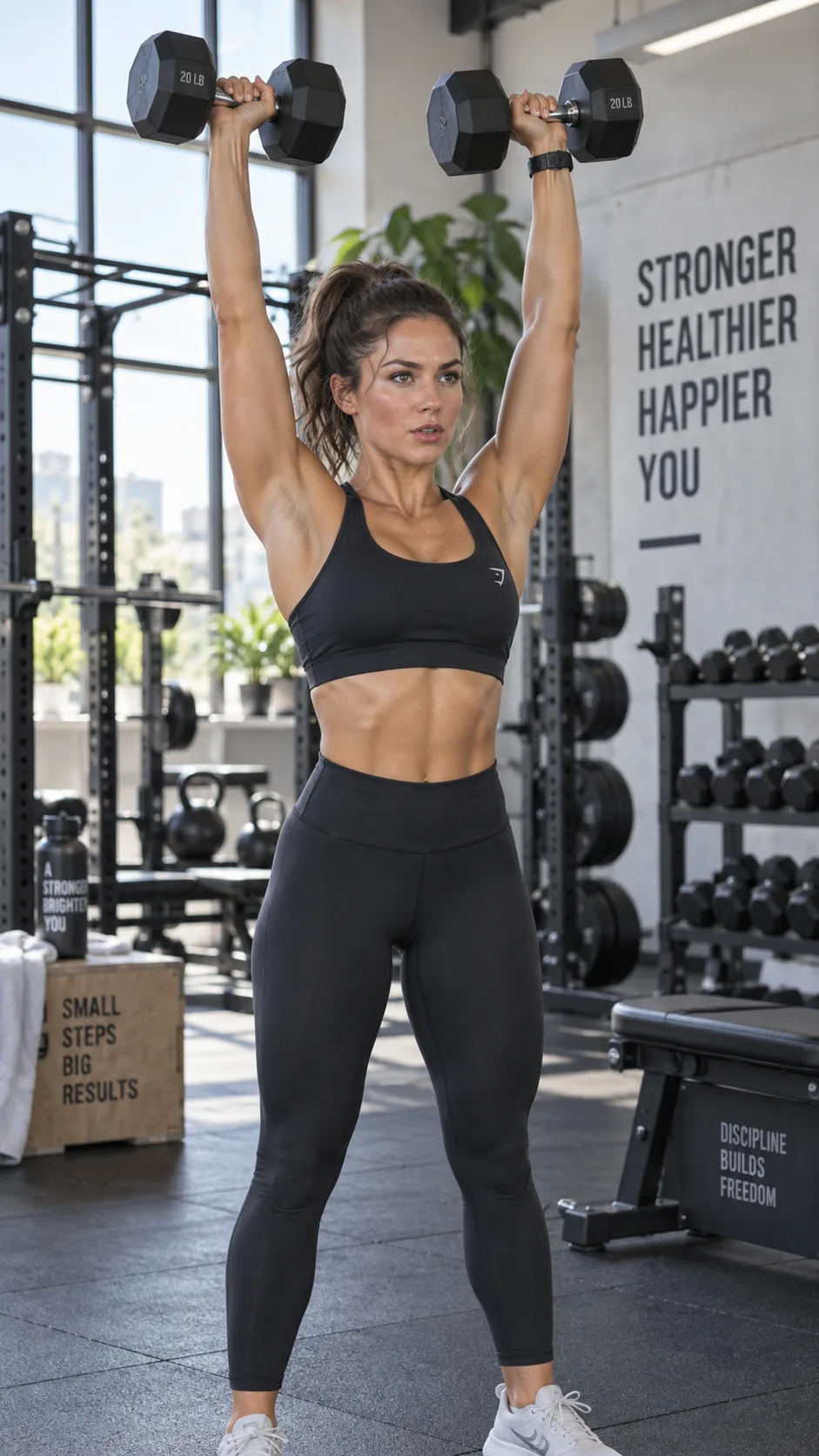
Why combining upper body and core training just makes sense
Most people train upper body one day, then dedicate a separate session to abs. That’s fine if you live at the gym. But for everyone else? It’s a massive time sink that you can easily eliminate.
Your core already activates during nearly every compound upper body movement. When you press a barbell overhead, your abs brace. When you row a dumbbell, your obliques fire to prevent rotation. So why treat core work like some completely separate thing?
Research from the National Strength and Conditioning Association (NSCA) consistently shows that compound movements recruit far more muscle fibers than isolation exercises. By strategically pairing upper body lifts with dedicated core work, you get more stimulus in less time, and your core gets trained twice: once as a stabilizer, once as the primary mover.
Think of it as a two-for-one deal, except you’re not sacrificing quality. You’re improving it.
The ground rules before you start
Before you grab a dumbbell and start swinging, let’s set some non-negotiables. These rules keep the workout effective AND keep your shoulders and spine happy long-term.
Warm up. Yes, do it.
I know. Warming up feels like doing homework before you’re allowed to play. But 5 minutes of targeted warm-up can prevent the shoulder injury that sidelines you for 5 months. That math works out pretty clearly.
Here’s a quick warm-up that takes under 5 minutes:
- Band pull-aparts, 2 sets of 15 (wakes up your rear delts and rotator cuff)
- Cat-cow stretches, 10 reps (mobilizes your thoracic spine)
- Dead bugs, 8 per side (activates your deep core before heavy lifting)
- Arm circles, 10 forward, 10 backward (gets synovial fluid moving in the shoulder joint)
Superset structure saves time
This workout uses supersets. You’ll pair an upper body exercise with a core exercise and move between them with minimal rest. This keeps your heart rate elevated, cuts total workout time by roughly 30%, and ensures you’re never just standing around scrolling your phone between sets.
Rest 60-90 seconds between supersets, not between individual exercises within the pair. That’s the whole trick.
Progressive overload still applies
If you’re lifting the same weight you lifted three months ago, you’re maintaining, not building. Add weight, add reps, or add a set every 1-2 weeks. Track your numbers. A simple notes app works. No fancy spreadsheet required.
The full upper body and core workout
This workout takes 40-50 minutes including warm-up. It hits your chest, back, shoulders, arms, and core in a logical sequence that maximizes efficiency. Every exercise earns its spot. Nothing is filler.
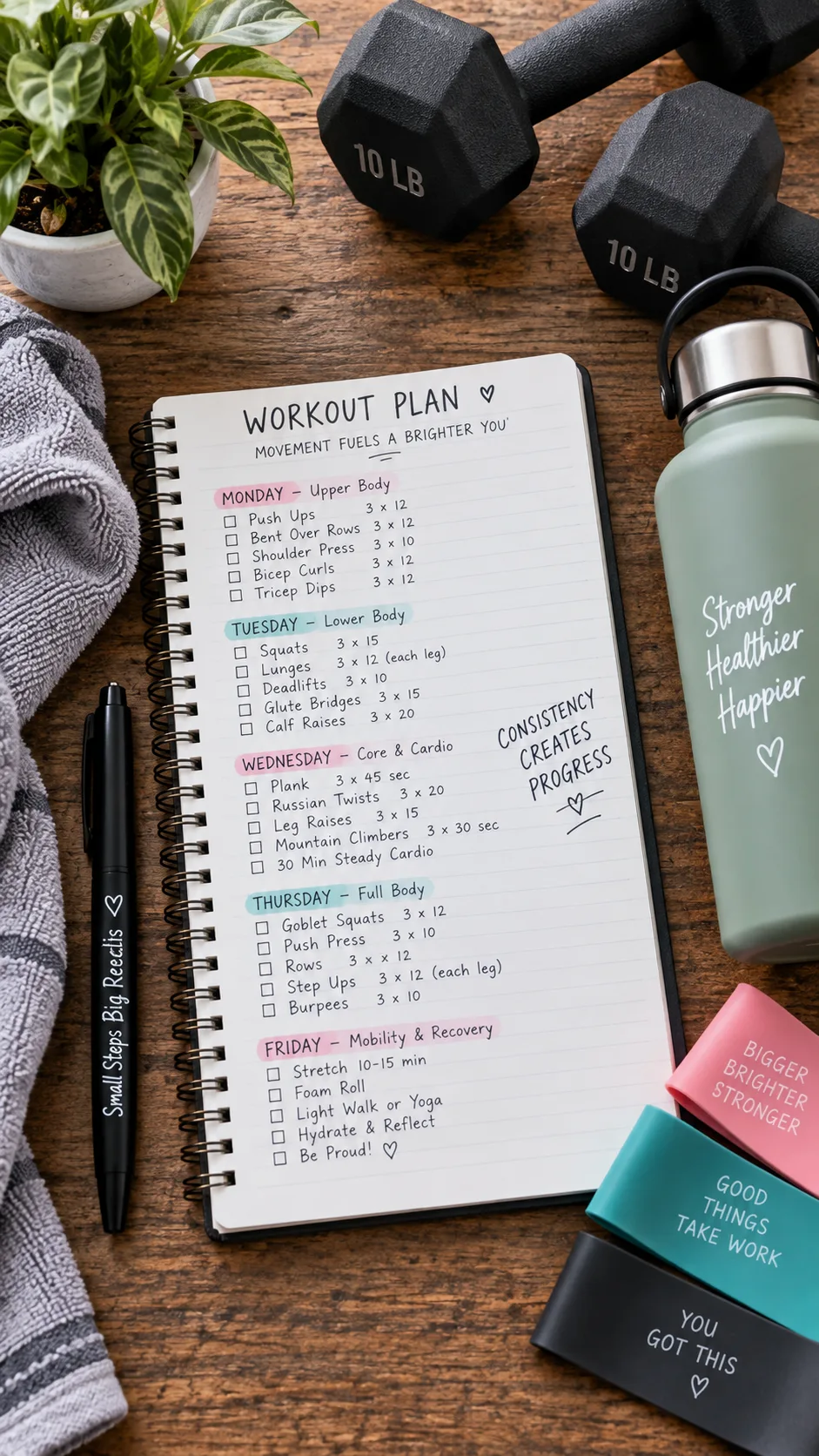
Superset 1: Chest + core stability
A1: Dumbbell Bench Press, 4 sets of 8-10 reps
The dumbbell bench press beats the barbell version here because each arm works independently, which means your core has to stabilize asymmetrical loads. Pick a weight that makes the last 2 reps genuinely challenging. If you’re finishing every set comfortably, go heavier.
A2: Plank with Shoulder Taps, 3 sets of 10 per side
This isn’t your grandma’s plank. By tapping your shoulders, you introduce an anti-rotation demand that lights up your obliques and transverse abdominis. Keep your hips DEAD STILL. If they’re swaying like a pendulum, widen your feet or slow down.
Superset 2: Back + core flexion
B1: Bent-Over Barbell Rows, 4 sets of 8-10 reps
Rows build the thick upper back that makes everything else look better, and they protect your shoulders by balancing out all that pressing. Hinge at the hips, keep your spine neutral, and pull the bar toward your lower ribcage. No ego lifting here. Ever wonder why people with strong rows rarely have shoulder problems? This is why.
B2: Cable Crunches, 3 sets of 12-15 reps
Cable crunches let you progressively overload your rectus abdominis, something bodyweight crunches can’t do once you’re past the beginner stage. Kneel in front of a cable machine, grab the rope attachment, and crunch DOWN, not forward. Think about bringing your ribcage to your pelvis. If you want more machine-based core options, check out our guide on core workout gym machines that build stronger abs without endless crunches.
Superset 3: Shoulders + anti-extension core
C1: Seated Dumbbell Overhead Press, 3 sets of 10-12 reps
Seated removes the temptation to turn this into a standing push press where your legs do half the work. Press the dumbbells straight up, fully extending your arms without locking out aggressively. Your core should be braced the entire time. If you feel your lower back arching excessively, the weight is too heavy. Period.
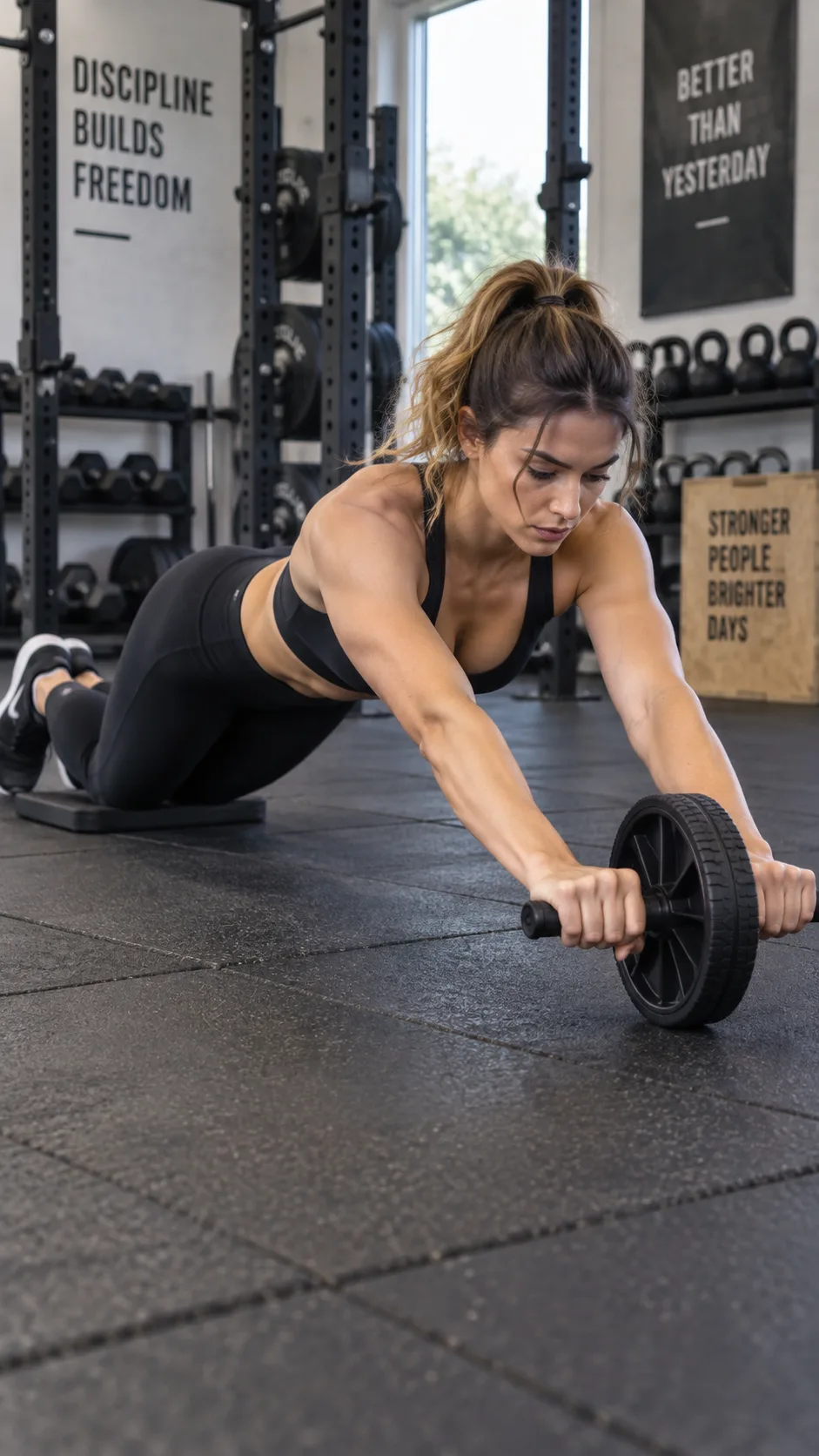
C2: Ab Wheel Rollouts (or Barbell Rollouts), 3 sets of 8-10 reps
This is arguably the single best core exercise in existence. The American Council on Exercise ranks rollout variations among the top exercises for overall core activation. Roll out as far as you can control, then pull back using your abs, NOT your hip flexors. Start from your knees if you’re newer to these.
Superset 4: Arms + rotational core
D1: Alternating Dumbbell Bicep Curls, 3 sets of 10 per arm
Alternating curls force your core to stabilize while one side is loaded. Curl with control. A full 2-second eccentric (lowering phase) will build more muscle than swinging the weight up with momentum. Your ego might take a hit when you drop the weight. Your biceps will thank you.
D2: Russian Twists (Weighted), 3 sets of 12 per side
Hold a dumbbell or plate at your chest, lean back slightly, and rotate from your THORACIC spine, not just your arms. Your feet can stay on the floor if you’re focusing on quality rotation, or elevate them for an extra challenge. In my experience, keeping your feet down and using heavier weight produces better results than the flailing version most people do.
Finisher: Triceps + core endurance
E1: Tricep Rope Pushdowns, 3 sets of 12-15 reps
Lock your elbows at your sides. Extend fully. Squeeze at the bottom. That’s it. Simple, effective, and it absolutely torches the back of your arms. If the cable station is taken (it always is), dumbbell overhead tricep extensions work as a solid substitute.
E2: Dead Bug Hold with Alternating Reach, 3 sets of 8 per side
Lie on your back, press your lower back into the floor, and KEEP IT THERE as you extend opposite arm and leg. This is a core endurance exercise that teaches your body to maintain spinal stability under movement, exactly what you need for real life and every other exercise in this workout.
How to program this into your weekly split
This upper body and core workout fits naturally into several weekly training schedules. Here’s how I’d slot it in depending on your training frequency:
3-day split
- Monday: Upper Body + Core (this workout)
- Wednesday: Leg and Glute Workout
- Friday: Full Body or repeat Upper/Lower
This approach works well for beginners and intermediate lifters who want consistent results without living at the gym. If you’re exploring structured splits, our 3-day split for women beginners breaks this concept down even further.
4-day upper/lower split
- Monday: Upper Body + Core (this workout)
- Tuesday: Lower Body
- Thursday: Upper Body + Core (variation or increased intensity)
- Friday: Lower Body
Running this workout twice per week lets you hit each upper body muscle group with enough frequency for optimal growth. According to a meta-analysis published in Sports Medicine, training each muscle group at least twice per week produces significantly better hypertrophy outcomes than once-weekly training.
Common mistakes that sabotage your results
I see these errors constantly, and I’ve made every single one of them myself at some point. Learning from other people’s mistakes is way more fun than learning from your own 🙂
Rushing through core work
People treat core exercises like they’re trying to speedrun a video game. Slower is almost always better for core training. When you rush through Russian twists or planks, you recruit momentum instead of muscle. Take your time. Feel the burn. That discomfort means it’s working.
Neglecting your back
Everyone wants to bench press. Very few people get excited about rows. But here’s the uncomfortable truth: your back muscles are larger than your chest muscles, and training them builds a more balanced, injury-resistant upper body. The row-to-press ratio in this workout is intentionally 1:1. Don’t skip the rows.
Using the same weight forever
If your workout journal (or your memory) tells you that you’ve pressed the same 25-pound dumbbells for the last six weeks, something needs to change. Progressive overload doesn’t have to mean adding 10 pounds every session. Even one extra rep per set counts as progression. Small gains compound into massive results over months.
Holding your breath
Breathe. Seriously. Exhale during the exertion phase (the hard part), inhale during the eccentric (the lowering part). Holding your breath spikes your blood pressure unnecessarily and can make you dizzy. Not a great look when you’re mid-press with dumbbells over your face.

How to scale this workout for your level
Not everyone reading this has the same training background, and that’s perfectly fine. Here’s how to adjust without changing the fundamental structure:
If you’re a beginner
- Drop all sets to 3 sets per exercise instead of 4
- Replace barbell rows with seated cable rows (easier to control form)
- Do standard planks instead of shoulder tap planks
- Use the ab wheel from your knees with a shortened range of motion
- Rest 90-120 seconds between supersets
If you’re intermediate to advanced
- Add a drop set to the final set of bench press and rows
- Progress to standing ab wheel rollouts
- Use a tempo prescription: try 3-second eccentrics on pressing movements
- Reduce rest periods to 45-60 seconds between supersets
- Add a loaded carry (farmer’s walk) as a final core finisher, 3 trips of 40 meters
Nutrition pointers that support this training
I’m not going to give you a full meal plan here. That deserves its own article. But I’d be doing you a disservice if I didn’t mention a few things that directly affect how well this workout builds strength.
Protein is non-negotiable. The current evidence from the International Society of Sports Nutrition recommends 1.6 to 2.2 grams of protein per kilogram of bodyweight daily for individuals focused on building muscle. That’s roughly 0.7 to 1 gram per pound. Hit that number, and you’re giving your muscles what they need to recover and grow.
Eat before you train. Fasted training has its advocates, but most people perform measurably better with some fuel in the tank. A small meal with carbs and protein 60-90 minutes before your workout can make a noticeable difference in your pressing and rowing strength. Even a banana and a protein shake will do the job.
And drink water. You’d be surprised how many people walk into the gym borderline dehydrated and wonder why they feel weak during overhead presses. Aim for at least half your bodyweight in ounces of water daily, more on training days.
What makes this workout different from the hundreds of others online
It’s not reinventing the wheel. And that’s the point. The best upper body and core workouts don’t need gimmicks, unusual equipment, or exercises that belong in a circus act. They need proven movements, intelligent pairing, and a structure that respects your time.
What THIS workout does differently is eliminate the dead space. There’s no wandering between random machines. No “ab day” taking up a whole separate session. No exercises included just because they look cool on Instagram. Every rep has a purpose, and every superset is designed to keep you moving while one muscle group recovers and another one works.
I’ve personally used variations of this structure for years, and it consistently delivers results, whether the goal is building visible muscle, increasing pressing strength, or just feeling more capable in everyday life. For context, I built this template originally when I had a newborn at home and literally could not spend more than 45 minutes in the gym. Constraints breed creativity.
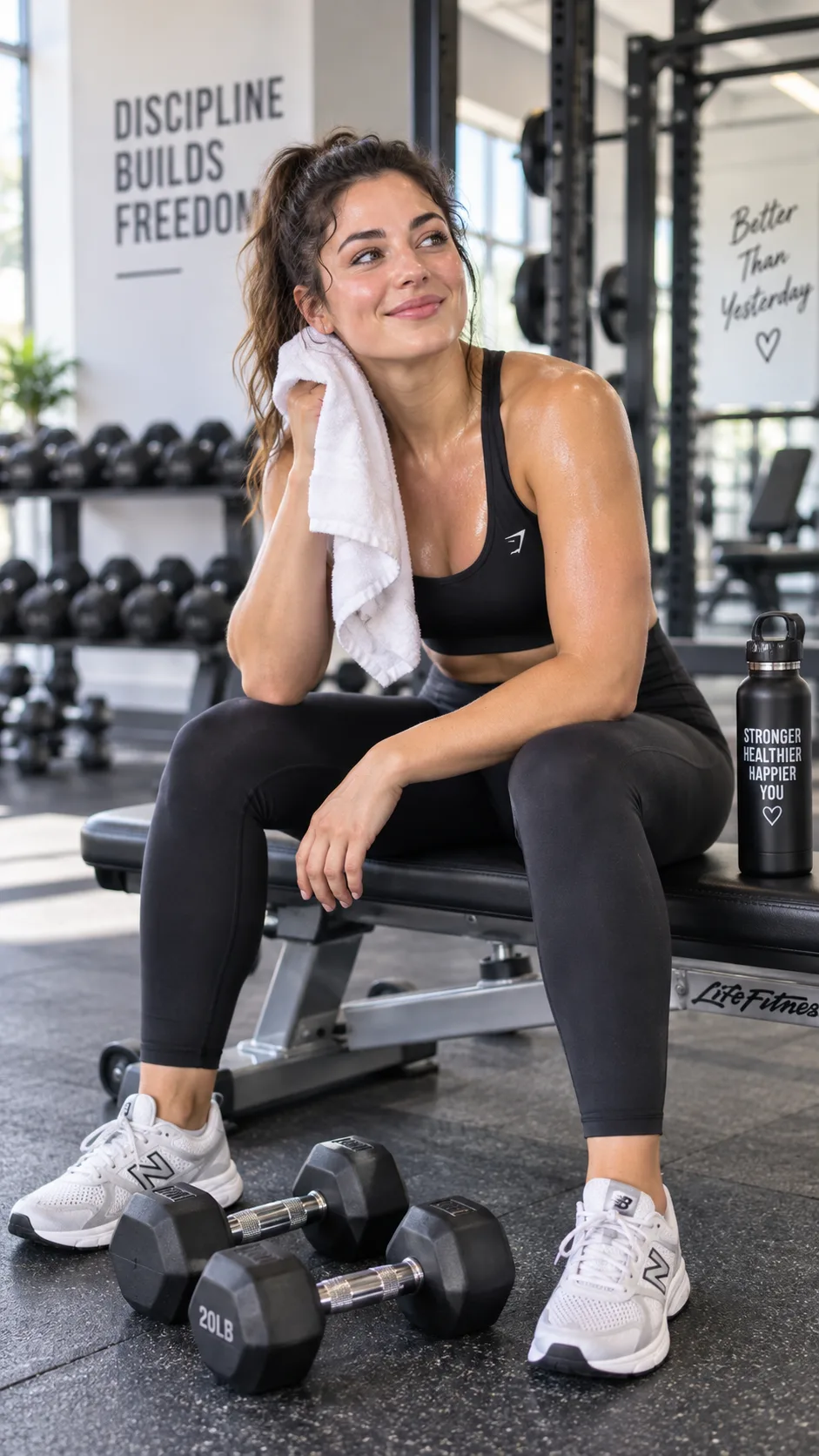
Quick reference: the workout at a glance
Print this, screenshot it, or save it to your phone. Here’s the full session laid out cleanly:
- Superset 1: Dumbbell Bench Press (4×8-10) + Plank Shoulder Taps (3×10/side)
- Superset 2: Bent-Over Barbell Rows (4×8-10) + Cable Crunches (3×12-15)
- Superset 3: Seated DB Overhead Press (3×10-12) + Ab Wheel Rollouts (3×8-10)
- Superset 4: Alternating DB Curls (3×10/arm) + Weighted Russian Twists (3×12/side)
- Finisher: Tricep Rope Pushdowns (3×12-15) + Dead Bug Alternating Reach (3×8/side)
Total time: 40-50 minutes including warm-up. Equipment needed: Dumbbells, barbell, cable machine, ab wheel (or barbell substitute). Frequency: 1-2 times per week within a balanced training split.
Final thoughts
Building a stronger upper body and core doesn’t require complicated programming, exotic exercises, or marathon gym sessions. It requires showing up, lifting with intention, progressing over time, and using a structure that doesn’t waste your energy on things that don’t matter.
This workout gives you exactly that. Run it consistently for 8-12 weeks, track your weights, eat enough protein, and you WILL see results. Stronger presses. A more stable core. Visible muscle definition. The kind of progress that makes you look forward to your next session.
Now close this tab, save the workout, and go put in the work. Your upper body and core won’t build themselves, but with this plan, they won’t take all day either.
