
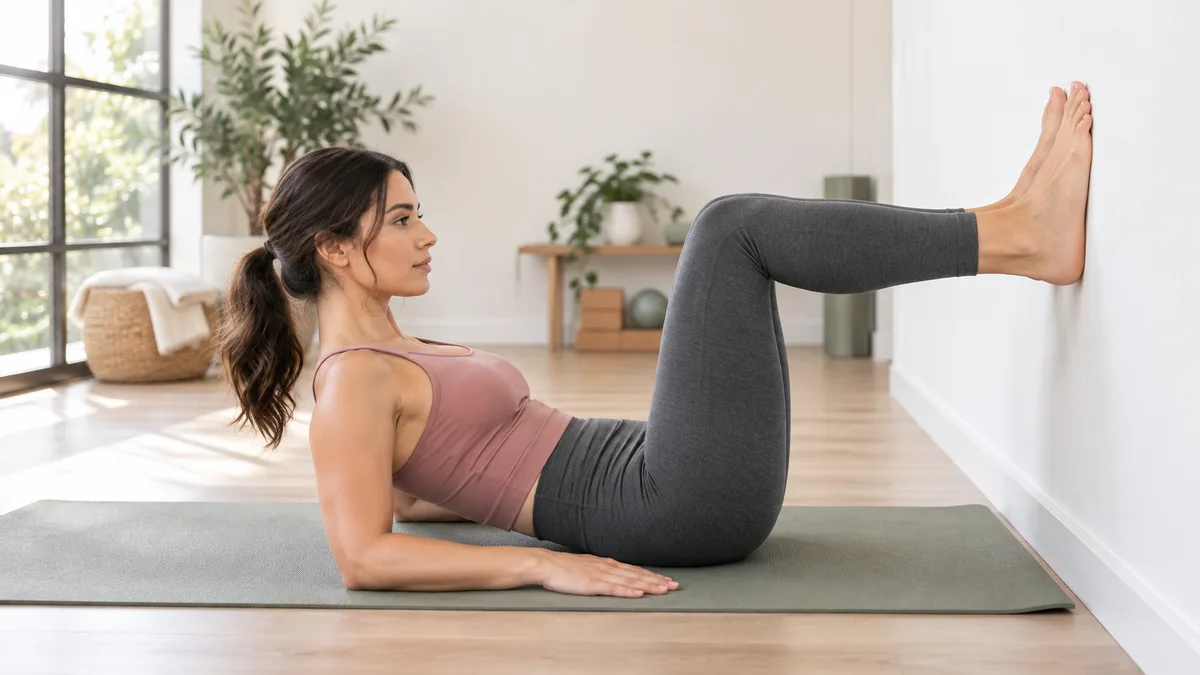
You’ve got a wall. You’ve got a body. That’s all the equipment you need for one of the most effective low-impact workouts around. Wall Pilates has absolutely exploded in popularity, and it deserves the hype.
Whether you’re recovering from an injury, brand new to fitness, or just sick of workouts that require seventeen pieces of equipment and a PhD in exercise science, wall Pilates strips everything back to basics. Your body, a flat wall, and about 20 minutes of your day. That’s it.
I started doing wall Pilates when my gym membership expired and my motivation to renew it was somewhere between “absolutely not” and “maybe next year.” Three weeks in, my core felt tighter, my posture improved, and I looked forward to working out. Wild, right?
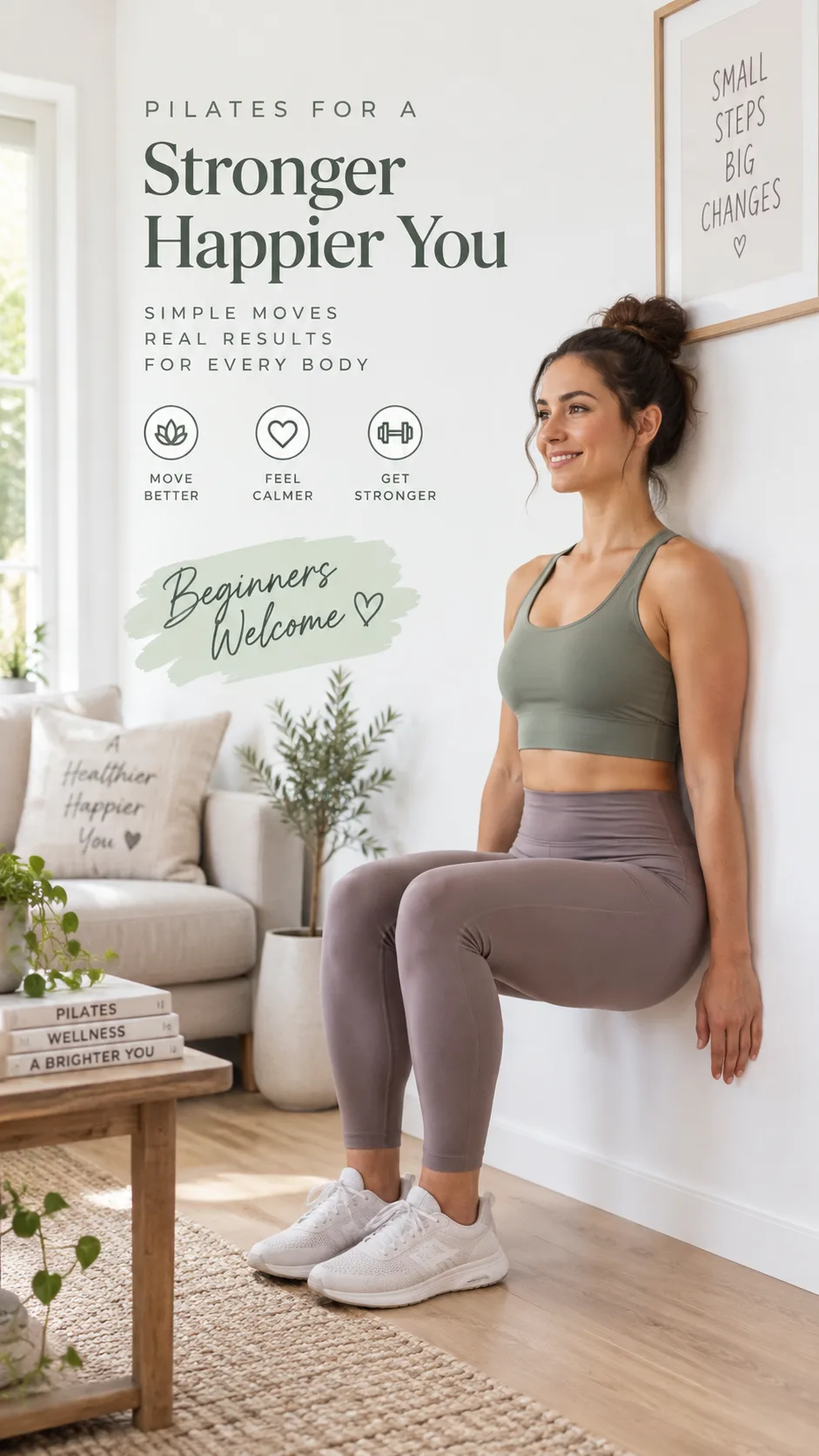
What exactly is wall Pilates?
Wall Pilates is a modified version of traditional Pilates that uses a wall as a prop for support, resistance, and alignment feedback. Think of the wall as your silent workout partner. It stabilizes you during moves that might otherwise feel wobbly and adds an extra challenge where you need it.
Traditional Pilates focuses on controlled movements, core engagement, and breath work. Wall Pilates keeps ALL of those principles but makes them more accessible for beginners. The wall gives you something to press against, lean into, or brace yourself on, which means better form from day one.
Here’s what makes it different from mat Pilates: the wall creates a fixed reference point for your body. You can feel when your spine isn’t aligned properly because the wall tells you immediately. You’re never guessing or hoping you’re doing it right.
Why beginners love it
- Zero equipment cost, no reformer, no fancy mat, no resistance bands needed
- Joint-friendly, low impact means your knees, hips, and back stay happy
- Built-in form correction, the wall physically prevents common alignment mistakes
- Scalable difficulty, easy to make moves harder or easier by adjusting your position
- Space efficient, you need roughly 6 feet of clear wall space, that’s all
The science behind why wall Pilates works
This isn’t just some social media trend with no substance. Research published in the Journal of Exercise Rehabilitation shows that Pilates significantly improves core strength, flexibility, and balance, even in people who’ve never exercised before. The wall component amplifies these benefits by providing proprioceptive feedback (fancy talk for “your body learns where it is in space”).
When you press your back against a wall during a leg lift, your deep stabilizer muscles fire up harder than they would during a regular floor exercise. Why? Because the wall creates isometric resistance. Your muscles work against an immovable surface, which recruits more muscle fibers than you’d expect.
A Mayo Clinic report on core exercises confirms that exercises engaging deep core muscles (like the transverse abdominis) contribute to better posture, reduced back pain, and improved functional movement in daily life. Wall Pilates hits every single one of those muscles.
Essential wall Pilates exercises for beginners
Alright, here are the actual moves. I’ve organized these from easiest to most challenging so you can progress naturally. Master each exercise before moving to the next one. Rushing through these is the fastest way to miss the benefits entirely.
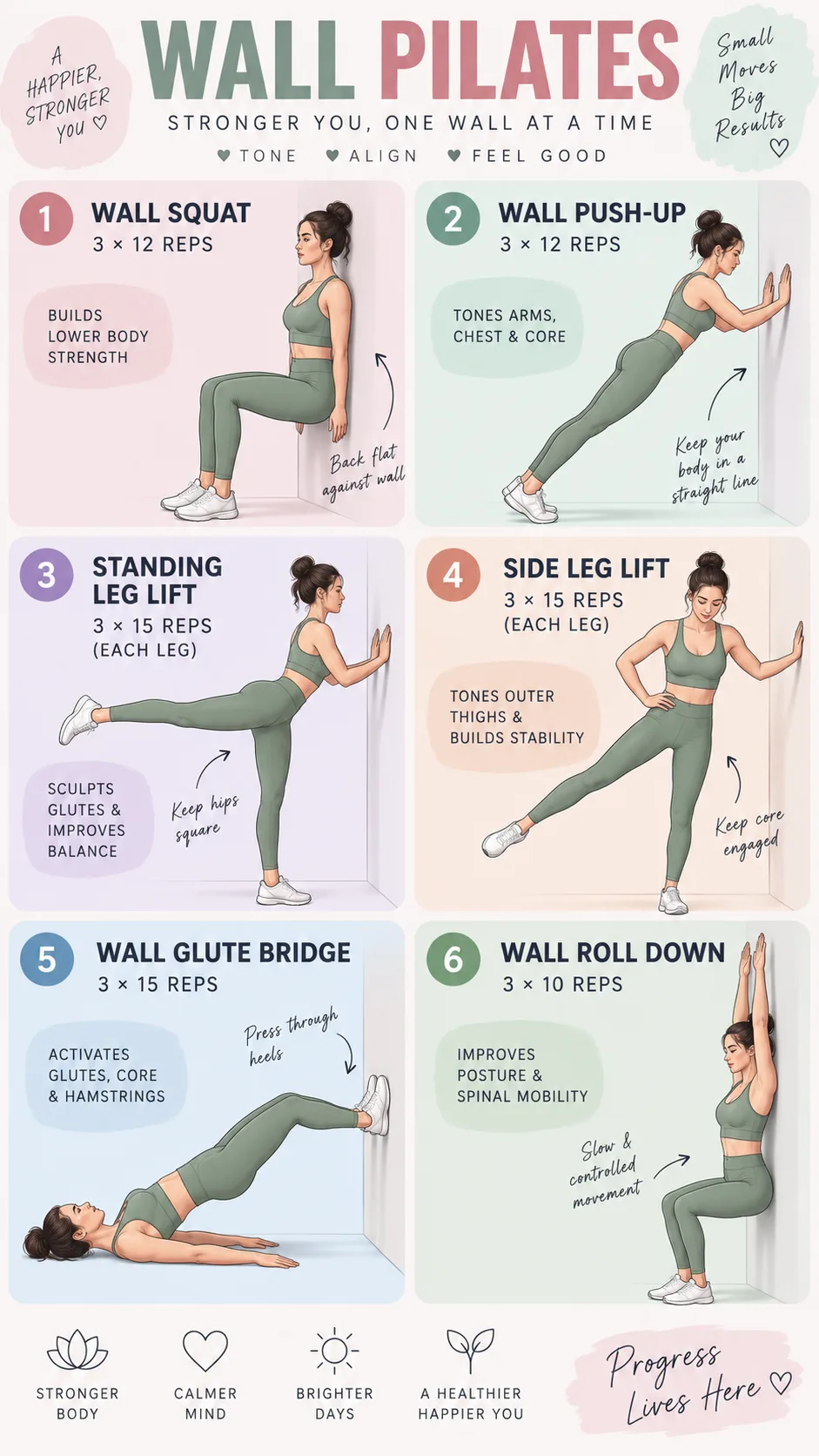
1. Wall Roll Down
Stand with your back flat against the wall, feet hip-width apart and about 12 inches from the base. Slowly roll your spine down the wall, one vertebra at a time, letting your arms hang heavy. Roll back up with the same slow control.
Reps: 8-10 | Focus: Spinal mobility and hamstring flexibility
2. Wall Sit with Pelvic Tilts
Slide down the wall until your thighs are roughly parallel to the floor (or as far as comfortable). Hold this position and perform small pelvic tilts, pressing your lower back into the wall, then releasing. Your quads will scream. Embrace it.
Hold: 30-60 seconds | Tilts: 10-15 | Focus: Quad strength, pelvic floor activation
3. Wall Bridge
Lie on your back with your feet flat against the wall, knees bent at 90 degrees. Press your feet into the wall and lift your hips toward the ceiling, squeezing your glutes at the top. Lower slowly. This one targets your posterior chain beautifully.
Reps: 12-15 | Focus: Glutes, hamstrings, lower back
4. Wall Plank
Place your hands on the wall at shoulder height, step your feet back until your body forms a straight line at an angle. Hold this position while engaging your core. Don’t let your hips sag or your butt pike up. It looks easy. It is not.
Hold: 30-45 seconds | Focus: Core stability, shoulder engagement
5. Single Leg Wall Press
Lie on your back, both feet on the wall with knees bent. Extend one leg straight up toward the ceiling while pressing the other foot firmly into the wall. Alternate legs with slow, controlled movements. Keep your lower back glued to the floor.
Reps: 10 each leg | Focus: Deep core, hip flexor control
6. Wall Hundred
This is the classic Pilates Hundred with a twist. Lie on your back with your legs pressed against the wall at a 90-degree angle. Lift your head and shoulders off the floor, extend your arms alongside your body, and pulse them up and down while breathing in for 5 counts and out for 5 counts.
Reps: 100 arm pulses (10 breath cycles) | Focus: Core endurance, breath control
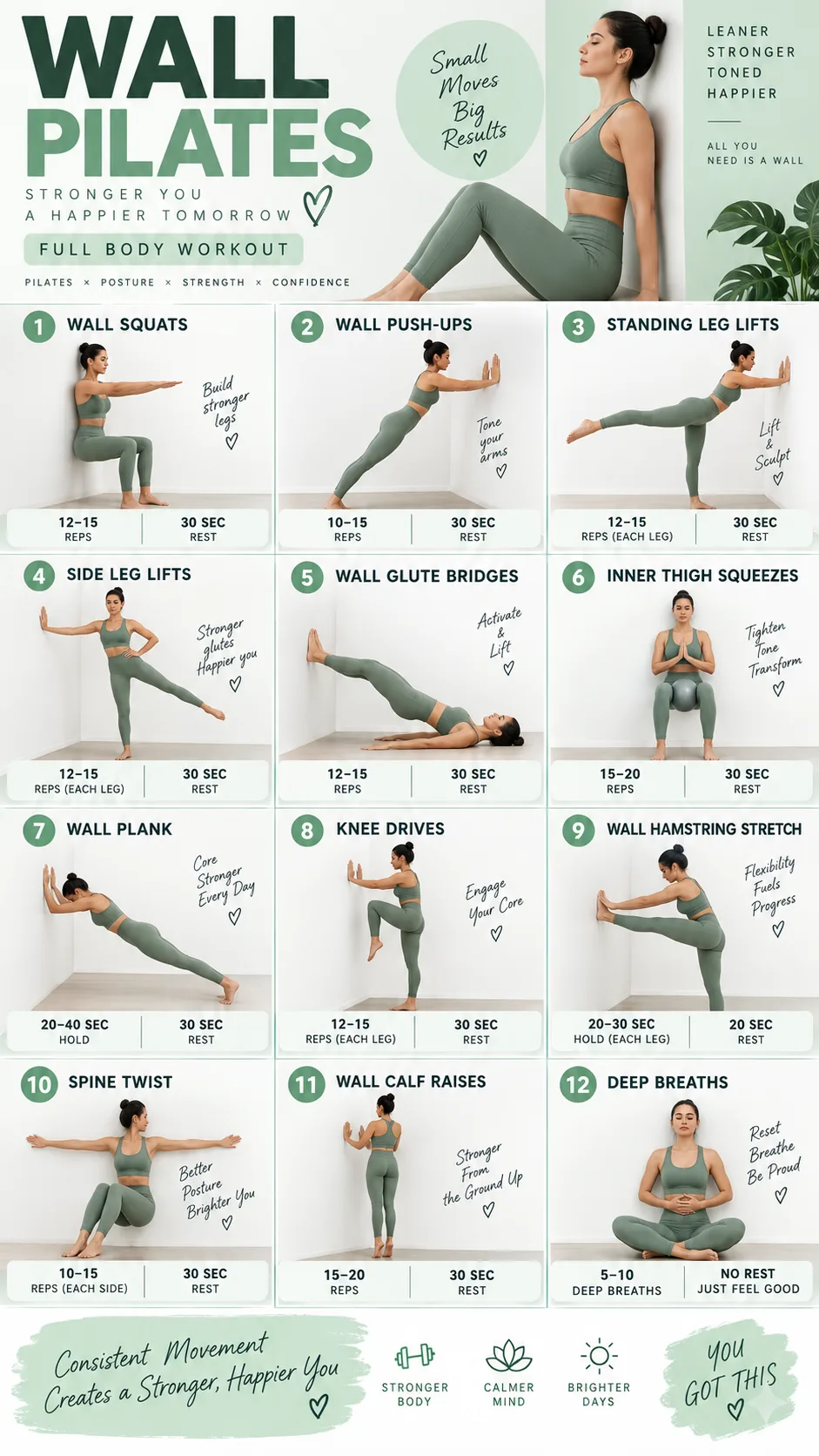
Free wall Pilates workout chart
I’ve put together a printable workout chart you can stick on your wall (meta, I know). This routine takes approximately 20 minutes and hits your entire body:
| Exercise | Reps/Duration | Sets | Rest |
|---|---|---|---|
| Wall Roll Down | 8 reps | 2 | 15 sec |
| Wall Sit + Pelvic Tilts | 45 sec + 12 tilts | 2 | 30 sec |
| Wall Bridge | 12 reps | 3 | 20 sec |
| Wall Plank | 30 sec | 3 | 20 sec |
| Single Leg Wall Press | 10 each leg | 2 | 15 sec |
| Wall Hundred | 100 pulses | 1 | None |
Pro tip: Screenshot this chart or print it out and literally tape it to the wall you’re using. Having visual cues right in front of you eliminates the need to check your phone mid-workout. Your phone is a distraction machine. Keep it away.
Video guide: wall Pilates in action
Reading about exercises is helpful, but seeing them performed correctly makes a massive difference. This beginner-friendly wall Pilates video walkthrough covers proper form, breathing cues, and common mistakes to avoid:
Watch the full video at least once before attempting the workout. Pay special attention to breathing patterns. Pilates uses lateral thoracic breathing (expanding your ribcage sideways rather than puffing your belly out). It feels weird at first, but you’ll get it within a few sessions.
The 30-day wall Pilates challenge
Ready to commit? This 30-day wall Pilates challenge gradually builds your strength, endurance, and flexibility week by week. You won’t go from zero to pretzel in a month, but you WILL notice real changes in how your body feels and moves.
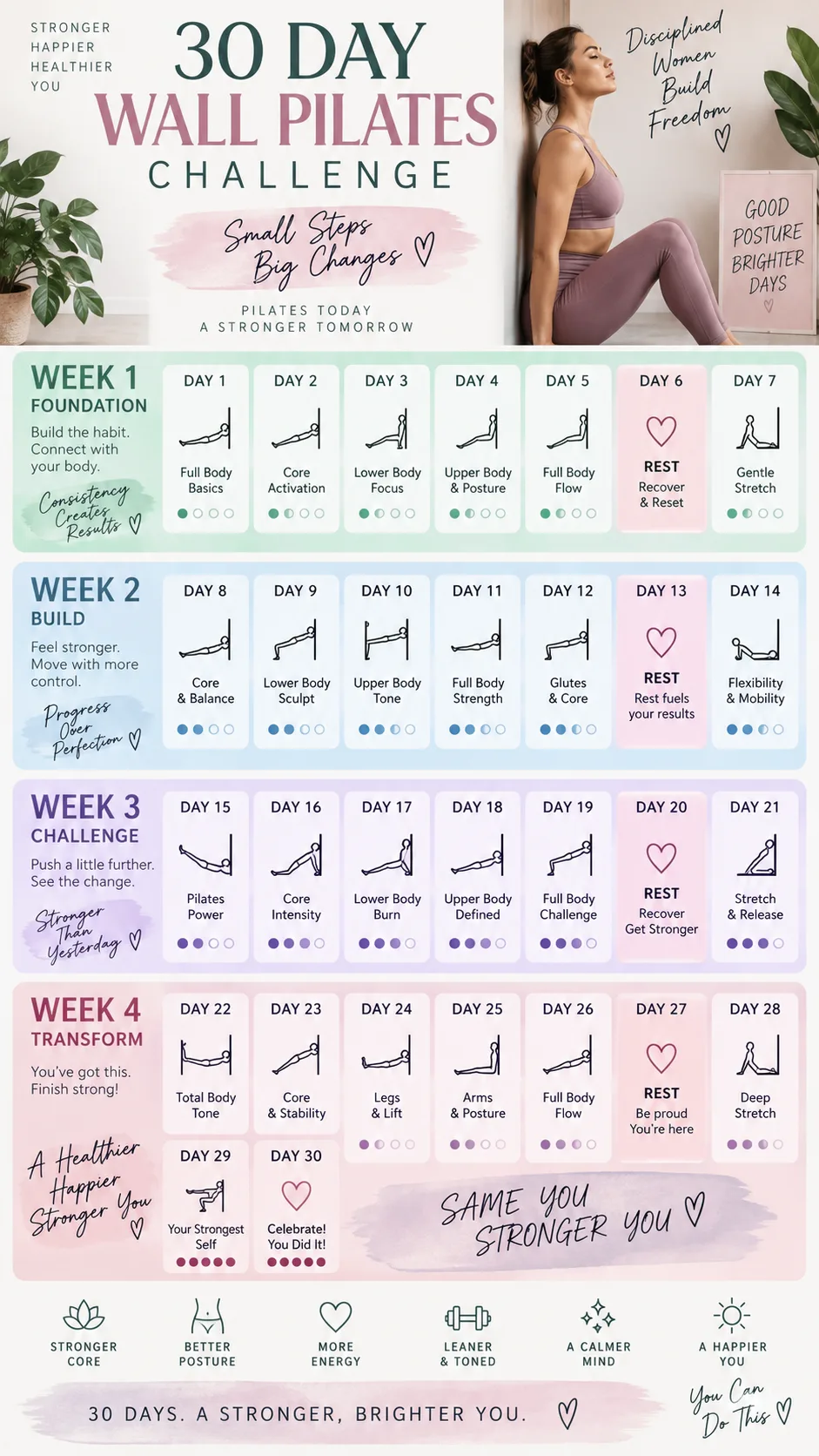
Week 1: Foundation (Days 1-7)
- Perform the basic chart workout 4 days this week (skip the Wall Hundred, you’re not ready yet, and that’s okay)
- Focus exclusively on form over speed or reps
- Hold each position for the minimum recommended time
- Take 3 rest days, spaced evenly throughout the week
Week 2: Building endurance (Days 8-14)
- Perform the full chart workout 5 days this week, including the Wall Hundred
- Increase hold times by 10-15 seconds on wall sits and planks
- Add 3-5 reps to each exercise
- Start incorporating the breath pattern intentionally with every single rep
Week 3: Adding intensity (Days 15-21)
- Perform the full workout 5 days with one extra set per exercise
- Add a wall squat pulse: hold a wall sit and pulse up and down 2 inches for 20 reps
- Add a wall push-up: 3 sets of 10 reps at a challenging angle
- Reduce rest periods between sets by 5-10 seconds
Week 4: Full send (Days 22-30)
- Perform the full workout 6 days this week
- Maximum hold times and reps across all exercises
- Try the entire routine without stopping between exercises (circuit style)
- On Day 30, repeat the Day 1 workout and notice how ridiculously easy it feels now 🙂
FYI, you might feel sore after the first few days. That’s completely normal. The deep stabilizer muscles you’re activating probably haven’t worked this hard in years (or ever). Gentle stretching and staying hydrated will help you recover faster.
Common wall Pilates mistakes to avoid
I’ve seen people make these errors repeatedly, and every one of them either reduces the effectiveness of your workout or increases injury risk. Don’t be that person.
- Holding your breath. The number one mistake. Pilates requires continuous, rhythmic breathing. If you’re turning purple, you’re doing it wrong.
- Standing too close to the wall. Your feet should sit 6-12 inches from the wall’s base for most standing exercises. Too close and you lose leverage.
- Rushing through reps. Wall Pilates rewards slowness. Every rep should take 3-5 seconds. Speed kills your form.
- Ignoring your core. Your abs should stay engaged during EVERY exercise, not just the obvious core moves. Think of pulling your belly button toward your spine.
- Using a textured or uneven wall. Brick walls, walls with molding, or walls covered in picture frames won’t work. Find a smooth, flat surface.
What results can you actually expect?
Time for some honesty. Wall Pilates won’t give you a six-pack in 30 days. If anyone promises that, they’re selling something. But here’s what you can realistically expect after a consistent month of practice:
- Noticeably better posture, you’ll catch yourself standing taller without thinking about it
- Reduced lower back pain, stronger deep core muscles directly support your spine
- Improved balance and stability, everyday movements feel more controlled
- Visible muscle tone, especially in your glutes, inner thighs, and midsection
- Better body awareness, you’ll start feeling muscles you didn’t know existed
In my experience, the mental benefits match the physical ones. There’s something meditative about slow, intentional movement that makes wall Pilates feel more like stress relief than punishment. Compare that to burpees, which feel exclusively like punishment.
Pairing wall Pilates with proper nutrition
Exercise without nutrition is like building a house without a foundation. You can absolutely complement your wall Pilates routine with a solid eating plan. If you’re looking for something balanced and beginner-friendly, check out our clean eating meal plan for beginners. It pairs perfectly with a low-impact movement practice.
For those focused on heart health alongside fitness (smart move), our heart healthy diet plan covers the nutritional side of keeping your cardiovascular system in great shape while you strengthen your muscles through Pilates.
Hydration matters too. Aim for at least half your body weight in ounces of water daily, and drink an extra 8-12 ounces before your wall Pilates session. Dehydrated muscles cramp, and cramps during a wall sit are a special kind of miserable.
Who should (and shouldn’t) try wall Pilates
Wall Pilates is remarkably inclusive, but it’s not universally appropriate without modifications. Here’s a quick breakdown:
Perfect for:
- Complete fitness beginners who feel intimidated by gym environments
- People recovering from injuries (with physician clearance)
- Older adults looking to improve balance and prevent falls
- Desk workers combating the effects of sitting 8+ hours daily
- Anyone who wants an effective workout without equipment costs
Proceed with caution if:
- You have uncontrolled high blood pressure. Isometric exercises can spike BP temporarily.
- You’re experiencing acute joint inflammation. Consult your doctor first.
- You have severe osteoporosis. Some wall exercises place pressure on the spine that may require modification.
When in doubt, talk to your healthcare provider. A physical therapist can also modify any of these exercises to suit your specific needs. The American College of Sports Medicine recommends that adults perform muscle-strengthening activities at least twice per week. Wall Pilates checks that box efficiently.
Tips to stay consistent for all 30 days
Starting is easy. Showing up on Day 14 when your motivation has completely evaporated? That’s where the real challenge lives. Here’s how to stick with it:
- Set a non-negotiable time. Morning works best for most people. Do it before your brain has time to generate excuses.
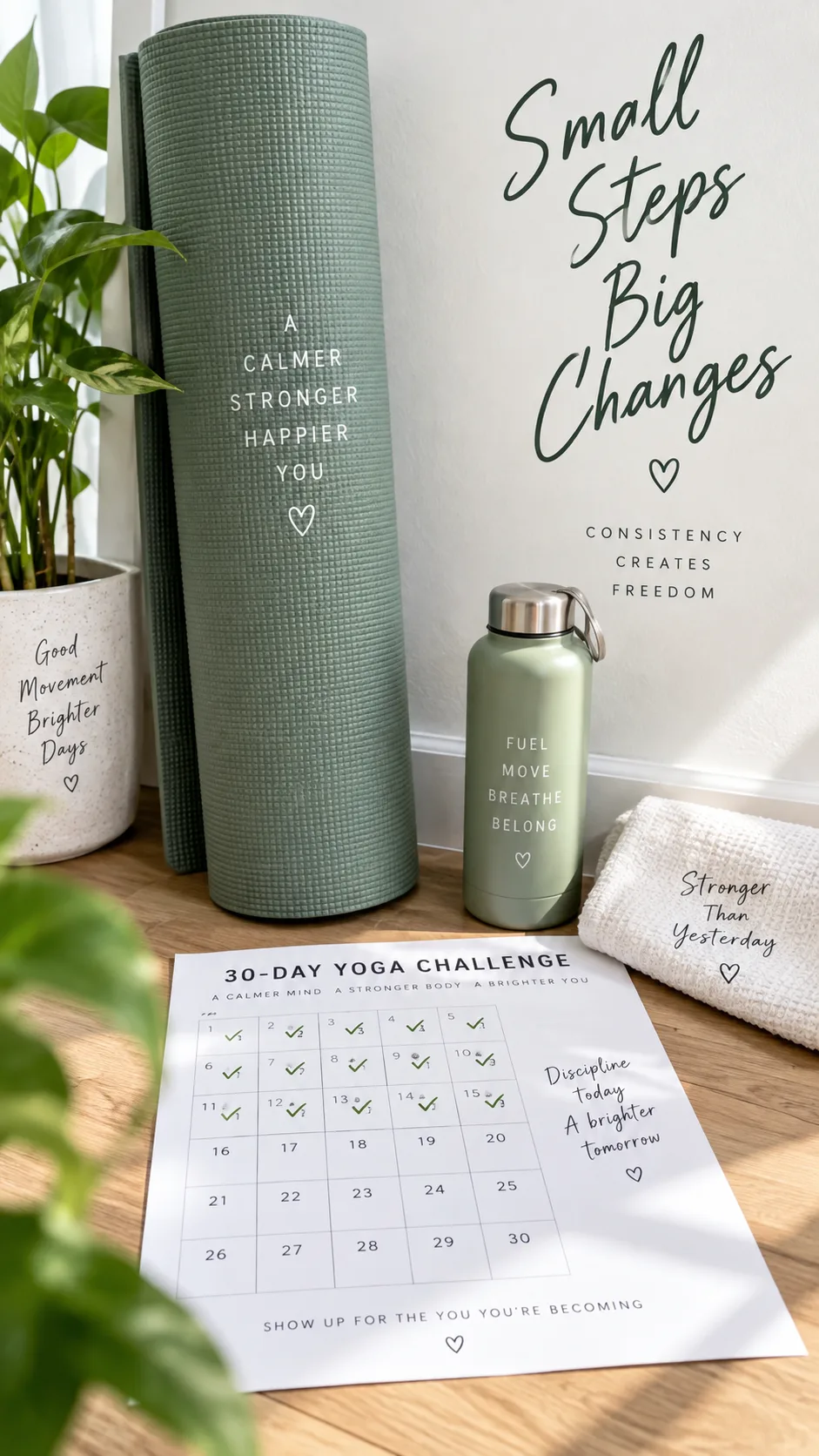
- Track your progress visually. Cross off each day on a physical calendar. That unbroken chain becomes surprisingly motivating.
- Find an accountability partner. Text a friend your workout selfie daily. Sounds cheesy, works brilliantly.
- Prepare your space the night before. Roll out your mat (if you use one), clear the wall area, and set out your workout clothes. Remove every friction point.
- Celebrate small wins. Held a wall sit 10 seconds longer than last week? That’s genuine progress. Acknowledge it.
Taking it further: beyond the 30-day challenge
Finished your 30 days? First of all, respect. Most people quit by Day 9. Now what? You’ve got options. You can repeat the challenge with increased intensity, add resistance bands to your wall exercises, or transition into a full traditional Pilates practice.
Many people discover that wall Pilates opens the door to broader movement practices: yoga, barre, functional training, or reformer Pilates. The body awareness and core strength you’ve built translate directly into every other form of exercise.
You can also start exploring more advanced wall Pilates movements like wall-assisted teasers, single-leg wall bridges, and wall-supported arabesque holds. The progression is virtually limitless once you’ve nailed the fundamentals.
Final thoughts
Wall Pilates strips away every excuse you’ve ever had for not working out. No gym membership, no equipment, no experience required. Just you and a wall, which, last time I checked, most of us have at least four of.
Start with the free chart above, follow the video for form guidance, and commit to the 30-day challenge. By Day 30, you won’t just feel stronger. You’ll have built a sustainable movement habit that doesn’t depend on motivation, fancy equipment, or perfect conditions.
Your wall has been holding up your ceiling this whole time. Put it to work on holding you up too. Now go clear some wall space and get moving.
