
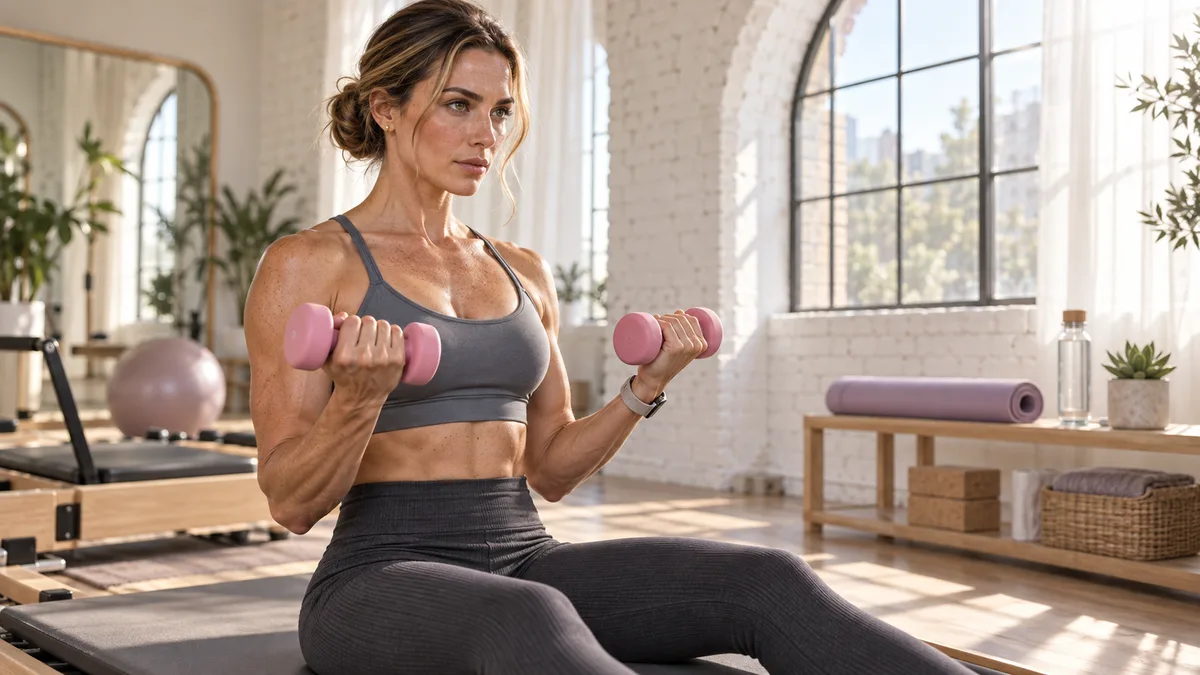
Your arms aren’t going to tone themselves. If you’ve been rolling out your mat and wondering why your biceps still look the same as they did six months ago, here’s the honest answer: bodyweight Pilates alone has limits. Add a pair of light dumbbells, though, and you completely change the game.
A Pilates arm workout with weights gives you the best of both worlds: the control, breath work, and postural alignment Pilates is famous for, plus the muscular resistance needed to build real definition. The result? Arms that look strong and feel strong, without the bulk most people aren’t after anyway.
Below you’ll find six targeted moves that combine classical Pilates principles with dumbbell resistance. Whether you’re a total beginner or a seasoned mat-worker, this routine will challenge your arms in a way that feels intentional, not just sweaty.
Why Pilates and weights work so well together
A lot of people assume Pilates is purely a flexibility or core practice. That’s only half the story. Pilates emphasizes precision, muscular engagement, and controlled movement, and when you layer resistance on top of that, your muscles have no choice but to adapt and grow.
Traditional dumbbell workouts often rely on momentum to push through reps. Pilates strips that momentum away. You move slowly, you breathe deliberately, and you keep your core braced throughout. According to ACE Fitness, slower, controlled resistance training increases time under tension, which is one of the primary drivers of muscle hypertrophy and tone.
The other thing Pilates brings to the table is posture and stabilization. Most people who lift weights regularly have imbalances they don’t even notice: one shoulder hiking up, the neck craning forward. Pilates corrects that as you train. You’re not just building your arms; you’re building them properly.
What you need to get started
Good news: you don’t need a reformer, a studio membership, or a lot of space. Here’s the short list.
- Dumbbells: 1-3 kg (2-5 lbs) for beginners, 3-5 kg (6-10 lbs) for intermediate. Start lighter than you think. Pilates rep ranges and tempos make even light weights surprisingly hard.
- A mat: Any non-slip yoga or Pilates mat works well.
- Comfortable, fitted clothing: You need to see your alignment. Baggy clothes make it harder to self-correct.
- About 25-35 minutes: That’s all this workout takes.
Not sure what to wear? Pilates Workout Outfit Ideas has solid picks that stay put when you’re moving through these exercises. And grippy socks are genuinely worth it on a wooden floor.
The 6 Pilates arm exercises with weights
1. Pilates chest press (standing)
Stand in Pilates stance: heels together, toes slightly apart, core drawn in, ribs knitted together. Hold a dumbbell in each hand at chest height, elbows bent at 90 degrees. Press both arms straight forward at shoulder height, fully extending without locking the elbows, then pull back slowly to the start.
Keep your shoulders down and away from your ears throughout. The moment they creep up, you’ve lost the engagement. Aim for 12-15 reps at a 3-second extension, 3-second return tempo. That slowness is non-negotiable. Speed is how this move becomes easy, and easy isn’t the goal here.
Muscles targeted: Anterior deltoid, pectorals, triceps, core stabilizers.
2. Lateral raise with Pilates breath
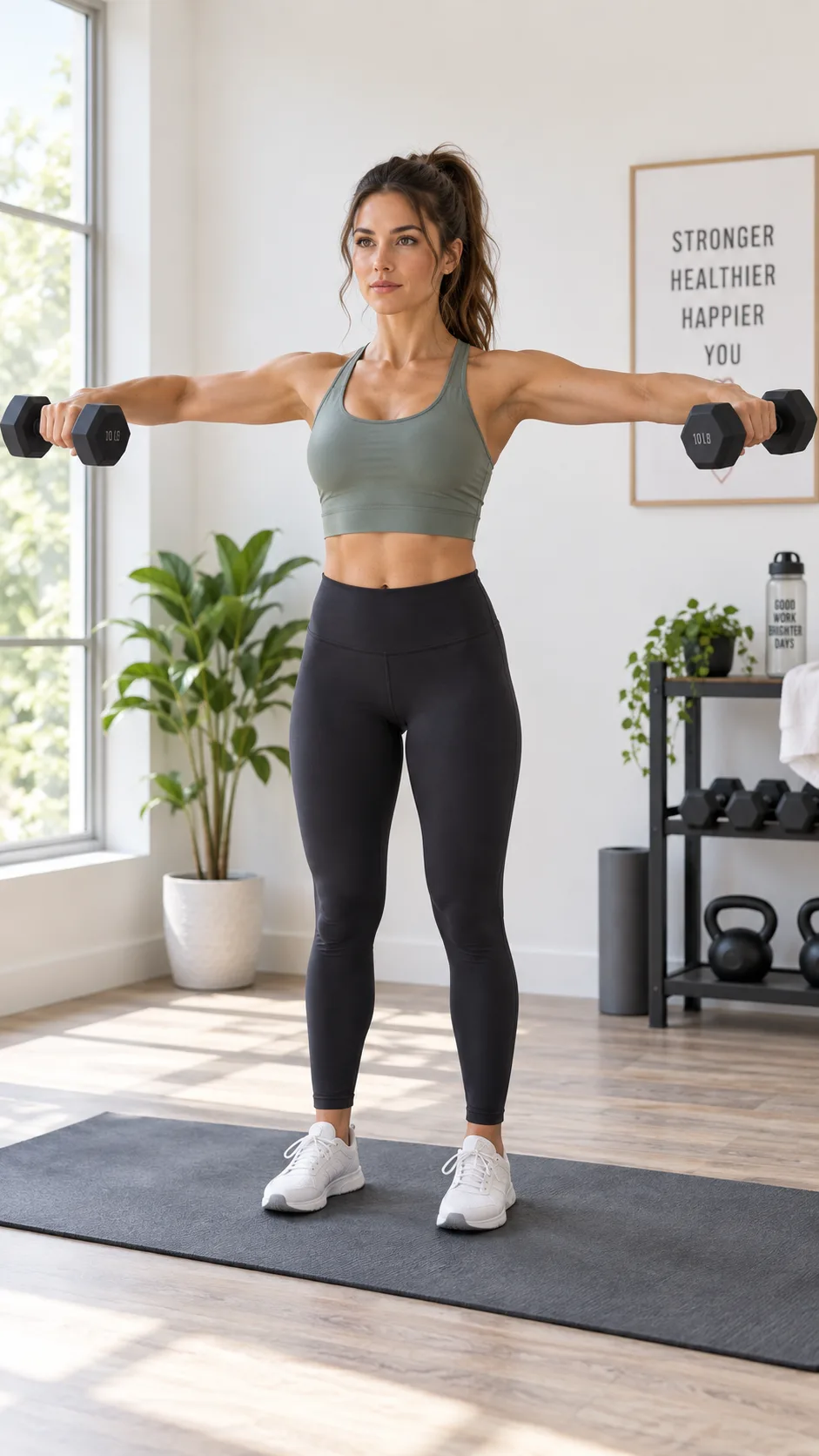
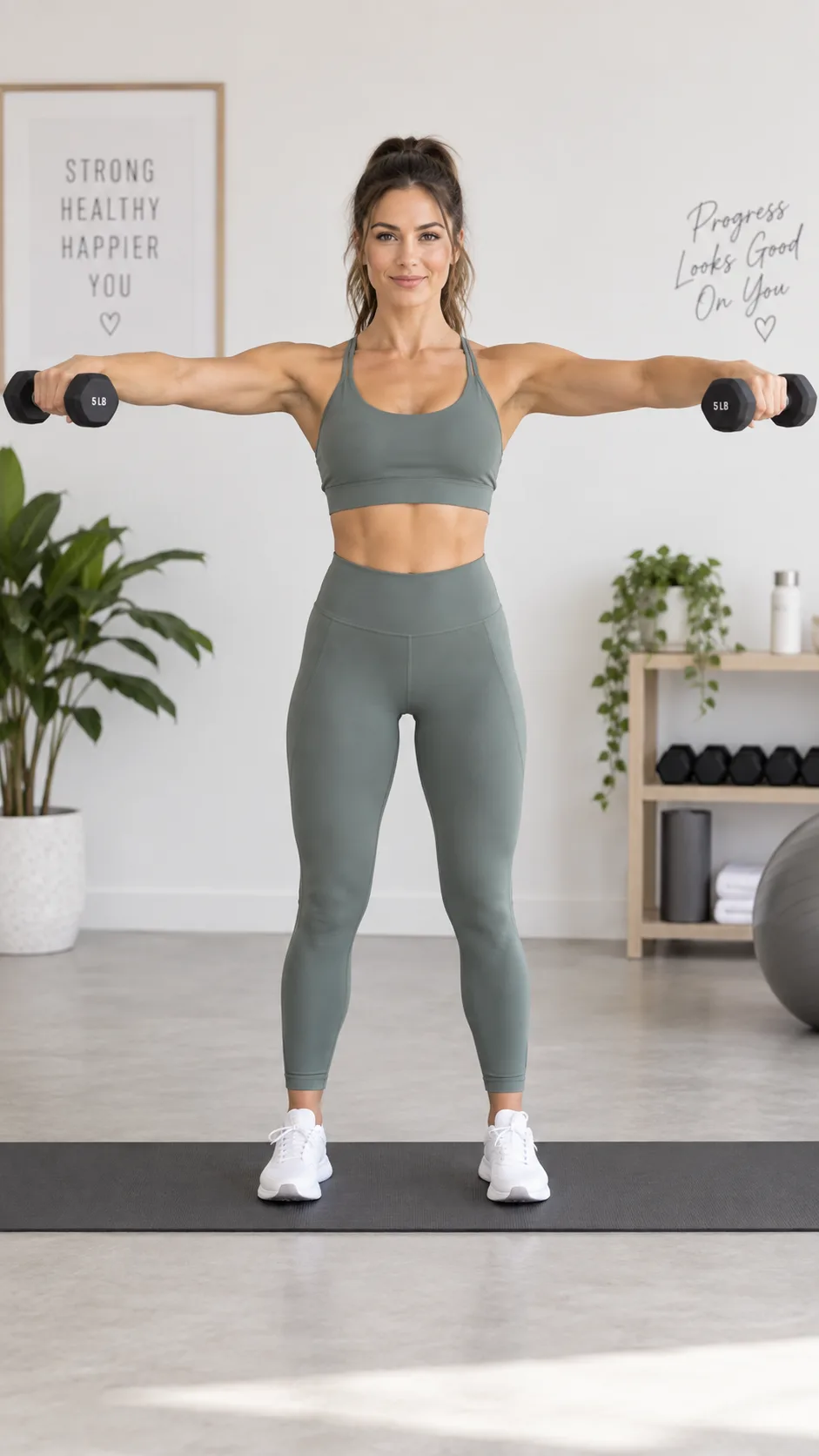
Still standing in your Pilates stance, hold the dumbbells at your sides, palms facing in. Inhale to prepare. On your exhale, slowly raise both arms out to the sides until they reach shoulder height, no higher. Lower on the next inhale, controlling every centimeter of the descent.
The exhale-on-effort rule from Pilates keeps your deep core engaged, which protects your lower back and keeps your posture honest. Most people rush the downward phase. That’s where a huge percentage of the muscle work happens. Don’t waste it.
Muscles targeted: Medial deltoid, upper trapezius, rotator cuff stabilizers.
Aim for 10-12 reps, 2-3 sets.
3. Bicep curl with Pilates stance and spine lengthening
Here’s where a lot of people unknowingly cheat: they swing their elbows forward as they curl. In the Pilates version, your elbows stay pinned to your sides. No swinging, no rocking, no forward lean. Just pure bicep work.
Stand tall, lengthen the crown of your head toward the ceiling, and curl both dumbbells up in a slow arc. Squeeze at the top for one full second, then lower over three counts. The Healthline guide on bicep curls confirms that the eccentric (lowering) phase builds as much muscle as the lifting phase, possibly more. So don’t just drop the weight back down.
Muscles targeted: Biceps brachii, brachialis, forearms.
Go for 12-15 reps per set.
4. Tricep overhead extension
Want to address the back of your arms? This is the move. Sit cross-legged on your mat or stand in Pilates stance. Hold one dumbbell with both hands, arms extended overhead. Lower the weight behind your head by bending at the elbows, keeping your upper arms close to your ears, then press back up to full extension.
The important thing here is that your upper arms don’t move. They stay vertical and close to your head the entire time. Only your forearms move. The moment your elbows splay wide, you recruit the shoulders more than the triceps, and that’s not what you’re going for.
Your core still matters here. Brace your abs to prevent your lower back from arching as you lower the weight behind you. Think of it as a full-body coordination challenge, not just an arm move.
Muscles targeted: Long head of the triceps, core stabilizers.
Aim for 10-12 reps, 3 sets.
5. Pilates bent-over row
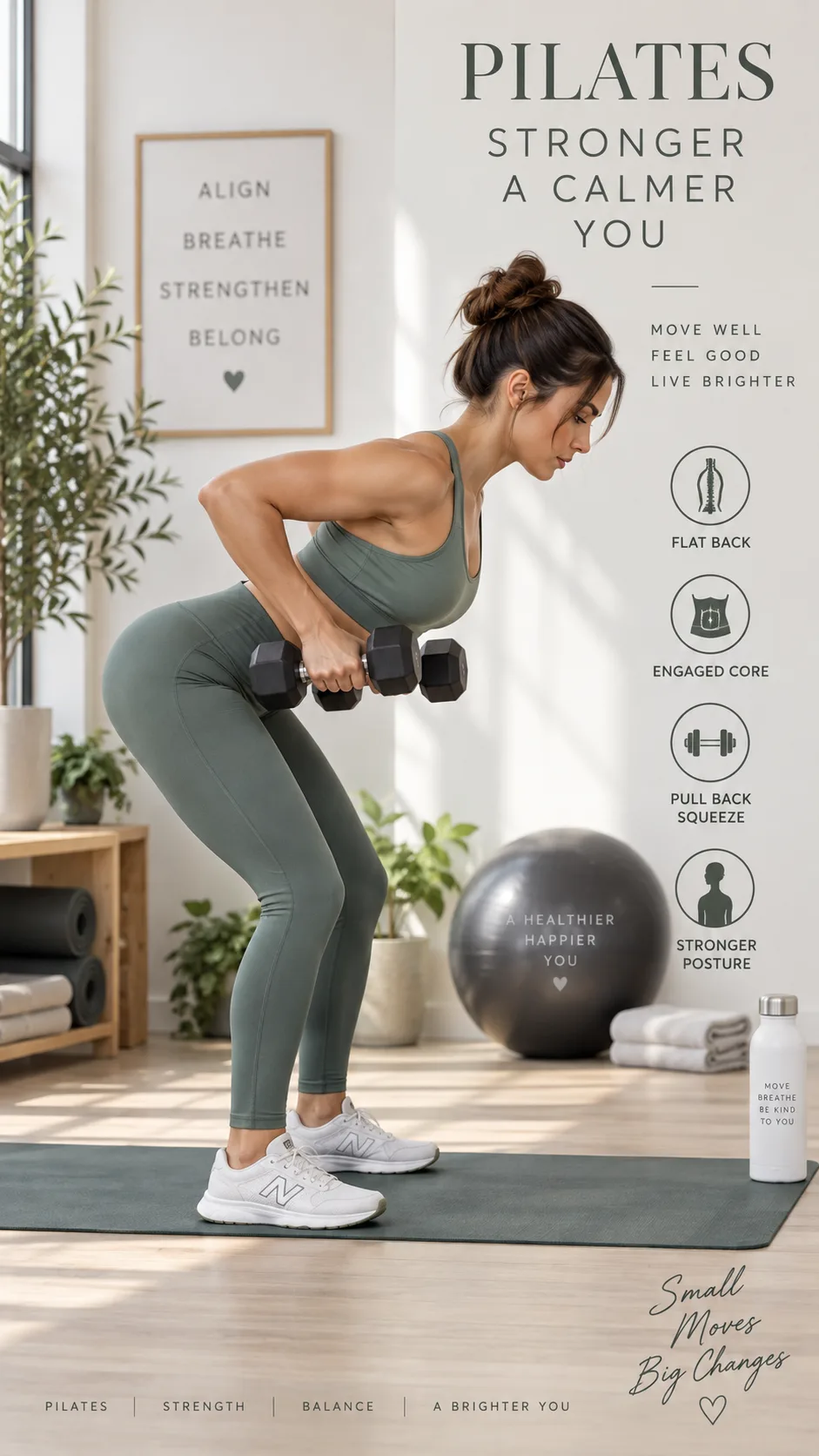
Stand with feet hip-width apart, hinge forward from your hips (not your waist) about 45 degrees, back flat, arms hanging straight toward the floor with a dumbbell in each hand. Pull both elbows straight back toward the ceiling, squeezing your shoulder blades together at the top. Lower slowly.
Ever wondered why your posture slumps no matter how much you try to fix it? Weak upper back muscles are usually the culprit. This move directly targets those rhomboids and mid-trapezius muscles that pull your shoulders back where they belong. Strong arms look better when they’re attached to good posture anyway.
Keep your neck long and your gaze down and slightly forward, not cranked up toward the mirror. Maintain that flat-back Pilates spinal position throughout.
Muscles targeted: Latissimus dorsi, rhomboids, rear deltoids, biceps.
Do 10-12 reps at a controlled 2-2 tempo.
6. Shoulder press with rib-to-hip connection
Sit cross-legged on your mat, both dumbbells at shoulder height, palms facing forward. Before you press, pull your ribs down toward your hips. This is the Pilates “rib-to-hip” cue that prevents your lower back from overextending as you press overhead. Then press both arms straight up until fully extended, lower slowly, repeat.
According to the National Academy of Sports Medicine (NASM), the overhead press activates all three heads of the deltoid plus the triceps and upper trapezius, making it one of the most efficient arm-and-shoulder moves you can do. Adding the Pilates breath and core connection makes it safer and more effective at the same time.
Muscles targeted: All three deltoid heads, triceps, upper trapezius, serratus anterior.
Go for 10-12 reps, 3 sets.
How to structure this into your weekly routine
This workout works best when you do it 2-3 times per week, with at least one full rest day between sessions. Your muscles need recovery time to rebuild stronger. Skipping rest days doesn’t make you faster; it just makes you sore and stagnant.
Here’s a simple weekly structure that works:
- Monday: Pilates arms with weights (this workout)
- Tuesday: Active recovery or a light walk
- Wednesday: Core and legs. Check out the Pilates Ab Workout for a stronger core
- Thursday: Rest
- Friday: Repeat the arms workout
- Saturday: Full body session or full body Pilates routine
- Sunday: Rest
Progressive overload still applies in Pilates. Once 12 reps feel genuinely easy with good form, increase your weight by 0.5-1 kg. Never sacrifice form for load. The Pilates principle of quality over quantity applies here more than anywhere else.
Common mistakes that kill your results
You can do all six moves and still not see progress if you make these errors. Here are the ones that show up most often.
- Going too heavy too soon: Heavier weights without Pilates control just become momentum-driven reps. Start lighter and master the tempo first.
- Holding your breath: Pilates breath is not optional. It activates your deep core and keeps your spine safe. Inhale to prepare, exhale on effort.
- Rushing the eccentric phase: Lowering a weight in one second instead of three cuts the muscle work almost in half. Slow down.
- Ignoring shoulder position: Shoulders should stay down and packed throughout every move. Raised, tense shoulders mean your upper traps are compensating for weak rotator cuff stabilizers.
- Skipping the warm-up: Cold shoulders and elbows do not love sudden resistance. Even five minutes of arm circles, chest openers, and cat-cow will make a real difference.
In my experience, the breath is the single hardest thing to get right when you first add weights. It feels unnatural to breathe out as you lift. But once it clicks, your whole form improves. It’s like flipping a switch on your core engagement.
Pilates vs. standard weight training for arms: what’s the real difference?
Standard arm workouts typically prioritize max load and rep failure. You go as heavy as you can handle, push through the burn, and call it done. Pilates with weights flips the script: you go lighter, slower, and with full-body awareness baked into every rep.
The outcome differs too. Heavy barbell or dumbbell training tends to build larger muscle mass. Pilates with light-to-moderate resistance builds lean definition, joint stability, and endurance, the kind of arms that look toned in a tank top and feel capable all day.
Neither approach is wrong; they just target different outcomes. If you want to explore more traditional dumbbell work alongside this routine, the Ultimate Arm Workout for Women with Weights covers that ground well and pairs nicely with what you’re building here.
Research from the Journal of Strength and Conditioning Research shows that lighter loads taken to or near muscular failure produce similar hypertrophy to heavy loads. Pilates keeps you closer to failure with less risk of injury. For most people training at home, that’s the smarter trade-off.
Quick reference: the full workout at a glance
- Pilates Chest Press — 12-15 reps, 3 sets
- Lateral Raise with Pilates Breath — 10-12 reps, 3 sets
- Bicep Curl with Spine Lengthening — 12-15 reps, 3 sets
- Tricep Overhead Extension — 10-12 reps, 3 sets
- Pilates Bent-Over Row — 10-12 reps, 3 sets
- Shoulder Press with Rib-to-Hip Connection — 10-12 reps, 3 sets
Rest 45-60 seconds between sets. Total workout time: approximately 25-35 minutes with a warm-up. That’s genuinely it. No hour-long ordeal required.
Final thoughts
A Pilates arm workout with weights isn’t a complicated thing. It’s six focused moves, a pair of light dumbbells, and a commitment to moving with intention instead of just grinding through reps. That shift in approach (slow, deliberate, breath-led) is what separates visible results from effort that just keeps you in maintenance mode.
Strong, defined arms aren’t built in a week, but they do get built by people who show up consistently and train smart. You’ve got the moves. You’ve got the structure. The only thing left is to do it.
Start this week, stay consistent for six weeks, and you’ll notice the difference. That’s not a motivational poster. That’s just how muscle adaptation works.
