
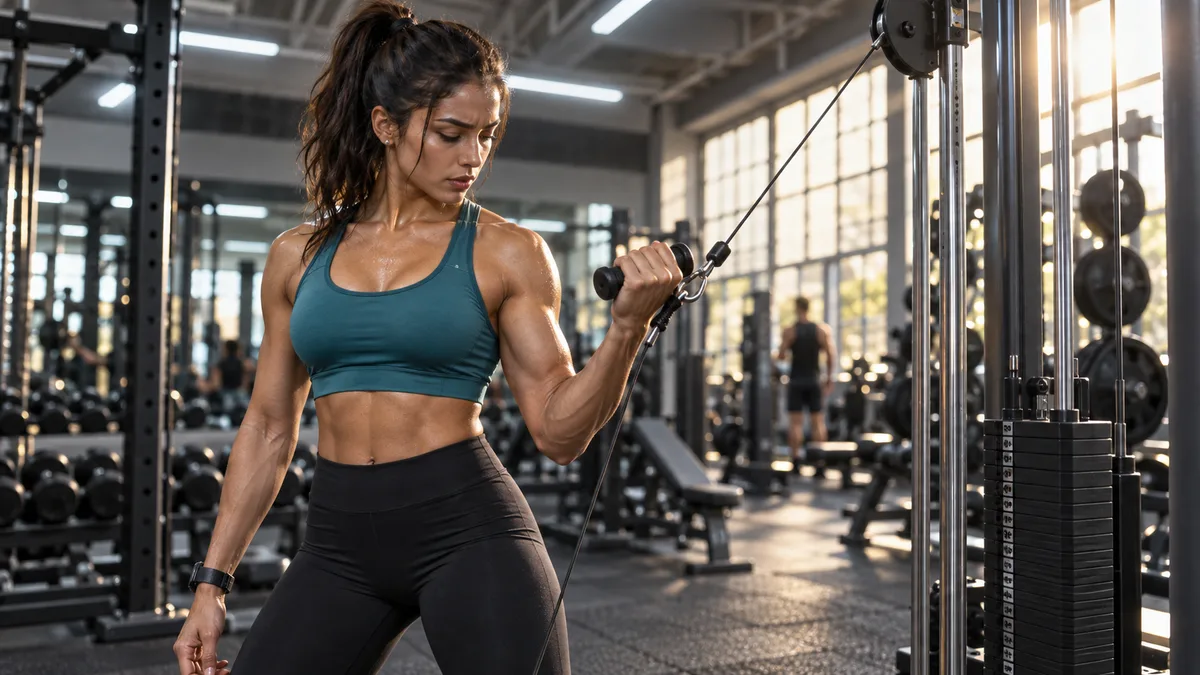
You’ve been grabbing the same pair of dumbbells for months. Maybe years. Your arms have stopped responding. They look the same as they did back in September, and you’re starting to wonder if your biceps even know they’re supposed to grow.
Your muscles adapt. They get comfortable. And comfortable muscles don’t change. That’s exactly where the cable machine steps in and shakes everything up. If you’ve been walking past it at the gym thinking it’s reserved for bodybuilders or “advanced” lifters, I need you to stop that immediately.
A cable arm workout provides something dumbbells literally cannot: constant tension throughout the entire range of motion. No dead spots at the top or bottom. No momentum cheating. Just your muscles working from start to finish on every single rep. Your arms will notice the difference within weeks.
Why cable machines work so well for women’s arm training
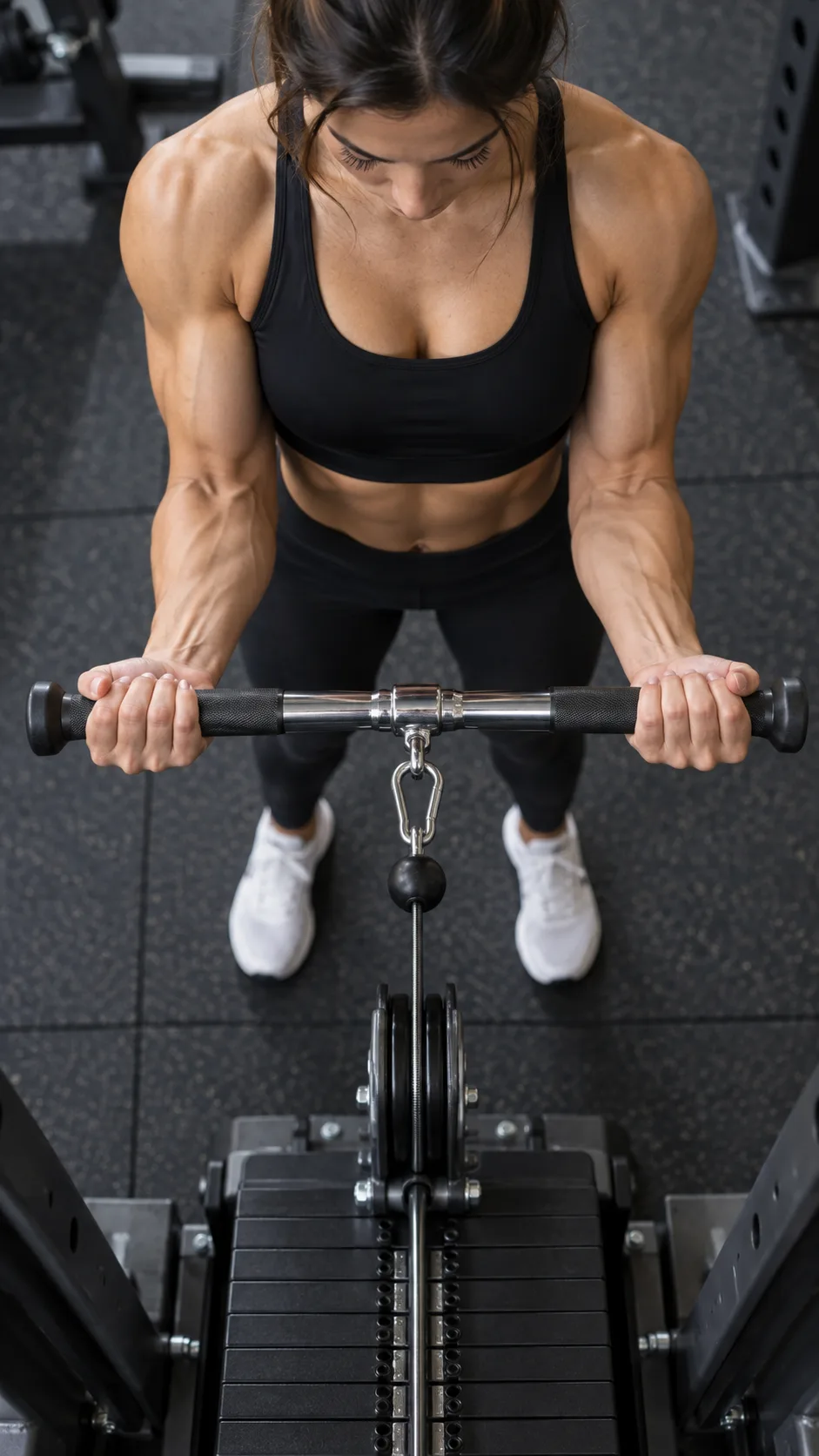
I’ll be blunt: dumbbells are fantastic. I love them. But they have a weakness that nobody talks about enough. When you curl a dumbbell, gravity only pulls it straight down. That means at certain points in the movement (like the very top and very bottom), your muscles barely do any work.
Cable machines fix this entirely. The pulley system keeps resistance on your muscles through every inch of the exercise. Your biceps, triceps, and forearms stay loaded the whole time. That’s more time under tension per rep, which translates directly to better muscle definition and strength gains.
Other reasons women should love the cable machine
- Adjustable in small increments: most cable stacks go up by 5 or even 2.5 pounds, making progressive overload smoother and more precise
- Joint-friendly: the consistent resistance pattern puts less stress on elbows and wrists compared to heavy free weights
- Versatile: one machine, dozens of exercises, every angle imaginable
- Harder to cheat: you can’t swing the cable like you swing a dumbbell (we’ve all done it, no judgment)
Research from the National Strength and Conditioning Association (NSCA) consistently supports the idea that varied resistance modalities, including cables, recruit more muscle fibers than sticking with a single training tool. Your arms deserve that variety.
The complete cable arm workout for women
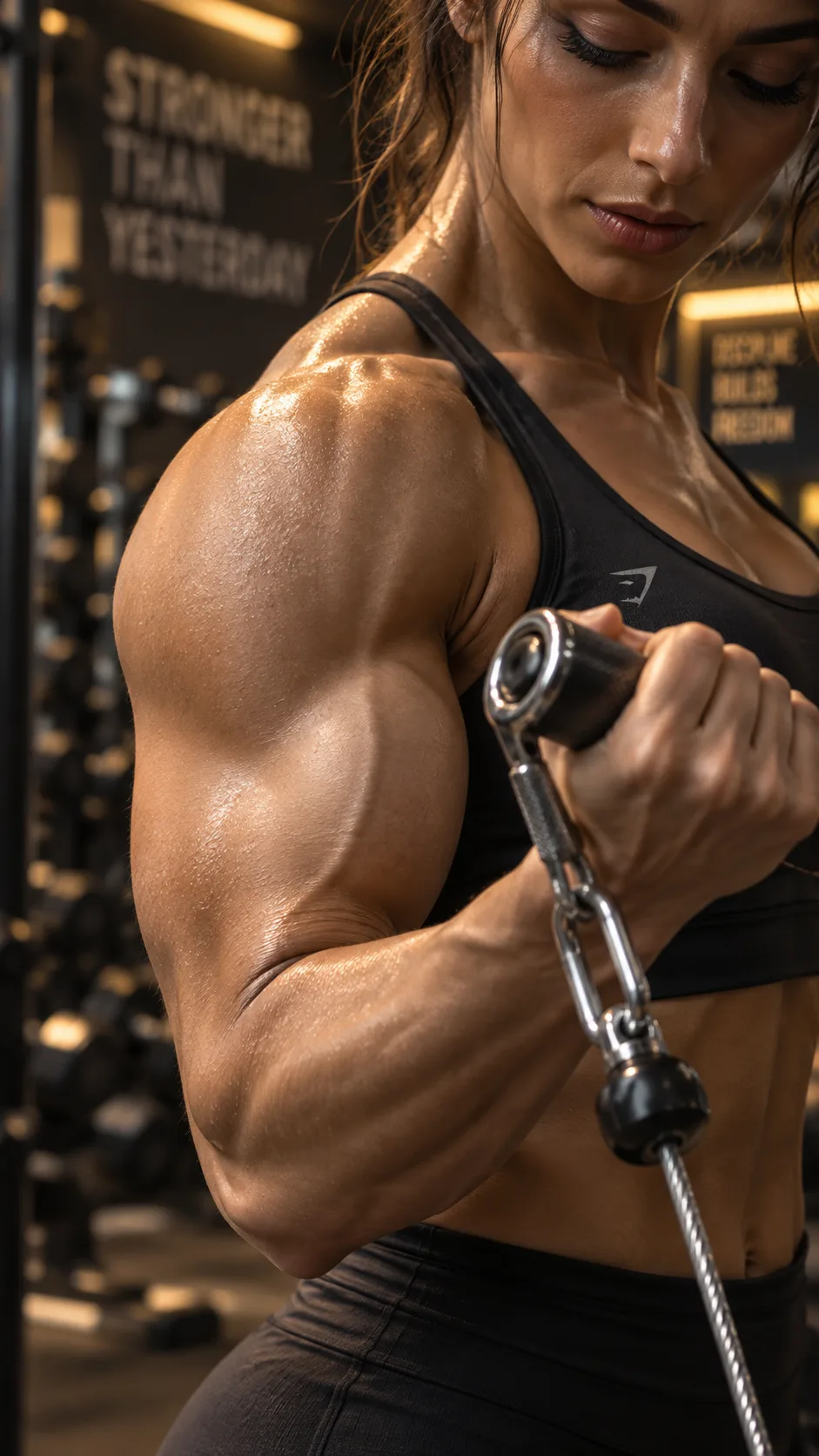
This workout targets your biceps, triceps, and forearms using nothing but the cable machine. You can complete it in about 30-35 minutes, and it pairs well with a shoulder or back session. Or run it solo on arm day. No shame in dedicating a whole day to your arms.
If you’re looking for a structured plan to slot this into, check out our full week workout plan for women that maps out every training day.
Quick overview
- Cable Bicep Curl (straight bar)
- Cable Rope Hammer Curl
- Single-Arm Cable Curl
- Cable Tricep Pushdown (straight bar)
- Cable Overhead Tricep Extension (rope)
- Single-Arm Reverse Grip Pushdown
- Cable Wrist Curl
Here’s each one broken down so you know exactly what you’re doing and why.
Bicep exercises on the cable machine
1. Cable Bicep Curl (Straight Bar Attachment)
Sets: 3 | Reps: 12-15 | Rest: 60 seconds
Attach a straight bar or EZ bar to the low pulley. Stand about a foot back from the machine, grip the bar with palms facing up, and curl it toward your shoulders. Keep your elbows pinned to your sides. They should NOT drift forward.
Lower the bar slowly. I mean slowly. Count to three on the way down. That eccentric phase is where a huge chunk of muscle growth happens, and most people rush right through it. Don’t be most people.
Form tip: If your shoulders roll forward at the top, the weight is too heavy. Drop it down 5 pounds. Your biceps don’t care about your ego.
2. Cable Rope Hammer Curl
Sets: 3 | Reps: 12-15 | Rest: 60 seconds
Swap the bar for a rope attachment. Keep your palms facing each other (neutral grip) and curl the rope up, pulling the ends apart slightly at the top. This targets the brachialis and brachioradialis, muscles that sit underneath and alongside your biceps.
Why does that matter? Because developing these muscles makes your arms look fuller and more defined from every angle, not just the front. Think of it as building the frame around the picture.
3. Single-Arm Cable Curl
Sets: 3 per arm | Reps: 10-12 | Rest: 45 seconds per arm
Use a D-handle on the low pulley. This is where you fix muscle imbalances, because (fun fact) almost everyone has one arm slightly stronger than the other. The single-arm version forces each bicep to pull its own weight. Literally.
Stand sideways to the machine, curl with control, and squeeze HARD at the top for a one-second hold. You’ll feel a peak contraction that a dumbbell curl just can’t match at that angle. Start with your weaker arm first so you can match the reps with your stronger side.
Tricep exercises on the cable machine
Your triceps make up roughly two-thirds of your upper arm mass. Read that again. If you want arms that look toned and sculpted, you absolutely cannot skip tricep work. Ever notice how some people only train biceps and their arms still look skinny from the side? That’s why.
4. Cable Tricep Pushdown (Straight Bar)
Sets: 3 | Reps: 12-15 | Rest: 60 seconds
Set the cable to the highest position. Grab the straight bar with an overhand grip, elbows tight to your ribs, and push the bar down until your arms are fully extended. Squeeze your triceps at the bottom like you’re trying to crack a walnut between your arm muscles.
The most common mistake? Letting your elbows flare out and using your lats to push the weight down. If you catch yourself doing this, lighten the load. Your triceps should do ALL the work here.
5. Cable Overhead Tricep Extension (Rope)
Sets: 3 | Reps: 10-12 | Rest: 60 seconds
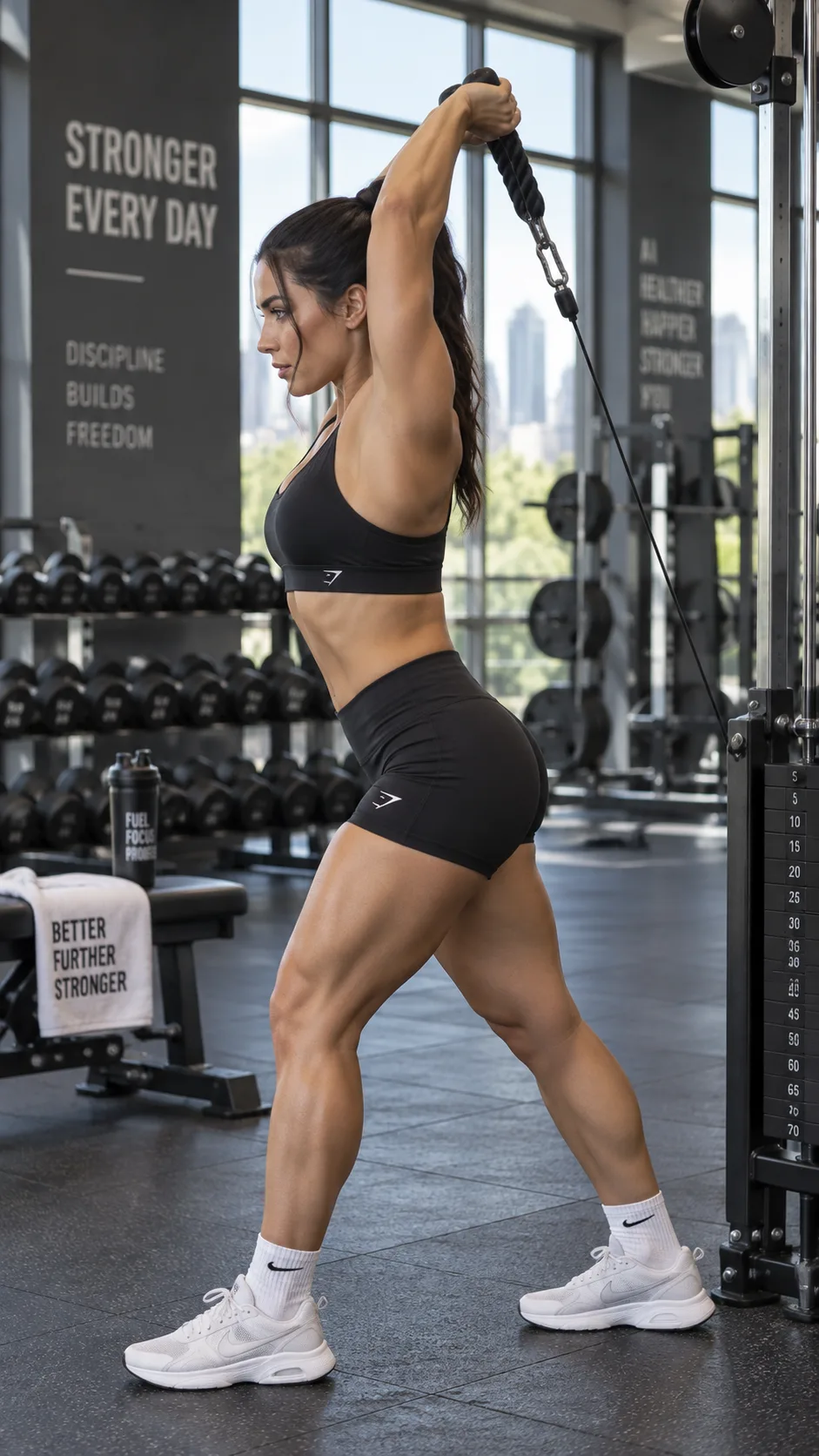
This one is incredible for targeting the long head of the triceps, the part that gives your arm that defined shape when viewed from behind. Attach the rope to a high pulley, face away from the machine, lean slightly forward, and extend your arms overhead.
Keep your upper arms close to your ears throughout the movement. When you lower the rope behind your head, you should feel a deep stretch in your triceps. That stretch is the magic. Recent research from the American Council on Exercise shows that training muscles in their lengthened position can increase hypertrophy, so don’t cut this range of motion short.
6. Single-Arm Reverse Grip Pushdown
Sets: 3 per arm | Reps: 10-12 | Rest: 45 seconds per arm
Use a D-handle on the high pulley. Grip it with your palm facing UP (supinated grip) and push down. This underhand position shifts emphasis to the medial head of the triceps and just feels different in the best possible way.
Go lighter than you think you need to. This exercise is about precision and squeeze, not about moving heavy weight. You’ll feel a contraction in a part of your tricep you didn’t know existed. You’re welcome 🙂
Don’t forget your forearms
7. Cable Wrist Curl
Sets: 2 | Reps: 15-20 | Rest: 45 seconds
Sit on a bench near the low pulley. Grab a straight bar, rest your forearms on your thighs with your wrists hanging off your knees, and curl the bar up using only your wrists. It’s a small movement, but your forearms will be on fire by rep 12.
Why bother with forearms? Because grip strength impacts every other exercise you do. Deadlifts, rows, pull-ups: they all improve when your forearms and grip get stronger. Plus, defined forearms just look good. Don’t let anyone tell you otherwise.
How to structure sets, reps, and weight selection
This is where a lot of women get tripped up. You pick a weight that feels “comfortable” and do 15 easy reps. But comfortable doesn’t build muscle. You need to choose a weight where the last 2-3 reps of each set feel genuinely challenging.
Not impossible. Not painful. But challenging enough that your form stays solid while your muscles are clearly working hard. Researchers call this training close to “failure”, and it’s one of the most important drivers of muscle growth, according to a 2021 systematic review published in the Journal of Strength and Conditioning Research.
Quick programming guidelines
- For muscle definition (hypertrophy): 3 sets of 10-15 reps at a moderate weight
- For strength: 4 sets of 6-8 reps at a heavier weight
- For endurance: 2-3 sets of 15-20 reps at a lighter weight
- Rest periods: 45-90 seconds between sets. Shorter rest means more metabolic stress and more burn.
- Tempo: Aim for 2 seconds up, 3 seconds down on every rep
If you’re brand new to cable training, start with the hypertrophy range. It’s the sweet spot for building visible arm definition without needing to go super heavy right away.
Common mistakes that kill your progress
I’ve seen these mistakes hundreds of times, and I’ve made most of them myself. Here’s what to avoid so you don’t waste your gym time.
- Using momentum instead of muscle. If your whole body sways during a cable curl, you’re basically doing a weird standing crunch, not an arm exercise. Plant your feet, brace your core, and ISOLATE.
- Going too heavy too soon. IMO, this is the number one reason people don’t feel the “right” muscle working. Drop the ego, drop the weight, and focus on the contraction.
- Rushing reps. Cable exercises reward slow, controlled movement. Speed is the enemy of muscle activation here.
- Skipping triceps. I said it before and I’ll say it again: your triceps are TWO-THIRDS of your arm. Train them at least as much as your biceps.
- Never changing attachments. The straight bar, EZ bar, rope, and D-handle all hit your muscles differently. Rotate through them regularly to keep your arms guessing.
Sample weekly schedule: where this workout fits
You don’t need to train arms every single day. Two dedicated arm sessions per week (or one arm-focused day plus one upper body day that includes arm work) is plenty for most women looking to build definition.
Here’s a sample split:
- Monday: Lower body (check out our best leg exercises for women)
- Tuesday: Cable arm workout (this routine!)
- Wednesday: Rest or light cardio
- Thursday: Full upper body (including some arm accessories)
- Friday: Lower body
- Saturday: Active recovery or yoga
- Sunday: Rest
And please, fuel your training properly. Muscle doesn’t build itself out of thin air. You need adequate protein, and our high protein meal plan for women breaks down exactly how to eat for lean muscle growth without overcomplicating things.
Can you really build sculpted arms without dumbbells?
Short answer: absolutely. Longer answer: your muscles don’t know what tool you’re using. They only know tension, stretch, and contraction. A cable machine delivers all three, and arguably better than dumbbells for isolation work.
I spent an entire training block (about 8 weeks) doing ONLY cable exercises for arms. No dumbbells, no barbells, no fixed-path machines. Just cables. The result? My arms looked noticeably more defined, especially my triceps. The constant tension made a real difference that I could see and feel.
That said, the best long-term approach is to use multiple tools. Cables one phase, dumbbells the next, bodyweight the next. Variety keeps adaptation happening. But if someone told me I could only pick one tool for arm training forever? I’d pick the cable machine without hesitation.
A quick visual guide to get you started
If you’re a visual learner (like most of us), watching proper cable arm exercise form makes a huge difference. This video walks through several of the movements we’ve covered and shows you exactly what good technique looks like:
Progressive overload: the real driver of change
One truth applies to every single exercise in this article: if you don’t progressively challenge your muscles over time, they won’t change. Progressive overload is non-negotiable for building stronger, more defined arms.
With cable machines, progressive overload is straightforward. You can:
- Add 2.5-5 pounds to the stack every 1-2 weeks
- Add one extra rep per set before increasing weight
- Slow down your tempo (3 seconds up, 4 seconds down)
- Reduce rest periods by 10-15 seconds
- Add a pause at peak contraction (1-2 seconds)
Track your weights and reps in a notebook or phone app. Seriously. You think you’ll remember that you did 12 reps at 25 pounds last Tuesday, but you won’t. Write it down. Your future sculpted arms will thank you.
Your arms deserve better than the same old routine
If your arms have hit a plateau, the answer isn’t to do MORE of what hasn’t been working. The answer is to do something different, and a cable arm workout gives you exactly that. Constant tension, versatile angles, joint-friendly resistance, and a level of muscle isolation that dumbbells struggle to match.
Run this workout twice a week for 6-8 weeks. Track your weights. Eat enough protein. Sleep well. And watch what happens. You’ll feel stronger within the first two weeks, and you’ll see changes by week four or five.
Your action step right now: Next time you’re at the gym, skip the dumbbell rack. Walk straight to the cable machine. Do this workout. Then come back and tell me your arms didn’t feel completely different afterward. I already know the answer.
