

You’ve got the gym membership. You’ve got the new trainers. You even downloaded three fitness apps. But every time you walk through those gym doors, you stand there like a lost tourist staring at a subway map. Sound familiar?
The truth nobody tells you: most beginners quit the gym because of confusion, not laziness. You don’t need more motivation. You need a plan. A dead-simple, follow-the-steps, no-thinking-required gym weekly workout plan that tells you exactly what to do on which day.
That’s exactly what I’m handing you right now. I spent my first six months in the gym bouncing between random YouTube exercises like a pinball machine. Once I locked into a structured weekly schedule, everything changed. My consistency, my results, my sanity. Let me save you those wasted months.
Why you need a gym weekly workout plan
Walking into a gym without a plan is like going grocery shopping when you’re starving and without a list. You’ll grab random stuff, waste time, and leave feeling unsatisfied. A structured weekly workout schedule eliminates decision fatigue and keeps you focused.
Research from the American College of Sports Medicine (ACSM) consistently shows that beginners who follow structured programs see significantly better strength gains and adherence rates than those who wing it. Structure breeds consistency. Consistency breeds results. Period.
Three things every good beginner plan needs
- Progressive overload: gradually increasing weight, reps, or sets over time so your body keeps adapting
- Adequate recovery: muscles grow during rest, not during the workout itself
- Balanced muscle training: hitting all major muscle groups each week to avoid imbalances and injury
Ever wondered why some people train for years and still look the same? They’re missing at least one of these. Usually it’s progressive overload. They keep lifting the same weight week after week, expecting magic.
How many days per week should a beginner train?
Three to four days per week is the sweet spot for most beginners. That’s not my opinion. That’s backed by guidelines from the National Strength and Conditioning Association (NSCA). More than that, and you risk burnout before you’ve even built the habit.
I know, I know. Instagram fitness influencers train six days a week and look incredible. But they didn’t start there, and neither should you. Your body needs time to adapt to this new stress. Jumping into a six-day split as a beginner is like trying to run a marathon when you haven’t jogged around the block yet.
The plan below uses a 4-day workout split, with three rest days built in. Those rest days aren’t optional. They’re where the muscle building happens.
Your complete gym weekly workout plan (4-day split)
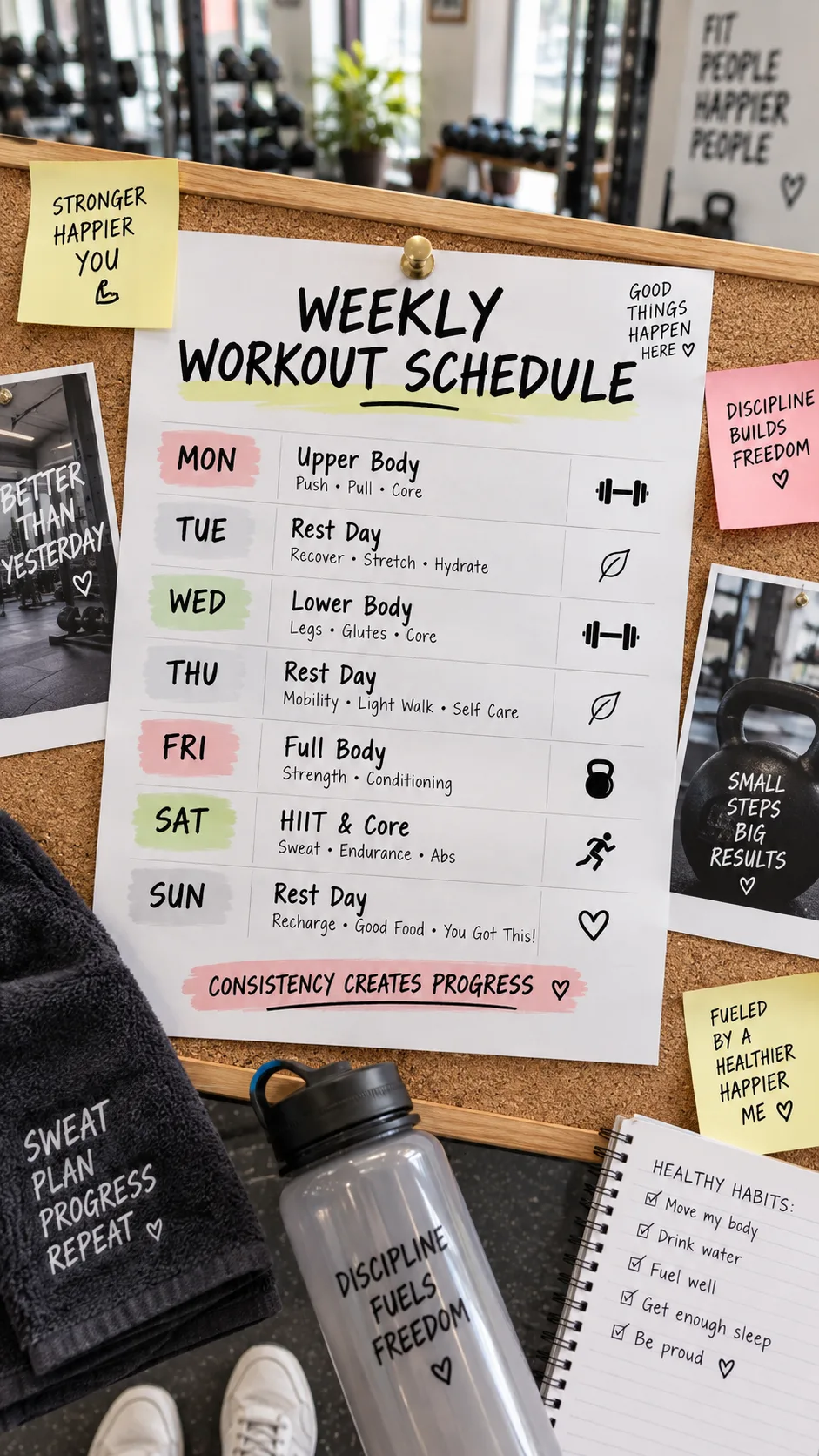
This beginner gym schedule follows an Upper/Lower split, meaning you alternate between upper body and lower body workouts. It’s simple, it’s effective, and it gives each muscle group plenty of recovery time. The full week looks like this:
Monday: Upper body (push focus)
- Flat Barbell Bench Press: 3 sets × 8-10 reps
- Seated Dumbbell Shoulder Press: 3 sets × 10-12 reps
- Incline Dumbbell Press: 3 sets × 10-12 reps
- Tricep Cable Pushdowns: 3 sets × 12-15 reps
- Lateral Raises: 3 sets × 15 reps
Start every session with a 5-minute warm-up on the treadmill, rowing machine, or jump rope. Don’t skip this. Cold muscles and heavy weights are not friends.
Tuesday: Lower body (quad and glute focus)
- Barbell Back Squat: 3 sets × 8-10 reps
- Leg Press: 3 sets × 10-12 reps
- Walking Lunges: 3 sets × 12 reps per leg
- Leg Extensions: 3 sets × 12-15 reps
- Standing Calf Raises: 4 sets × 15 reps
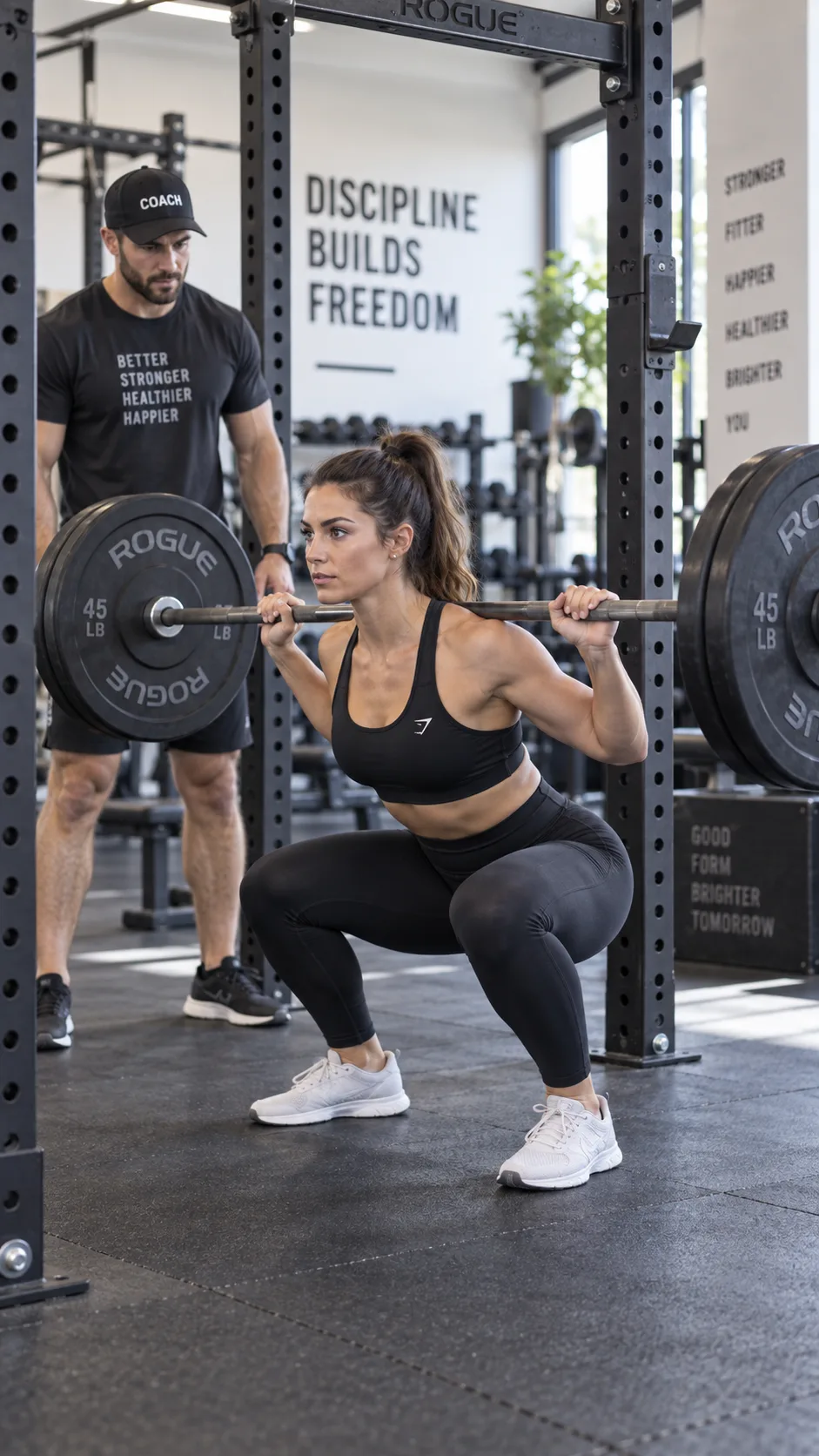
The barbell squat is the king of lower body exercises, but form comes before weight, always. If you can’t squat with proper depth using just the barbell, use that as your starting point. There’s zero shame in it. I squatted an empty bar for three weeks when I started, and my legs are doing just fine now.
Wednesday: Rest day
Rest doesn’t mean lying on the couch all day (though I won’t judge). Light activity like walking, stretching, or a gentle mat Pilates session can speed up recovery by increasing blood flow to sore muscles.
Thursday: Upper body (pull focus)
- Barbell Bent-Over Row: 3 sets × 8-10 reps
- Lat Pulldown: 3 sets × 10-12 reps
- Seated Cable Row: 3 sets × 10-12 reps
- Dumbbell Bicep Curls: 3 sets × 12 reps
- Face Pulls: 3 sets × 15 reps
Face pulls are non-negotiable. They strengthen your rear delts and rotator cuff muscles, which counterbalances all the pressing you do on Monday. Your shoulders will thank you in five years.
Friday: Lower body (hamstring and glute focus)
- Romanian Deadlift: 3 sets × 8-10 reps
- Hip Thrusts: 3 sets × 10-12 reps
- Leg Curls: 3 sets × 12-15 reps
- Bulgarian Split Squats: 3 sets × 10 reps per leg
- Standing Calf Raises: 4 sets × 15 reps
Bulgarian split squats are brutal. They look easy until you try them with proper form. But they’re one of the best unilateral exercises for building balanced leg strength and stability. Stick with them. The payoff is enormous.
Saturday and Sunday: Rest days
Use the weekend to recover, meal prep, and get ready for the next week. If you’re itching to move, go for a hike, play a sport, or try a bodyweight workout at home. Just keep the intensity low.
How to progress each week (without overcomplicating it)
This is where most beginner plans fall short. They tell you WHAT to do but not how to make it harder over time. Without progressive overload, your muscles have no reason to grow. Your body adapts, and you plateau.
Follow this dead-simple progression model:
- Week 1-2: Focus entirely on learning proper form. Use light weights. Seriously, leave your ego at the door.
- Week 3-4: Aim to hit the TOP of the rep range for every set. If the plan says 8-10 reps, go for 10.
- Week 5+: Once you can complete all sets at the top of the rep range with good form, increase the weight by 2.5-5 lbs (1-2.5 kg) and drop back to the bottom of the rep range.
This cycle repeats indefinitely. It’s not glamorous, but it works like clockwork. Small, consistent weight increases over months add up to massive strength gains. IMO, this is the single most important concept a beginner can understand.
How long should each workout take?
Each session in this gym weekly workout plan should take roughly 45-60 minutes, including your warm-up. If you’re spending 90 minutes in the gym as a beginner, you’re either resting too long between sets or scrolling Instagram between exercises. (Be honest. We’ve all done it.)
Rest 60-90 seconds between sets for compound movements like squats and bench press. For isolation exercises like bicep curls and lateral raises, keep rest periods to 45-60 seconds. Set a timer on your phone if you need to.
Efficiency matters. The goal is to get in, work hard, and get out. You don’t earn extra gains by lingering near the water fountain.
Common beginner mistakes that sabotage results
I made every single one of these mistakes when I started. Save yourself the frustration and dodge them from day one.
1. Program hopping
You find a workout plan, follow it for two weeks, see a different one online, and switch. Then you switch again. And again. Stop. Stick with one program for a minimum of 8-12 weeks before evaluating results. Consistency with a decent plan will always beat inconsistency with a “perfect” one.
2. Skipping legs
The “I’ll train legs next week” mentality is a meme for a reason. Your legs contain the largest muscles in your body. Training them releases more growth hormones and burns more calories than any upper body workout. Skip them, and you’re leaving gains on the table. Plus, nobody wants to look like a lollipop :/
3. Ignoring nutrition
You cannot out-train a bad diet. If you’re eating garbage, your results will reflect it. You don’t need to be perfect, but you do need to eat enough protein. Aim for roughly 0.7-1 gram of protein per pound of body weight daily. If you want help structuring your meals, check out our guide on building a macro meal plan for beginners.
4. Ego lifting
Loading up the barbell with more weight than you can handle and using terrible form is the fastest way to get injured. Nobody in the gym is judging how much you lift. I promise. The only person watching you is the guy between sets who’s staring into space.
Tracking your workouts: the habit nobody bothers with
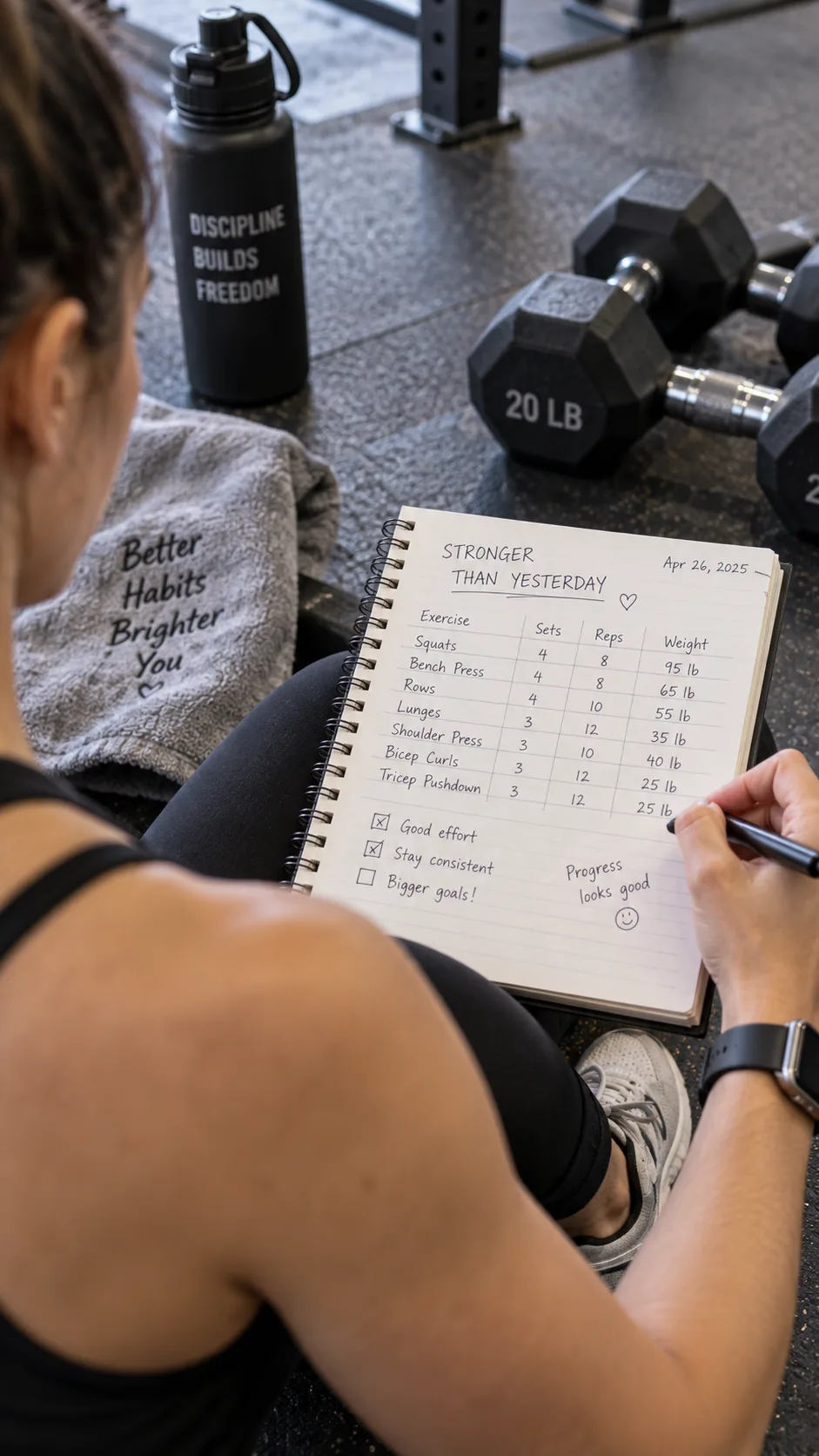
If you’re not writing down your workouts, how do you know if you’re progressing? You don’t. Your memory is unreliable, especially when you’re tired and sweaty mid-session.
Use a simple notebook, a notes app on your phone, or a dedicated tracking app like Strong. For every exercise, record the weight used, the number of reps completed, and how it felt. This data becomes your roadmap for progression.
What gets measured gets improved. This applies to the gym just as much as it applies to business, finances, or anything else worth doing well.
When should you switch to a more advanced program?
You should run this beginner gym workout plan for at least 12 weeks. After that point, you’ll likely notice that your strength gains start to slow down. That’s totally normal. It means you’ve graduated from “beginner” to “intermediate.” Congratulations, you’ve earned it.
Signs you’re ready to progress:
- You can no longer add weight to the bar every 1-2 weeks
- Your form is consistently solid on all major lifts
- You feel confident navigating the gym independently
- You want more training volume or variety
At that point, consider transitioning to a Push Pull Legs (PPL) workout plan, which increases training frequency and volume. It’s the natural next step from the Upper/Lower split.
Sample week at a glance
Your entire week, summarized in one quick-reference format:
- Monday: Upper Body, Push (Chest, Shoulders, Triceps)
- Tuesday: Lower Body, Quads and Glutes
- Wednesday: REST
- Thursday: Upper Body, Pull (Back, Biceps, Rear Delts)
- Friday: Lower Body, Hamstrings and Glutes
- Saturday: REST
- Sunday: REST
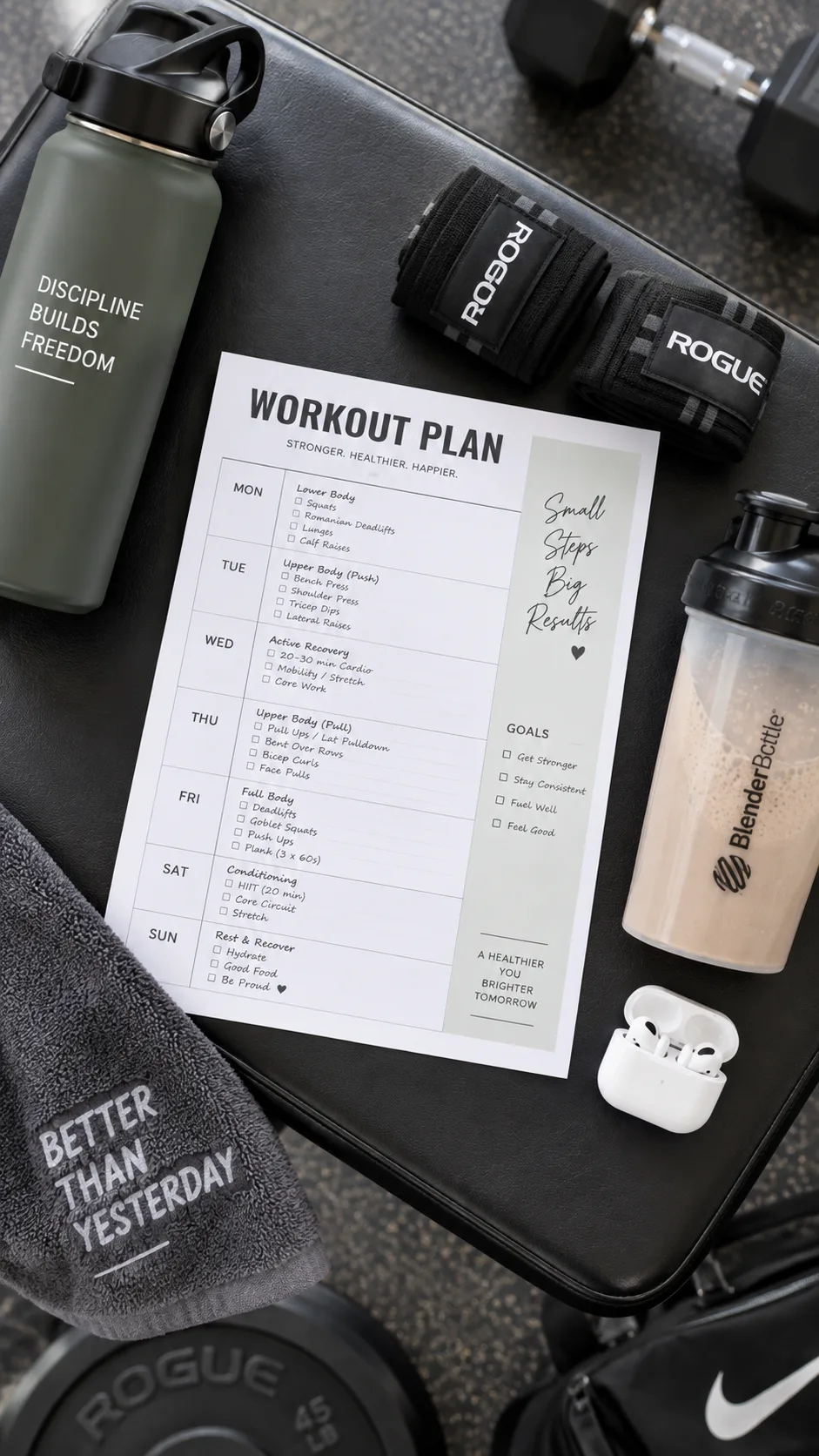
Print this. Screenshot it. Tattoo it on your forearm. Whatever you need to do to remove the guesswork when you walk into the gym.
Quick tips to make your first month easier
Your first few weeks in the gym can feel overwhelming, so here are some practical tips I wish someone had told me on day one:
- Go during off-peak hours. Early mornings, mid-afternoons, or late evenings are typically less crowded. You’ll have more access to equipment and feel less self-conscious.
- Watch exercise tutorials BEFORE you go. Spend 10 minutes the night before watching proper form videos for the next day’s workout. You’ll feel way more confident.
- Bring a water bottle and headphones. Hydration matters, and music makes everything better. These two items alone make the gym experience 10x more enjoyable.
- Don’t compare yourself to others. Everyone started somewhere. That jacked person deadlifting 400 lbs was once a confused beginner standing exactly where you are right now.
- Schedule your workouts like appointments. Put them in your calendar. Treat them as non-negotiable commitments, not optional activities.
Final thoughts: just start
It all boils down to this: the best gym weekly workout plan is one you’ll follow. This beginner schedule gives you a clear structure, balanced muscle training, built-in recovery, and a straightforward path to progression. It removes every excuse and every question mark.
You don’t need the perfect plan. You don’t need expensive supplements. You don’t need a personal trainer (though one can help). You just need to show up consistently, follow the program, track your progress, and fuel your body properly.
The hardest workout you’ll ever do is the first one. After that, momentum takes over. So grab this plan, walk into that gym with purpose, and stop wandering around like you’re lost in IKEA. You’ve got the map now. Go build something. 🙂
