
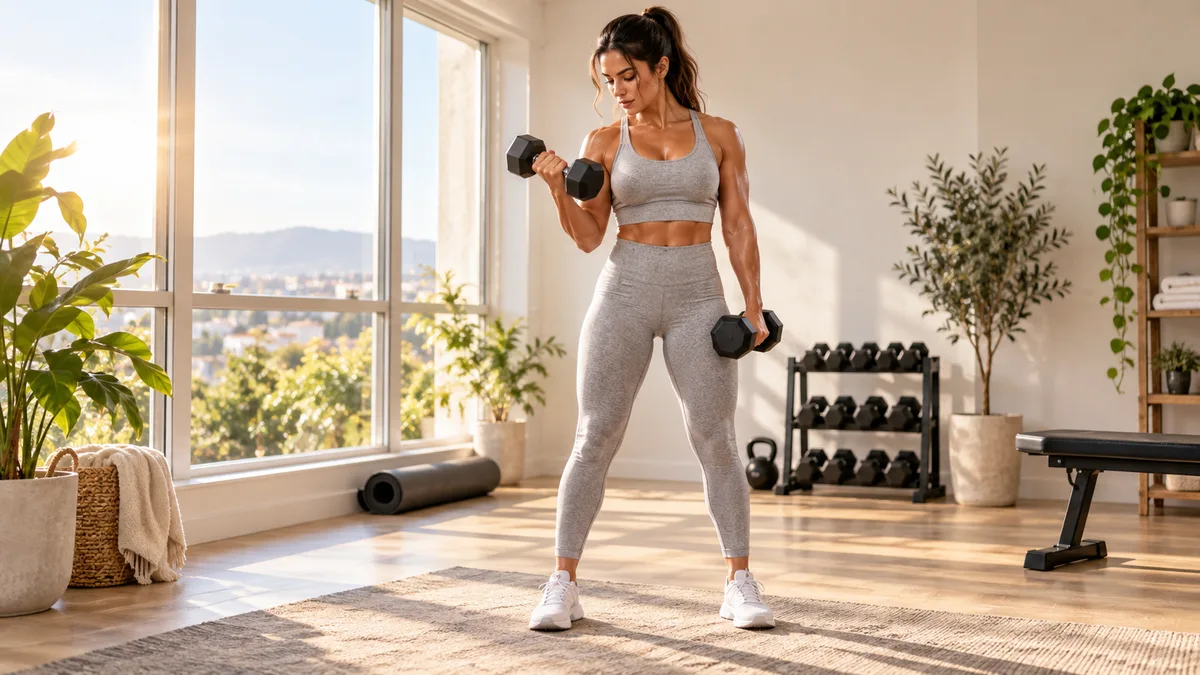
You don’t need a cable machine, a fancy gym membership, or two hours of free time. You need a pair of dumbbells, about 20 minutes, and the willingness to feel a burn that’ll remind you your arms exist. That’s it. A solid dumbbell arm workout for women can transform your upper body faster than you’d expect, and these 8 moves prove it.
I spent years avoiding arm exercises because I genuinely believed the myth that lifting weights would make me “bulky.” Spoiler alert: it didn’t. What it DID do was give me arms I actually wanted to show off in sleeveless tops, plus the strength to carry all my grocery bags in one trip. Priorities, right?
Whether you’re training at home or in the gym, this guide breaks down exactly which dumbbell exercises target your biceps, triceps, and shoulders, and how to do them with proper form so you actually see results instead of just going through the motions.
Why dumbbell arm workouts are perfect for women
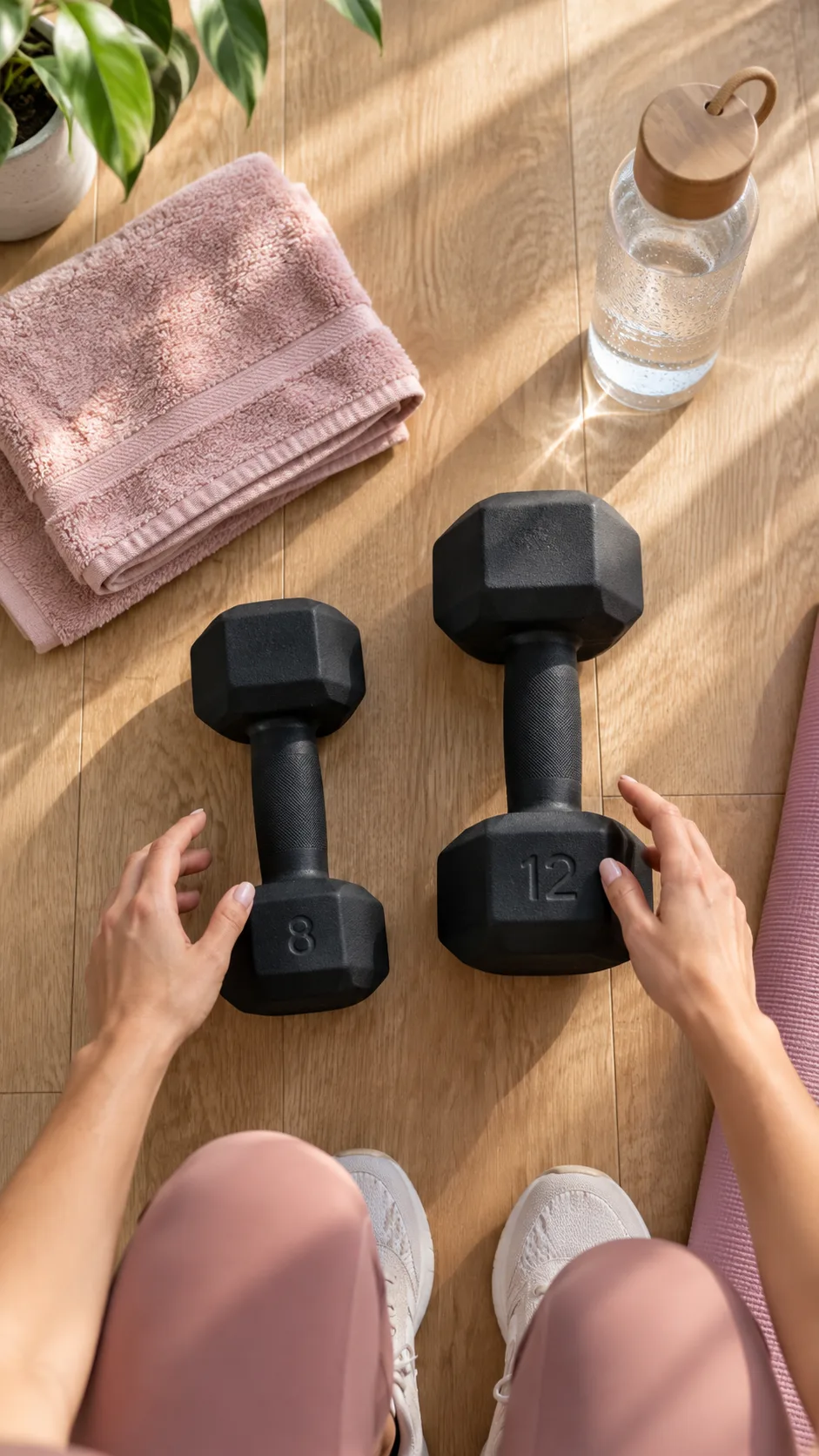
Something worth getting straight: dumbbells are one of the most effective tools for building arm definition. They force each arm to work independently, which means your stronger side can’t compensate for the weaker one. That imbalance you’ve been ignoring? Dumbbells fix it.
Unlike machines that lock you into a fixed range of motion, free weights recruit more stabilizer muscles. Your core fires up. Your grip strength improves. You build functional strength that actually transfers to everyday life. The American Council on Exercise (ACE) confirms that resistance training with free weights improves bone density, lean muscle mass, and metabolic rate, all of which matter for women’s long-term health.
And no, you will NOT wake up looking like a bodybuilder after a few sessions. Women produce roughly 15 to 20 times less testosterone than men, which makes significant muscle bulk extremely difficult without years of dedicated effort and specific nutrition protocols. What you WILL get? Lean, toned, defined arms.
What dumbbell weight should you start with?
This is the question everyone asks, and the answer depends entirely on your current strength level. Here’s a quick guideline:
- Complete beginners: Start with 3 to 5 lb (1.5 to 2.5 kg) dumbbells
- Some training experience: 8 to 10 lb (3.5 to 4.5 kg) dumbbells
- Intermediate lifters: 12 to 15 lb (5.5 to 7 kg) dumbbells
- Advanced: 15 to 20+ lb (7 to 9+ kg) dumbbells
Here’s my rule of thumb: pick a weight that feels challenging by rep 8 but doesn’t destroy your form. If you’re swinging your entire body to curl a dumbbell, it’s too heavy. If you could do 25 reps without breaking a sweat, it’s too light. Find that sweet spot where the last 2 to 3 reps genuinely challenge you.
And I cannot stress this enough: you should absolutely plan to increase your weights over time. Progressive overload drives muscle growth. Those cute 2 lb pink dumbbells served their purpose, but they won’t build definition forever.
The 8 best dumbbell arm exercises for women
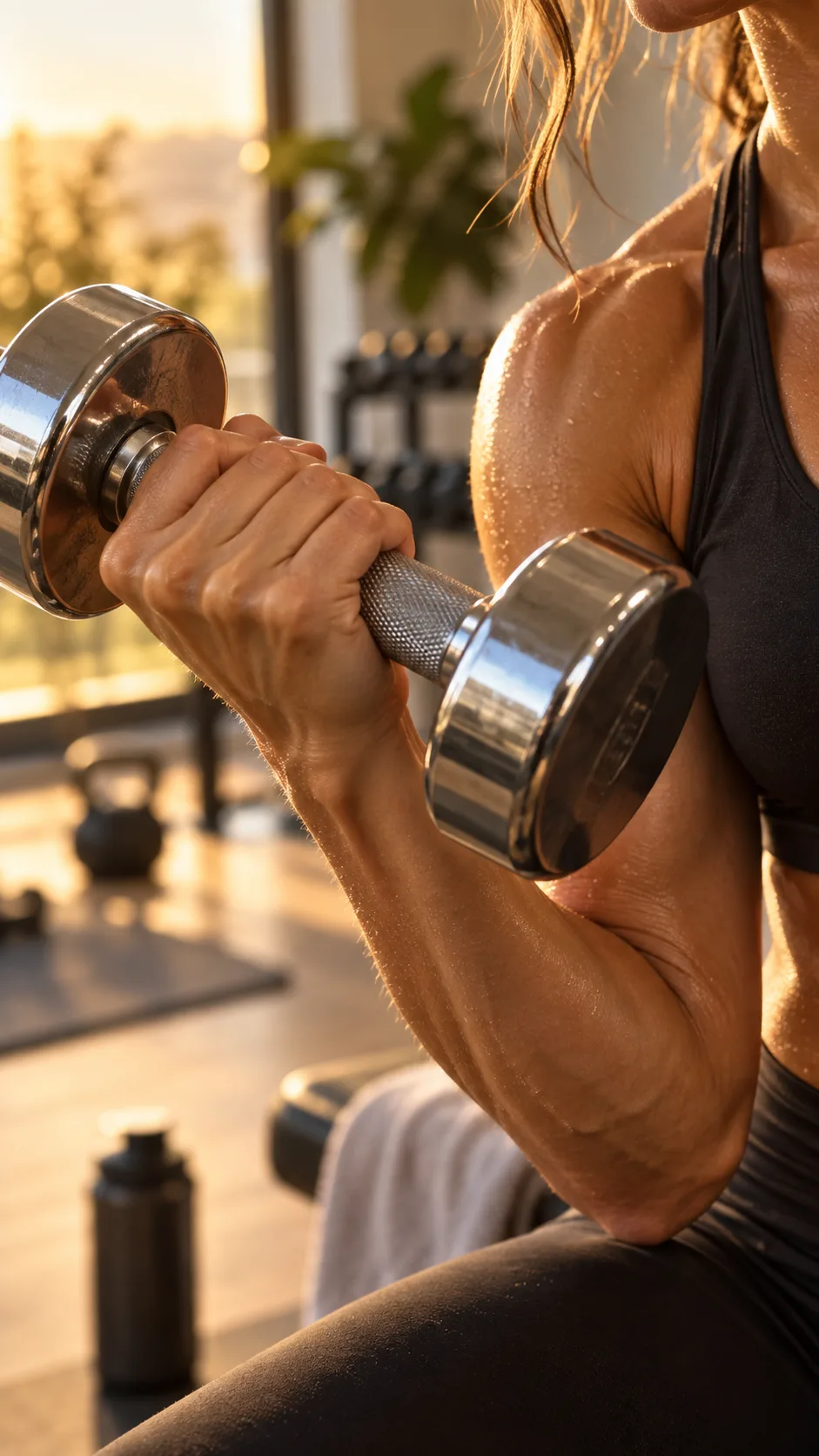
These are the 8 moves that form a complete arm workout targeting your biceps, triceps, and shoulders. Each exercise earns its spot because it’s effective, beginner-friendly, and requires nothing more than a pair of dumbbells.
1. Standard bicep curl
The classic. The OG. The one you already know, but are you doing it correctly? Stand with feet hip-width apart, arms fully extended, palms facing forward. Curl both dumbbells toward your shoulders while keeping your elbows pinned to your sides. Lower slowly. That “slowly” part matters more than you think.
Target: Biceps brachii
Reps: 10 to 12 reps x 3 sets
The biggest mistake I see? People swinging their torso to generate momentum. Keep your upper body completely still. If you can’t, lower the weight. Your ego will survive.
2. Hammer curl
Same setup as the bicep curl, but you rotate your grip so your palms face each other (like you’re holding hammers). This subtle change shifts emphasis to the brachialis and brachioradialis, muscles that add width and thickness to your arms.
Target: Brachialis, brachioradialis, biceps
Reps: 10 to 12 reps x 3 sets
Ever wondered why your arms look flat even though you do tons of curls? You’re probably neglecting hammer curls. They build that rounded, 3D arm shape that standard curls alone can’t achieve.
3. Overhead tricep extension
Your triceps make up roughly two-thirds of your upper arm mass. Read that again. If you want defined arms, you absolutely cannot skip tricep work. Hold one dumbbell with both hands behind your head, elbows pointing toward the ceiling. Extend your arms straight up, then lower the weight back down with control.
Target: Triceps (long head)
Reps: 10 to 12 reps x 3 sets
This exercise specifically targets the long head of the triceps, which runs along the back of your arm. That’s the area most women point to when they say they want to “tone up.” The overhead position puts maximum stretch on this muscle, making it seriously effective.
4. Tricep kickback
Hinge at your hips so your torso is roughly parallel to the floor. Pin your elbows to your sides at a 90-degree angle. Now extend your forearms straight back until your arms are fully locked out. Squeeze at the top for a second, then return to the starting position.
Target: Triceps (lateral head)
Reps: 12 to 15 reps x 3 sets
Research from the ACE-sponsored triceps study ranked kickbacks among the most effective tricep exercises when performed correctly. The catch? Keep your upper arm completely stationary. All the movement happens at the elbow joint.
5. Shoulder press
Stand or sit with a dumbbell in each hand at shoulder height, palms facing forward. Press the weights directly overhead until your arms are fully extended, then lower back to shoulder height. Simple, brutal, effective.
Target: Anterior and medial deltoids, triceps
Reps: 8 to 10 reps x 3 sets
Your shoulders frame your entire upper body. Strong, defined delts create that athletic silhouette and make your arms look incredible in anything sleeveless. The shoulder press also recruits your triceps as a secondary muscle, giving you more work done per rep.
6. Lateral raise
Stand with dumbbells at your sides, palms facing inward. With a slight bend in your elbows, raise both arms out to the sides until they reach shoulder height. Pause, then lower slowly. You’ll feel the burn fast, even with light weights.
Target: Medial deltoids
Reps: 12 to 15 reps x 3 sets
FYI, you’ll need lighter dumbbells for this one. Seriously. The medial deltoid is a small muscle, and most women overload it immediately. Start lighter than you think and focus on controlled movement. You’ll thank me on rep 12 when your shoulders are screaming.
7. Concentration curl
Sit on a bench or chair, spread your legs slightly, and brace the back of your working arm against your inner thigh. Curl the dumbbell toward your shoulder using only your bicep. No momentum, no body english, just pure isolated contraction.
Target: Biceps (peak)
Reps: 10 to 12 reps per arm x 3 sets
This exercise eliminates every possible cheat. Your thigh acts as a brace, forcing your bicep to do ALL the work. It’s humbling. It’s effective. And it builds that peak at the top of your bicep that looks fantastic when you flex.
8. Close-grip dumbbell press (floor press)
Lie on the floor (or a bench) with a dumbbell in each hand. Hold them directly over your chest with your palms facing each other and elbows tucked close to your body. Lower the weights until your elbows touch the floor, then press back up.
Target: Triceps, chest (inner), anterior deltoids
Reps: 10 to 12 reps x 3 sets
This move sneaks in some chest and shoulder work while hammering your triceps. The close grip and tucked elbows shift the emphasis away from your chest and onto the back of your arms. It’s a compound movement, meaning you work multiple muscle groups at once. Maximum efficiency for a 20-minute session.
How to structure your dumbbell arm workout
Knowing the exercises is only half the battle. How you organize them into a workout matters just as much. Here’s a sample structure that’ll take you about 20 to 25 minutes:
- Warm-up: 2 to 3 minutes of arm circles, light shoulder rolls, and bodyweight push-ups
- Bicep Curls, 3 sets x 10 to 12 reps
- Overhead Tricep Extension, 3 sets x 10 to 12 reps
- Hammer Curls, 3 sets x 10 to 12 reps
- Tricep Kickbacks, 3 sets x 12 to 15 reps
- Shoulder Press, 3 sets x 8 to 10 reps
- Lateral Raises, 3 sets x 12 to 15 reps
- Concentration Curls, 3 sets x 10 to 12 reps per arm
- Close-Grip Floor Press, 3 sets x 10 to 12 reps
Rest 30 to 60 seconds between sets. If you’re working with heavier weights on compound movements like the shoulder press, take up to 90 seconds. Listen to your body. Recovering properly between sets lets you maintain form and intensity throughout the entire workout.
Want to build this into a full weekly routine? Check out our weekly gym workout plan for women for a complete schedule that balances arms with legs, back, and everything else.
How often should you train arms?
Two to three dedicated arm sessions per week hits the sweet spot for most women. Your muscles need time to recover and rebuild, and training the same muscle group every single day actually slows your progress. More isn’t always more.
Space your arm workouts at least 48 hours apart. So if you train arms on Monday, your next session should land on Wednesday or Thursday. You can fill the gaps with lower body work. Something like a solid leg day routine keeps your training balanced and prevents that dreaded “I only train upper body” look.
Your arms also get indirect work during other upper body exercises. Rows hit your biceps. Push-ups hammer your triceps. So even on non-arm days, those muscles still get attention. Factor that in when planning your weekly volume.
Common mistakes that kill your arm gains
I’ve made every one of these mistakes personally, so consider this section a public service announcement 🙂
Using momentum instead of muscle
Swinging weights around like you’re conducting an orchestra doesn’t count as a rep. If your entire body moves to lift the dumbbell, the weight is too heavy. Drop down a size and focus on slow, controlled reps. Your muscles grow from tension, not momentum.
Neglecting the eccentric (lowering) phase
Most people focus on the lifting part and let gravity handle the lowering. Big mistake. The eccentric phase, when you lower the weight, creates just as much muscle stimulus as the lift. Take 2 to 3 seconds to lower the dumbbell on every single rep. You’ll feel the difference immediately.
Skipping triceps entirely
I get it. Bicep curls feel satisfying and your biceps look great in the mirror. But remember: triceps make up roughly 66% of your upper arm. If you want arm definition, you need to train them equally, if not more. Balance your bicep and tricep work in every session.
Never increasing the weight
Your body adapts. Those 5 lb dumbbells that challenged you three months ago? Your muscles have already adjusted. Progressive overload, gradually increasing weight, reps, or sets over time, drives continued muscle growth. Bump up your weights every 2 to 4 weeks when your current weight starts feeling easy.
Nutrition tips to support arm definition
You can do the best arm workout in the world, but if your nutrition doesn’t support muscle growth, you’ll spin your wheels. Protein is the building block of muscle tissue, and most women don’t eat enough of it.
Aim for 0.7 to 1.0 grams of protein per pound of body weight daily. Good sources include chicken, fish, eggs, Greek yogurt, tofu, and legumes. The International Society of Sports Nutrition recommends this range specifically for women engaged in resistance training.
If you need a structured plan, our high protein meal plan for women maps out exactly what to eat to build lean muscle and support your training goals. Pairing smart nutrition with consistent dumbbell workouts accelerates your results dramatically.
Don’t forget hydration either. Dehydrated muscles perform worse and recover slower. Aim for at least 8 to 10 glasses of water daily, more on training days.
Can you get defined arms at home?
Absolutely yes. Every single exercise in this workout requires nothing more than a pair of dumbbells and enough space to extend your arms. No bench required (the floor works perfectly). No squat rack. No cable machine. Just you, your dumbbells, and determination.
IMO, home workouts remove every excuse. No commute, no waiting for equipment, no feeling self-conscious under gym lighting. You press play on your favorite playlist, grab your weights, and get it done in your living room. That accessibility makes consistency easier, and consistency is the single biggest factor in building arm definition.
If you’re just starting out and don’t even own dumbbells yet, you can begin with bodyweight arm exercises using zero equipment. Water bottles and filled backpacks also work as improvised weights until you invest in a proper set.
Your 4-week progression plan
Want a roadmap? Here’s how to progress over the first month:
- Week 1: 2 sets per exercise, lighter weight, focus entirely on learning proper form
- Week 2: Increase to 3 sets per exercise, same weight, prioritize controlled reps
- Week 3: 3 sets per exercise, increase weight by 2 to 3 lbs on at least 3 exercises
- Week 4: 3 sets per exercise, push for the higher end of rep ranges, add weight where possible
After four weeks, assess your progress. Take photos, track your weights, note how the exercises feel. You’ll notice visible changes in arm definition within 4 to 6 weeks of consistent training paired with adequate protein intake. That’s not a sales pitch. It’s just how muscle adaptation works when you follow through.
Final thoughts: your stronger arms start today
Here’s the thing about arm workouts for women with dumbbell weights: they work because they’re simple. You don’t need complicated machines or an Instagram influencer’s 47-step routine. Eight foundational dumbbell exercises, performed consistently with progressive overload and proper nutrition, will build the strong, defined arms you’re after.
Start with the exercises above. Master the form before chasing heavier weights. Train 2 to 3 times per week. Eat enough protein. And give yourself grace. Visible results take a few weeks, not a few days. But once those results show up? You’ll wonder why you didn’t start sooner.
Pick up those dumbbells today. Your future arms are counting on you.
