
Your legs carry you through every single day — up stairs, through grocery runs, across parking lots — and yet most of us treat leg day like an afterthought. If you’ve ever finished a Pilates class and felt muscles you genuinely didn’t know existed, you already understand why Pilates leg workouts hit different. This isn’t about loading up a barbell and grunting through squats (no shade to that approach). This is about precision, control, and the kind of burn that sneaks up on you mid-rep and stays for days.
I remember my first reformer class. I walked in thinking, “How hard can springs and a sliding carriage really be?” Twenty minutes later, my inner thighs were shaking like I’d run a marathon. Pilates humbles you, and your legs feel every second of it. So whether you’re working on a mat at home or have access to a reformer, let’s break down the best moves that’ll make your legs longer-looking, genuinely stronger, and more sculpted than ever.
Why Pilates Builds Better Legs Than You’d Expect
Here’s the thing most people get wrong about Pilates: they assume it’s “just stretching.” That misconception dies fast once you hold a single-leg bridge for 30 seconds while your glutes stage a full revolt. Pilates targets the deep stabilizer muscles that traditional weight training often misses — your adductors, your pelvic floor, those tiny muscles around your ankles and knees that keep everything aligned.
The magic lies in eccentric muscle contractions — the slow, controlled lengthening phase of each movement. According to research published by the National Institutes of Health, eccentric training produces significant improvements in muscle strength, flexibility, and functional performance. Pilates practically invented this concept. Every rep asks you to resist gravity, resist the spring tension, and resist the urge to just flop back down.
And that “longer legs” claim? It’s not literal (sorry, Pilates can’t add inches to your femur). But it CAN improve your posture, lengthen tight hip flexors, and create lean muscle definition that makes your legs appear longer and more toned. That visual difference is real, and it comes from working muscles through their full range of motion — something Pilates does better than almost any other modality.
The Best Mat Pilates Leg Exercises
No reformer? No problem. A mat and your own bodyweight provide more than enough resistance to build serious leg strength. These moves form the foundation of any solid mat Pilates workout, and they’ll challenge you regardless of your fitness level.
1. Single Leg Circles
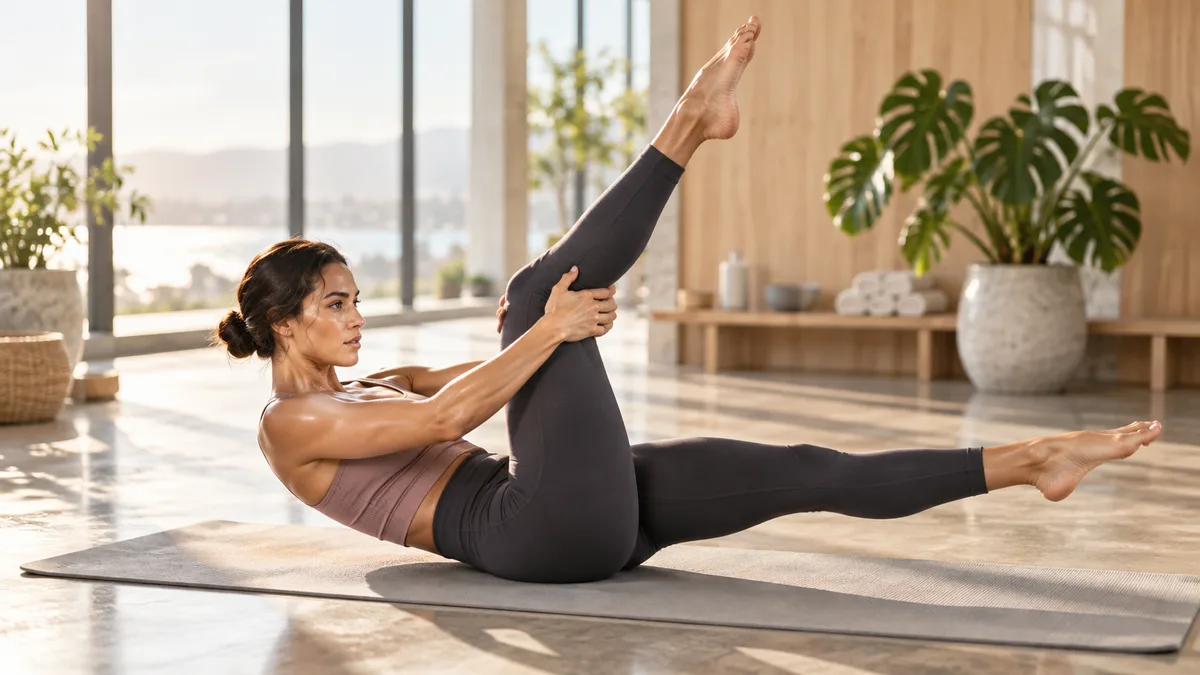
Lie on your back, extend one leg straight up toward the ceiling, and draw controlled circles with your toes. Sounds simple, right? Try keeping your hips completely still while your leg traces those circles. Your hip stabilizers and deep core muscles work overtime to prevent your pelvis from rocking.
Key tips:
- Keep circles small and controlled — bigger isn’t better here
- Reverse the direction after 5-8 reps each way
- Press your opposite leg firmly into the mat for stability
- Engage your lower abs to anchor your pelvis
2. Pilates Side-Lying Leg Series
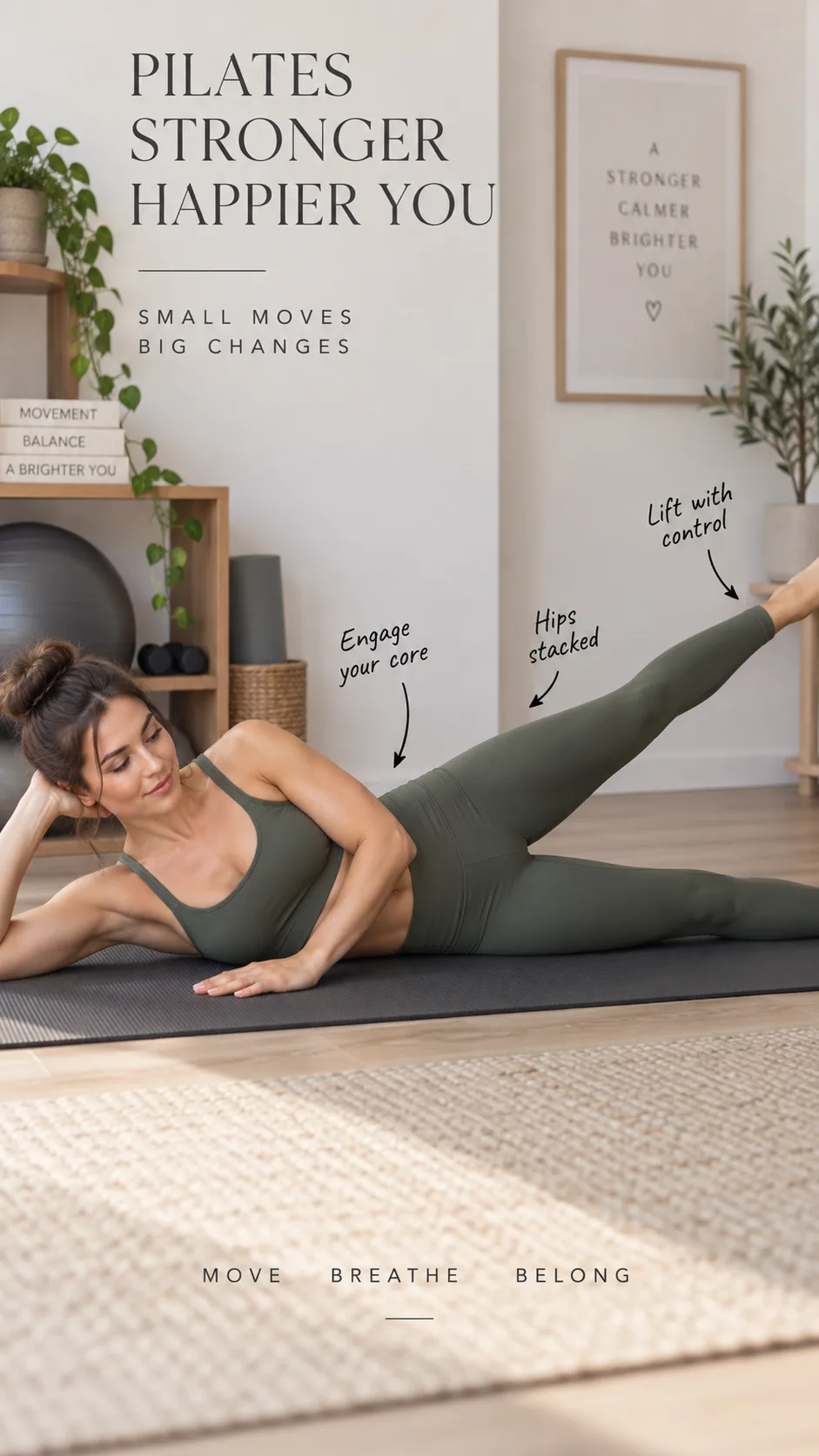
This series is an absolute beast for your outer thighs, inner thighs, and glutes. You’ll lie on your side and move through a sequence of lifts, circles, and pulses that target every angle of your leg. The beauty of this series? It isolates each leg individually, so your dominant side can’t compensate for your weaker one.
The full sequence typically includes:
- Straight leg lifts (10-15 reps)
- Small forward and back kicks
- Tiny circles in both directions
- Inner thigh lifts with the bottom leg
- Bicycle movements
Ever noticed one hip feels tighter or weaker than the other? This series exposes that imbalance fast. Pay attention to it — addressing asymmetry now prevents injuries later.
3. The Pilates Bridge (and Its Evil Variations)
The basic glute bridge gets a serious upgrade in Pilates. You articulate through your spine one vertebra at a time, squeezing your glutes and hamstrings at the top, then rolling back down with agonizing control. Add a single-leg variation and your hamstrings will personally send you a complaint letter.
Try these progressions:
- Basic bridge: Both feet planted, lift and lower with spinal articulation
- Marching bridge: Hold the bridge while alternating lifting each foot
- Single-leg bridge: Extend one leg to the ceiling, bridge on one foot
- Bridge with heel slides: Slowly extend one leg out along the mat while holding the bridge
4. Standing Pilates Leg Work
Don’t overlook standing exercises. Pilates standing leg presses, single-leg balances, and relevés (heel raises) build functional strength that translates directly to daily life. Standing on one leg while performing slow, controlled movements challenges your proprioception — your body’s awareness of where it exists in space.
If you’re looking for a complete lower body routine you can combine with these moves, check out this guide on the best full leg workout for stronger, more sculpted legs.
Top Reformer Moves for Sculpted Legs
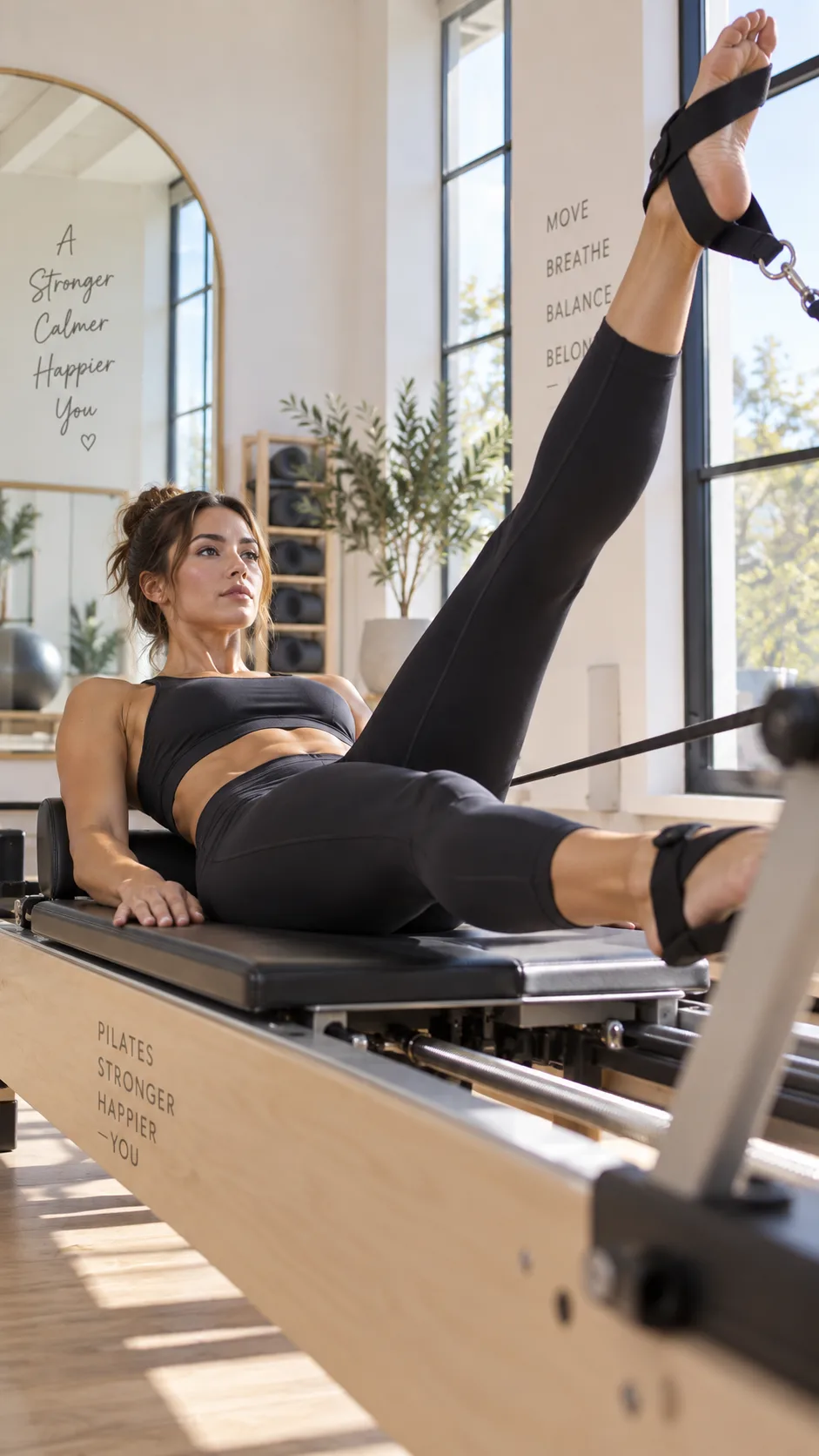
The reformer takes everything great about mat Pilates and adds variable spring resistance, a sliding carriage, and about a hundred ways to make your legs work harder. If you’ve never tried reformer Pilates, FYI — your first session will redefine what “leg day” means to you.
1. Footwork Series
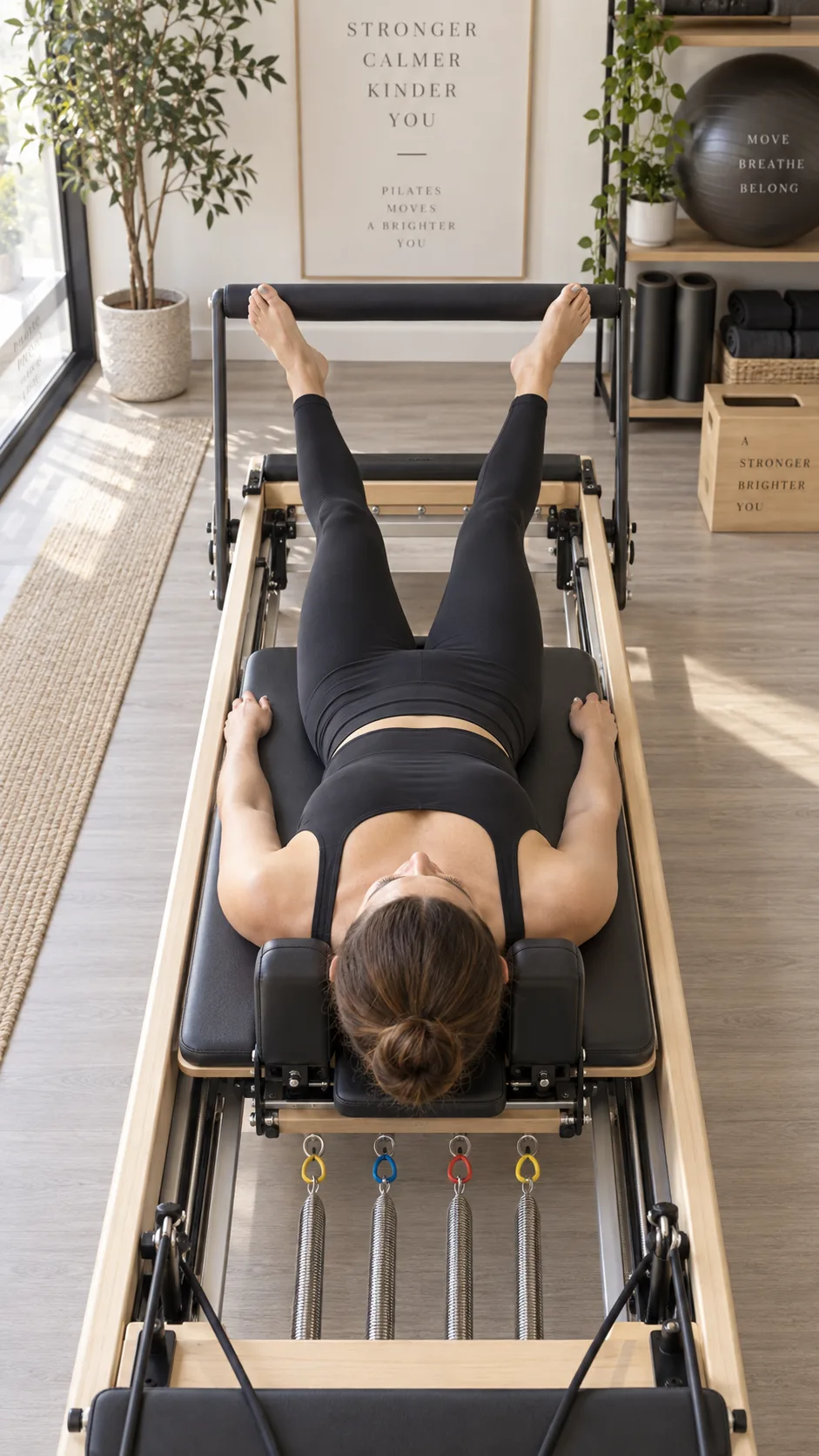
This is usually the very first thing you do on the reformer, and it’s basically a Pilates-fied leg press. Lying on your back with your feet on the footbar, you press the carriage out and control it back in. The spring resistance forces you to work in both directions — pushing out AND controlling the return — which doubles the muscle engagement compared to momentum-based exercises.
The footwork series cycles through multiple foot positions:
- Parallel (Pilates V): Heels together, toes apart — targets inner thighs and quads
- Parallel hip-width: Evenly engages quads, hamstrings, and glutes
- Wide second position: Emphasizes inner thighs and outer glutes
- Heels on the bar: Shifts focus to hamstrings and calves
- Toes on the bar (relevé): Lights up your calves and ankle stabilizers
2. Single-Leg Footwork
Take everything from the footwork series and do it on one leg. That’s it. That’s the upgrade. Your stabilizing muscles go into overdrive, and any strength imbalance between your left and right leg becomes impossible to ignore. I’ve seen people confidently press heavy springs with both legs and then absolutely struggle with one medium spring on a single leg. Bilateral strength doesn’t equal unilateral strength, and the reformer proves that instantly.
3. Long Stretch Series (Plank on the Reformer)
You hold a plank position with your hands on the footbar and your feet on the carriage, then press the carriage back and pull it forward. Your legs drive the entire movement while your core stabilizes. It’s essentially a moving plank that demands serious quad engagement, hip flexor control, and hamstring activation all at once.
4. Standing Splits
One foot on the carriage, one foot on the platform. You press the carriage out into a split position, controlling both the extension and the return. This move delivers an incredible combination of strength training and active stretching for your hamstrings, adductors, and hip flexors. It’s also slightly terrifying the first time you try it — which, honestly, is part of the fun.
5. Scooter
Standing on one leg on the reformer platform, you use the other foot to press the carriage back in a scooping motion. This targets your glutes and hamstrings with laser precision. The standing leg works just as hard — it stabilizes your entire body while the moving leg generates force. Two-for-one deal, and your legs will feel it for days.
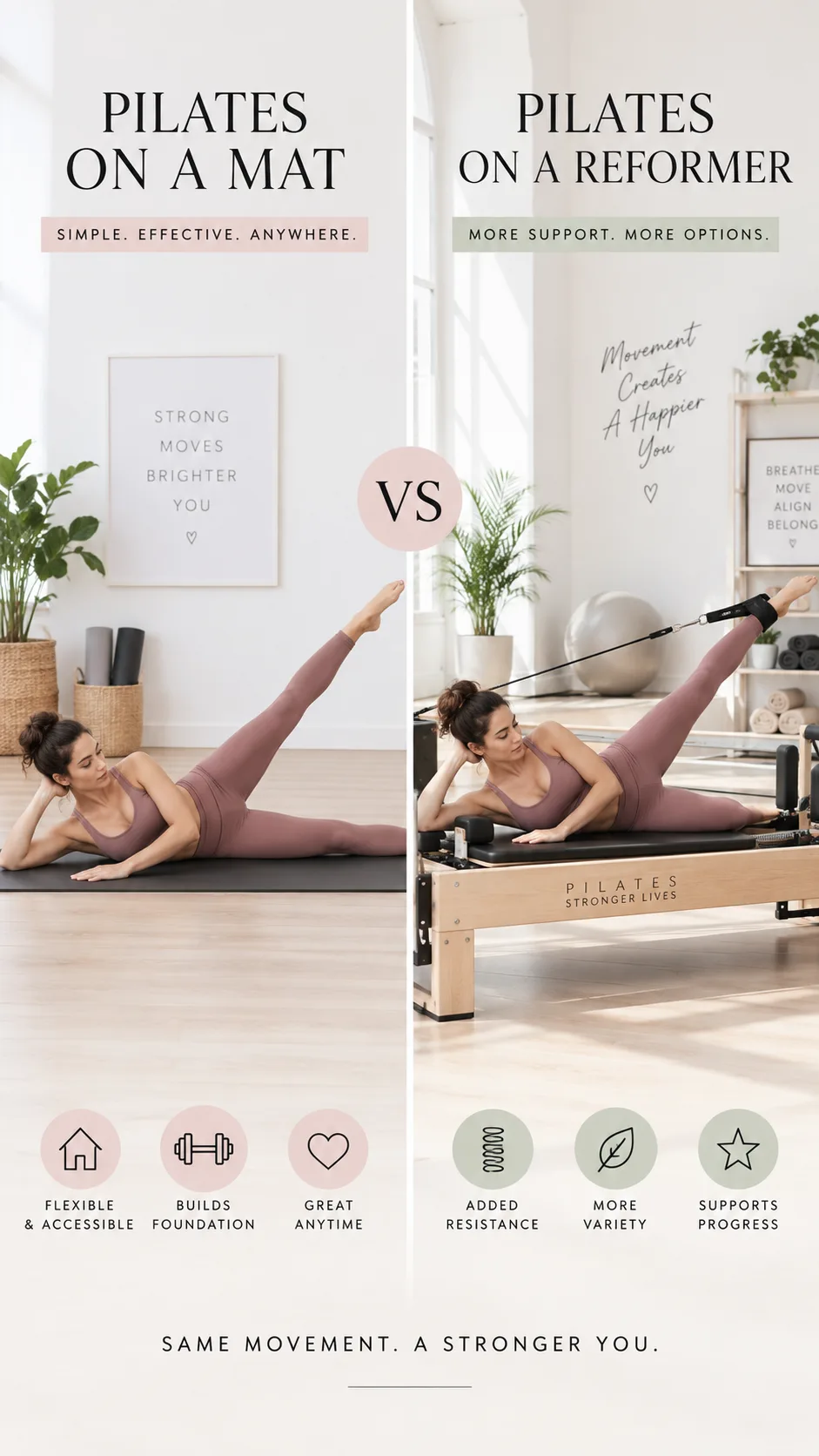
Mat vs. Reformer: Which Builds Better Legs?
Short answer: both. Longer answer: they complement each other beautifully, and the “best” option depends on your goals and what you have access to.
Mat Pilates relies on bodyweight and gravity. It builds deep core strength and teaches you to control your own body mass — a foundational skill. You can do it anywhere, anytime, with zero equipment. The Pilates Foundation emphasizes that mat work remains the purest form of the method Joseph Pilates originally created.
Reformer Pilates adds external resistance through springs, allowing you to progressively overload muscles and work through larger ranges of motion. The sliding carriage creates instability that forces your stabilizers to fire constantly. For pure leg sculpting, the reformer offers more variety and resistance options.
IMO, the ideal approach combines both. Use mat work for your home practice and reformer sessions when you can get to a studio. Your legs benefit from the variety, and you avoid the plateau that comes from doing the same movements repeatedly.
How to Structure Your Pilates Leg Workout
Throwing random exercises together won’t give you optimal results. Structure matters. Here’s a framework that ensures you hit every muscle group and progress safely.
Warm-Up (5 Minutes)
- Pelvic tilts and spinal articulation
- Hip circles in tabletop position
- Gentle hamstring stretches
- Ankle rolls and calf pumps
Main Workout (25-35 Minutes)
- Bilateral movements first — bridges, footwork series, or squats (8-12 reps)
- Unilateral work second — single-leg variations to address imbalances (6-10 reps per side)
- Side-lying series — outer thigh, inner thigh, and glute isolation (10-15 reps each)
- Standing balance work — relevés, single-leg balances, standing splits (6-8 reps)
- Active stretching — controlled movements through full range of motion
Cool-Down (5 Minutes)
- Figure-four stretch for piriformis and outer hip
- Supine hamstring stretch with a strap or towel
- Seated inner thigh stretch (butterfly position)
- Standing quad stretch with balance challenge
If you’re brand new to Pilates, start with a beginner-friendly Pilates routine before jumping into an advanced leg-focused session. Building foundational control first prevents injury and makes every exercise more effective long-term.
Common Mistakes That Sabotage Your Leg Results
You can do every exercise on this list and still get mediocre results if you fall into these traps. I’ve watched hundreds of people make these mistakes (and made most of them myself early on).
- Moving too fast. Speed is the enemy of Pilates. Every rep should feel controlled and deliberate. If you’re bouncing or using momentum, you’ve stripped away the very thing that makes Pilates effective.
- Ignoring the eccentric phase. The return portion of every movement matters just as much as the effort phase. Letting the reformer springs snap you back or dropping your leg after a lift wastes half the exercise.
- Gripping with your quads. Quad dominance plagues many people, especially those who sit at desks all day. Actively think about engaging your glutes and hamstrings rather than defaulting to your quads for every push and press.
- Holding your breath. Your muscles need oxygen to work efficiently. The American Council on Exercise confirms that proper breathing directly impacts muscular endurance and performance. Exhale during the effort, inhale during the return.
- Skipping one side. I know your right side is easier. Do the left side anyway. Do it first if you have to. Symmetry isn’t just aesthetic — it protects your joints and prevents compensatory movement patterns.
How Often Should You Do Pilates Leg Workouts?
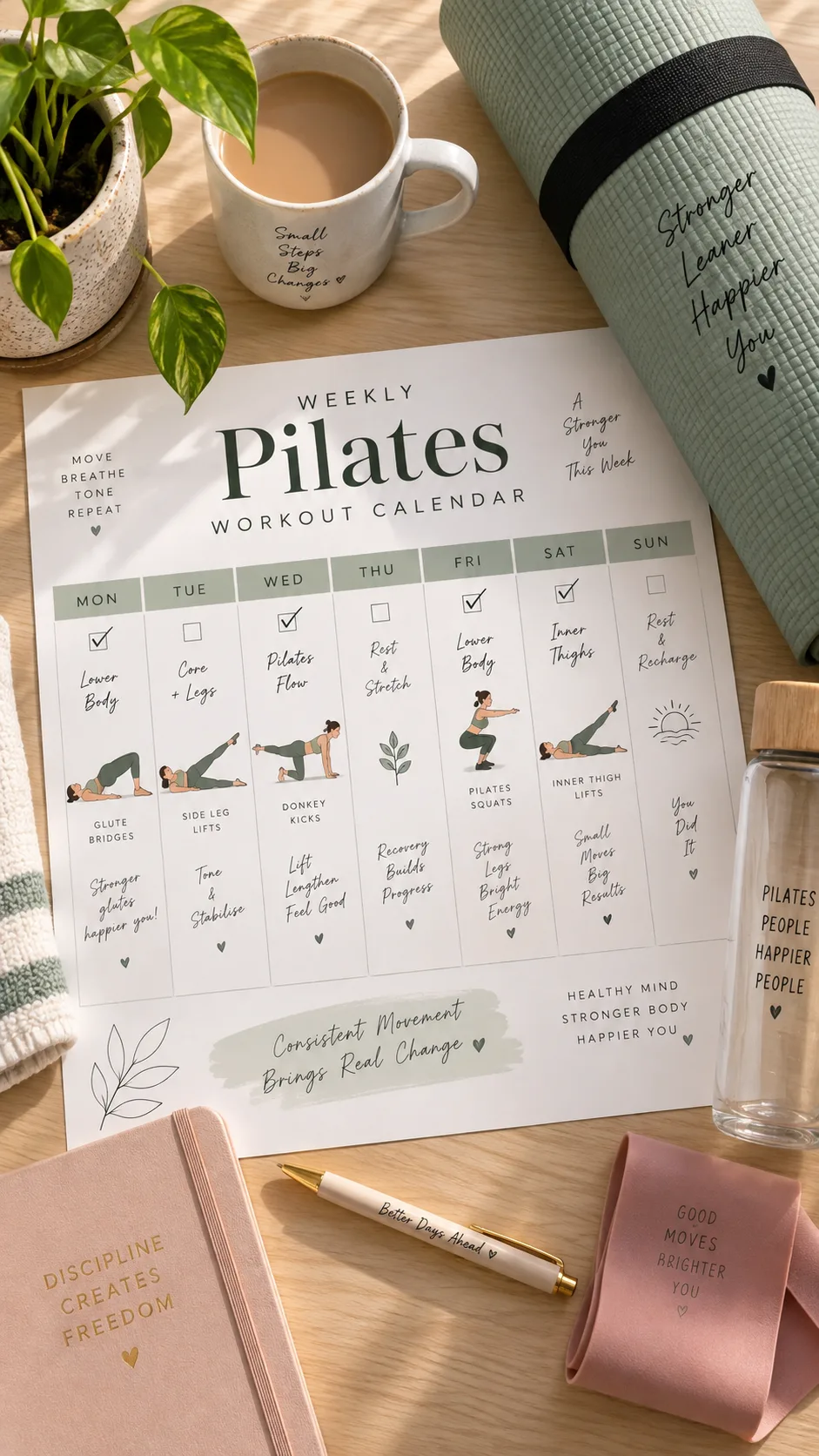
For noticeable results, aim for 2-3 dedicated leg sessions per week, with at least 48 hours between intense sessions targeting the same muscle groups. Your muscles grow and strengthen during recovery, not during the workout itself — so rest days aren’t laziness, they’re strategy 🙂
A solid weekly split might look like this:
- Monday: Mat Pilates leg focus
- Wednesday: Reformer full body (which naturally includes significant leg work)
- Friday: Mat or reformer leg emphasis with core integration
- Other days: Walking, light stretching, active recovery, or upper body focus
Consistency beats intensity every single time. Three moderate sessions per week for six months will transform your legs far more than six brutal sessions per week for three weeks before you burn out. Play the long game.
What Results Can You Realistically Expect?
Let’s keep this honest. After 4-6 weeks of consistent Pilates leg workouts, you’ll notice improved muscle tone, better balance, and less stiffness in your hips and knees. Your jeans might fit differently around your thighs — not necessarily smaller, but more defined and firm.
By 3-4 months, visible sculpting becomes apparent. Your legs look leaner, your posture improves (which genuinely makes your legs appear longer), and movements that once felt challenging become fluid. You’ll also notice functional improvements — climbing stairs feels easier, your knees track better during squats, and your overall lower body stability skyrockets.
By 6+ months, the changes compound. People start commenting. Your movement quality in other activities — running, cycling, hiking — improves dramatically because Pilates builds the supporting musculature that other exercises demand but rarely develop.
Final Thoughts: Your Legs Deserve Better Than Leg Press Machines
Look, I’m not here to trash traditional gym work. Heavy compound lifts have their place, and if you love the squat rack, keep squatting. But if you want legs that aren’t just strong but also balanced, flexible, and resilient — legs that move beautifully and carry you pain-free for decades — Pilates leg workouts deserve a permanent spot in your routine.
Start where you are. A mat on your living room floor works perfectly. Grab a reformer class when you can. Focus on control over speed, quality over quantity, and consistency over perfection. Your legs will thank you — probably by shaking uncontrollably during your next side-lying series, but that’s how you know it’s working.
Now stop reading and go do some single-leg circles. Your stronger, longer-looking legs are waiting.
