

You walk into the gym on Monday. You do chest because… it’s Monday and that’s apparently the law. Tuesday? Maybe back. Wednesday? You skip because you’re sore. Thursday you feel guilty, so you do arms. Friday you wing it. Sound familiar?
Here’s the truth: a random gym workout days schedule is the fastest route to mediocre results and total burnout. I spent my first two years of training exactly like this. No structure, no plan, just vibes. And I looked basically the same the entire time. Not great for motivation.
The fix isn’t training harder. It’s training smarter with a weekly workout split that respects both your goals and your recovery. Let me show you exactly how to set that up.
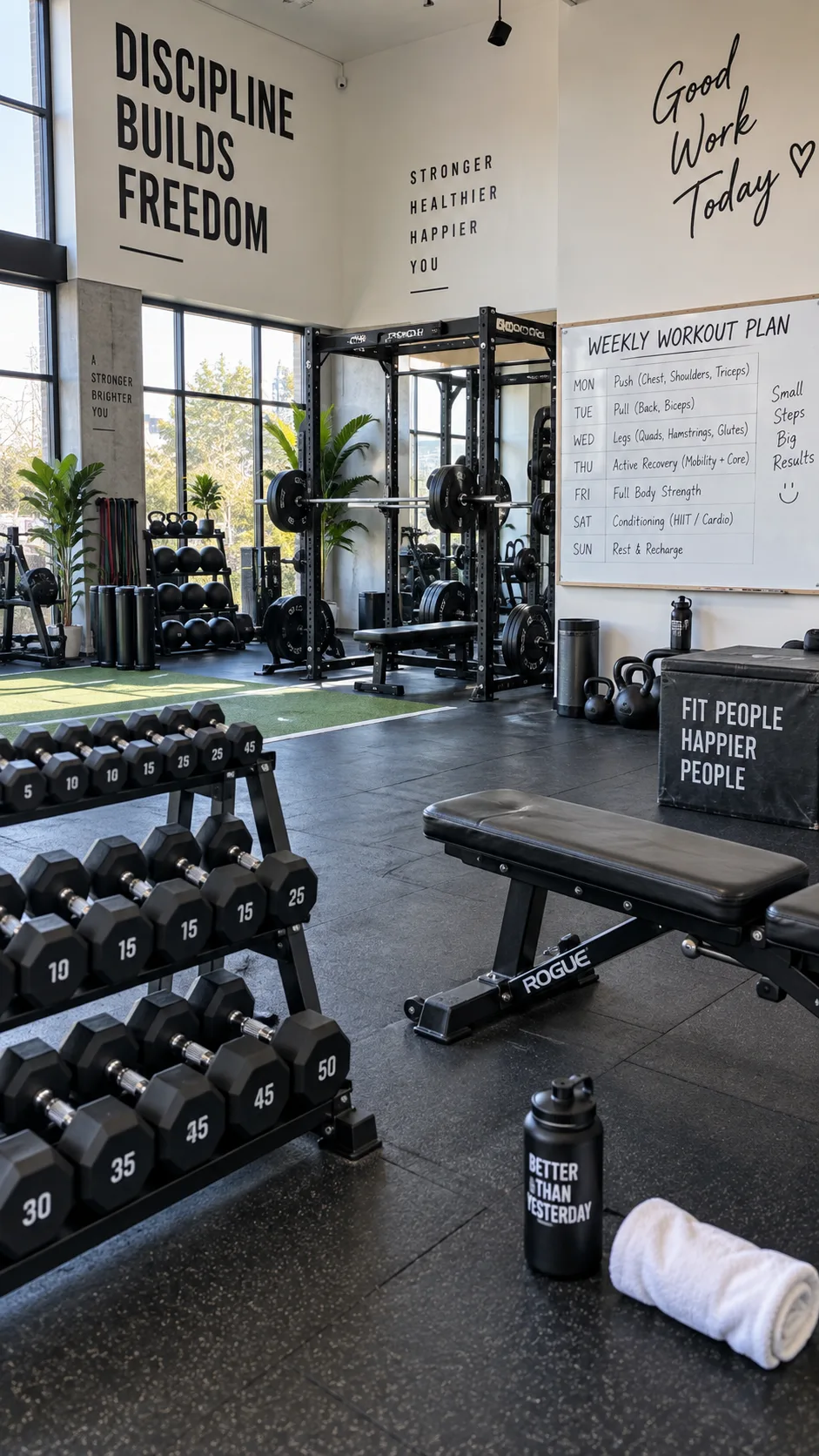
Why your gym workout days schedule matters
Think of your workout schedule like a blueprint for a house. Without it, you’re just hammering nails into random boards and hoping something holds up. Your body builds muscle during recovery, not during the workout itself. If you smash the same muscle groups on back-to-back days, you’re literally sabotaging your own progress.
Research from the American Council on Exercise confirms that muscles typically need 48 to 72 hours of recovery after resistance training to repair and grow. A properly structured weekly split guarantees every muscle group gets that window without guesswork.
Ever wondered why some people train five days a week and look incredible while others train six days and look exhausted? The schedule is the difference. Full stop.
The most popular weekly workout splits (and who they’re for)
Not every training split works for every person. Your ideal gym workout days schedule depends on your experience level, available time, and recovery capacity. Here are the main options worth considering.
The 3-day full body split
Best for: Beginners, busy professionals, and anyone getting back into the gym after a break.
You hit every major muscle group three times per week, typically Monday, Wednesday, and Friday. Each session covers compound lifts like squats, bench press, rows, and overhead press. Simple, effective, and backed by solid science.
A 2019 meta-analysis published in the Journal of Sports Sciences found that training each muscle group at least twice per week produces significantly more hypertrophy than once-a-week training. The 3-day full body split nails that frequency with minimal time commitment.
Sample layout:
- Monday: Full Body A (squat focus)
- Tuesday: Rest
- Wednesday: Full Body B (deadlift focus)
- Thursday: Rest
- Friday: Full Body C (bench focus)
- Saturday & Sunday: Rest or light cardio
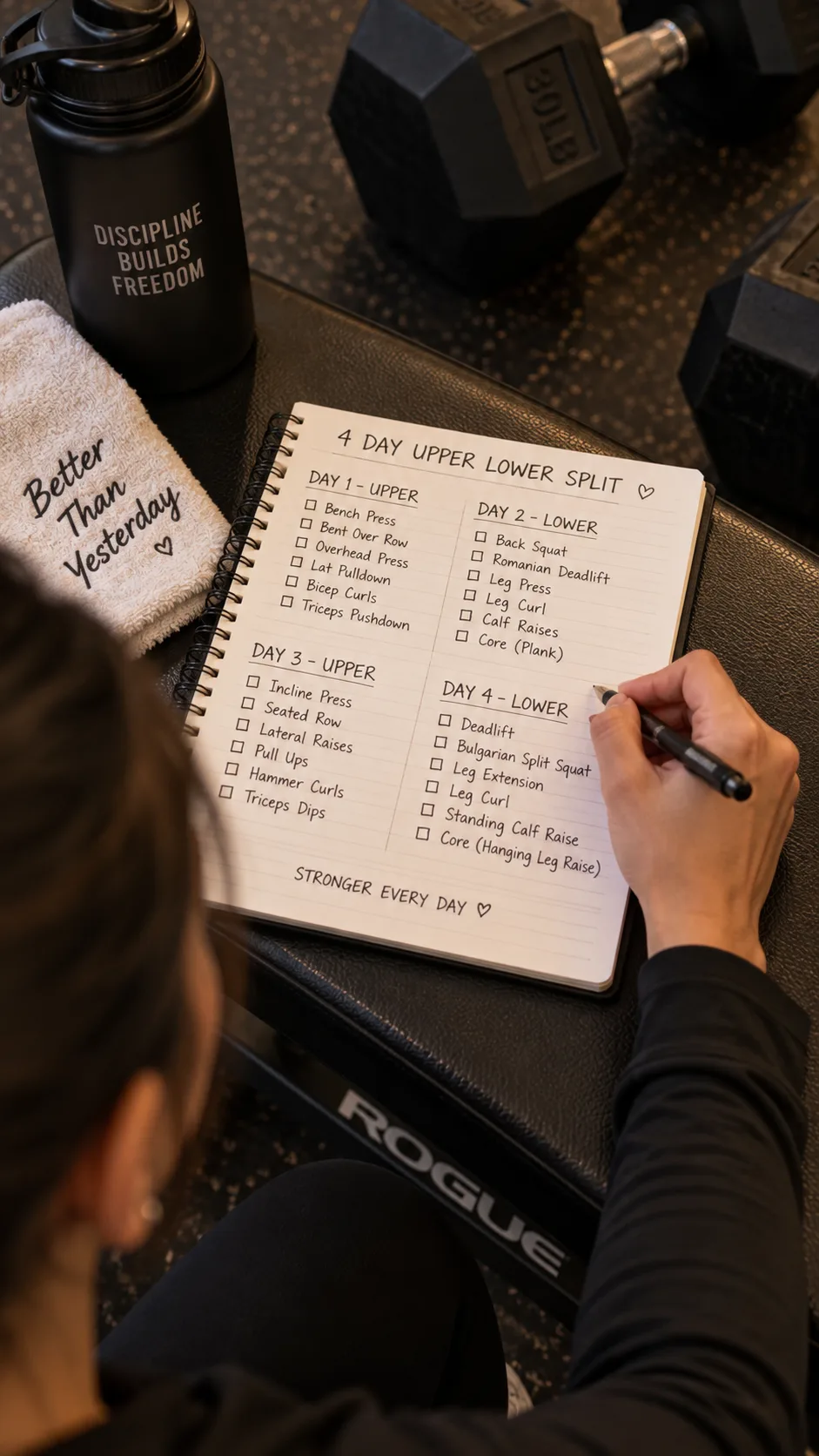
The 4-day upper/lower split
Best for: Intermediate lifters who want more volume without living at the gym.
This one splits your training into upper body and lower body days, and you run each twice per week. It gives you enough volume per session to push hard while leaving plenty of recovery time. In my experience, this is the single best split for the majority of natural lifters.
Sample layout:
- Monday: Upper Body
- Tuesday: Lower Body
- Wednesday: Rest
- Thursday: Upper Body
- Friday: Lower Body
- Saturday & Sunday: Rest
The beauty here? You train each muscle group twice per week, you get a midweek rest day, and your weekends stay free. It’s the sweet spot of effort and life balance.
The 5-day Push/Pull/Legs (PPL) split
Best for: Intermediate to advanced lifters ready for higher volume and frequency.
Push/Pull/Legs groups your muscles by movement pattern: pushing muscles (chest, shoulders, triceps), pulling muscles (back, biceps, rear delts), and legs (quads, hamstrings, glutes, calves). You rotate through all three, then repeat, typically running it across five or six training days.
This split has become incredibly popular for good reason. It lets you hammer each muscle group with plenty of sets while keeping sessions focused and efficient. If you want a structured 5-day workout split designed for building curves, the PPL framework adapts beautifully for that goal too.
Sample 5-day layout:
- Monday: Push
- Tuesday: Pull
- Wednesday: Legs
- Thursday: Rest
- Friday: Push
- Saturday: Pull
- Sunday: Rest
Notice that legs only get hit once in this particular rotation. The following week, you’d shift the pattern so legs come up twice. This rolling schedule keeps everything balanced over time.
The bro split (6-day body part split)
Best for: Advanced lifters with excellent recovery and a LOT of free time.
You know this one. Chest Monday, Back Tuesday, Shoulders Wednesday, and so on. Each muscle group gets destroyed once per week with massive volume. Bodybuilders have used this approach for decades.
My honest take: for most natural lifters, the bro split isn’t optimal. You only stimulate each muscle once per week, and research consistently shows that higher frequency beats higher single-session volume for muscle growth in drug-free athletes. Save this split for when you’re truly advanced and need that level of isolation work.
How to pick the right workout schedule for your life
The “best” gym workout days schedule means nothing if you can’t stick to it. A perfect 6-day program you follow for three weeks before burning out loses to a good 3-day program you follow for three years. Consistency always beats intensity.
Ask yourself these questions before committing:
- How many days per week can you REALISTICALLY train? Not ideally. Realistically. Account for work, family, social life, and the fact that you’re a human being who sometimes just wants to watch TV.
- How well do you recover? If you’re sleeping five hours a night and eating like a college freshman, a 5-day split will bury you. Fix the basics first.
- What’s your training experience? Beginners need less volume and can recover from full-body sessions easily. Advanced lifters typically need more specialized splits.
- What are your actual goals? General fitness? Muscle building? Strength? Sport performance? Each goal nudges you toward a slightly different structure.
Be brutally honest with yourself here. I once tried running a 6-day PPL split while working 60-hour weeks. I lasted exactly 11 days before my body basically filed a formal complaint. Dropped to four days, and everything, results included, improved dramatically.

The balanced weekly gym schedule I recommend
After years of experimenting and coaching, here’s the weekly workout split I recommend for most people who want to build muscle without burnout. It’s a 4-day upper/lower split with optional active recovery.
Why this one? Because it hits every muscle group twice per week, keeps sessions under 60 minutes, leaves room for life, and provides enough stimulus for meaningful progress. It’s boring in the best possible way: reliable, sustainable, and effective.
The week at a glance
- Monday, Upper Body A (Strength Focus): Bench press, barbell rows, overhead press, pull-ups, face pulls, tricep dips
- Tuesday, Lower Body A (Strength Focus): Back squats, Romanian deadlifts, leg press, leg curls, calf raises, core work
- Wednesday, Rest or Active Recovery: Walking, yoga, light stretching, foam rolling
- Thursday, Upper Body B (Hypertrophy Focus): Dumbbell bench press, cable rows, lateral raises, chin-ups, bicep curls, skull crushers
- Friday, Lower Body B (Hypertrophy Focus): Front squats, hip thrusts, Bulgarian split squats, leg extensions, seated calf raises, hanging leg raises
- Saturday, Optional Light Cardio or Mobility: A 30-minute walk, a swim, or just active fun
- Sunday, Complete Rest: You earn this. Take it.
Notice the distinction between strength-focused days (heavier weight, lower reps, compound lifts) and hypertrophy-focused days (moderate weight, higher reps, more isolation). This combination gives you raw strength and visible muscle growth at the same time.
If you’ve been looking for a well-structured weekly strength plan, this framework scales perfectly whether you train four or five days.
Rest days: the secret weapon you keep ignoring
Can we talk about rest days for a second? Because too many people treat them like a sign of weakness. “Rest is for the weak.” No. Rest is for people who understand basic biology.
Muscle protein synthesis, the process where your body builds new muscle tissue, peaks about 24-48 hours after training and can stay elevated for up to 72 hours. If you train a muscle again before that process finishes, you’re essentially interrupting construction halfway through.
According to the National Strength and Conditioning Association (NSCA), inadequate recovery contributes directly to overtraining syndrome, which comes with fun symptoms like:
- Decreased performance despite increased effort
- Chronic fatigue and poor sleep
- Increased injury risk
- Mood disturbances and irritability
- Loss of motivation (the kiss of death for any training program)
Your rest days aren’t lazy days. They’re growth days. Treat them with the same respect you give your training days. Eat well, sleep well, hydrate, and let your body do its thing.

Common mistakes that lead to burnout (and how to avoid them)
I’ve watched so many motivated people crash and burn within months because of the same handful of mistakes. Here’s what to watch out for:
1. Doing too much too soon
You get fired up, download a 6-day advanced bodybuilding program, and go all in from day one. By week three, your joints ache, you dread the gym, and you quietly abandon the whole thing. Start with the minimum effective dose and add volume gradually. Your ego can wait.
2. Ignoring deload weeks
Every 4-6 weeks, you should drop your training volume or intensity by about 40-50% for an entire week. This “deload week” lets accumulated fatigue dissipate so you can come back stronger. Skip it, and you’ll plateau, or worse, regress.
3. Training through pain
Soreness and pain are NOT the same thing. Muscle soreness after a workout? Normal. Sharp, stabbing pain in a joint during a lift? That’s your body screaming at you to stop. Listen to it. A week off now beats six months off after a torn rotator cuff.
4. Neglecting sleep and nutrition
You cannot out-train a bad diet or chronic sleep deprivation. Period. If you’re sleeping under 7 hours consistently, your recovery tanks, your hormones suffer, and your gym workout days schedule becomes borderline counterproductive. For reference, the Sleep Foundation reports that athletes who sleep less than 7 hours face a 1.7x higher injury risk.
5. Never adjusting the plan
Your workout split from six months ago might not serve you today. Life changes. Schedules shift, stress levels fluctuate, goals evolve. Reassess your gym schedule every 8-12 weeks and adjust based on your current reality, not some ideal version of yourself.
How to progress without overtraining
Progressive overload drives muscle growth. You HAVE to challenge your muscles more over time, or they stop adapting. But “more” doesn’t always mean “heavier.” Here’s how to progress intelligently within your weekly workout split:
- Add reps before adding weight. If your program calls for 3×8, work up to 3×12 with the same weight before increasing the load.
- Add sets gradually. Start with 10-12 hard sets per muscle group per week. Over months, work up toward 15-20 if recovery allows.
- Improve exercise quality. Better form, better mind-muscle connection, slower eccentrics. All of these count as progress even when the weight stays the same.
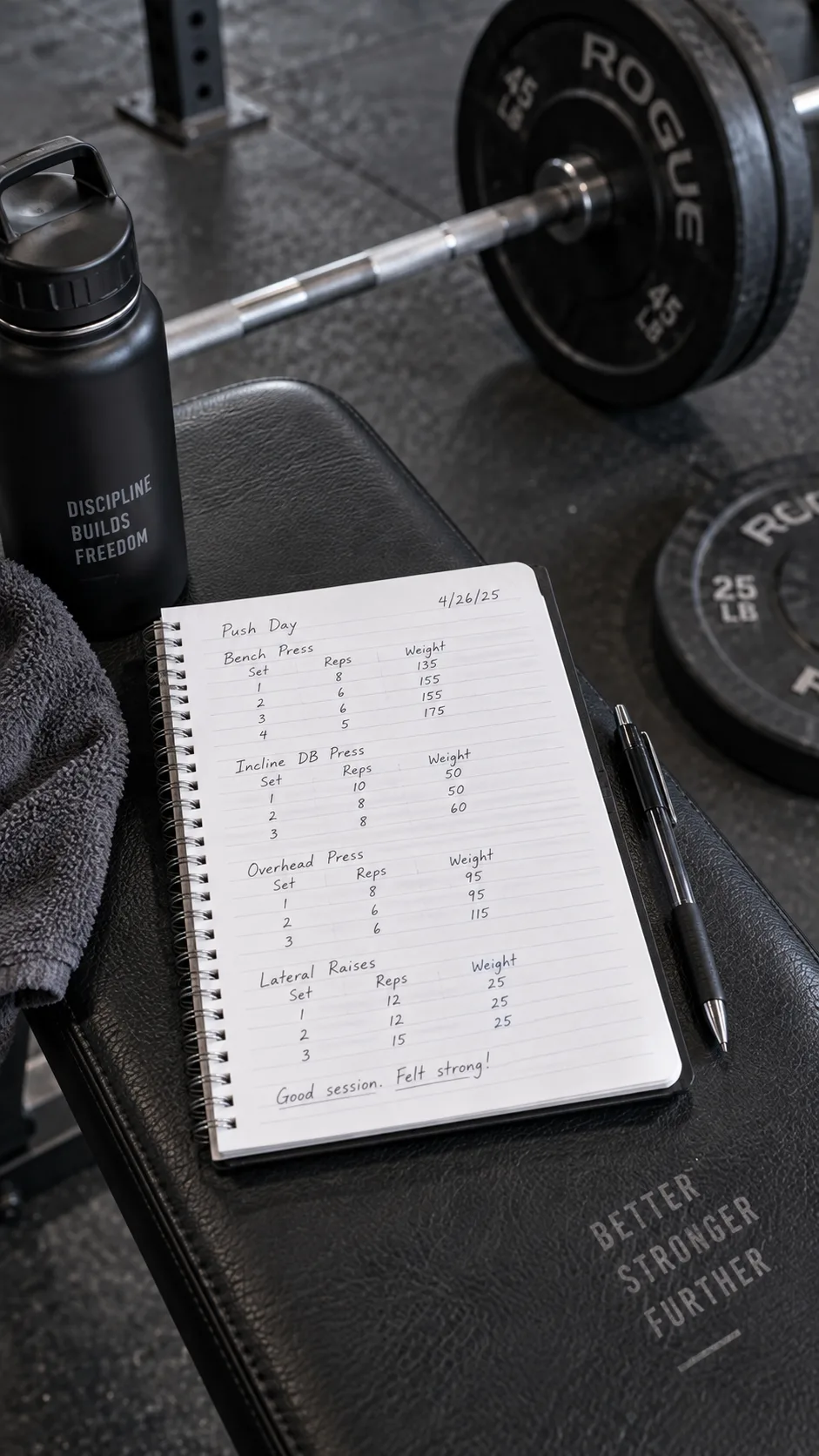
- Track everything. A training log removes guesswork. If you aren’t writing down your sets, reps, and weights, you’re flying blind.
- Use RPE (Rate of Perceived Exertion). Most working sets should land around RPE 7-8, meaning hard but with 2-3 reps left in the tank. Going to absolute failure every set fries your nervous system.
The goal is to push just hard enough to signal adaptation, then recover fully before pushing again. Your gym workout days schedule should create this rhythm naturally. If it doesn’t, something needs to change.
Quick guide: matching your schedule to your goals
Still not sure which split fits you? Here’s a quick reference:
- General fitness + fat loss: 3-day full body split + 2 days of cardio
- Muscle building (beginner): 3-4 day full body or upper/lower split
- Muscle building (intermediate): 4-day upper/lower split or 5-day PPL
- Muscle building (advanced): 5-6 day PPL or specialized body part split
- Strength focus: 3-4 day full body or upper/lower with heavy compound lifts
- Women building curves + strength: A dedicated 5-day women’s workout split with emphasis on glutes and shoulders
Remember: the best workout schedule is the one you’ll follow week after week, month after month. Fancy programming means nothing without consistency behind it.
Build the schedule, build the habit, build the muscle
Getting your gym workout days schedule right isn’t complicated, but it does require intention. Pick a split that matches your experience level and available time. Hit each muscle group at least twice per week. Prioritize recovery as much as training. Progress gradually. And for the love of all things gains-related, take your rest days.
Here’s your action plan in 30 seconds:
- Honestly assess how many days you can train each week
- Choose the appropriate split from this article
- Follow it consistently for at least 8 weeks before changing anything
- Track your workouts, sleep, and nutrition
- Deload every 4-6 weeks
- Reassess and adjust as needed
You don’t need to live at the gym to build an impressive physique. You need a smart plan, the discipline to follow it, and the patience to let it work. Start this week. Your future self will thank you.
