

So you want to train six days a week. That’s ambitious, and I respect it. But here’s the thing most people get wrong: they jump into a 6 days workout plan gym schedule with zero strategy, crush themselves for two weeks, and then ghost the gym like a bad Tinder date.
You don’t have to be that person. A well-structured 6-day split gives you more recovery per muscle group than a sloppy 4-day plan where you’re cramming everything together. The secret? Smart programming.
I’ve personally run 6-day splits for years. The results are clear: leaner physique, better energy, and zero burnout. Let me show you exactly how to set yours up.

Why a 6-day gym workout plan works
Training six days per week sounds intense, but it’s smarter than training four days with marathon sessions. You spread the volume across more days, which means shorter workouts, better focus, and targeted recovery for each muscle group.
Research published in the Journal of Strength and Conditioning Research found that higher training frequency with moderate volume per session produces superior hypertrophy results compared to lower frequency with high volume. Translation? More frequent, shorter hits beat fewer, brutal ones.
The big benefit is rotation. While you’re training chest on Monday, your legs from Saturday are recovering. While you hit back on Tuesday, your chest starts rebuilding. Every muscle gets roughly 48-72 hours of rest before you touch it again.
Who should use a 6-day split?
This isn’t a beginner plan. If you’ve never touched a barbell, start with a gym routine for beginners first. You need at least 3-6 months of consistent training under your belt before jumping to six days.
This split works best for intermediate to advanced lifters who genuinely enjoy being in the gym and want to maximize lean muscle growth without each session destroying them. If that’s you, keep reading.
The best 6-day workout split: Push/Pull/Legs (twice)
After trying upper/lower splits, bro splits, and everything in between, I keep coming back to one format: Push/Pull/Legs done twice per week. It’s the gold standard for a reason.
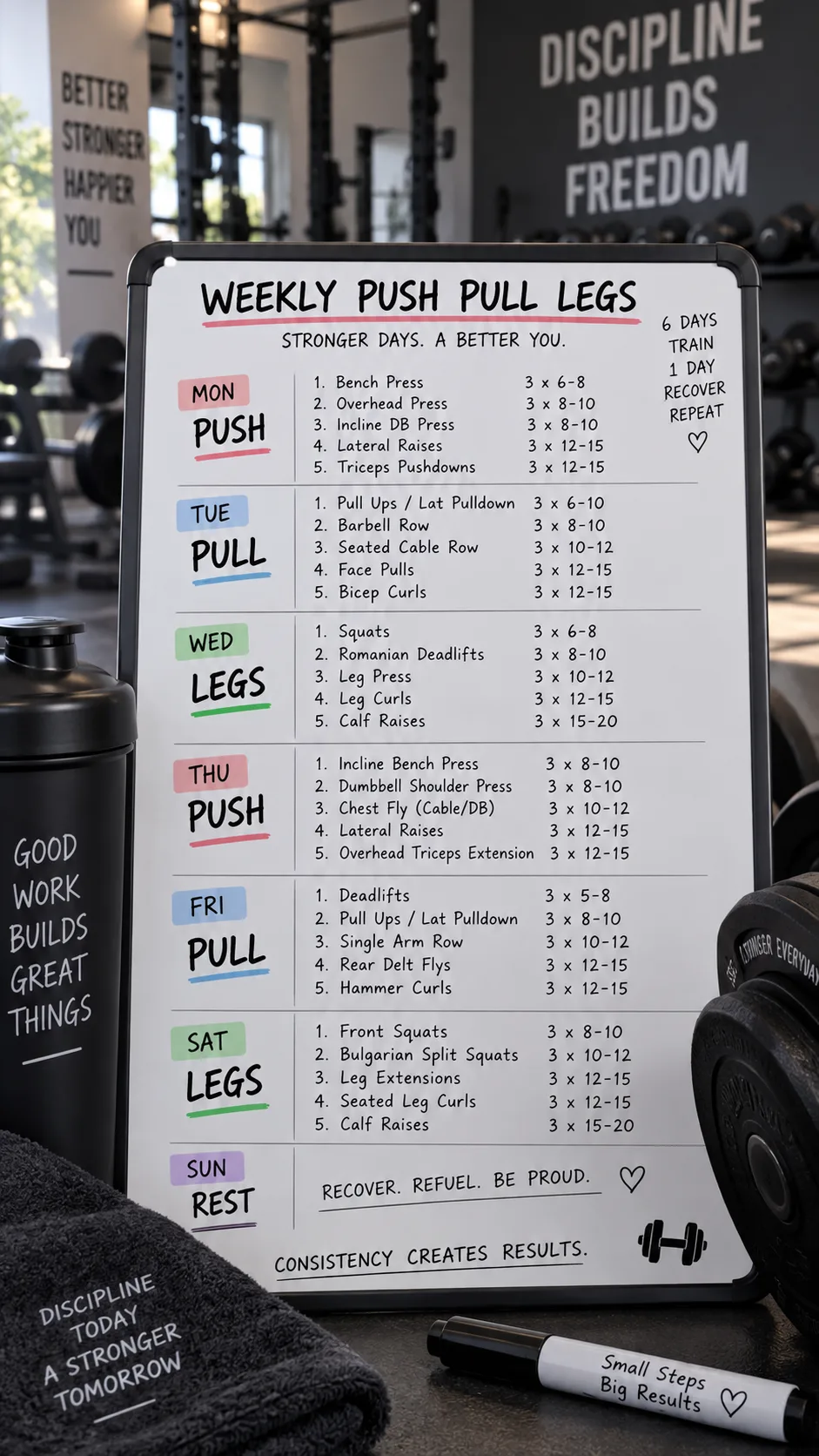
Here’s the weekly layout:
- Monday: Push (Chest, Shoulders, Triceps)
- Tuesday: Pull (Back, Biceps, Rear Delts)
- Wednesday: Legs (Quads, Hamstrings, Glutes, Calves)
- Thursday: Push (Chest, Shoulders, Triceps)
- Friday: Pull (Back, Biceps, Rear Delts)
- Saturday: Legs (Quads, Hamstrings, Glutes, Calves)
- Sunday: REST
Each muscle group gets hit twice per week, the sweet spot for hypertrophy according to a meta-analysis by Schoenfeld et al. (2016). You train hard, you recover, and you grow. Simple.
Day 1: Push day (heavy emphasis)
Your first push day of the week focuses on heavier compound movements. You’re fresh, your nervous system is ready, so take advantage of it.
- Barbell Bench Press: 4 sets x 6-8 reps
- Overhead Press (Barbell or Dumbbell): 3 sets x 8-10 reps
- Incline Dumbbell Press: 3 sets x 10-12 reps
- Cable Lateral Raises: 3 sets x 12-15 reps
- Tricep Dips or Close-Grip Bench: 3 sets x 8-10 reps
- Overhead Tricep Extension: 2 sets x 12-15 reps
Total time? About 50-60 minutes. That’s it. No two-hour gym marathons needed.
Day 2: Pull day (heavy emphasis)
Same philosophy here. Lead with the big lifts while your back and biceps are completely fresh. Ever wondered why your deadlift stalls? It’s probably because you’re doing it after seven other exercises.
- Barbell Rows: 4 sets x 6-8 reps
- Weighted Pull-Ups (or Lat Pulldowns): 3 sets x 8-10 reps
- Seated Cable Rows: 3 sets x 10-12 reps
- Face Pulls: 3 sets x 15-20 reps
- Barbell Curls: 3 sets x 8-10 reps
- Hammer Curls: 2 sets x 12-15 reps
Face pulls aren’t optional, by the way. Your shoulders will thank you in ten years. Consider them non-negotiable insurance for shoulder health.
Day 3: Leg day (quad focus)
Nobody said you have to dread leg day. Okay, maybe a little dread is normal. But splitting your leg volume across two days makes each session WAY more manageable.
- Barbell Back Squats: 4 sets x 6-8 reps
- Leg Press: 3 sets x 10-12 reps
- Walking Lunges: 3 sets x 12 reps per leg
- Leg Extensions: 3 sets x 12-15 reps
- Standing Calf Raises: 4 sets x 12-15 reps
If you want to build a complete lower body, check out our full week workout plan for the gym for even more leg day variations.

Day 4: Push day (volume emphasis)
Your second push day shifts the focus. Lighter weights, more reps, more isolation work. This creates a different stimulus and prevents your joints from taking a beating.
- Dumbbell Bench Press: 3 sets x 10-12 reps
- Machine Shoulder Press: 3 sets x 10-12 reps
- Cable Flyes: 3 sets x 12-15 reps
- Lateral Raises (Dumbbells): 4 sets x 15-20 reps
- Rope Pushdowns: 3 sets x 12-15 reps
- Skull Crushers: 2 sets x 10-12 reps
Notice the difference? Dumbbells replace barbells. Machines replace free weights on some exercises. This variation protects your joints AND creates a novel training stimulus. In my experience, this heavy/light approach is the single best thing you can do for longevity in the gym.
Day 5: Pull day (volume emphasis)
Same idea as Day 4. You’re chasing the pump here, not maxing out. Your back responds incredibly well to higher rep work, so lean into it.
- Single-Arm Dumbbell Rows: 3 sets x 10-12 reps
- Wide-Grip Lat Pulldowns: 3 sets x 12-15 reps
- Chest-Supported T-Bar Row: 3 sets x 10-12 reps
- Reverse Pec Deck (Rear Delts): 3 sets x 15-20 reps
- Incline Dumbbell Curls: 3 sets x 12-15 reps
- Cable Curls: 2 sets x 15-20 reps
If you want extra guidance on building your upper body, our upper body workout plan breaks down strength and definition exercises in detail.
Day 6: Leg day (hamstring and glute focus)
Your second leg day shifts the emphasis to the posterior chain. Hamstrings, glutes, and yes, more calves. Because nobody ever regretted training their glutes more.
- Romanian Deadlifts: 4 sets x 8-10 reps
- Bulgarian Split Squats: 3 sets x 10-12 reps per leg
- Hip Thrusts: 3 sets x 10-12 reps
- Lying Leg Curls: 3 sets x 12-15 reps
- Seated Calf Raises: 4 sets x 15-20 reps
Bulgarians are brutal. I won’t sugarcoat that. But they build single leg strength like nothing else, and they’ll fix any muscle imbalances you’re carrying around.
How to avoid burnout on a 6-day plan
Here’s where most people sabotage themselves. Training six days a week without a burnout strategy is like driving cross-country without checking your gas gauge. Eventually, you’ll stall.
1. Control your volume
Aim for 15-20 total sets per muscle group per week, split across both sessions. That’s roughly 8-10 sets per session per muscle. Going beyond that doesn’t build more muscle. It just digs a deeper recovery hole.
2. Implement deload weeks
Every 4-6 weeks, cut your volume and intensity by about 40-50% for one full week. You’ll feel antsy and under-stimulated, and that’s exactly the point. Your body catches up, repairs micro-damage, and comes back stronger.
3. Prioritize sleep
This isn’t fluffy wellness advice. Sleep is literally when your muscles grow. The Sleep Foundation notes that athletes need 7-9 hours for optimal recovery and performance. If you’re sleeping five hours and training six days, you’re fighting yourself.
4. Eat enough food
A 6-day workout plan demands fuel. You can’t run this split on 1,200 calories and expect results. Aim for a slight caloric surplus (200-300 calories above maintenance) if building muscle is your goal, or eat at maintenance if you want to recomp.
Nutrition quick guide for your 6-day split
Training hard without eating right is like building a house without bricks. Here’s a no-nonsense nutrition framework:
- Protein: 0.8-1g per pound of bodyweight daily (non-negotiable)
- Carbs: 1.5-2.5g per pound, fuel your workouts, don’t fear carbs
- Fats: 0.3-0.4g per pound, enough for hormonal health
- Water: Minimum half your bodyweight (in pounds) in ounces daily
For what it’s worth, timing matters less than total daily intake. Don’t stress about your “anabolic window.” Just hit your numbers consistently.
Common mistakes that wreck a 6-day gym workout plan
I’ve made every one of these mistakes personally, so learn from my pain:
- Going to failure on every set. Save true failure for your last set of isolation exercises. Compound lifts should stop 1-2 reps short of failure.
- Skipping the rest day. Sunday exists for a reason. Your muscles don’t grow in the gym. They grow while you recover. Take. The. Day. Off.
- Neglecting mobility work. Five minutes of dynamic stretching before each session and some foam rolling on rest days goes a LONG way.
- Program hopping. Stick with this split for at least 8-12 weeks before judging results. Muscle building is slow. Accept it.
- Ignoring progressive overload. Add weight, add reps, or add a set every week or two. Without progression, you’re just exercising, not training.
How to track progress on this plan
What gets measured gets managed. Keep a simple training log, paper or app, doesn’t matter. Track the weight, sets, and reps for every exercise, every session.
Week over week, you should see small improvements. Maybe it’s an extra rep on bench press. Maybe it’s 5 more pounds on squats. These tiny wins compound into massive results over months.
Take progress photos every two weeks and body measurements monthly. The scale alone tells a terrible story because muscle weighs more than fat. You could look dramatically different at the same body weight.
Can you modify this 6-day plan?
Absolutely. The push/pull/legs framework is flexible. Here are some smart modifications:
- Short on time? Superset antagonistic muscles (like biceps and triceps) to cut session time by 15-20 minutes.
- Weak body part? Add 2-3 extra sets for that muscle on one of its training days. Don’t overhaul the entire program.
- Training at home? Swap barbell movements for dumbbell equivalents. A solid set of adjustable dumbbells covers 90% of this plan. Check out ACE’s Exercise Library for alternative movements.
- Want to add cardio? Do 15-20 minutes of low intensity cardio after lifting, or add a 30-minute walk on rest day. Don’t add HIIT on top of six lifting days. That’s a recipe for burnout.
The bottom line on your 6 days workout plan gym schedule
A 6-day workout plan at the gym isn’t about being hardcore. It’s about being strategic. The push/pull/legs split hits every muscle twice a week, keeps sessions under an hour, and gives each body part adequate recovery time.
Pair it with proper nutrition, solid sleep, and a deload week every month or so, and you’ve got a sustainable system that builds lean muscle without grinding you into dust.
Start this split next Monday. Track everything. Stay consistent for 12 weeks. I promise, future you will be very glad present you committed. Now stop reading and go warm up.
