
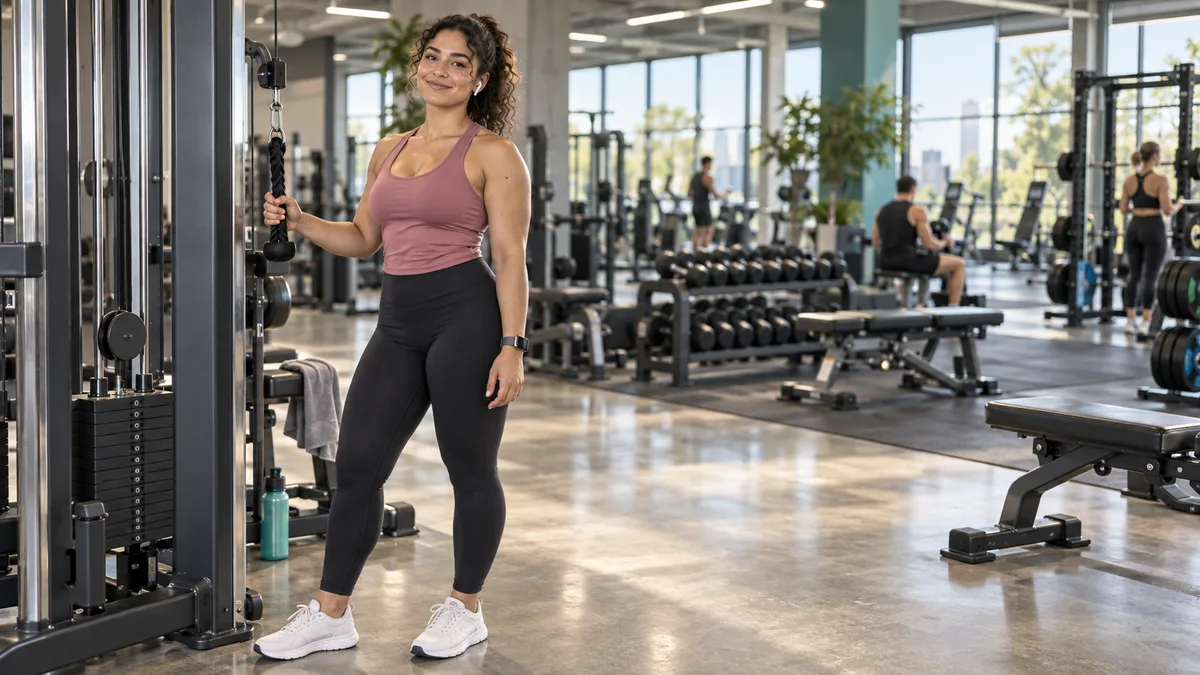
Walking into a gym for the first time feels a lot like showing up to a party where everyone already knows each other, and you forgot the dress code. The machines look intimidating, the free weight section seems like someone else’s territory, and you’re half-convinced everyone’s watching you. They’re not, by the way. They’re too busy checking themselves out in the mirror.
Here’s the truth nobody tells you: your first week at the gym matters more than any other week. Not because of the calories you’ll burn or the muscles you’ll build, but because of the confidence you’ll either gain or lose. Get it right, and you’ll want to come back. Get it wrong, and that gym membership becomes the world’s most expensive keychain.
This guide gives you a complete beginner full body workout gym routine built specifically for women in their first week. No guesswork. No wandering around aimlessly. Just a clear, proven plan that makes you feel like you belong, because you absolutely do.
Why a full body workout makes the most sense for beginners
You might have seen those elaborate “chest day” and “back day” splits on Instagram. Ignore them. Those routines work great for people who’ve been training for years. For someone just starting out? They’re overkill and honestly kind of pointless.
A beginner full body workout hits every major muscle group in a single session. That means you stimulate more muscle, burn more calories, and build a solid foundation, all in about 45 minutes. Research from the Journal of Strength and Conditioning Research consistently shows that beginners respond better to full body training frequency than body part splits.
Think about it this way: why train your legs only once a week when you could train them (lightly) two to three times and see faster results? Your muscles recover quickly when you’re new to training. Take advantage of that rookie magic while it lasts.
If you want a deeper breakdown of the science behind this approach, check out our guide on the simple beginner full body workout routine that builds strength without overwhelm.
What you’ll need (spoiler: not much)
You don’t need fancy equipment or a personal wardrobe of matching gym sets. Here’s your bare minimum checklist:
- Comfortable athletic shoes (cross-trainers or flat soled sneakers work best)
- A water bottle, because dehydration makes everything harder
- A small towel for common courtesy
- Your phone with this routine saved so you can reference it between sets
That’s it. No lifting belt. No gloves. No pre-workout supplement that tastes like battery acid mixed with candy. Just you and a plan.
The first-week game plan: how to structure your sessions
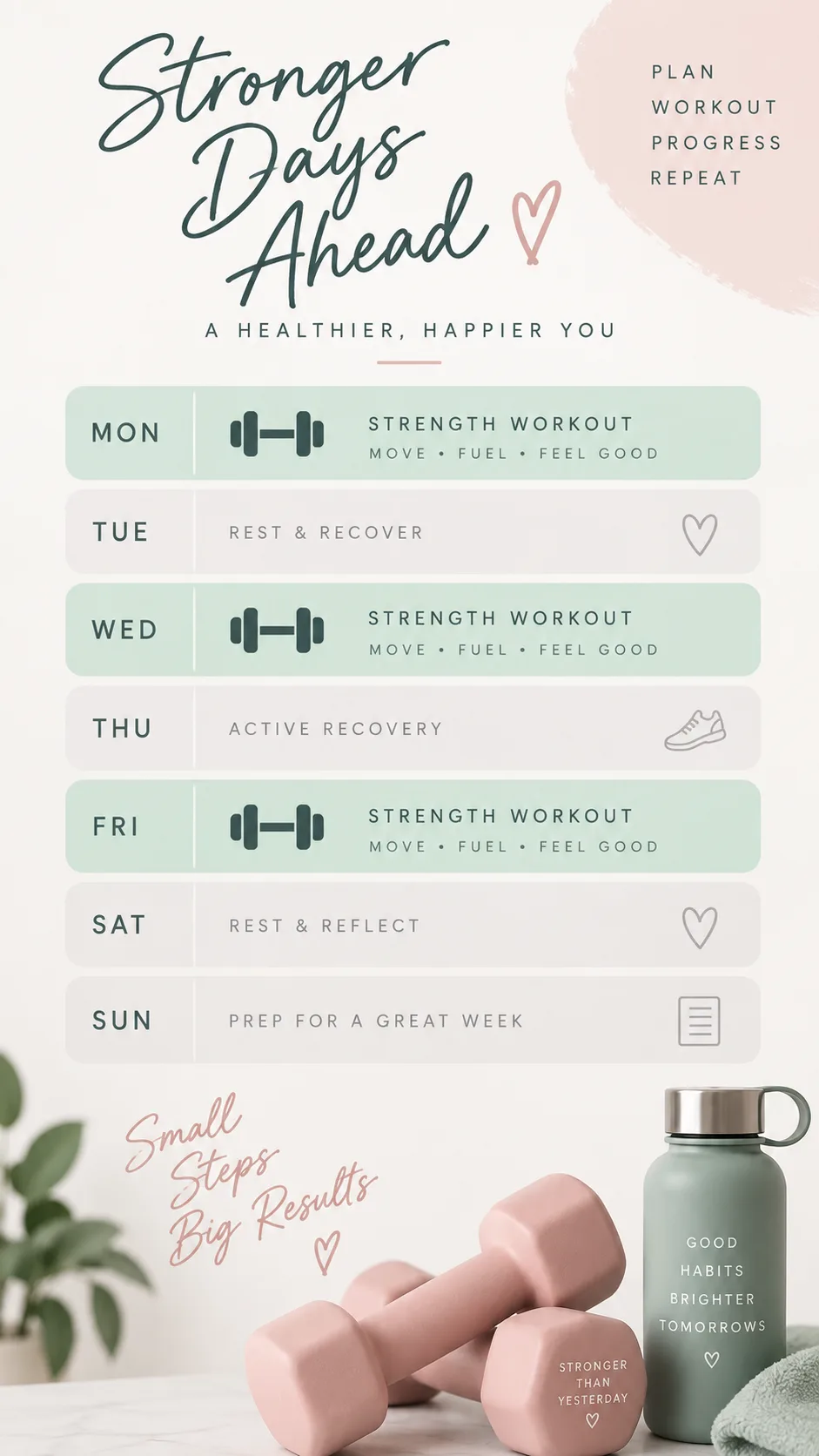
During your first week, you’ll hit the gym three times with at least one rest day between each session. A Monday/Wednesday/Friday schedule works perfectly, but any three non-consecutive days will do.
Session structure overview
- Warm-up: 5 to 7 minutes of light cardio (treadmill walk, stationary bike)
- Main workout: 6 exercises targeting the full body
- Cool-down: 5 minutes of stretching
Each session should take roughly 40 to 50 minutes. That’s it. You don’t need two-hour marathon sessions. Quality beats quantity every single time, especially in week one.
Your complete beginner full body workout gym routine
Here’s the actual routine. Every exercise uses either machines or dumbbells. No complicated barbell movements yet. We’re keeping things approachable while still building real strength.
Exercise 1: Goblet squat
Sets: 3 | Reps: 10 to 12 | Rest: 60 seconds
Hold a single dumbbell at your chest with both hands. Push your hips back, squat down until your thighs hit parallel, then drive back up through your heels. The goblet squat is the single best lower body exercise for beginners because the weight position practically forces good form.
Ever noticed how a toddler squats with perfect technique? That’s what you’re reclaiming here. Your body already knows how to do this. You just need to remind it.
Exercise 2: Lat pulldown (machine)
Sets: 3 | Reps: 10 to 12 | Rest: 60 seconds
Grab the bar slightly wider than shoulder width. Pull it down to your upper chest while squeezing your shoulder blades together. Control the bar back up. Don’t let it yank your arms. This exercise targets your lats, upper back, and biceps, giving you that posture-improving pull strength.
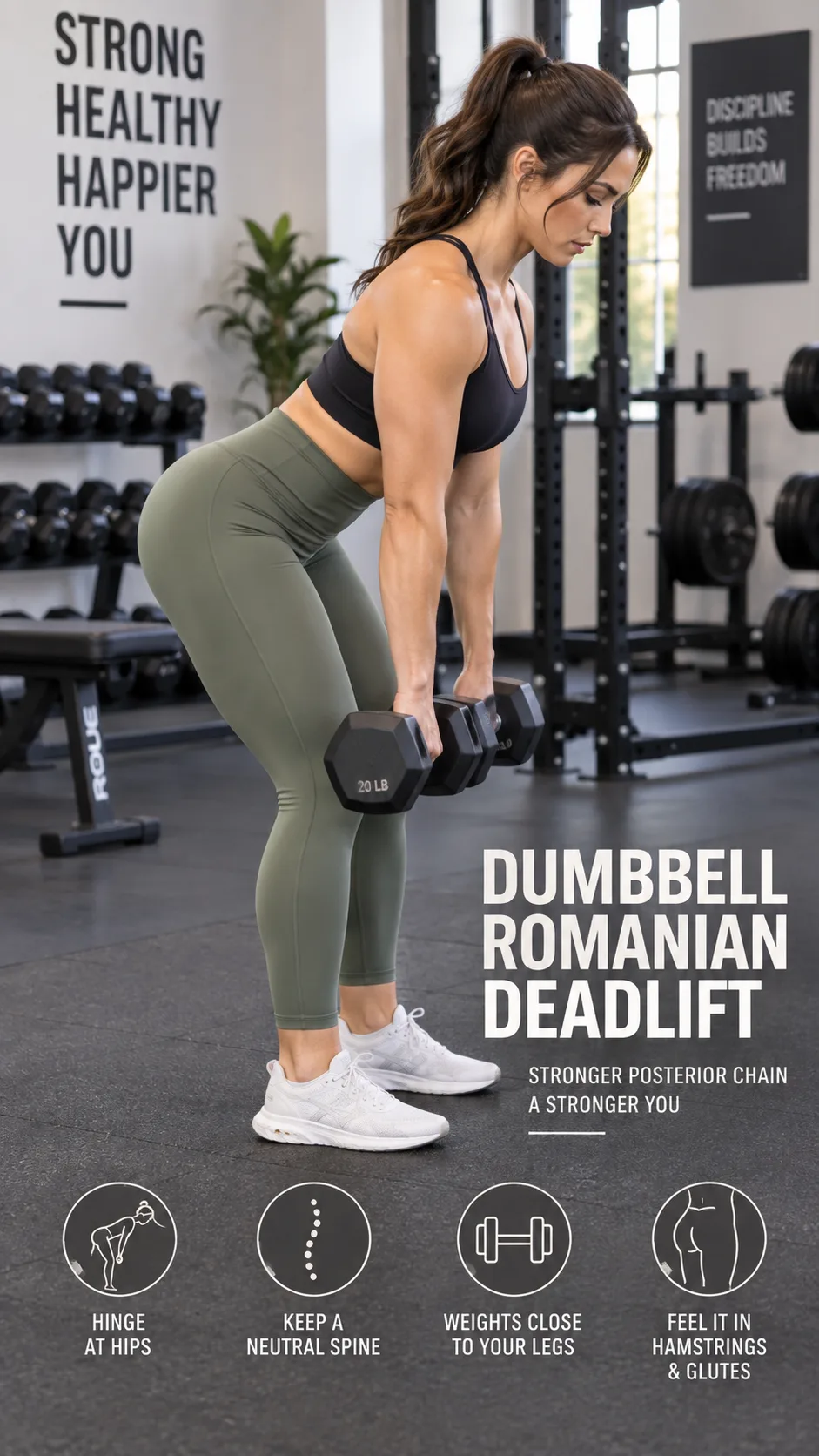
Exercise 3: Dumbbell Romanian deadlift
Sets: 3 | Reps: 10 | Rest: 60 seconds
Hold dumbbells in front of your thighs. Hinge at the hips, slide the weights down your shins, and feel a deep stretch in your hamstrings. Drive your hips forward to stand back up. This movement builds your entire posterior chain: hamstrings, glutes, and lower back.
Start light. Seriously. A pair of 10-pound dumbbells will humble you on this one, and that’s perfectly fine.
Exercise 4: Seated chest press (machine)
Sets: 3 | Reps: 10 to 12 | Rest: 60 seconds
Adjust the seat so the handles align with your mid-chest. Press forward, extend your arms (don’t lock your elbows), and slowly return. The chest press machine provides a safe, guided movement path that lets you focus entirely on pushing strength without worrying about balance.
For more machine-based exercises you can add later, our full body workout at gym with machines guide has you covered.
Exercise 5: Dumbbell shoulder press
Sets: 3 | Reps: 10 | Rest: 60 seconds
Sit on a bench with back support. Hold dumbbells at shoulder height, palms facing forward. Press them overhead until your arms are almost straight, then lower back down with control. Strong shoulders change everything, from how your clothes fit to how you carry grocery bags up three flights of stairs.
Exercise 6: Bodyweight glute bridge
Sets: 3 | Reps: 15 | Rest: 45 seconds
Lie on your back, knees bent, feet flat on the floor. Squeeze your glutes hard and lift your hips toward the ceiling. Hold for a one-count at the top, then lower. This finisher fires up your glutes, muscles that spend way too much of the day sitting in a chair doing absolutely nothing.
A quick visual guide to proper form
Watching proper form in action makes a real difference, especially when you’re brand new. This video covers fundamental gym exercises for women with clear demonstrations:
How to pick the right weight (without guessing)
This part trips up almost every beginner. How heavy should you go? Here’s a simple rule that works every time:
Pick a weight where the last 2 reps of each set feel challenging but doable with good form. If you finish your set of 12 and feel like you could easily do 5 more, the weight is too light. If you can barely squeeze out 6 reps with your form crumbling, it’s too heavy.
Most women dramatically underestimate what they can lift. Don’t grab the 3-pound dumbbells just because they’re pink and look “safe.” Your purse weighs more than that. Challenge yourself.
According to the American Council on Exercise, progressive overload (gradually increasing the challenge) remains the single most important principle for building strength. Even small increases matter enormously over time.
The confidence factor: why your first week is really about your brain
The physical gains you’ll make in week one are minimal. Your muscles won’t visibly change. You won’t suddenly deadlift a car. But your brain will undergo a massive shift, and that’s the real win.
Every single rep you complete reinforces a new identity: “I’m someone who works out.” Every time you walk into that gym and follow through on your plan, you’re building self-trust. And self-trust is the foundation that every future fitness goal sits on.
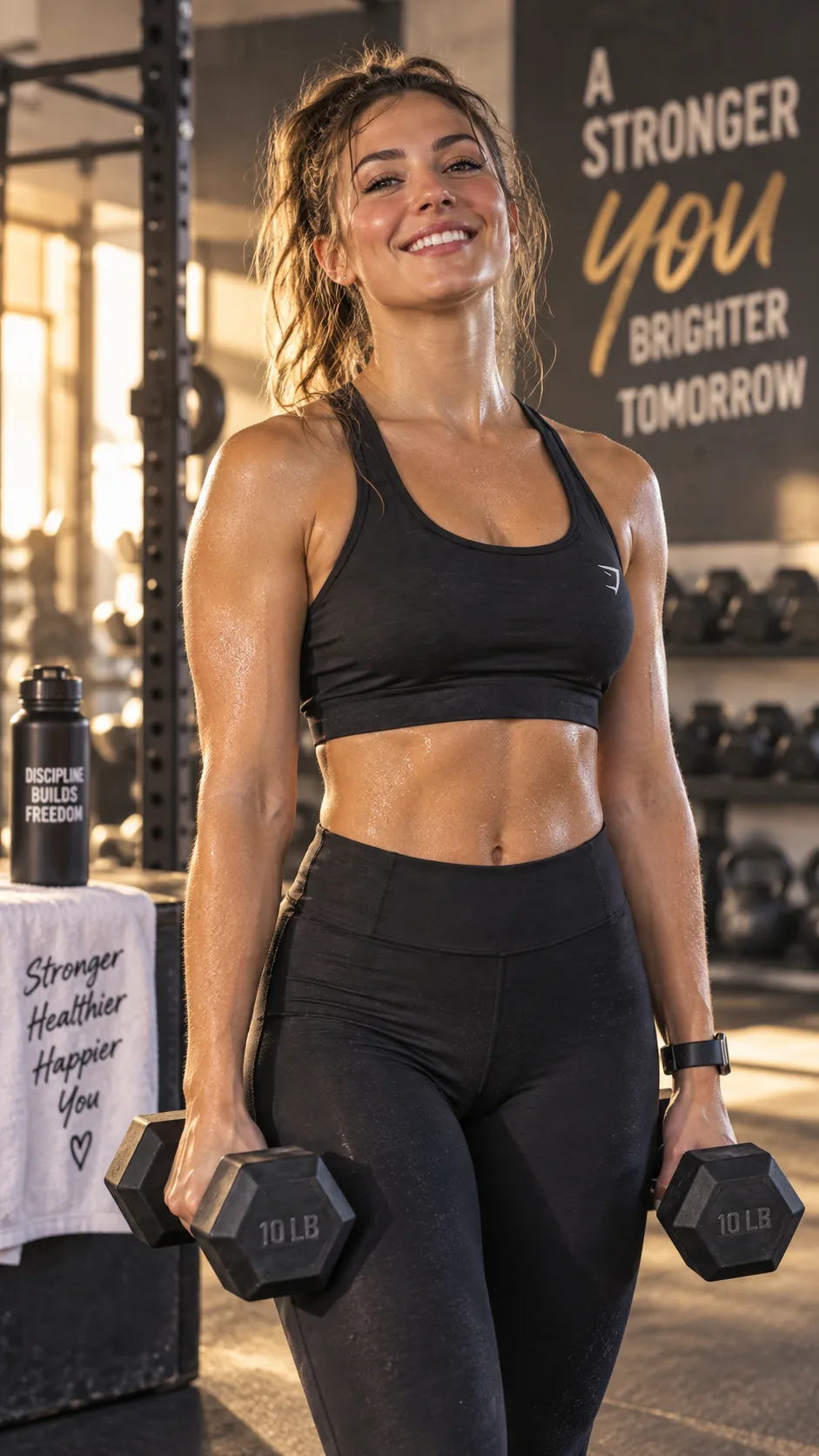
I remember my own first week at the gym years ago. I did bicep curls with 5-pound dumbbells in a corner, terrified someone would notice how weak I was. Nobody did. And three months later, I was helping someone else navigate their first week. Everyone starts somewhere.
Common first-week mistakes (and how to dodge them)
Mistake 1: Doing too much, too soon
Enthusiasm is great. Crippling soreness that makes sitting on a toilet feel like an Olympic event? Not great. Stick to the prescribed sets and reps. You’ll still get sore (that’s normal), but it should be manageable, not debilitating.
Mistake 2: Skipping the warm-up
Five minutes on the treadmill isn’t optional. Cold muscles perform worse and get injured more easily. Warm up every single time. No exceptions.
Mistake 3: Comparing yourself to everyone else
That woman doing pull-ups like a superhero? She started with lat pulldowns, too. That guy throwing around heavy dumbbells? He once struggled with the empty bar. Your only competition is who you were yesterday.
Mistake 4: Not tracking anything
Write down your weights, sets, and reps after each session. Use your phone’s notes app. It takes 30 seconds. What gets tracked gets improved. A week from now, you’ll want to know exactly where you started so you can beat those numbers.
What about cardio?
Great question. Should you add cardio to your first week? Keep it minimal. Your warm-up provides some cardiovascular benefit, and the resistance training itself will elevate your heart rate plenty.
If you genuinely enjoy cardio, add 10 to 15 minutes of walking on an incline treadmill after your strength work. But don’t prioritize 45-minute elliptical sessions over lifting. Strength training delivers more transformative results for beginners: better body composition, improved bone density, and that “toned” look that hours of cardio alone can’t produce.
The World Health Organization recommends adults perform muscle-strengthening activities at least twice per week alongside aerobic exercise. Your three full body sessions already exceed that baseline.
Nutrition in week one: keep it simple
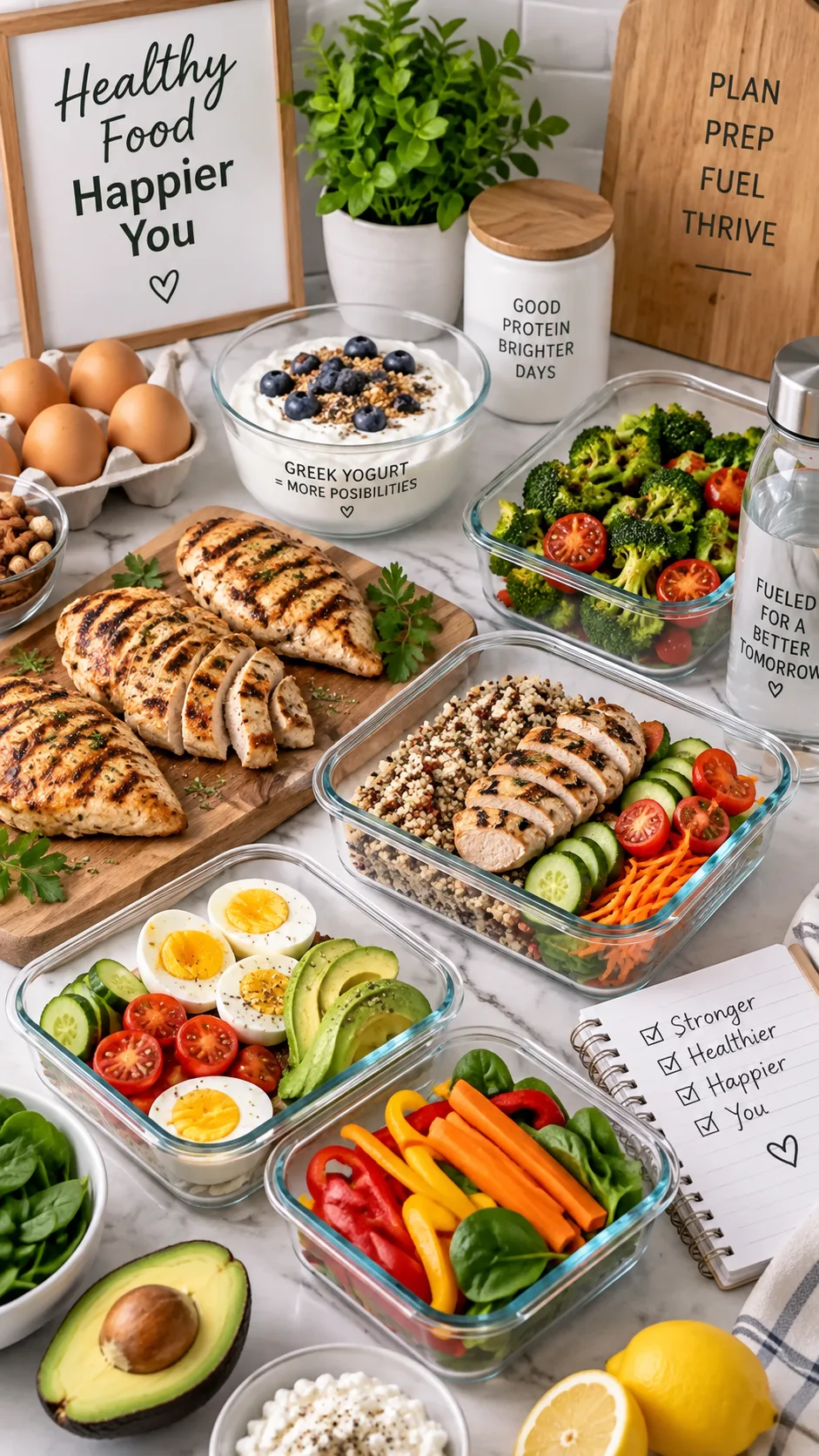
You don’t need to overhaul your entire diet right now. Seriously. Trying to change everything at once is the fastest route to burning out. Focus on two things only:
- Eat enough protein. Aim for a palm-sized portion at each meal (chicken, fish, eggs, Greek yogurt, tofu).
- Stay hydrated. Drink at least half your bodyweight in ounces of water daily.
That’s your entire first-week nutrition plan. Master those two habits before adding complexity. The Academy of Nutrition and Dietetics stresses that sustainable dietary changes happen incrementally, not overnight.
After week one: where do you go from here?
Congratulations, you survived your first week. Now what?
During weeks two and three, keep the same routine but increase the weight slightly on exercises where you felt strong. Add 2.5 to 5 pounds per exercise. This gradual progression builds strength without overwhelming your joints and connective tissues, which adapt more slowly than muscles do.
After about four weeks, you’ll want to either add exercises, increase volume, or start exploring different training splits. Our detailed guide on full body workout plans for women maps out exactly how to progress beyond the beginner phase without overtraining.
Signs you’re ready to progress
- Your current weights feel too easy for the last 2 reps
- You’re recovering faster between sessions
- You feel comfortable with exercise form and gym navigation
- You look forward to your workouts (yes, this happens)
Quick recap: your first-week cheat sheet
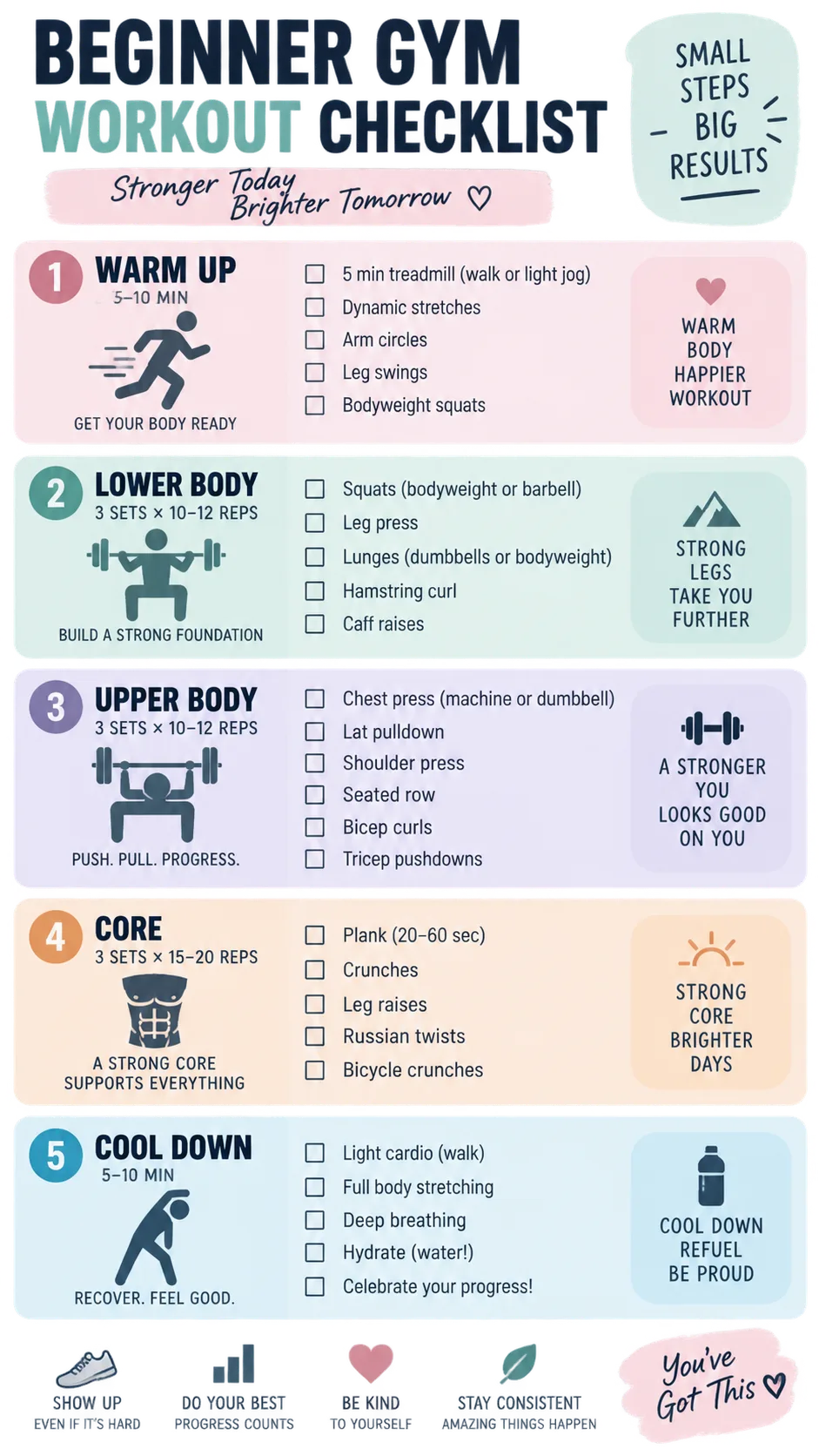
Here’s everything in one glance so you can screenshot this and bring it to the gym:
- Train 3 days per week on non-consecutive days
- Warm up for 5 to 7 minutes of light cardio
- Perform 6 exercises: Goblet Squat, Lat Pulldown, Romanian Deadlift, Chest Press, Shoulder Press, Glute Bridge
- Do 3 sets of 10 to 15 reps per exercise
- Rest 45 to 60 seconds between sets
- Choose challenging but manageable weights
- Track everything, even if it’s just in your notes app
- Cool down and stretch for 5 minutes minimum
The final word
Starting a beginner full body workout at the gym isn’t about transforming your body in seven days. It’s about proving to yourself that you can show up, follow a plan, and leave feeling better than when you walked in. That’s it. That’s the whole secret.
The women who build long-term fitness habits don’t start with perfect routines or flawless form. They start with one decision to try, followed by the courage to keep showing up even when it feels awkward. And it will feel awkward at first. That’s completely normal.
Your first week builds the confidence. Your consistency builds the results. So grab your water bottle, save this routine to your phone, and go claim your space in that gym. You’ve already done the hardest part: you decided to start.
