

You’ve been doing 20+ sets on push day, leaving the gym with arms so pumped you can barely grip your steering wheel, and yet you look pretty much the same as you did three months ago. Sound familiar? The problem isn’t effort. It’s exercise order, set selection, and a whole lot of junk volume sneaking into your routine.
I spent years stacking chest and triceps exercises like I was building a Jenga tower. More blocks, more impressive, right? Wrong. I just ended up with a wobbly mess of fatigue, mediocre contractions, and shoulders that hated me. The fix wasn’t adding more. It was ordering fewer, higher-quality movements and cutting the dead weight.
This article breaks down a chest and triceps workout built around smart push-day sequencing. You’ll learn exactly which exercises to do first, which to save for later, and which ones you can probably ditch entirely.
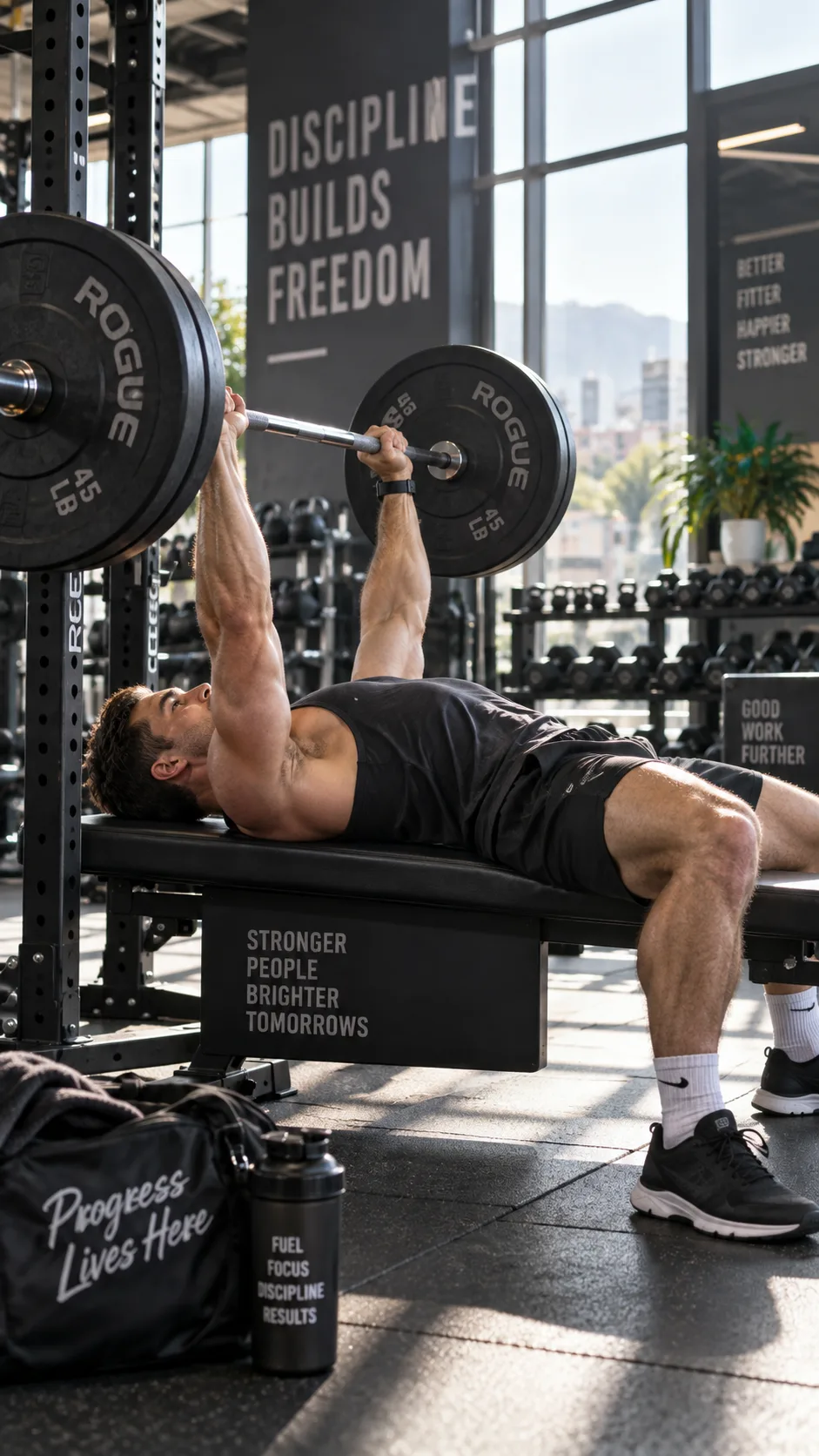
What is junk volume, and why is it killing your gains?
Junk volume is any set that doesn’t meaningfully contribute to muscle growth. It’s the stuff you do because “more is better,” except your muscles stopped responding four sets ago. Think of it like revving a car engine in neutral. Lots of noise, zero forward movement.
Research published in the Journal of Strength and Conditioning Research consistently shows that somewhere between 10-20 hard sets per muscle group per week hits the sweet spot for hypertrophy in most trained lifters. Go beyond that, and you’re not building. You’re just accumulating fatigue and extending recovery time.
Here’s the kicker: on a chest and triceps push day, your triceps already take a beating during every pressing movement. So when you follow up five chest exercises with five triceps exercises, those tricep sets aren’t all productive. Many of them are pure junk volume because the muscle is already fried from pressing.
The overlap problem
Every bench press, incline press, and chest dip recruits your triceps as a secondary mover. By the time you finish your chest work, your triceps have already logged significant volume. If you ignore this overlap, you end up overtraining your triceps while thinking you’re being thorough.
A smarter approach? Count those indirect triceps sets. Then program your direct triceps work accordingly. Two to three focused triceps exercises after chest work is usually plenty, and sometimes even generous.
Why exercise order matters more than exercise selection
Ever noticed how your last exercise always feels terrible compared to your first? That’s not laziness. That’s central and peripheral fatigue doing exactly what science says it does. The order you perform exercises directly impacts force production, muscle activation, and ultimately the quality of each set.
A study from the National Library of Medicine (PubMed) database showed that muscles trained earlier in a session experience greater hypertrophy than those trained later. Translation: put your priority muscle first.
For a chest and triceps workout focused on definition, this means leading with compound chest movements when you’re freshest, transitioning to isolation chest work, and finishing with targeted triceps exercises. Simple concept, but most people get it backwards or jumble it randomly.
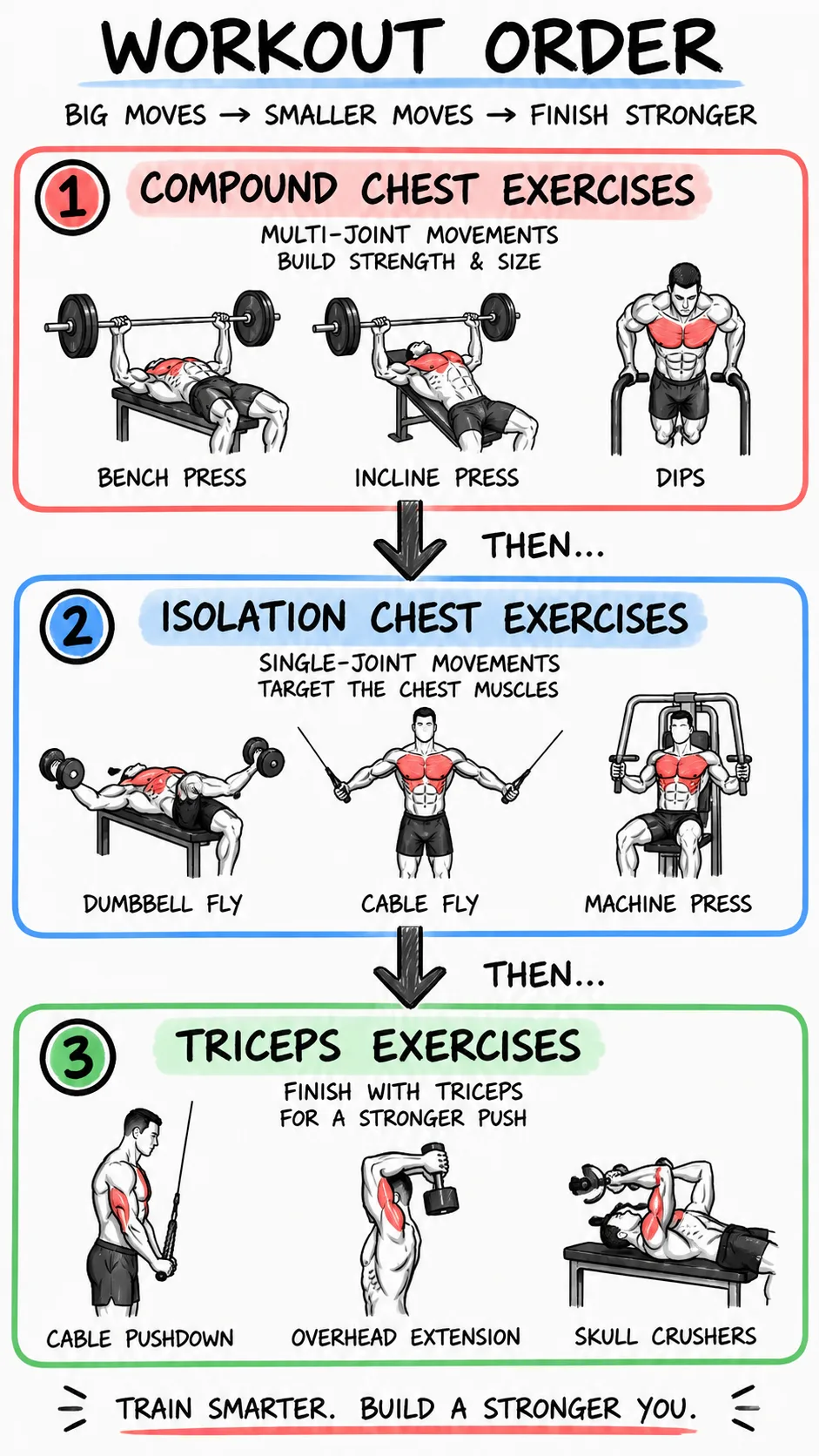
The optimal push-day exercise order
Here’s the framework I’ve used (and recommended to dozens of training partners) that consistently produces better chest and tricep definition without bloating your session with unnecessary sets. Total working sets: 14-18. Total time: about 50-60 minutes.
Phase 1: Heavy compound chest (6-8 working sets)
You start here because compound pressing demands the most from your nervous system, your stabilizers, and your ego. Hit these when you’re fresh and capable of moving real weight with proper form.
- Barbell bench press or dumbbell bench press, 3-4 sets of 6-8 reps. This is your bread and butter. Pick one, go heavy, and focus on controlled eccentrics. Your chest AND triceps are both working hard here.
- Incline dumbbell press (30-degree angle), 3 sets of 8-10 reps. The slight incline shifts emphasis to the upper chest without turning it into a front delt exercise. Keep the angle moderate. 45 degrees is too steep for most people. IMO, dumbbells beat barbells here for range of motion.
That’s it for heavy compounds. Two exercises. Six to seven working sets. Your chest has received a massive growth stimulus, and your triceps have already banked 6-7 indirect sets. Remember that number.
Phase 2: Chest isolation (3-4 working sets)
Now you shift gears. Isolation work lets you chase the contraction without your triceps stealing the show. This is where you build that defined, separated look.
- Cable flyes (low-to-high or mid-height), 3-4 sets of 10-15 reps. Cables maintain constant tension throughout the entire range of motion, which free-weight flyes simply can’t match. Squeeze at the top like you’re trying to crush a walnut between your pecs.
One isolation exercise. Three to four quality sets. Why not more? Because you already hammered your chest with heavy compounds. Adding a second fly variation or a pec deck on top of this usually just generates fatigue without any extra growth stimulus. That’s textbook junk volume.
If you want a more comprehensive chest routine that pairs well with back training, check out this chest and back workout for ideas on balanced upper-body programming.

Phase 3: Direct triceps work (4-6 working sets)
Here’s where most people go overboard. You do NOT need five triceps exercises after a full chest session. Your triceps have already worked through every press you just performed. Two exercises (maybe three if you’re advanced) with focused intent will finish the job.
- Overhead triceps extension (cable or dumbbell), 3 sets of 10-12 reps. The overhead position stretches the long head of the triceps, which is the biggest head and the one most responsible for that horseshoe shape. This is the exercise most people skip, and it’s the one that matters most for triceps definition.
- Cable pushdowns (rope or V-bar), 2-3 sets of 12-15 reps. Classic finisher. Keep your elbows pinned, spread the rope at the bottom, and squeeze. Higher reps work beautifully here because the muscle is already pre-fatigued from pressing.
Total direct triceps sets: 5-6. Add the 6-7 indirect sets from chest pressing, and your triceps have logged 11-13 total sets. That’s right in the hypertrophy sweet spot without crossing into overtraining territory.
The complete workout at a glance
Here’s the full session laid out cleanly. Print it, screenshot it, tattoo it on your forearm, whatever works 🙂
| Exercise | Sets × Reps | Rest |
|---|---|---|
| Barbell or Dumbbell Bench Press | 3-4 × 6-8 | 2-3 min |
| Incline Dumbbell Press | 3 × 8-10 | 2 min |
| Cable Flyes | 3-4 × 10-15 | 60-90 sec |
| Overhead Triceps Extension | 3 × 10-12 | 60-90 sec |
| Cable Pushdowns | 2-3 × 12-15 | 60 sec |
Total working sets: 14-18. That’s it. No fluff, no filler, no “bonus burnout sets” that just extend your gym time without extending your results.
Exercises you can probably cut from your push day
This might sting, but some popular push-day staples deserve the chopping block. Not because they’re bad exercises, but because they become redundant when you’ve already covered the bases above.
- Decline bench press: Your flat bench press already hits the lower chest fibers effectively. Unless you’re a competitive bodybuilder chasing a very specific look, the decline press is redundant volume for most people.
- Skull crushers after heavy pressing: Your elbows have already handled significant load. Skull crushers pile on joint stress when cables can deliver the same triceps stimulus with far less wear and tear.
- Machine chest press + barbell bench press in the same session: Pick one compound pressing pattern. Doing both is the definition of diminishing returns.
- Kickbacks: They only load the triceps at the very end of the range. Overhead extensions and pushdowns cover the full strength curve far better.
Cutting these doesn’t mean they’re useless forever. It means that on THIS particular push day, they add volume without adding meaningful stimulus. Context matters.
How to progress this workout over time
A workout without a progression plan is just a list of exercises. You need a system for getting stronger and pushing your muscles into new territory week after week.
Double progression method
This is the simplest, most effective approach for intermediate lifters. Here’s how it works:
- Pick a rep range for each exercise (e.g., 8-10 reps).
- Use the same weight until you hit the TOP of the range on ALL sets.
- Once you achieve that, increase the weight by the smallest increment available.
- Repeat the cycle with the new weight.
Example: You bench press 185 lbs for sets of 8, 8, 7. Next week, you get 8, 8, 8. The following week, you hit 9, 9, 8. Eventually you reach 10, 10, 10, then you bump the weight to 190 lbs and start at 8 reps again. Slow? Yes. Effective? Ridiculously so.
When to add volume
If you’ve been running this routine for 8-12 weeks and progress stalls, consider adding ONE set to your weakest exercise rather than adding a whole new movement. Go from 3 sets to 4 on your incline press before you even think about tossing in a new exercise. Small adjustments beat wholesale changes every time.
For those specifically chasing more upper-body mass, this chest and tricep workout for men offers an alternative split with slightly higher volume for experienced lifters.
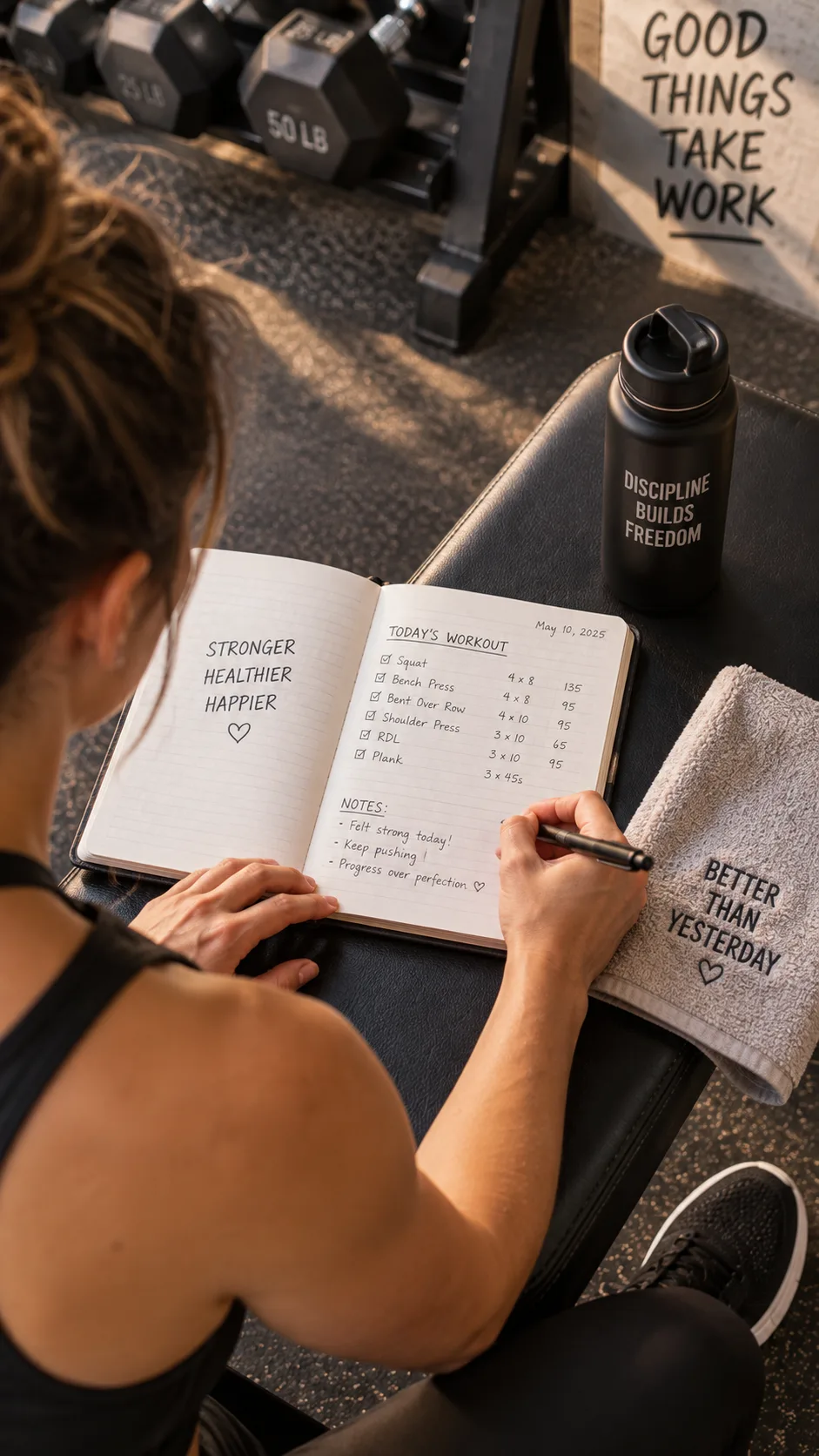
Common push-day mistakes that create junk volume
Even with the right exercises in the right order, a few bad habits can turn productive sets into wasted ones. Watch out for these:
1. Ego lifting on compounds
Loading 315 on the bench and bouncing it off your sternum with a four-inch range of motion doesn’t build your chest. It builds your chiropractor’s retirement fund. Full range of motion with controlled tempo beats heavy partial reps for hypertrophy every single time. Check your ego at the door.
2. Rushing through isolation work
Cable flyes aren’t meant to feel heavy. They’re meant to feel precise. If you’re swinging your whole body into every rep, you’ve turned an isolation exercise into a bad compound movement. Slow down, squeeze at peak contraction, and feel the muscle working.
3. Adding “finishers” you don’t need
Dropsets, burnout sets, and 100-rep challenges have their place, but that place is NOT at the end of every session. These techniques spike fatigue dramatically while providing questionable extra stimulus. Use them sparingly, maybe once every few weeks, not as a permanent fixture.
4. Ignoring the mind-muscle connection on triceps
Your triceps respond exceptionally well to focused contractions. The American Council on Exercise (ACE) has published EMG data showing that intentional squeezing significantly increases muscle activation. Don’t just push the weight. Think about your triceps doing the pushing.
How this fits into a weekly training split
This chest and triceps workout slots perfectly into several popular training splits. Here are the most practical options:
- Push/Pull/Legs (PPL): Run this as your push day. Pair it with a pull day (back and biceps) and a leg day. Train each twice per week for optimal frequency.
- Upper/Lower Split: Use this as the pressing portion of your upper day, then add some back and bicep work afterward.
- Bro Split: Dedicate one day to this chest and triceps session. You’ll finish faster than your gym buddies doing their 25-set marathon, and you’ll probably grow more.
Whichever split you choose, aim to hit each muscle group at least twice per week for maximum hypertrophy. Research from Sports Medicine consistently supports higher training frequencies over once-per-week body part splits.
If you’re looking for a gym-based chest routine that incorporates machines alongside triceps work, this chest day workout plan covers machine-based alternatives worth exploring.
Nutrition and recovery: the stuff nobody wants to hear
You already know this part, but I’m saying it anyway because skipping it would be irresponsible. No workout, no matter how perfectly ordered, overcomes a terrible diet or chronic sleep deprivation.
For building definition, you need adequate protein intake. Aim for 0.7-1 gram of protein per pound of bodyweight daily. That’s not broscience. That’s the current consensus across sports nutrition research. Chicken, fish, eggs, Greek yogurt, protein powder: pick your weapons.
Sleep matters just as much. Growth hormone release peaks during deep sleep, and your muscles literally repair themselves overnight. Cutting sleep short is like leaving the gym mid-workout and expecting full results. Shoot for 7-9 hours. Yes, really.
How to know if your volume is working
Here’s a quick gut-check system I use to audit whether my push-day volume is productive or just padding my workout tracker:
- Performance test: Are you getting stronger (even slowly) on your main lifts over 4-6 week periods? If yes, your volume is probably right. If you’re stagnating or regressing, you might have too much.
- Soreness check: Feeling some muscle soreness 24-48 hours later is normal. Feeling destroyed for 4+ days means you’ve overdone it.
- Pump quality: Your last exercise should still produce a decent pump. If your final triceps sets feel completely flat and lifeless, you’ve likely accumulated too much fatigue earlier in the session.
- Joint health: Persistent elbow or shoulder pain during pressing is a red flag. Junk volume doesn’t just waste time. It wears down connective tissue.
FYI, tracking your workouts in a simple app or notebook makes this evaluation process 10x easier. You can’t manage what you don’t measure.
Final thoughts: less volume, more intent
The chest and triceps workout that builds real definition isn’t the one with the most exercises or the most sets. It’s the one where every single set has a purpose, every rep gets your full attention, and every exercise earns its spot in the lineup.
Start with heavy compound presses when your energy is highest. Transition to isolation work for targeted chest stimulation. Finish with focused triceps exercises that complement (not duplicate) the work your tri’s already did during pressing. Keep total volume in the 14-18 set range, progress consistently using double progression, and cut anything that doesn’t directly contribute to growth.
That’s the entire playbook. No secret exercises, no complicated periodization schemes, no 90-minute gym sessions. Just smart ordering, honest effort, and the discipline to leave the gym before you’ve crossed the line from productive to pointless. Now go build something worth showing off.
