
You walked into the gym, looked around at the machines, cables, and free weights, and immediately wanted to walk back out. Sound familiar? You’re not alone, and this guide exists specifically to fix that problem.
A beginner full body workout doesn’t need to be complicated. In fact, the simpler you keep it at the start, the faster you’ll build real, lasting strength. This is the routine that actually works.
Why full body workouts win for beginners
Most beginners make the same mistake: they jump straight into a split routine (chest Monday, back Tuesday, legs Wednesday) before their muscles even know what’s happening. The result? Soreness, confusion, and quitting by week three.
Full body training hits every major muscle group every session. For beginners, this means more practice with the movements, faster skill acquisition, and more frequent muscle stimulation. Research published in the Journal of Strength and Conditioning Research consistently shows that higher training frequency produces better strength gains in untrained individuals.
You also get more efficient sessions. Three days a week, and you’ve trained your whole body. That’s it. No six-day gym schedule. No skipping leg day (we all know how that goes :/).
The science behind frequency over volume
When you’re new to lifting, your nervous system is learning how to recruit muscle fibers. Every rep teaches your body something new. Hitting a muscle twice or three times a week accelerates that learning curve dramatically compared to once-a-week training.
More practice = faster progress. It really is that simple at the beginner stage. Save the split routines for when you’ve built a solid foundation over 6 to 12 months of consistent training.
The core principles before you touch a weight
Before you write down a single exercise, you need to understand three things. These aren’t optional. They’re the difference between steady progress and a frustrating plateau.
- Progressive overload: gradually increase the weight, reps, or sets over time. Without this, you’re just exercising. With it, you’re training.
- Form first, weight second: moving badly under heavy load is how injuries happen. Learn the pattern, then load it.
- Consistency beats intensity: three moderate sessions a week for three months beats one brutal session a week every time.
The Mayo Clinic recommends strength training at least two days per week for general health. Three days, as this program uses, puts you well ahead of that baseline while keeping recovery manageable.
Your beginner full body workout routine
This is a three-day-per-week program. Train Monday, Wednesday, Friday, or any three non-consecutive days that work for your schedule. Each session takes roughly 45 to 60 minutes including warm-up.
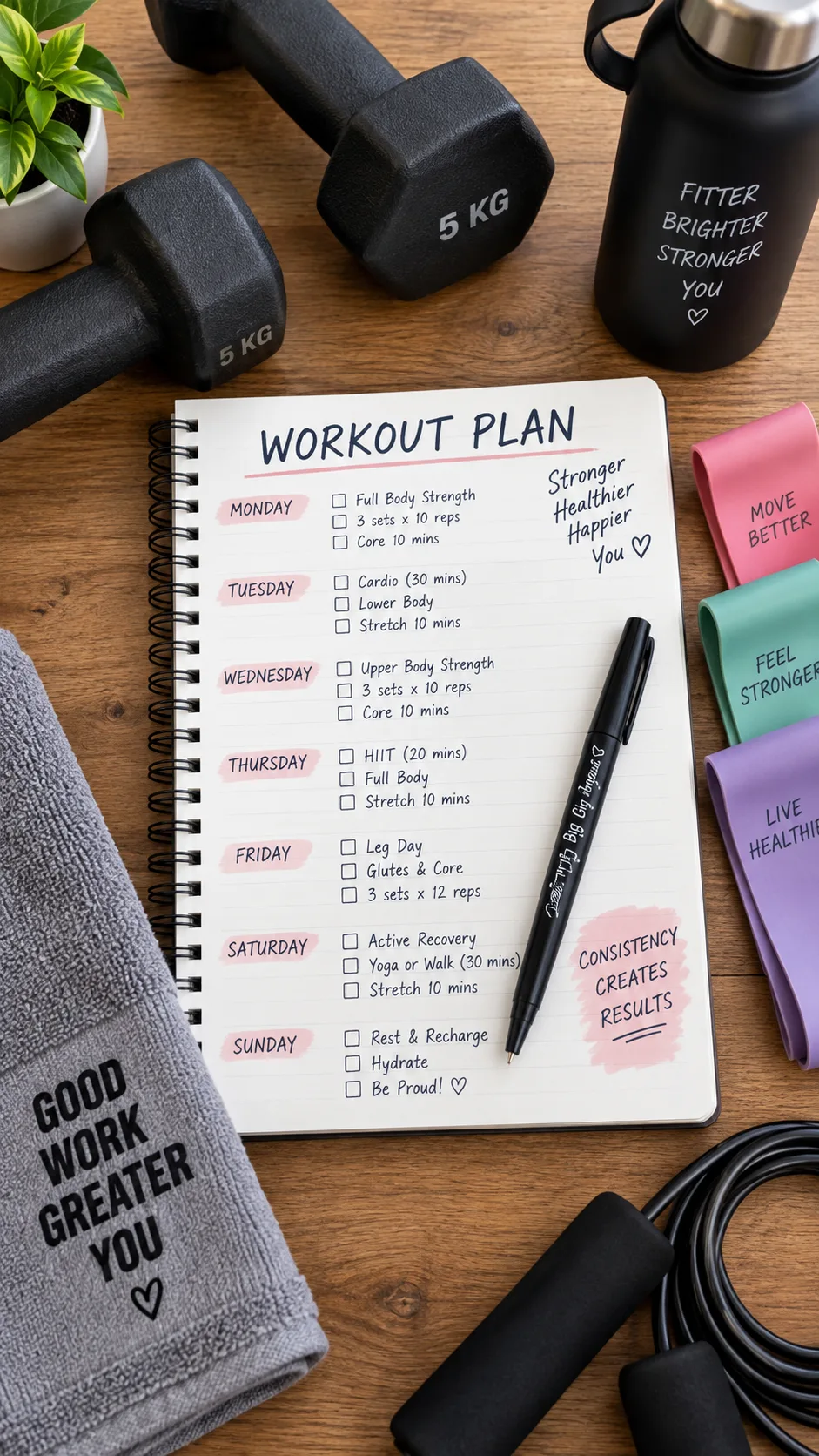
The workout (3 days per week, same session)
- Barbell Back Squat (or Goblet Squat), 3 sets x 8 reps
- Dumbbell Romanian Deadlift, 3 sets x 10 reps
- Bench Press (or Push-Up), 3 sets x 8-10 reps
- Dumbbell Row, 3 sets x 10 reps each side
- Overhead Press (Dumbbell or Barbell), 3 sets x 8 reps
- Plank, 3 sets x 20-30 seconds
Rest 90 to 120 seconds between sets. That rest isn’t wasted time. It’s when your muscles recover enough to give you a quality next set.
For a more detailed breakdown of how to structure your weekly schedule around a routine like this, check out The Full Body Workout Routine That Builds Strength and Tone Without Wasting Time.
How heavy should you go?
Start lighter than you think you need to. Seriously. Your ego will tell you to load more plates, but your joints will thank you later for showing some patience. Pick a weight where the last 2 reps feel challenging but your form stays solid. That’s your starting point.
Each week, try to add a small amount: 2.5 to 5 lbs on upper body exercises, 5 to 10 lbs on lower body exercises. That’s progressive overload doing its job. Over three months, those tiny jumps add up to something real.
Exercise breakdown: what each move actually does
Ever wondered why these specific exercises and not the dozen other things you could pick? Every choice here has a purpose.
Squat: the king of lower body strength
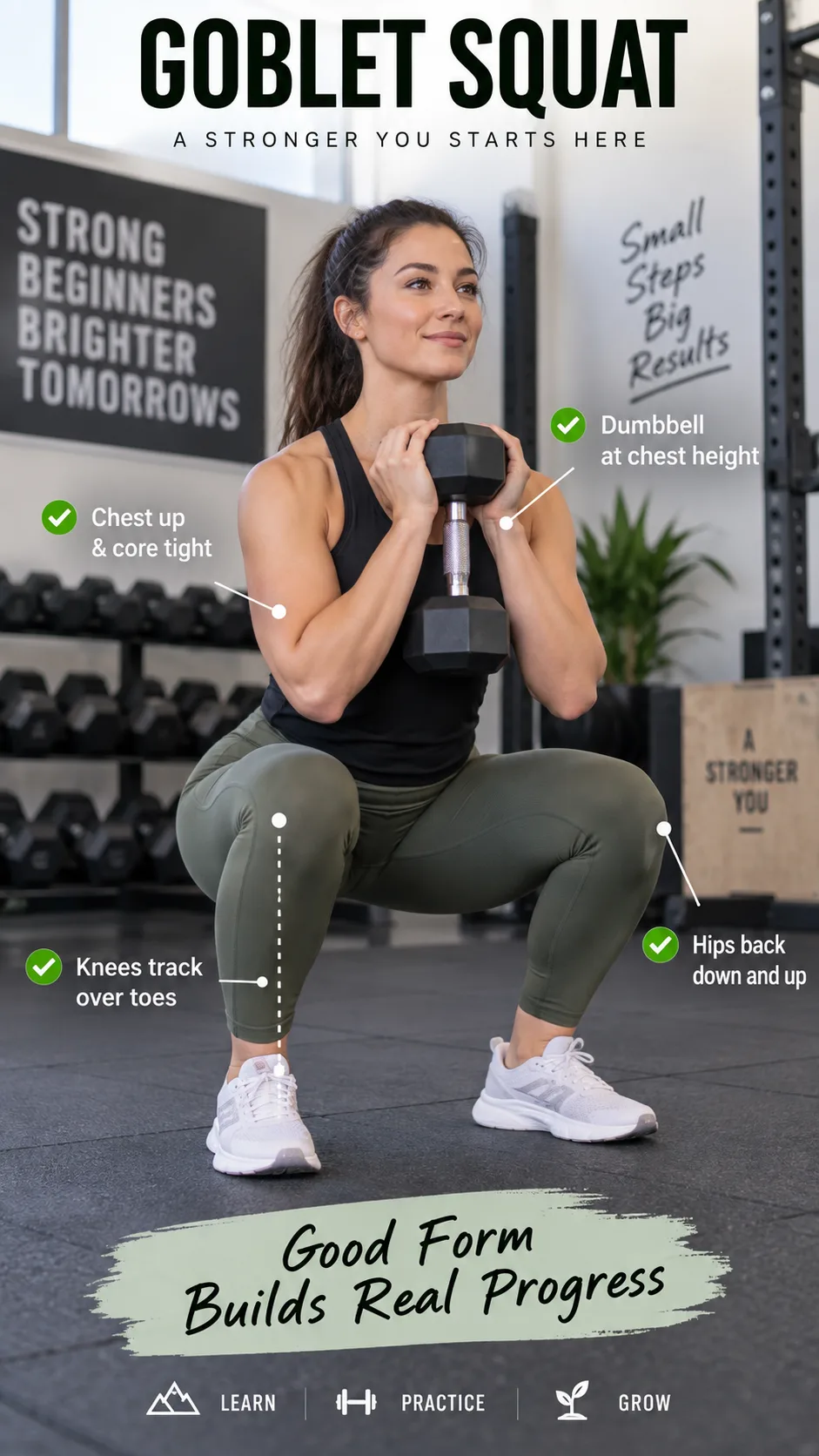
The squat works your quads, hamstrings, glutes, and core simultaneously. No single exercise builds lower body strength more effectively. Start with a goblet squat (holding a dumbbell at your chest) if barbell squats feel awkward at first. The goblet variation naturally teaches you to stay upright and keep your chest up.
Romanian deadlift: your posterior chain’s best friend
The Romanian deadlift (RDL) targets your hamstrings and glutes through a hinge pattern, a movement most beginners completely ignore. Weak hamstrings and glutes cause knee pain, lower back issues, and poor athletic performance. Fix them early, and you’ll avoid a lot of problems down the road.
Push your hips back, feel the stretch in your hamstrings, then drive your hips forward to stand up. Keep the weights close to your body the whole time.
Bench press: upper body pushing strength
The bench press builds your chest, front delts, and triceps. If you don’t have access to a bench or barbell yet, push-ups work just as well at the beginner stage. And they’re harder than most people expect when done correctly with full range of motion.
If you’re training from home without equipment, Full Body Workout at Home No Equipment: The Beginner-Friendly Routine That Builds Real Strength gives you a complete alternative program to follow.
Dumbbell row: pulling balance
For every pushing exercise, you need a pulling exercise. The dumbbell row targets your lats, rhomboids, and biceps. Neglect pulling and you’ll end up with rounded shoulders and postural issues, a common consequence of chest-focused “bro splits.” Match your push volume with pull volume, and your shoulders will stay healthy long-term.
Overhead press: shoulder and core stability
Pressing overhead builds the deltoids, upper traps, and triceps while demanding serious core stability. It also works as a great diagnostic tool. If your lower back arches excessively when pressing overhead, your core or hip flexor flexibility needs work.
Plank: core that actually functions
Crunches are not the answer. The plank teaches your core to resist movement, which is exactly what your core does during squats, deadlifts, and daily life. Build a strong anti-rotation, anti-extension core, and every other lift improves.
A sample week in real life
Here’s what your first week might actually look like:
- Monday: Full body session (45-55 min), stretching afterward
- Tuesday: Rest or light walk/mobility work
- Wednesday: Full body session (45-55 min)
- Thursday: Rest or light activity
- Friday: Full body session (45-55 min)
- Saturday/Sunday: Rest, active recovery (walks, stretching, sports)
Rest days are not optional extras. They’re when your muscles actually rebuild stronger. Skipping them doesn’t make you more dedicated; it just makes your next session worse.
Warm-up: the part everyone skips (don’t)
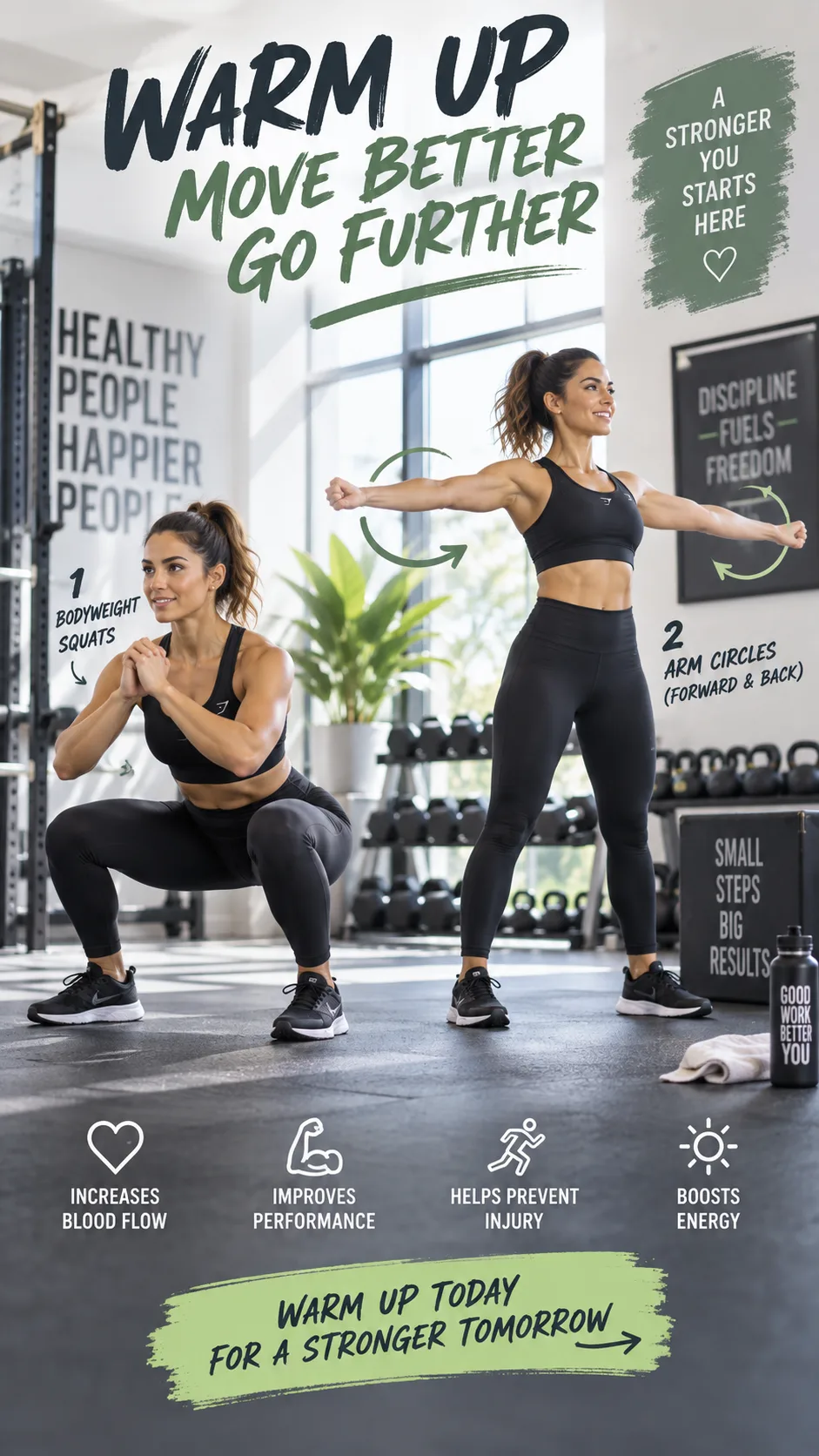
A 5 to 10 minute warm-up increases blood flow, raises muscle temperature, and reduces injury risk. Cold muscles tear more easily. This isn’t a scare tactic. It’s just biology.
Here’s a simple warm-up sequence that takes under 10 minutes:
- 5 minutes light cardio (treadmill walk, bike, or jumping jacks)
- 10 bodyweight squats
- 10 hip circles each direction
- 10 arm circles forward and back
- 10 glute bridges
- 5 inchworms
After that, do one “feeler” set of your first exercise with light weight before your working sets. Your body will thank you.
Nutrition basics: you can’t out-train a bad diet
You don’t need to obsess over macros on day one. But a few basics make a real difference in how well you recover and how fast you progress.
- Protein: aim for roughly 0.7-1g per pound of bodyweight daily. Chicken, eggs, Greek yogurt, fish, legumes. Pick what you enjoy.
- Calories: if building strength is the goal, eating enough total calories matters. Undereating while training hard leads to fatigue, poor recovery, and stalled progress.
- Hydration: drink water consistently throughout the day, not just during the workout. Even mild dehydration hurts performance and recovery.
ACE Fitness provides solid evidence-based guidance on sports nutrition for those who want to go deeper on the dietary side without drowning in bro-science forums.
Common beginner mistakes to avoid
IMO, this section alone is worth reading twice. These mistakes set beginners back by weeks or months, and they’re all avoidable.
- Going too heavy too soon. Ego loading is the fastest path to injury and the slowest path to strength.
- Skipping the warm-up. Already covered, but seriously, don’t.
- Inconsistent attendance. Showing up 3 days a week for 3 months beats showing up 6 days a week for 3 weeks then burning out.
- Chasing soreness. Soreness is not an indicator of a good workout. Progress in the weights is. Stop treating DOMS as a success metric.
- Comparing yourself to experienced lifters. The person squatting 300 lbs started with the bar. Everyone does.
- Program hopping. Pick one beginner program and run it for at least 8 to 12 weeks before changing anything.
How long before you see results?
Honest answer: strength gains start in 2 to 3 weeks, but they’re mostly neural adaptations at first. Your brain gets better at recruiting the muscle you already have. Visible muscle growth typically appears around the 6 to 8 week mark for most beginners who train consistently and eat adequately.
Three months of consistent full body training will produce a noticeable transformation in both strength and body composition. That’s 36 workouts. That’s entirely achievable. The question is whether you’ll stay consistent long enough to get there.
What separates people who get results from people who don’t isn’t genetics or perfect programming. It’s showing up when they don’t feel like it. The workout only fails if you skip it.
Watch: beginner full body workout tutorial
If you want to see proper form demonstrated before you hit the gym, this tutorial covers the exact movements in this program with clear coaching cues:
When to progress beyond this program
This beginner full body workout will serve you well for 3 to 6 months. You’ll know it’s time to advance when:
- Progress on weight or reps stalls for 2 to 3 consecutive weeks despite good recovery
- The basic movements feel automatic and technically solid
- You’ve been consistent for at least 12 weeks
At that point, you’re ready to explore intermediate programming: slightly higher volume, more exercise variation, and possibly a 4-day split. Women specifically benefit from a structured gym plan designed around full body training for women, which accounts for recovery needs and hormonal cycles when scaling up training volume.
NASM’s guidelines on progressive resistance training offer a research-backed framework for how to structure that next phase of training when you get there.
Final thoughts: keep it simple, stay consistent
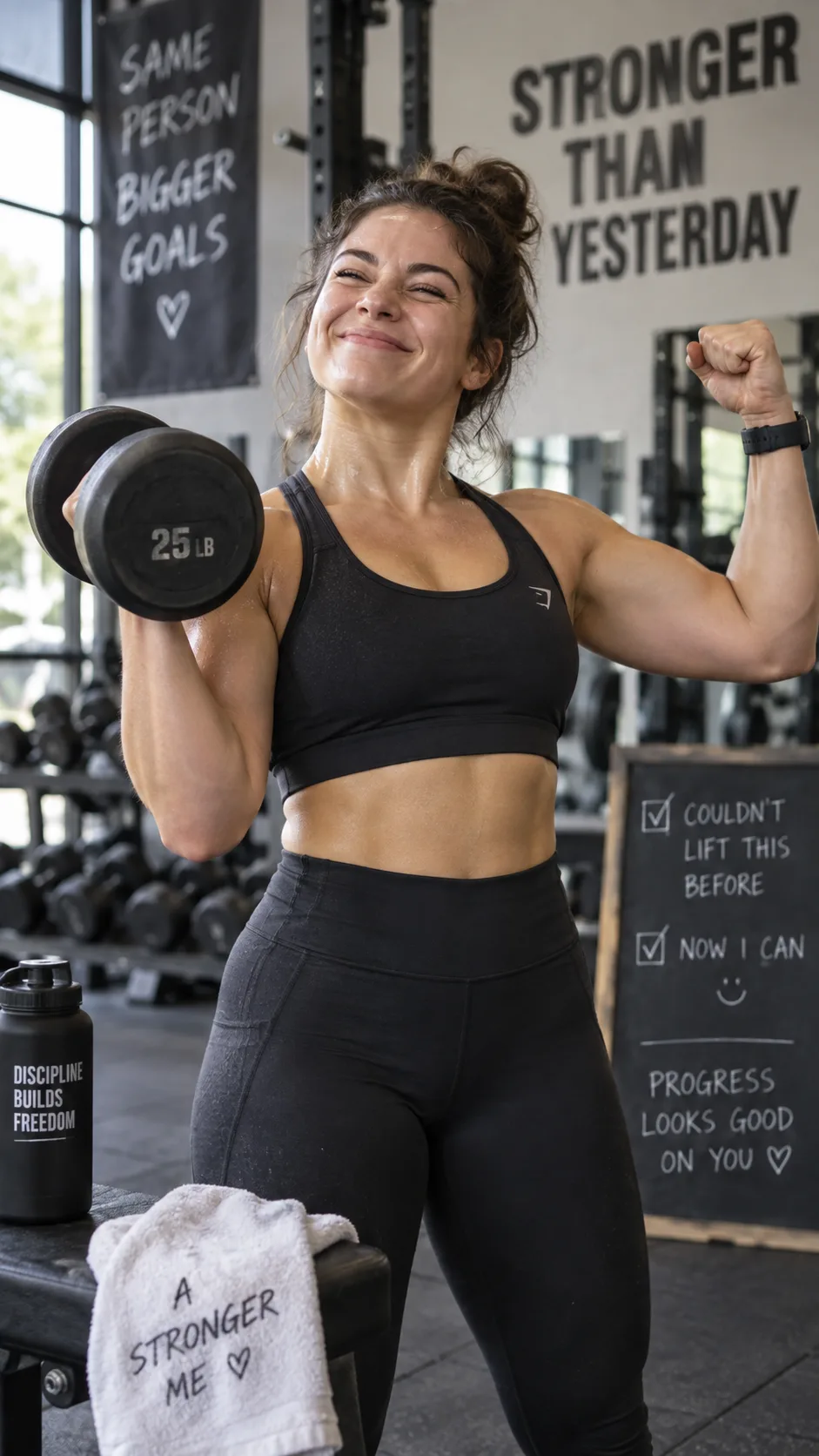
The best beginner full body workout is the one you actually do. Not the one with the most exercises, the fanciest equipment, or the most complex periodization scheme. This routine works because it hits every major muscle group, teaches the fundamental movement patterns, and gives you enough recovery time to come back stronger each session.
Start with this program. Follow it for 12 weeks. Track your weights and reps. Show up consistently. Do those four things and you’ll be miles ahead of everyone who’s still searching for the “perfect” program instead of running one.
The hardest part isn’t the workout itself. It’s starting. You’ve already done that by reading this far, so now go lift something. 🙂
