
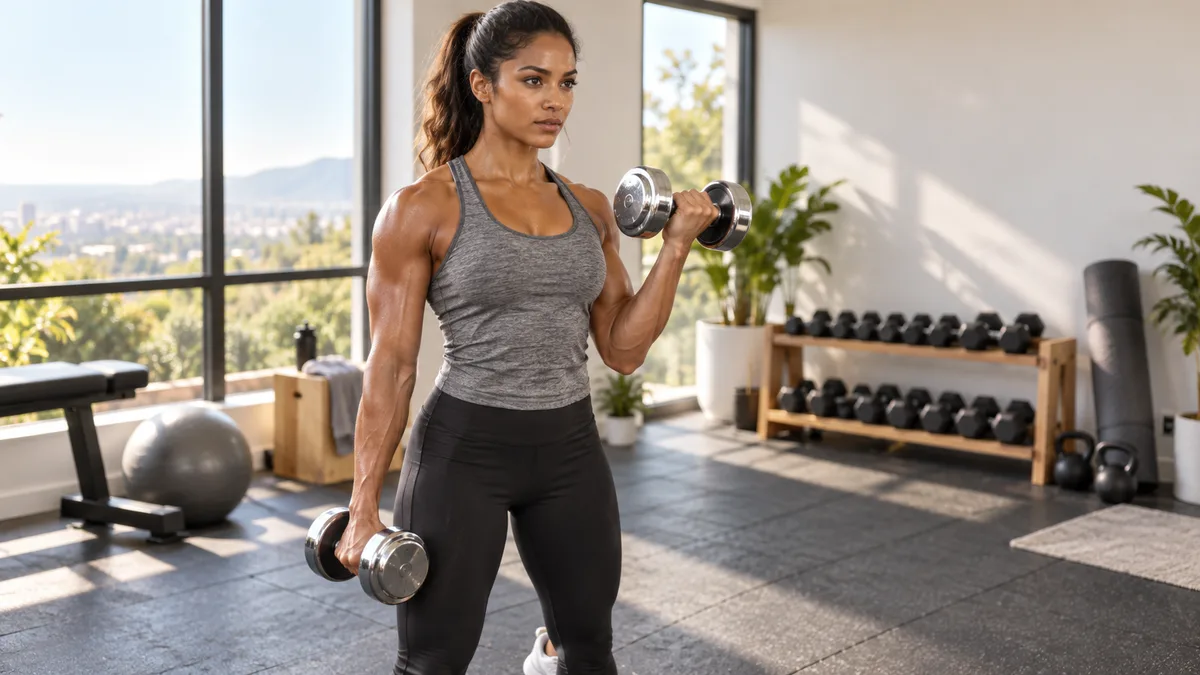
You want arms that look strong, defined, and capable. Not just for the mirror, but because strong arms make everyday life easier. And here’s the thing: you don’t need a fancy cable machine or a gym membership to get there. A pair of dumbbells and the right 9 moves will do more for your arm definition than most hour-long gym sessions ever will.
I’ve been training with dumbbells for years, and the biggest mistake I see people make is going through the motions without purpose. These 9 exercises fix that. Each one targets a specific part of your arms (biceps, triceps, and shoulders) so you build balanced, sculpted muscle from every angle.
Why dumbbells are perfect for toning your arms
Ever wondered why dumbbells show up in almost every serious trainer’s program? They force each arm to work independently, which means your stronger side can’t secretly carry your weaker side. That leads to more balanced muscle development and better definition over time.
Dumbbells also let your joints move through a natural range of motion. Compared to barbells or machines, they recruit more stabilizing muscles with every rep. More muscle fibers working means more stimulus for growth, and more growth means more definition. Simple as that.
According to ACE Fitness, compound and isolation dumbbell exercises together produce the most well-rounded arm development. That’s exactly what this workout delivers.
If you want to expand this into a full upper body routine, check out our Complete Upper Body Dumbbell Workout Plan. It pairs perfectly with everything here.
What you need before you start
Choosing the right dumbbell weight
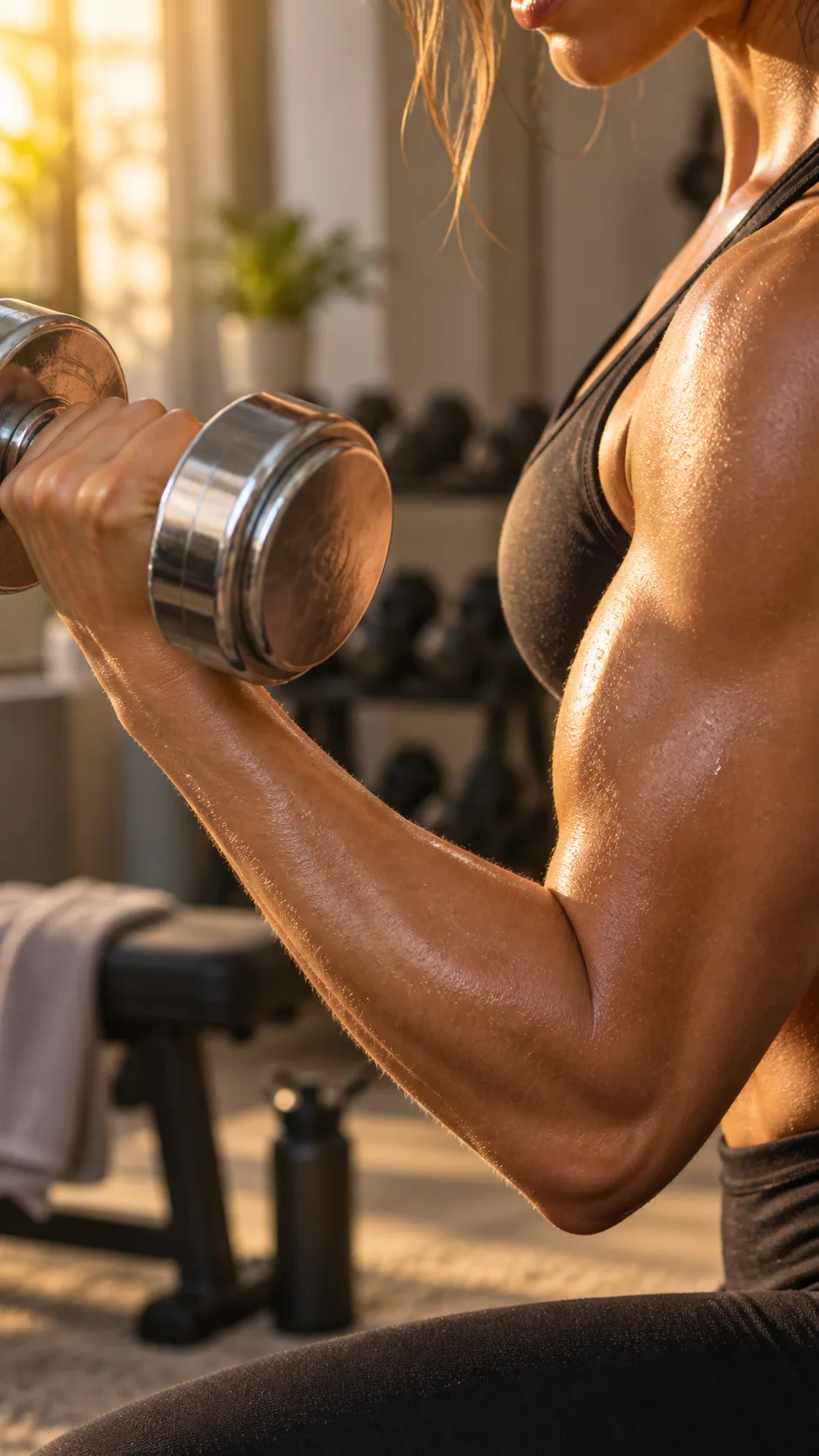
This matters more than people admit. Too light and you won’t stimulate enough muscle tissue. Too heavy and your form breaks down, which shifts the work away from the target muscle, and that defeats the entire point.
- Beginners: Start with 5-10 lb dumbbells for isolation moves (curls, kickbacks) and 8-15 lb for compound moves
- Intermediate: 10-20 lb for isolation, 15-25 lb for compound exercises
- Advanced: Go heavier where form stays clean. That’s your ceiling, not a fixed number
A good rule: if you can breeze through 15 reps with perfect form, the weight is too light. If you can’t hit 8 clean reps, it’s too heavy.
How often to train your arms
Research from the National Academy of Sports Medicine supports training each muscle group 2-3 times per week for optimal hypertrophy. For most people, two dedicated arm sessions per week plus upper body compound work hits that sweet spot.
Give muscles at least 48 hours between sessions to recover. Recovery is where the actual adaptation and definition happens. Training sore muscles doesn’t speed things up; it slows you down.
The 9 sculpting dumbbell moves for toned arms
Here’s the full lineup. Work through all 9 or pick a targeted grouping based on your session focus. Each exercise includes sets, reps, and the coaching cue that makes it work.
1. Standard bicep curl
The classic for a reason. Bicep curls isolate the biceps brachii, the muscle that creates that visible peak when you flex. Stand with feet hip-width apart, dumbbells at your sides with palms facing forward. Curl both dumbbells toward your shoulders, squeeze hard at the top, then lower slowly.
- Sets/Reps: 3 sets of 10-12 reps
- Coaching cue: Keep your elbows pinned to your sides. Moving them forward turns this into a front raise
- Tempo tip: Take 3 seconds on the way down; that slow eccentric phase builds more muscle
2. Hammer curl
Same movement, different grip, and that distinction changes everything. Hammer curls target the brachialis, a muscle that sits underneath the bicep and physically pushes it up when developed. Hold dumbbells with a neutral grip (palms facing each other) and curl straight up.
- Sets/Reps: 3 sets of 10-12 reps
- Coaching cue: Don’t let the wrists rotate mid-rep. Keep that neutral grip locked in the whole way
- Bonus: This also builds the brachioradialis, which fills out the forearm
3. Concentration curl
If you want to isolate the bicep peak and feel it working, this is the move. Sit on a bench, rest your elbow against the inside of your thigh, and curl the dumbbell slowly up toward your shoulder. The fixed elbow eliminates any body English. The bicep does all the work, no cheating allowed.
- Sets/Reps: 3 sets of 10 reps per arm
- Coaching cue: Pause and squeeze for one full second at the top of each rep
- Why it works: By eliminating momentum, you get maximum tension on the muscle throughout the movement
4. Overhead tricep extension
Your triceps make up roughly two-thirds of your upper arm. If you want defined arms, you have to train them just as hard as your biceps. Most people forget this. The overhead extension targets the long head of the tricep, which is the largest and most visible portion.
Hold one dumbbell with both hands overhead, arms fully extended. Lower it behind your head by bending at the elbows, then press back up. Keep your upper arms close to your ears throughout.
- Sets/Reps: 3 sets of 10-12 reps
- Coaching cue: Only your forearms move. Your upper arms stay completely still
- Avoid: Flaring your elbows out wide, which reduces the load on the tricep
5. Tricep kickback
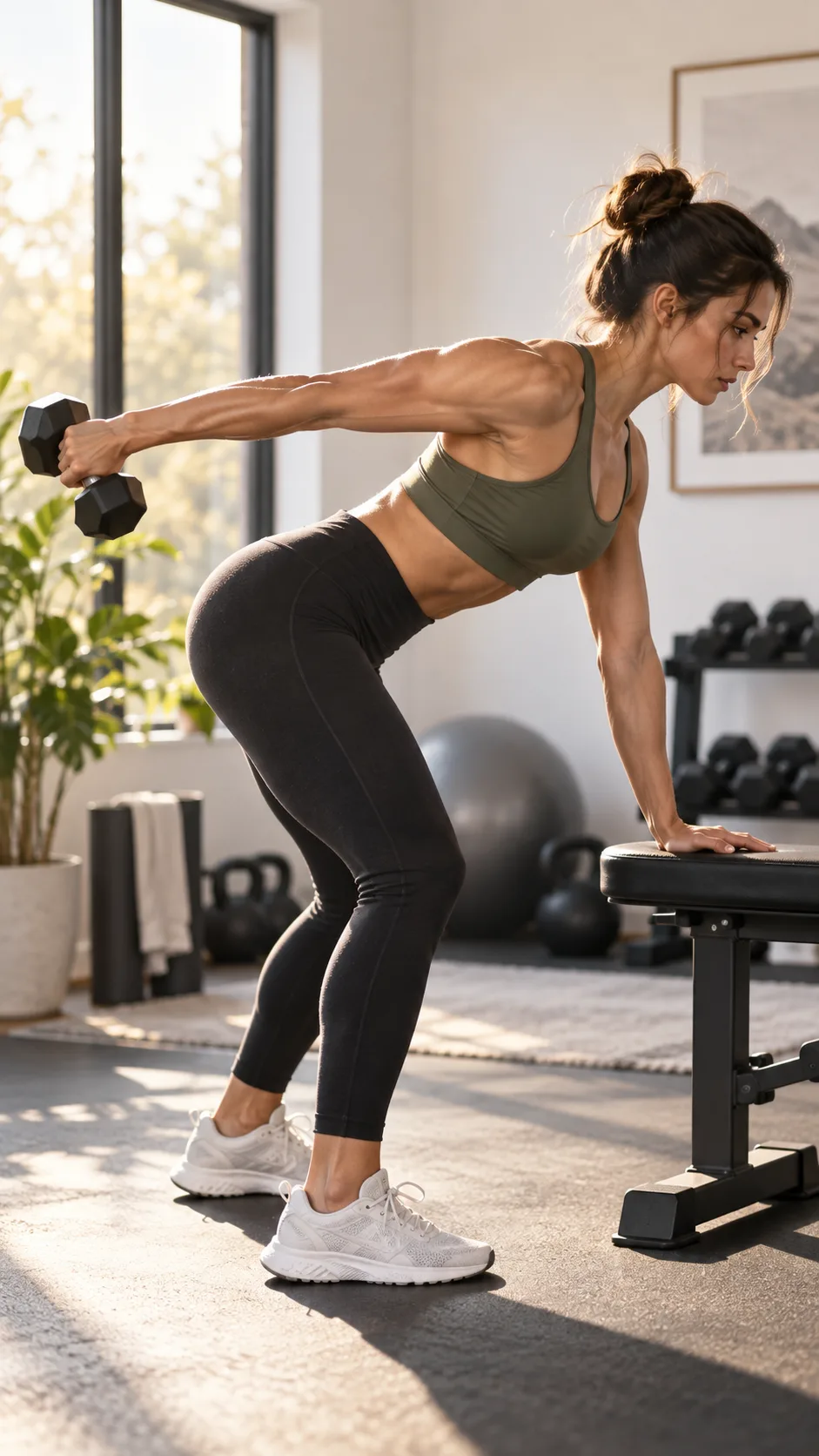
This one looks deceptively easy, which is exactly why people rush through it and get nothing out of it. Hinge forward at the hips with a flat back, pin your upper arm parallel to the floor, and extend your forearm back until your arm is completely straight. Squeeze hard at full extension, because that peak contraction is where the real work happens.
- Sets/Reps: 3 sets of 12 reps per arm
- Coaching cue: Upper arm stays parallel to the floor the entire time, not tilted down
- Weight note: Go lighter than you think here; most people butcher this with too much weight
6. Dumbbell skull crusher
The name sounds dramatic but the exercise is just an overhead tricep press done lying down, and it’s incredibly effective. Lie on a bench or the floor, hold dumbbells directly above your chest with palms facing each other, then lower them toward your temples by bending at the elbows. Press back up without locking the elbows fully at the top.
- Sets/Reps: 3 sets of 10-12 reps
- Coaching cue: Lower slowly and with control. This is an exercise where rushing causes shoulder issues
- Muscles hit: All three heads of the tricep, with emphasis on the lateral and medial heads
7. Lateral raise
Want that defined shoulder cap that makes your arms look sculpted even in a t-shirt? Lateral raises build the medial deltoid, the shoulder muscle that creates width and that clean, athletic shape. Stand with dumbbells at your sides and raise both arms out to shoulder height, leading with your elbows, not your hands.
- Sets/Reps: 3 sets of 12-15 reps
- Coaching cue: Tip the front of the dumbbell very slightly downward at the top. This keeps the deltoid engaged and protects the rotator cuff
- Common mistake: Shrugging your traps up as you raise. Keep shoulders down and packed
8. Front raise
Where lateral raises hit the medial delt, front raises target the anterior (front) deltoid. Hold dumbbells in front of your thighs with palms facing down. Raise one or both dumbbells straight out in front to shoulder height, then lower with control. Alternating arms lets you keep strict form on every rep.
- Sets/Reps: 3 sets of 10-12 reps (or 10-12 per arm if alternating)
- Coaching cue: Avoid using body sway or momentum. The shoulder does the work, not your lower back
- Pairing tip: Superset with lateral raises to hit both deltoid heads back to back
9. Bent-over rear delt fly
Most people ignore the rear deltoid, then wonder why their arms look flat from the side. The bent-over fly fixes that. Hinge forward at the hips, let the dumbbells hang in front of you with a slight bend in the elbows, then raise both arms out to your sides in a wide arc. Squeeze your shoulder blades together at the top.
- Sets/Reps: 3 sets of 12-15 reps
- Coaching cue: Think about leading with your elbows, not your hands. It keeps the rear delt engaged instead of recruiting the traps
- Why it matters: Strong rear delts improve posture, which itself makes arms look more defined
How to structure this as a full workout
You’ve got 9 moves. Now here’s how to put them together into a session that delivers results rather than just leaving you sweaty and confused.
Option A: Full arm day (all 9 moves)
- Lateral Raise, 3 sets x 12-15 reps (warm up with lighter weight)
- Standard Bicep Curl, 3 sets x 10-12 reps
- Overhead Tricep Extension, 3 sets x 10-12 reps
- Hammer Curl, 3 sets x 10-12 reps
- Tricep Kickback, 3 sets x 12 reps each side
- Concentration Curl, 3 sets x 10 reps each side
- Skull Crusher, 3 sets x 10-12 reps
- Front Raise, 3 sets x 10-12 reps
- Bent-Over Rear Delt Fly, 3 sets x 12-15 reps
Rest 45-60 seconds between sets. The full session runs about 45-55 minutes at a focused pace. Rest 90 seconds on heavier compound moves like skull crushers if needed.
Option B: Two shorter sessions (split by muscle group)
Session 1, Biceps + Front Delts: Bicep Curl, Hammer Curl, Concentration Curl, Front Raise
Session 2, Triceps + Shoulders: Overhead Extension, Tricep Kickback, Skull Crusher, Lateral Raise, Rear Delt Fly
This split works well if you train 4-5 days a week and want to pair arms with larger muscle group days. Add these sessions to your Full Upper Body Dumbbell Workout Plan for a well-rounded weekly schedule.
Tips that speed up your results
The exercises alone won’t get you there if the supporting habits are off. Here’s what genuinely moves the needle:
- Progressive overload is non-negotiable. Add 2.5-5 lbs or one extra rep every 1-2 weeks. Your muscles adapt fast, so don’t let them get comfortable.
- Protein intake matters. According to Healthline, most active people benefit from 0.7-1 gram of protein per pound of bodyweight daily to support muscle repair and growth.
- Slow down the eccentric (lowering) phase. Three seconds down on every rep doubles the time under tension, and time under tension drives hypertrophy.
- Sleep is a training variable, not a luxury. Muscle tissue repairs and grows during deep sleep. Cutting sleep cuts your results. Full stop.
- Consistency beats intensity every time. Two solid workouts a week for six months outperforms one brutal week followed by three weeks off. Show up consistently.
The single biggest unlock for most people is just slowing down and feeling the muscle work. Stop rushing through reps and start controlling the movement. It changes everything.
Common mistakes that kill your progress
Want to know why a lot of arm workouts don’t deliver? These are the culprits:
- Using momentum instead of muscle. Swinging the dumbbells up uses your back and hip flexors, not your biceps. Control the weight from start to finish.
- Skipping triceps. Triceps make up two-thirds of your upper arm. If you only curl, you’re building 33% of the arm and neglecting the rest. Train both.
- Neglecting the rear delts. They stabilize your shoulders and make your arms look defined from every angle, not just the front.
- Never changing the stimulus. Your muscles adapt to the same weight and rep scheme within weeks. Vary your reps, tempo, rest times, and weight to keep progressing.
- Skipping rest days. Muscles don’t grow during training. They grow during recovery. More sessions aren’t always better sessions.
If you’re a woman looking for a no-equipment option to complement this, our Best Arm Workout for Women covers bodyweight moves that pair well with dumbbell training days.
How long until you see results?
Here’s the honest answer: you’ll feel a difference in 2-3 weeks and see a visible difference in 6-8 weeks with consistent training and adequate protein. Mayo Clinic research confirms that strength adaptations begin quickly, but visual changes in muscle definition take longer because they also depend on body composition, not just muscle size.
The takeaway: trust the process. Track your weights and reps each session so you can see the strength improvements happening even before the mirror catches up. Progress is progress, even when it’s not visible yet.
Your arms won’t sculpt themselves (but these 9 moves help)
You now have everything you need: 9 targeted dumbbell exercises, structured workout options, and the habits that make the training stick. There’s no secret shortcut, just consistent reps, progressive overload, enough protein, and enough sleep.
Pick a weight, start with Move 1, and go. The best arm workout is always the one you do. Come back to this guide each week, track what you lift, and add a little more weight or a couple extra reps as soon as the current load starts feeling manageable.
Strong, defined arms aren’t a genetic gift. They’re the result of deliberate training done repeatedly over time. These 9 moves give you the blueprint. Now go build something worth flexing.
