
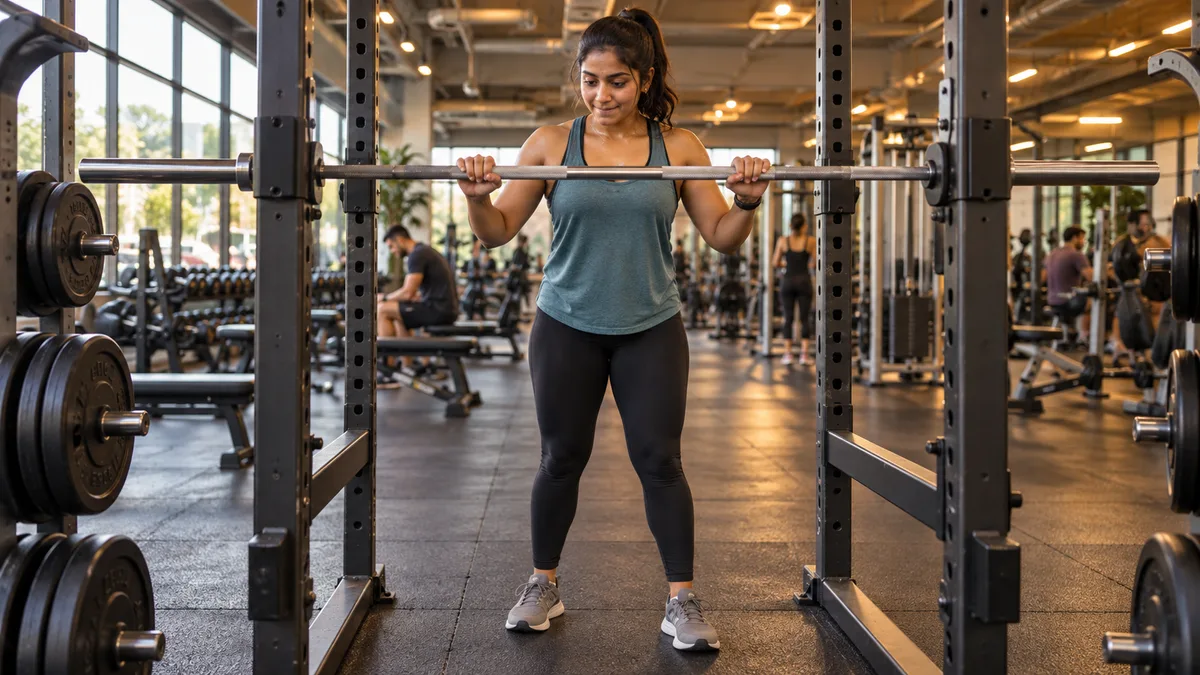
Walking into the gym for your first leg day feels a bit like showing up to a party where you don’t know anyone, and everyone else looks like they’ve been friends for years. The squat rack seems intimidating, the leg press machine looks like it belongs in a spaceship, and you have absolutely no idea where to start.
Here’s the thing: every single person in that gym had a first leg day. Every one of them felt awkward, unsure, and probably loaded the wrong weight at least once. You’re not behind. You’re just beginning. And this guide exists to make sure your beginning feels strong, clear, and surprisingly fun.
Below, you’ll find a complete beginner leg day workout at the gym that covers exercise selection, proper form cues, sets, reps, and the confidence-building details nobody tells you about. No fluff. No complicated fitness jargon. Just a workout you can walk in and do.
Why leg day matters more than you think
Skipping leg day isn’t cute, and it isn’t strategic. Your legs house the largest muscle groups in your entire body: your quadriceps, hamstrings, glutes, and calves. Training them burns more calories per session than almost any upper body workout you could do.
Beyond the calorie burn, strong legs improve literally everything else in your life. Climbing stairs without getting winded? Thank your quads. Picking up heavy grocery bags without tweaking your back? Your hamstrings and glutes handled that. The American College of Sports Medicine notes that lower body resistance training also significantly improves bone density, something that matters at every age.
There’s also something deeply satisfying about feeling powerful from the ground up. A strong foundation changes the way you carry yourself, and that confidence starts on day one.
What you need before you hit the gym floor
Footwear and clothing
Wear flat, stable shoes. Not those squishy running sneakers with the thick foam sole. Running shoes absorb force, which is great for pavement and terrible for squats. You want to feel the ground beneath you. Converse, Vans, or dedicated lifting shoes all work well.
For clothing, pick something you can move freely in. You’ll squat, lunge, and bend at the hips. If your leggings ride up or your shorts restrict your range of motion, you’ll spend more time adjusting your outfit than training your legs.
Mindset check
Nobody, and I mean nobody, cares what weight you’re lifting. The guy squatting 315 pounds? He’s focused on not passing out. The woman on the leg press? She’s counting reps in her head. You are invisible in the best possible way. Use that freedom to focus entirely on yourself.
Your only job today: learn the movements and leave the gym feeling better than when you walked in.
The complete beginner leg day workout at the gym
This routine targets your quads, hamstrings, glutes, and calves using beginner-friendly exercises with clear progressions. You’ll need about 45 to 55 minutes including your warm-up. Print this page, screenshot it, bookmark it, whatever keeps it accessible when you walk through those gym doors.
Step 1: The warm-up (5 to 8 minutes)
Never skip your warm-up. Cold muscles don’t perform well and they get injured more easily. That’s not an opinion. That’s basic physiology.
- 5 minutes on the stationary bike or treadmill walk at a comfortable pace (just enough to break a light sweat)
- Bodyweight squats — 2 sets of 10 reps
- Leg swings (front to back, side to side) — 10 each leg
- Glute bridges on the floor — 2 sets of 12 reps
This primes your joints, activates your glutes (which love to stay sleepy), and sends blood to the muscles you’re about to work. Think of it as waking your legs up before asking them to do real work.
Step 2: Goblet squats
Sets: 3 | Reps: 10 to 12 | Rest: 60 to 90 seconds
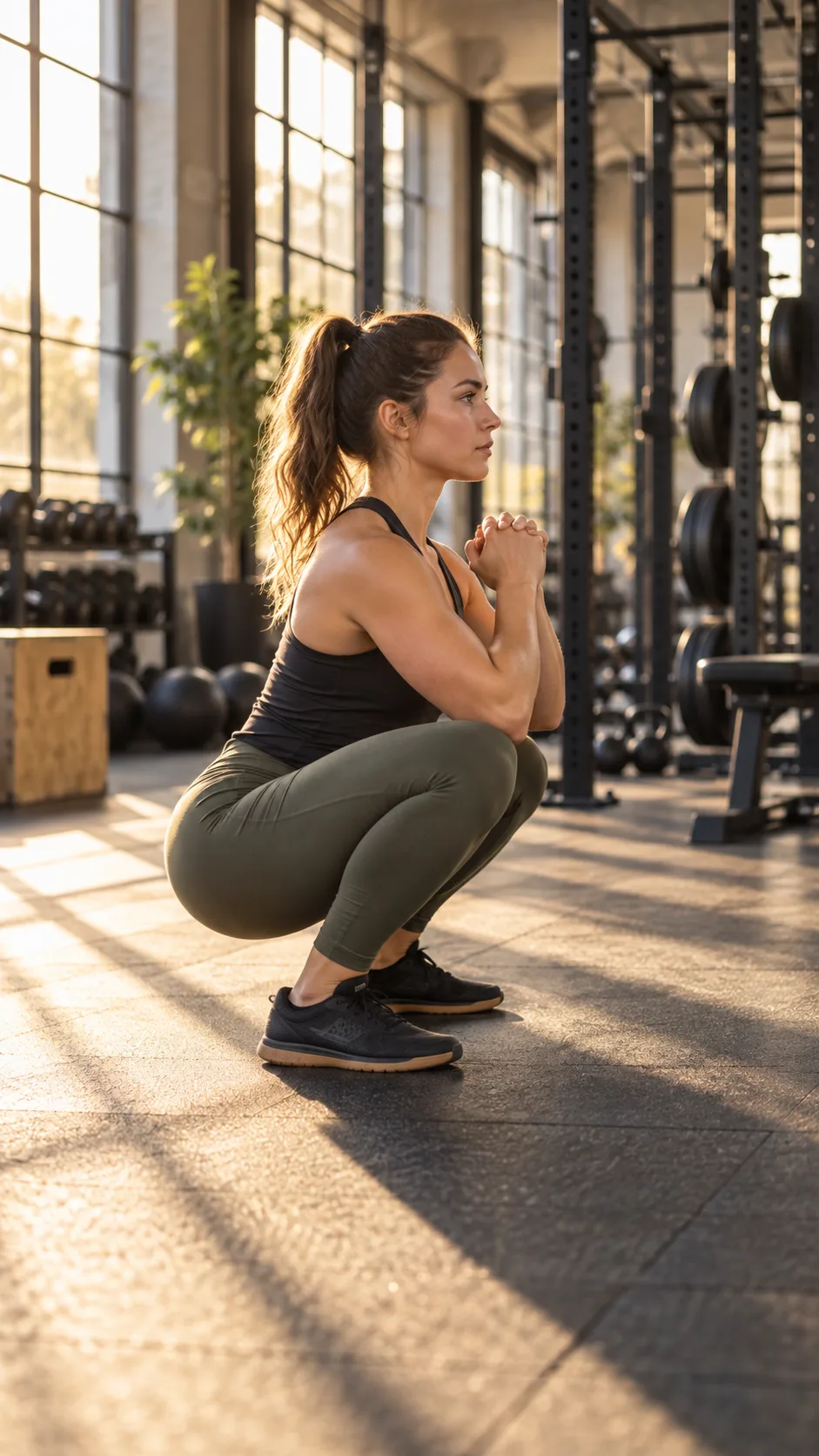
The goblet squat teaches you perfect squat mechanics without the intimidation of a barbell on your back. Grab a dumbbell or kettlebell, hold it at chest height with both hands, and squat down like you’re sitting into a chair. Keep your chest up, your knees tracking over your toes, and push through your entire foot to stand back up.
Start with a weight that feels manageable but not effortless. If you can do 12 reps and still feel like chatting about your weekend plans, go heavier. If you’re struggling by rep 6, lighten the load. The sweet spot is challenging but controlled.
If you want to explore more squat variations as you progress, the Smith machine leg workout guide covers excellent options for building quad and glute strength with added stability.
Step 3: Leg press machine
Sets: 3 | Reps: 10 to 12 | Rest: 60 to 90 seconds
The leg press is a beginner’s best friend. The machine guides the movement for you, so you can focus entirely on pushing weight and building strength without worrying about balance. Place your feet shoulder-width apart on the platform, lower the sled until your knees hit about 90 degrees, and press through your heels to extend your legs.
One important tip: never lock your knees completely at the top. Keep a tiny bend. Your joints will thank you for decades to come.
Step 4: Romanian deadlifts (RDLs)
Sets: 3 | Reps: 10 | Rest: 60 to 90 seconds
Romanian deadlifts target your hamstrings and glutes in a way that almost nothing else can. Hold a pair of dumbbells in front of your thighs, hinge at your hips (push your butt back like you’re closing a car door with it), and lower the dumbbells along your shins until you feel a deep stretch in the back of your legs. Then squeeze your glutes to stand tall again.
The biggest mistake beginners make here: rounding the back. Keep your spine neutral the entire time. Imagine balancing a broomstick along your back. It should touch your head, upper back, and tailbone throughout the movement. If it doesn’t, reduce the weight and practice the pattern.
Step 5: Walking lunges
Sets: 3 | Reps: 10 per leg | Rest: 60 to 90 seconds
Walking lunges build single-leg strength, improve your balance, and seriously challenge your quads and glutes. Step forward, lower your back knee toward the floor (don’t slam it, a gentle hover is perfect), and drive through your front heel to step into the next lunge.
Start with just your bodyweight. Seriously. Walking lunges have a sneaky way of humbling even experienced lifters, so there’s zero shame in going unweighted for your first few sessions. Once you own the movement, grab a pair of light dumbbells.
Step 6: Seated leg curls
Sets: 3 | Reps: 12 | Rest: 60 seconds
This machine isolates your hamstrings, the muscles running along the back of your thighs. Adjust the pad so it sits comfortably just above your ankles, select a light weight, and curl the pad toward your glutes with control. Slow the movement down on the way back up. That eccentric (lowering) phase builds strength incredibly well.
The research on eccentric training consistently shows it produces significant muscle and strength gains, especially for beginners. So resist the urge to let the weight just drop. Control it.
Step 7: Standing calf raises
Sets: 3 | Reps: 15 | Rest: 45 seconds
Your calves deserve attention too. Stand on the edge of a step or the calf raise machine, lower your heels below the platform, and press up onto your toes as high as you can. Pause at the top for a full second. That pause makes a HUGE difference in how much your calves work.
Higher reps work well here because calves are endurance muscles. They carry you around all day, every day. You need volume to challenge them.
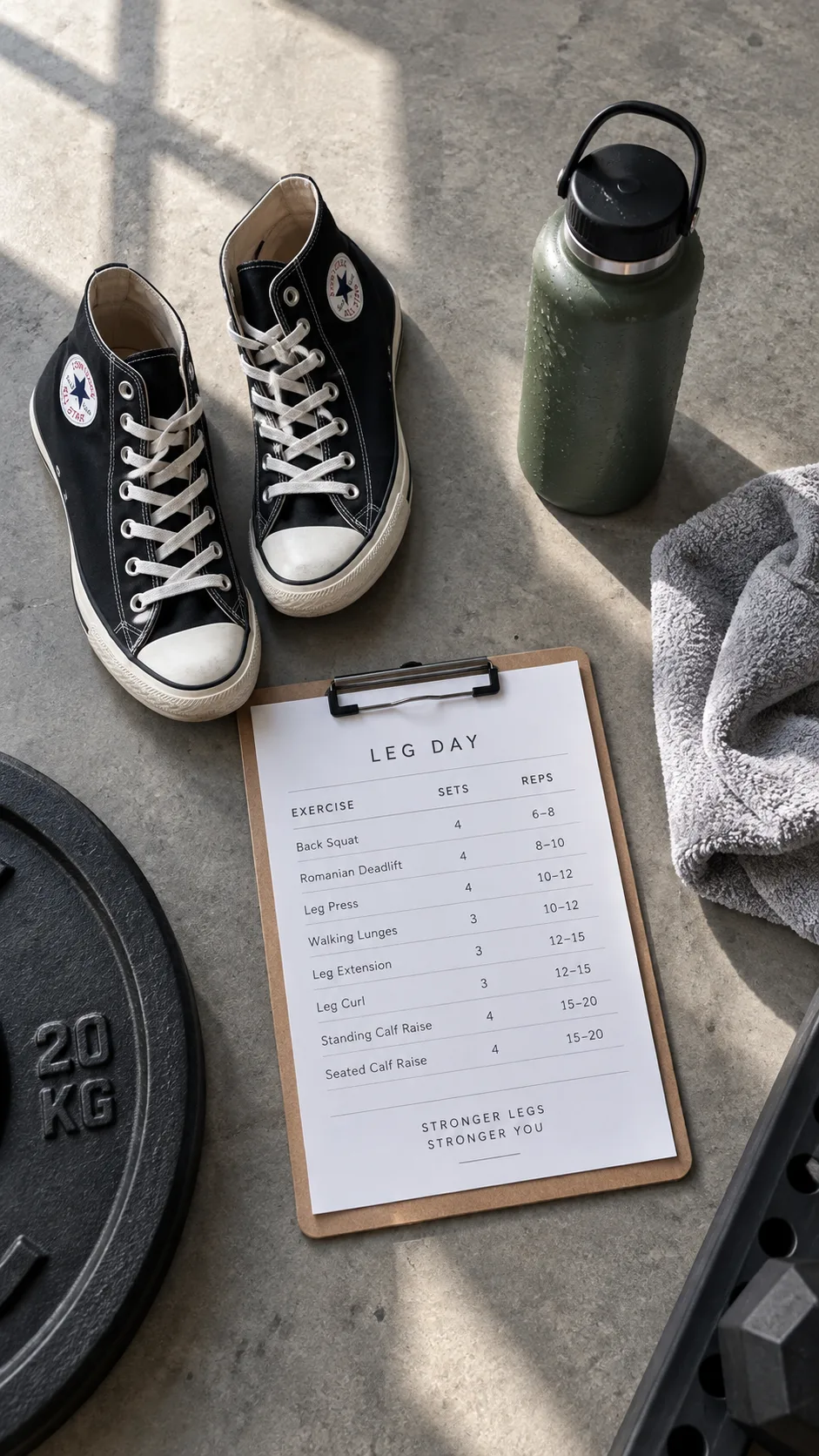
Quick reference: your full beginner leg day routine
Here’s the entire workout in one clean snapshot:
- Warm-Up — 5 to 8 minutes (bike/walk + bodyweight activation)
- Goblet Squats — 3 x 10 to 12
- Leg Press — 3 x 10 to 12
- Romanian Deadlifts — 3 x 10
- Walking Lunges — 3 x 10 per leg
- Seated Leg Curls — 3 x 12
- Standing Calf Raises — 3 x 15
Total time: roughly 45 to 55 minutes. Total exercises: 6 (plus warm-up). Total excuses needed to skip it: zero 🙂
How to choose the right weight as a beginner
This trips up almost everyone. You don’t want to go so light that you feel nothing, but you also don’t want to load up heavy and destroy your form on set one. Here’s the simple rule I always recommend:
Pick a weight where reps 8 through 10 feel genuinely challenging, but you could still do 2 more with decent form. That’s your working weight. Write it down. Next week, try to add a small increment or squeeze out one extra rep. That’s progressive overload, and it’s exactly how beginners build strength week after week.
If a weight feels “too easy” through all your sets, bump it up by the smallest available increment next session. Progress doesn’t need to be dramatic. It just needs to be consistent.
Common beginner leg day mistakes (and how to dodge them)
I’ve made most of these myself, so learn from my mistakes instead of earning your own. Deal?
- Skipping the warm-up: You’ll feel stiff during squats and your performance will suffer. Five minutes of warming up saves you weeks of recovering from a preventable tweak.
- Going too heavy too soon: Your ego isn’t a muscle you need to train. Start lighter than you think you should and build from there.
- Cutting depth on squats: Half squats give you half results. Aim for at least parallel (thighs parallel to the floor) on every rep.
- Rushing through reps: Speed kills quality. Control every rep. Two seconds down, one second up is a good starting tempo.
- Neglecting hamstrings: Everyone loves quad exercises. But balanced leg development requires equal attention to the muscles you can’t see in the mirror.
- Comparing yourself to others: Someone else’s chapter 20 is not your chapter 1. Stay in your lane and track YOUR progress.
What about soreness after your first leg day?
Oh, it’s coming. The soreness you’ll feel 24 to 48 hours after your first leg day has a fancy name: Delayed Onset Muscle Soreness (DOMS). It’s completely normal, it doesn’t mean you did anything wrong, and it will get dramatically less intense as your body adapts over the next few weeks.
The National Strength and Conditioning Association notes that DOMS peaks between 24 and 72 hours post-exercise and resolves on its own. Walking, light stretching, and staying hydrated all help speed up recovery. Sitting on the couch and refusing to move? That makes it worse.
The worst thing you can do is let that first-session soreness scare you away from coming back. Your second leg day will feel noticeably better. Your third? Even easier. Consistency is the antidote to soreness.
How often should beginners train legs?
Once or twice a week works perfectly for most beginners. If you’re following a full body program, you’ll naturally hit your legs in each session. If you prefer a split routine, dedicate one full day to legs and you’ll see solid progress.
Need help building the rest of your weekly schedule around leg day? The 3 day split workout for women gym beginners lays out a practical structure that balances upper body, lower body, and recovery without leading to burnout.
The main principle: give your legs at least 48 hours of rest before training them again. Muscles grow during recovery, not during the workout itself. Respect the process and you’ll see results faster than if you hammer your legs every single day.
When should you progress this workout?
Follow this routine for 4 to 6 weeks. During that time, focus on two things: improving your form and gradually increasing the weight or reps. Once you can complete every exercise at the top of the rep range with good form and moderate effort, your body is ready for new challenges.
Progression options include:
- Adding a set to each exercise (going from 3 to 4 sets)
- Swapping goblet squats for barbell back squats
- Introducing Bulgarian split squats or hip thrusts
- Reducing rest periods to increase workout density
For a deeper look at leg day exercises and progressions, the lower body workout at the gym guide covers more advanced movements you can rotate in as you grow stronger.
The confidence factor nobody talks about
Here’s what I genuinely believe: the hardest part of your first leg day at the gym isn’t the squats, the lunges, or even the soreness afterward. The hardest part is walking through the door and deciding you belong there.
And you do. Full stop. Whether you’re squatting the bar or squatting 200 pounds, you showed up. You chose to invest in yourself. That decision alone puts you ahead of everyone who stayed home because they felt “not ready enough.”
Confidence doesn’t come before the first set. It comes FROM the first set. From learning that the leg press isn’t that scary. From realizing that Romanian deadlifts feel kind of amazing once you nail the hip hinge. From walking out of the gym with shaky legs and a genuine smile because you just DID that.
Final thoughts: your legs are ready, so are you
You now have a complete beginner leg day workout at the gym that covers every major muscle group, respects your current fitness level, and sets you up for real, measurable progress. No guesswork, no complicated programming, no reason to stand in the gym feeling lost.
Start with the warm-up. Hit each exercise with intention. Write down your weights. Come back next week and do it a little better. That’s the entire formula.
Your first leg day doesn’t need to be perfect. It just needs to happen. So pick a day this week, open this guide on your phone, and go make those legs work. Future you, the one walking up stairs without a second thought and feeling genuinely strong, will be incredibly glad you started today.
