
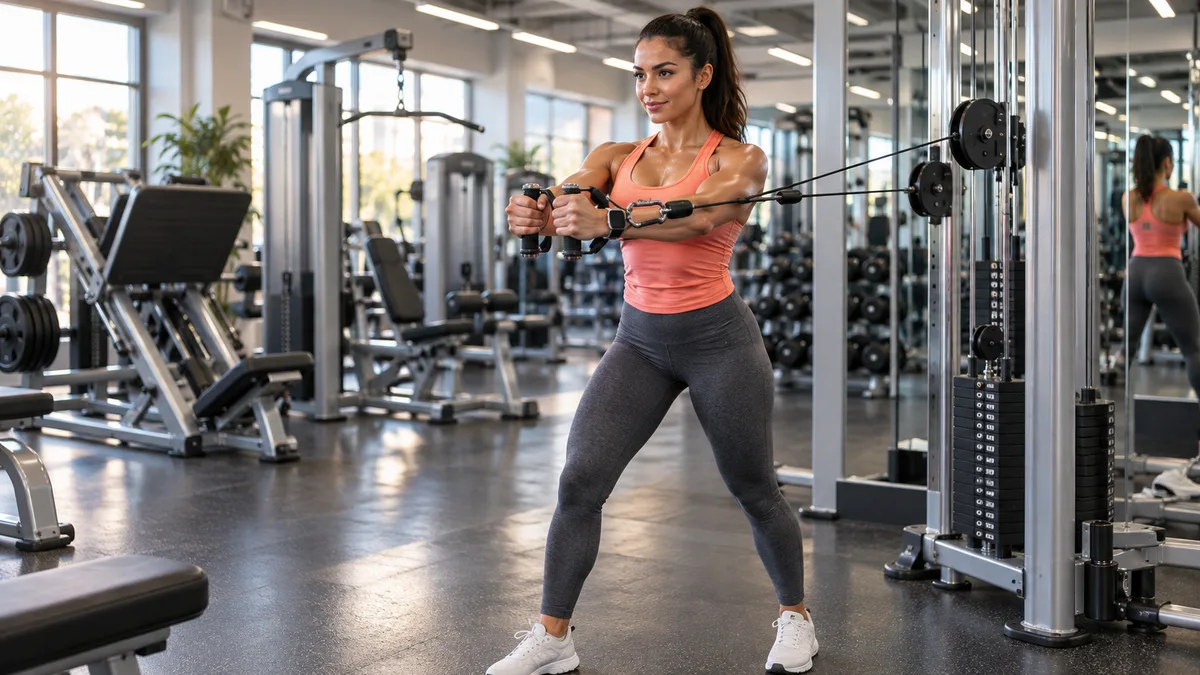
You walk into the gym. You look around at 47 different machines. You hop on the one that’s open, do some reps until your arms feel weird, then wander to the next available thing. Sound familiar? This is what I call “pinball workouts.” You bounce randomly from machine to machine with zero strategy. Most of us have been there.
Gym machines are incredible tools for women who want to build strength, shape muscle, and stop wasting time. But only if you use them with a plan. Not a complicated spreadsheet. Not a bodybuilder’s 6-day split. Just a simple, repeatable formula that tells you what to do every time you walk through those gym doors.
That’s what we’re building today: a beginner machine formula that replaces chaos with clarity.
Why machines are perfect for beginners (despite what the internet says)
There’s this persistent myth floating around fitness circles that machines are “inferior” to free weights. You’ve probably seen the memes. But here’s what experienced trainers know: machines are the fastest way for beginners to build strength safely.
Why? Because machines control the movement path for you. When you’re new to training, your stabilizer muscles haven’t caught up yet. Free weights demand balance, coordination, and body awareness that takes months to develop. Machines let you load the target muscle immediately without worrying about dropping a dumbbell on your foot.
According to the American College of Sports Medicine, resistance training machines provide a controlled environment that reduces injury risk for new exercisers while still delivering significant strength gains. That’s smart training, full stop.
The real advantages nobody talks about
- Built-in guidance: Most machines have instruction diagrams right on them. Try getting that from a barbell.
- Easy weight adjustments: Moving a pin is way less intimidating than loading plates.
- Confidence builder: You can focus on effort instead of worrying about form disasters.
- Solo-friendly: No spotter needed. Ever.
- Consistent tracking: Same machine, same settings, easy to see progress week over week.
Does this mean you should never touch free weights? Of course not. But if you’re in your first 8 to 12 weeks of consistent training, machines give you the biggest return on your gym time. Period.
The problem with random workouts (and why you’re not seeing results)
Let me paint you a picture. Monday, you do the leg press and some abs. Wednesday, you hit the chest press and… also abs. Friday, you try that cable machine in the corner because nobody’s using it. Next week? Completely different combination depending on what’s free.
This is the #1 reason beginners plateau before they even really start. Without a structured gym routine, women’s workout plans become a guessing game. And your body doesn’t respond to randomness. It responds to progressive, repeated stimulus.
What happens when you train randomly
- You overtrain some muscles and completely neglect others (hello, muscle imbalances)
- You never increase weight because you don’t remember what you lifted last time
- You feel “busy” but never get stronger
- You lose motivation because there’s no measurable progress
- You eventually quit, not because the gym doesn’t work, but because your approach didn’t
Ever wondered why some women seem to transform in a few months while others look the same after a year? It’s almost never genetics. It’s structure. A repeatable plan beats random effort every single time.
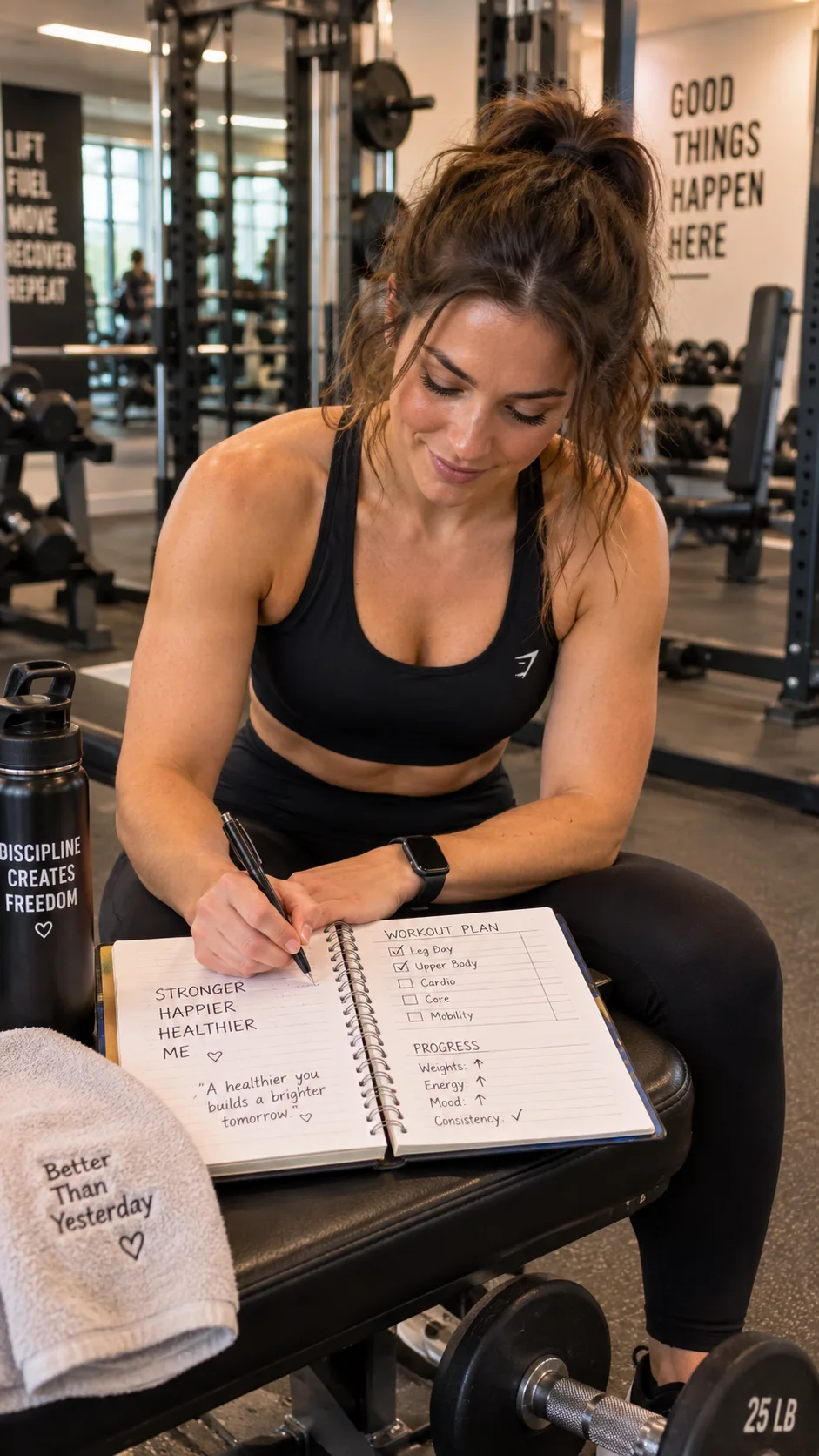
The beginner machine formula: your exact blueprint
Okay, here’s the formula. I’ve kept this deliberately simple because complexity kills consistency. You can always add more later. Right now, the goal is to build the habit of structured training that covers your entire body.
The formula structure
You’ll train 3 days per week, hitting every major muscle group across two alternating workouts. This gives each muscle group enough stimulus AND enough recovery time. Here’s the split:
Workout A: Lower Body + Core
- Leg Press, 3 sets of 12 reps
- Leg Curl Machine, 3 sets of 12 reps
- Leg Extension Machine, 3 sets of 12 reps
- Hip Abduction Machine, 3 sets of 15 reps
- Cable Crunch or Ab Machine, 3 sets of 15 reps
Workout B: Upper Body + Core
- Chest Press Machine, 3 sets of 12 reps
- Seated Row Machine, 3 sets of 12 reps
- Shoulder Press Machine, 3 sets of 12 reps
- Lat Pulldown Machine, 3 sets of 12 reps
- Cable Crunch or Ab Machine, 3 sets of 15 reps
Your week looks like this: Monday → Workout A, Wednesday → Workout B, Friday → Workout A. The following week, you flip it: Monday → B, Wednesday → A, Friday → B. Simple alternation. That’s it.
If you want a more detailed weekly schedule that maps this out for you, check out this complete weekly weight training schedule for women that takes all the guesswork out.
How to use each machine (the quick-start guide)
Knowing which machines to use is half the battle. Knowing how to use them properly is the other half. Here’s a crash course on each machine in your formula.
Leg press
Sit with your back flat against the pad. Place feet shoulder-width apart on the platform, about mid-height. Push through your whole foot, not just your toes. Lower until your knees hit roughly 90 degrees, then press back up without locking your knees at the top. This machine targets your quads, glutes, and hamstrings all at once. It’s the biggest bang-for-your-buck lower body machine in the gym.
Leg curl machine
This one isolates your hamstrings, the muscles on the back of your thighs. Adjust the pad so it sits just above your ankles. Curl the weight toward your glutes with control, then lower it slowly. The slow lowering part (the eccentric) is where a huge chunk of your strength gains happen. Don’t rush it.
Leg extension machine
The counterpart to the leg curl. This targets your quadriceps on the front of your thighs. Sit with your back against the pad, hook your ankles behind the lower roller, and extend your legs straight out. Quick tip: don’t slam the weight up. Squeeze at the top for a one-second count, then lower with control.
Hip abduction machine
Yes, the one everyone makes fun of on social media. Guess what? It works your glute medius, which matters enormously for hip stability, knee health, and that rounded side-glute shape. Sit upright, push your knees outward against the pads, and control the return. IMO, this is one of the most underrated machines in any gym.
Chest press machine
Adjust the seat so the handles align with your mid-chest. Grip the handles, push forward until your arms are almost straight (don’t lock elbows), then return slowly. This works your chest, front shoulders, and triceps. The machine version lets you push hard without needing a spotter, which makes it perfect for building upper body pushing strength on your own.
Seated row machine
Sit with your chest against the pad (if your gym’s version has one). Pull the handles toward your torso, squeezing your shoulder blades together at the end. This machine builds your upper back, rear shoulders, and biceps. Think about pulling with your elbows, not your hands. That mental cue fires up the right muscles.
Shoulder press machine
Adjust the seat so the handles start at about ear height. Press up until your arms are nearly straight, then lower back to the start. This hits your shoulders and triceps. Keep your back pressed firmly against the pad. Arching your back turns this into a weird chest exercise, and that’s not the goal.
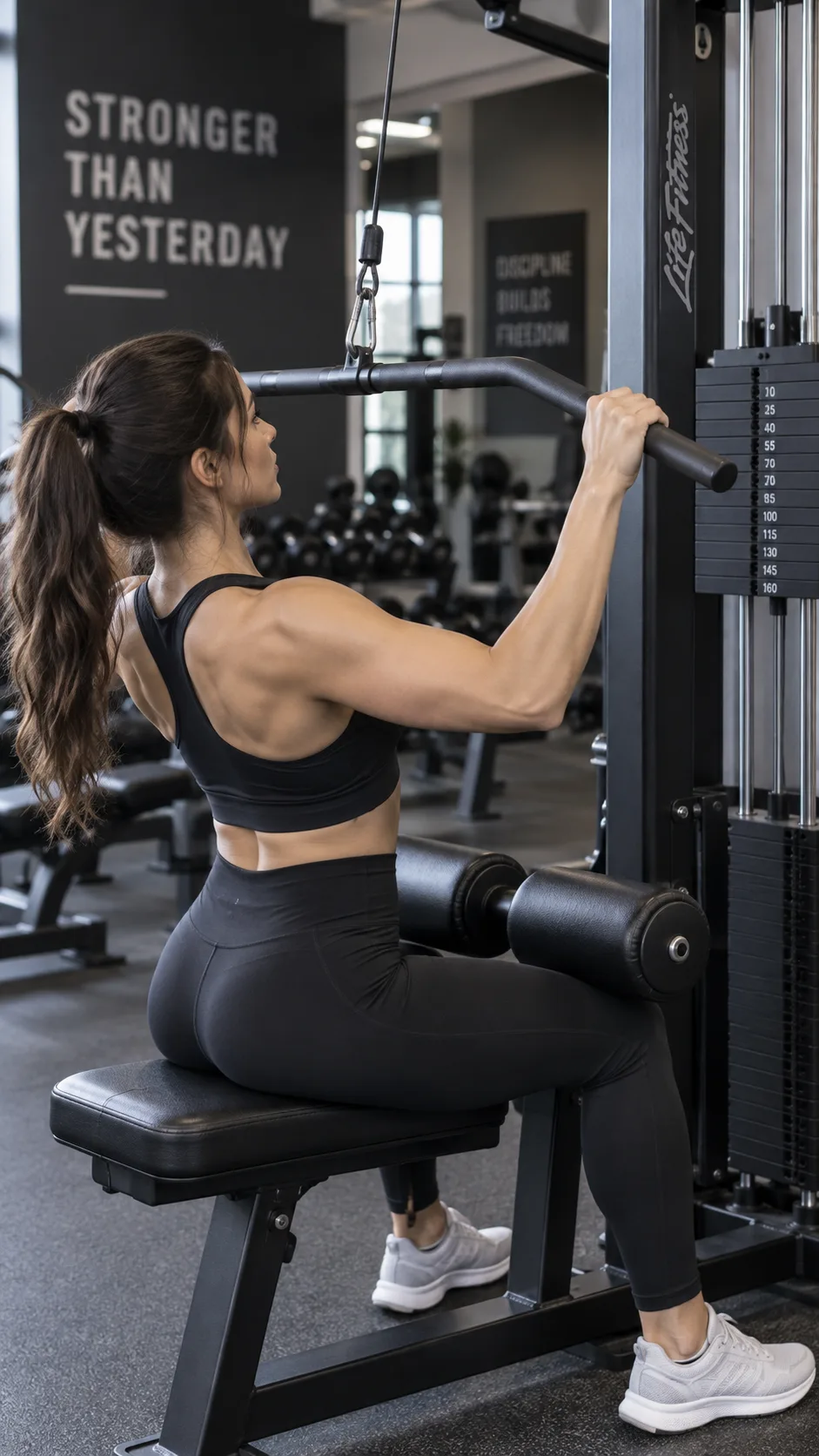
Lat pulldown machine
Grip the bar slightly wider than shoulder width. Pull it down toward your upper chest while keeping your torso upright (a slight lean is fine, but don’t turn it into a rowing motion). Squeeze at the bottom, then let the bar return slowly. This one builds the muscles that give your back width and help with posture. Your women’s workout plan should always include a vertical pulling movement, and this is the best machine option.
Progressive overload on machines: where the real changes happen
Doing the same weight for the same reps week after week will get you the same body week after week. Progressive overload is the principle that you need to gradually increase the demand on your muscles to keep them adapting.
On machines, this is beautifully simple. The National Strength and Conditioning Association recommends beginners increase resistance when they can complete all prescribed reps with good form across all sets.
The double progression method
This is the easiest progression system for beginners, and it works like this:
- Start with a weight where you can complete 3 sets of 10 reps with good form
- Each session, try to add reps. Aim for 3 sets of 11, then 3 sets of 12
- Once you can do 3 sets of 12 reps with clean form, increase the weight by one increment
- Drop your reps back to 10 at the new weight
- Repeat the cycle
This method is chef’s kiss for machines because the weight increments are fixed and predictable. You’ll never wonder “should I go heavier?” The formula tells you exactly when. Write down your weights and reps after every session. Seriously. Your notes app works fine. A gym notebook works better. Just track it.
Common beginner mistakes that sabotage your results
Even with a solid formula, a few sneaky mistakes can slow your progress. I’d rather you dodge them now than learn them the hard way like I did.
Mistake #1: Going too light
If you finish your set of 12 and feel like you could easily do 8 more, that weight is too light. Your last 2 to 3 reps should feel genuinely challenging. Not painful, not form-breaking, but challenging. The whole “women shouldn’t lift heavy” thing is a myth that belongs in the trash alongside low-fat diet advice from the 90s.
Mistake #2: Skipping the upper body
I get it. Most women walk into the gym wanting to work their glutes and legs. But ignoring your upper body creates imbalances, limits your overall metabolism boost, and robs you of that strong, capable feeling that comes from balanced training. Your chest press and row days matter just as much as your leg days.
Mistake #3: No rest between sets
Scrolling Instagram between sets doesn’t count as resting if you’re taking 5-minute breaks. But the opposite problem is more common for beginners: rushing through sets with no rest at all. Aim for 60 to 90 seconds between sets. Set a timer. Your muscles need that recovery window to perform well on the next set.
Mistake #4: Changing your routine every week
The fitness industry makes money by selling you novelty. New workout! New split! New machine circuit! But your muscles don’t need to be “confused.” That’s a marketing myth. They need consistent, progressive stimulation. Stick with this formula for at least 8 weeks before changing anything. The results will speak for themselves.

How to structure your gym session from start to finish
Knowing the exercises is great. But what does the full session look like? Here’s your complete gym visit, broken down minute by minute.
- Arrive + Warm Up (5 to 7 minutes): Walk briskly on the treadmill or use the elliptical. Get your heart rate up slightly and your joints warm. This isn’t cardio. It’s prep.
- Complete Your Workout (25 to 35 minutes): Do each exercise in order with 60 to 90 seconds rest between sets. Focus on controlled movement, not speed.
- Optional Cooldown (5 minutes): Light stretching or foam rolling. Not mandatory, but your future self will thank you for the flexibility work.
Total time: 35 to 45 minutes, three times a week. That’s about 2 hours of structured gym time per week. Anyone telling you that you need to live at the gym to see results is either selling something or doing it wrong. FYI, research from the Medicine & Science in Sports & Exercise journal consistently shows that 2 to 3 resistance training sessions per week produce significant strength and body composition changes in beginners.
When to graduate from this formula
This machine-based plan isn’t meant to be your forever routine. Think of it as your training wheels phase, an 8 to 12 week foundation that builds your strength, confidence, and gym habits. After that, you’ll be ready to start integrating free weights, compound movements, and more advanced splits.
Signs you’re ready to level up:
- You’ve completed at least 8 consecutive weeks without skipping more than 2 to 3 sessions
- You’ve increased the weight on most machines at least 2 to 3 times
- You feel comfortable and confident moving around the gym
- You’re curious about free weights and want to try new movements
- Your current weights are no longer challenging at 12 reps
When you hit that point, you can start blending machine work with dumbbell and barbell exercises. A great next step is a structured women’s weekly weight training schedule that incorporates both machines and free weights progressively.
Stop wandering, start building
Random workouts feel productive. Structured workouts are productive. That’s the difference between spending months at the gym hoping for change and spending months at the gym creating change.
This beginner machine formula gives you everything you need: the right machines, the right order, the right sets and reps, and a clear progression system. No guesswork, no wandering, no more staring at the cable machine wondering what it does.
Print this out, screenshot it, save it to your notes, whatever works. Then walk into the gym with a plan and own that workout. Your stronger, more confident, genuinely-excited-to-train future self is counting on you to start today. 🙂
