
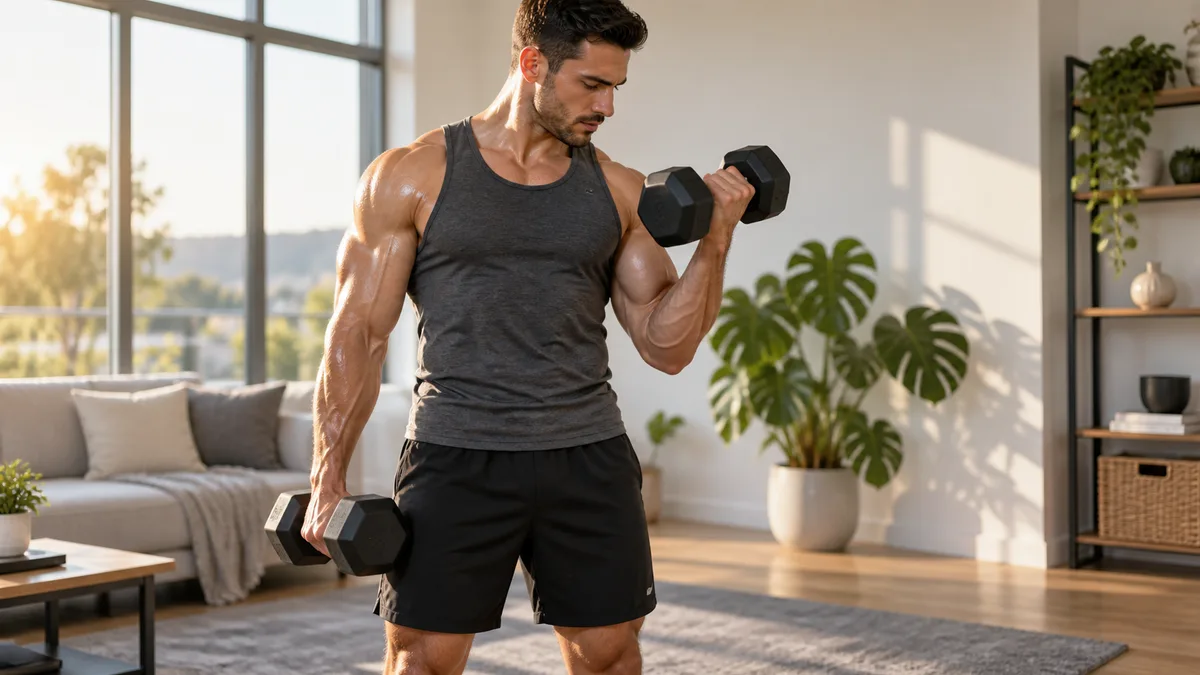
Your gym membership expired. Your motivation didn’t. You absolutely do NOT need a fancy facility to sculpt arms that look like they belong on a fitness magazine cover. All you need is a pair of dumbbells, a little floor space, and about 30 to 40 minutes of focused effort.
I spent years believing the lie that serious arm training required cable machines, preacher curl benches, and that weird rope attachment thing nobody can ever find. Spoiler: it doesn’t. Some of my best arm gains happened in my living room with a $40 set of adjustable dumbbells and a playlist that had no business being that loud.
So if you’re ready to build genuinely defined biceps and triceps using nothing but dumbbells and your own determination, keep reading. Every move here earns its spot.
Why dumbbells beat most gym machines for arm definition
Here’s something most people overlook: dumbbells force each arm to work independently. That means your stronger arm can’t compensate for your weaker one, a problem that happens constantly on barbells and cable machines. You fix imbalances faster, and you build more symmetrical arms in the process.
Dumbbells also allow a greater range of motion than most fixed machines. According to the American Council on Exercise (ACE), exercises that maximize range of motion recruit more muscle fibers, which directly translates to better definition over time.
Then there’s the stabilization factor. When you curl a dumbbell, your forearms, wrists, and even your core kick in to keep things steady. That extra engagement means more calories burned and more functional strength built per rep. Ever wondered why people who train exclusively on machines sometimes look strong but move awkwardly? This is why.
What you actually need (equipment list)
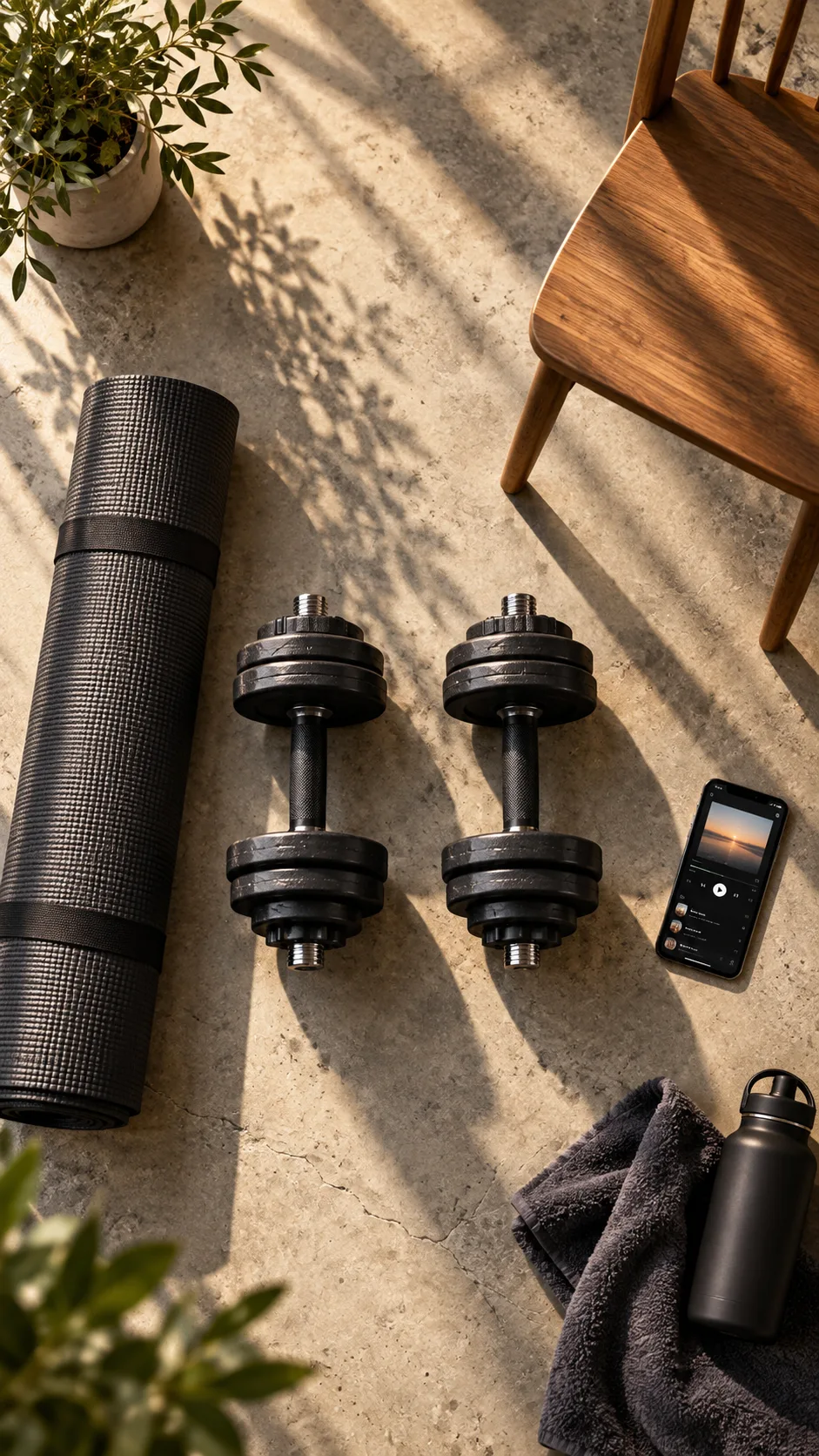
This stays brutally simple. Here’s your shopping list:
- A pair of dumbbells, ideally adjustable for the most versatility. If you’re buying fixed weights, grab a lighter set (8 to 15 lbs) and a heavier set (15 to 25 lbs) depending on your current strength level.
- A flat bench or sturdy chair, optional but helpful for certain movements like concentration curls and overhead extensions.
- A workout mat, mostly for comfort during floor-based tricep work.
That’s it. No squat rack, no cable tower, no judgment from the guy doing bicep curls in the squat rack. Just you and your dumbbells.
The best dumbbell bicep exercises for home workouts
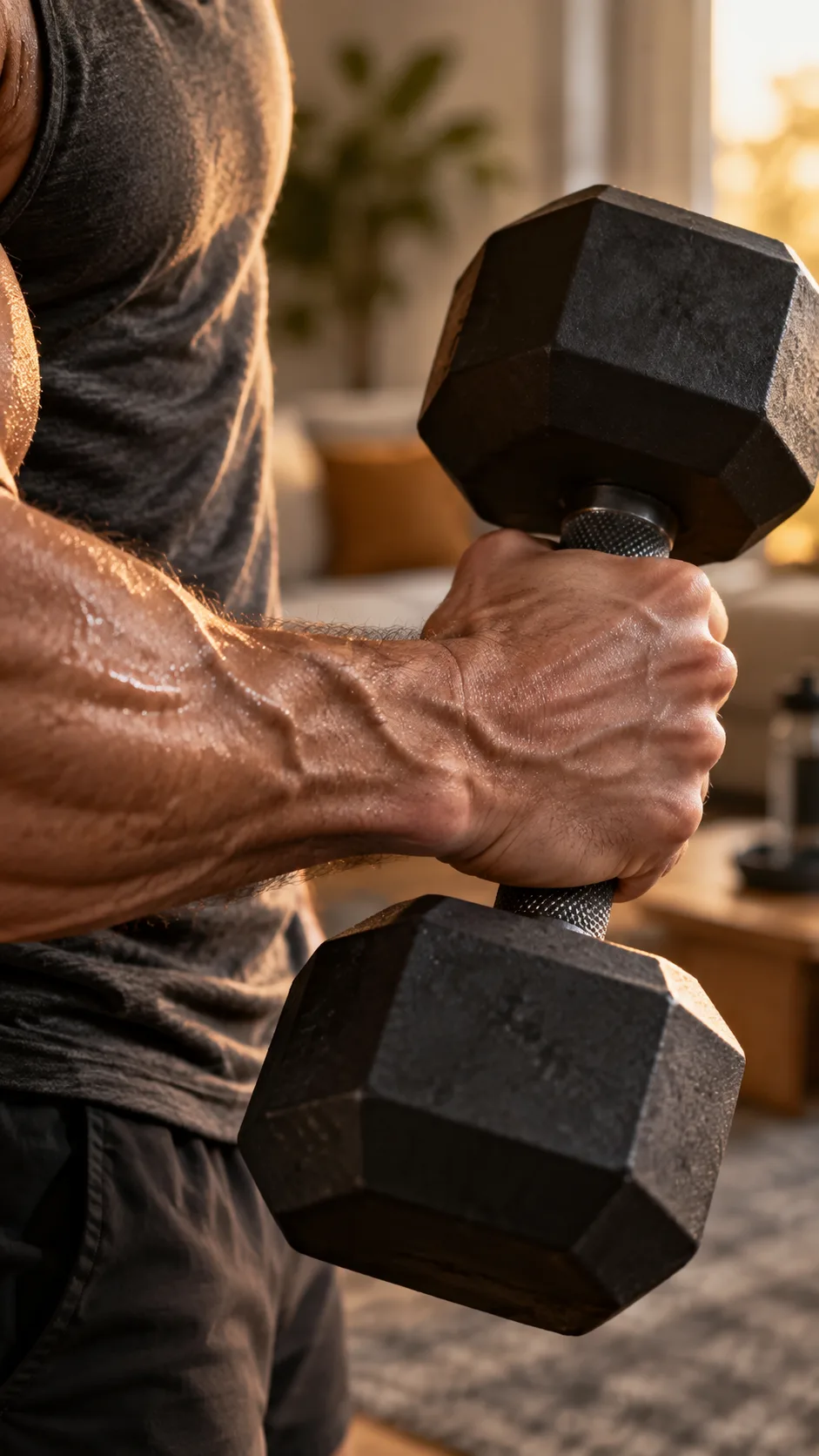
Your biceps have two heads (hence “bi”), the long head and the short head. To build fully defined arms, you need to target both. These exercises do exactly that.
1. Standing dumbbell curl
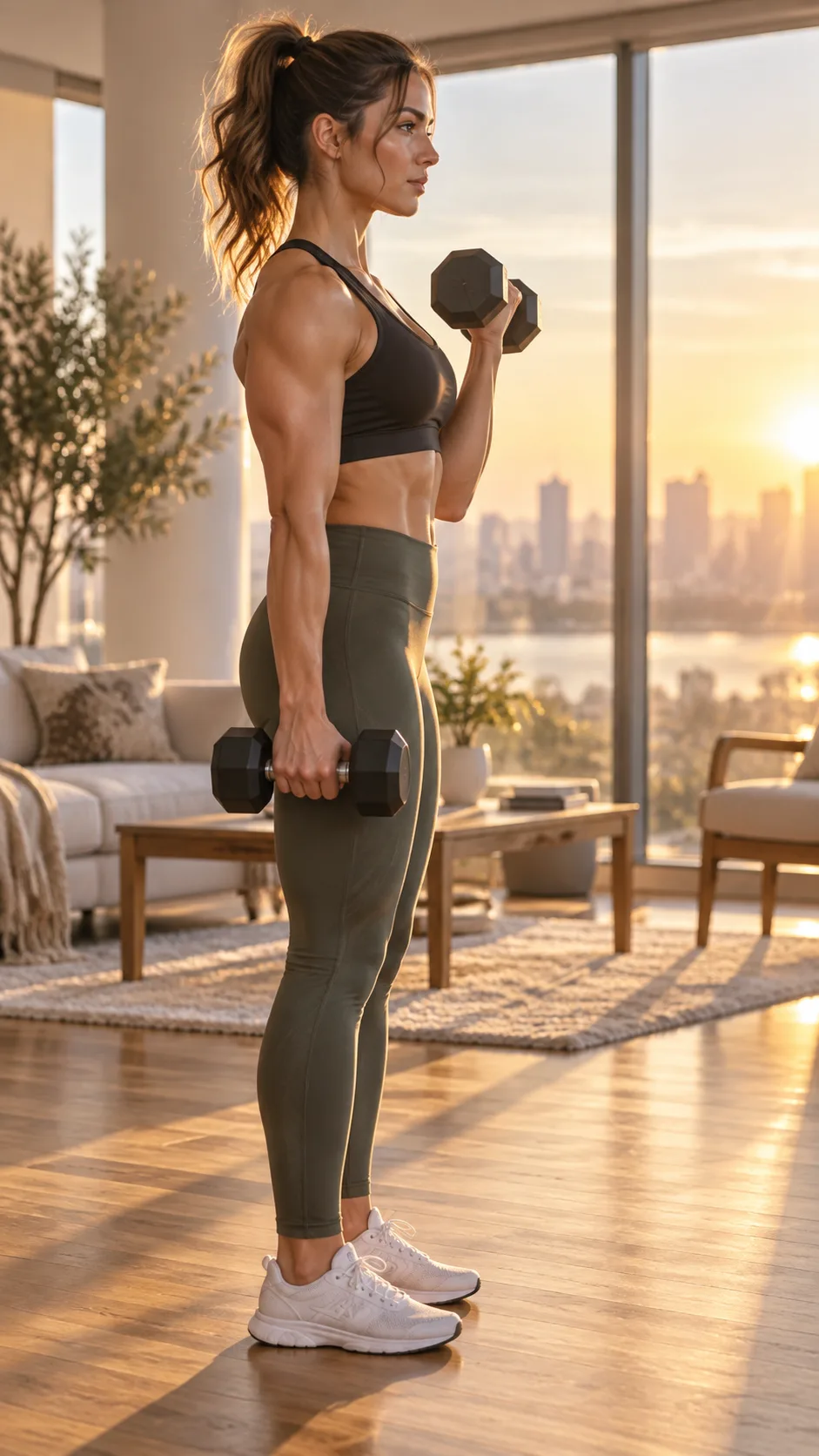
The classic. Stand with your feet shoulder-width apart, hold a dumbbell in each hand with palms facing forward, and curl the weights up toward your shoulders. Control the descent, because that eccentric phase does massive work for muscle growth.
Keep your elbows pinned to your sides. The moment they drift forward, your front delts start stealing the work. Nobody wants that.
2. Hammer curls
Same setup, but turn your palms to face each other (neutral grip). Hammer curls crush your brachialis, the muscle that sits between your bicep and tricep and makes your arms look thicker from the side. They also blast your forearms, which is a nice bonus.
These feel slightly easier than standard curls, so bump the weight up a notch if you can.
3. Incline dumbbell curl
If you have a bench or can prop yourself against a sturdy inclined surface, this exercise stretches the long head of the bicep more than any other curl variation. That stretch under load creates a powerful growth stimulus.
Sit back at roughly a 45-degree angle, let your arms hang straight down, and curl from that fully stretched position. You’ll use lighter weight here, and your ego will survive.
4. Concentration curl
Sit on a bench or chair, brace your elbow against the inside of your thigh, and curl one dumbbell at a time. The ACE study I mentioned earlier ranked concentration curls as the #1 bicep exercise for muscle activation. That’s not my opinion. That’s science doing the talking.
The isolation here is unreal. Zero momentum, zero cheating, maximum bicep engagement.
5. Cross-body hammer curl
Instead of curling straight up, bring the dumbbell across your body toward the opposite shoulder. This subtle angle shift hits the brachialis and brachioradialis differently, adding width to your arms that standard curls miss.
Keep these slow and deliberate. Rushing through cross-body curls defeats the entire purpose.
The best dumbbell tricep exercises for home workouts
Your triceps make up roughly two-thirds of your total upper arm mass. Read that again. If you want arms that actually look big and defined, you CANNOT skip tricep training. Yet so many people obsess over curls and wonder why their arms look incomplete. Sound familiar?
1. Overhead tricep extension
Hold one dumbbell with both hands behind your head, elbows pointing toward the ceiling. Extend the weight upward until your arms straighten, then lower slowly. This exercise targets the long head of the tricep, the biggest of the three tricep heads and the one most responsible for that “horseshoe” shape.
Keep your core tight and avoid arching your lower back. If you feel it in your spine, the weight is too heavy.
2. Tricep kickback
Hinge at your hips, keep your upper arm parallel to the floor, and extend the dumbbell backward until your arm is completely straight. Squeeze hard at the top for a full second.
I’ll be honest: kickbacks get a bad reputation in some fitness circles, but when you perform them with strict form and a controlled tempo, they absolutely torch the lateral and medial tricep heads. The National Strength and Conditioning Association (NSCA) recognizes kickbacks as an effective isolation movement for tricep development.
3. Lying dumbbell tricep extension (skull crusher)
Lie flat on a bench or the floor, hold dumbbells above your chest with arms straight, then bend at the elbows to lower the weights toward your temples. Press them back up by extending your triceps. Using dumbbells instead of a barbell here lets each arm move through its natural arc, which reduces elbow stress significantly.
If you’re doing these on the floor, you get a natural safety stop at the bottom. Perfect for solo training at home.
4. Close-grip dumbbell press
Lie on your back, hold two dumbbells together above your chest with a neutral grip, and press them straight up. Keep the dumbbells touching throughout the movement. This turns a chest exercise into a tricep-dominant compound movement, meaning you can load it heavier than pure isolation exercises.
Compound movements like this also trigger a stronger hormonal response, which supports overall muscle growth.
5. Single-arm overhead extension
Same concept as the two-handed version, but using one arm at a time. This variation exposes any strength imbalances between your left and right triceps and lets you focus entirely on one side. If you’ve noticed one arm lagging behind, this move fixes that fast.
A complete bicep and tricep dumbbell workout you can do today
Enough theory. Here’s a full workout you can run through right now. Perform these exercises in the order listed, resting 60 to 90 seconds between sets.
Bicep block
- Standing Dumbbell Curl, 3 sets x 10 to 12 reps
- Hammer Curl, 3 sets x 10 to 12 reps
- Concentration Curl, 3 sets x 8 to 10 reps per arm
Tricep block
- Close-Grip Dumbbell Press, 3 sets x 10 to 12 reps
- Overhead Tricep Extension, 3 sets x 10 to 12 reps
- Tricep Kickback, 3 sets x 12 to 15 reps per arm
Finisher (optional but highly recommended)
- Alternating Curl to Overhead Press, 2 sets x 8 reps per arm. Curl the dumbbell up, then press it overhead. This supersets your biceps and shoulders for a brutal pump to close things out.
This entire workout takes about 35 to 40 minutes. Run it twice per week with at least 48 hours of rest between sessions, and you’ll see noticeable changes within 4 to 6 weeks. Consistency matters way more than perfection here.
If you want to add variety, check out this bicep and tricep workout guide with 8 exercises for even more options.
Programming tips: sets, reps, and progressive overload
Doing random curls with random weights produces random results. You need a plan. Here’s how to structure your dumbbell arm training for maximum definition:
- Rep range for hypertrophy: 8 to 15 reps per set. This zone maximizes time under tension and metabolic stress, the two primary drivers of muscle growth according to research published in the Journal of Strength and Conditioning Research.
- Sets per muscle group per week: Aim for 10 to 20 total sets for biceps and 10 to 20 for triceps across your weekly training.
- Progressive overload: Add weight, add reps, or slow down your tempo every 1 to 2 weeks. Your muscles adapt quickly, so you have to keep challenging them.
- Tempo: Try a 2-1-3 tempo (2 seconds up, 1 second hold, 3 seconds down). That slow eccentric phase creates micro-damage in the muscle fibers, which triggers repair and growth.
Track your workouts. Write down the weight, sets, and reps every single session. The people who track their training progress faster than those who wing it. Every single time.
Common mistakes that kill your arm gains
I’ve made most of these mistakes myself, so trust me when I say they’re worth avoiding 🙂
- Swinging the weights. Momentum is the enemy of isolation. If you have to rock your entire body to curl a dumbbell, the weight is too heavy. Drop it down and do the rep properly.
- Neglecting triceps. Remember, triceps make up two-thirds of your arm. Spending 80% of your workout on curls is a recipe for imbalanced, underwhelming arms.
- Never changing your routine. Your muscles adapt to the same stimulus within 4 to 6 weeks. Swap exercises, change rep ranges, or alter your grip regularly.
- Ignoring nutrition. You can train perfectly and still see zero definition if your diet doesn’t support muscle recovery and fat loss. Prioritize adequate protein (0.7 to 1g per pound of bodyweight) and eat in a slight caloric surplus if you want to build, or a slight deficit if you want to reveal definition.
- Training arms every single day. Muscles grow during rest, not during the workout itself. Two to three dedicated arm sessions per week is the sweet spot for most people.
How to maximize definition (it’s not just about training)
Building muscle is only half the equation. Seeing that muscle requires low enough body fat for definition to show through. Here’s the honest truth about visible arm definition:
Men typically start seeing arm definition around 12 to 15% body fat. Women usually see it around 18 to 22%. You achieve this through a combination of strength training (which you’re now covering with this workout), adequate protein intake, and a sensible nutrition plan.
Sleep also plays a MASSIVE role. Your body releases the majority of its growth hormone during deep sleep. Consistently getting fewer than 7 hours per night literally sabotages your muscle-building efforts. That late-night scroll session isn’t worth it.
For a well-rounded approach to upper body training, consider adding some upper back dumbbell moves to your weekly routine as well. Strong back muscles improve your posture and make your arms look even more defined.
Upgrading your home arm workout over time
You will eventually outgrow a single pair of dumbbells, and that’s a good problem to have. Here’s how to keep progressing without buying an entire gym:
- Invest in adjustable dumbbells. Brands like Bowflex, PowerBlock, or budget alternatives give you 5 to 50+ lbs in one compact set.
- Add resistance bands. Loop a band around the dumbbell and under your feet during curls to add accommodating resistance at the top of the movement.
- Introduce supersets and drop sets. Pair a bicep exercise immediately with a tricep exercise (superset) to increase intensity without adding equipment.
- Try slow eccentrics. Lower the weight for 5 to 6 seconds per rep. This dramatically increases time under tension and works even with lighter dumbbells.
If you also want to explore movements beyond standard dumbbell work, a solid upper body kettlebell routine can complement your arm training beautifully and keep things fresh.
How often should you train biceps and triceps at home?
For most people, two dedicated arm sessions per week delivers the best results. You can either run the full workout listed above twice, or split it into a bicep-focused day and a tricep-focused day spread across the week.
If you’re also doing push-ups, dumbbell presses, or rows as part of a broader routine, your arms already get indirect stimulation from those compound movements. In that case, one focused arm day plus the indirect work from compound lifts might be plenty.
Listen to your body. If your elbows ache or your biceps still feel sore after 48 hours, extend your rest. Recovery is where growth happens, not during the workout itself.
Final thoughts: your arms, your living room, your rules
You don’t need a gym to build defined, strong arms. You need the right dumbbell exercises, a structured plan, progressive overload, and patience. That’s the entire formula.
This bicep and tricep dumbbell workout gives you everything required to build real, visible arm definition from home. Start with the routine above, track your progress, eat enough protein, sleep well, and watch what happens over the next 8 to 12 weeks.
The best workout program is the one you actually do consistently. So grab those dumbbells, press play on your favorite playlist, and start building the arms you’ve been thinking about. No commute required.
