
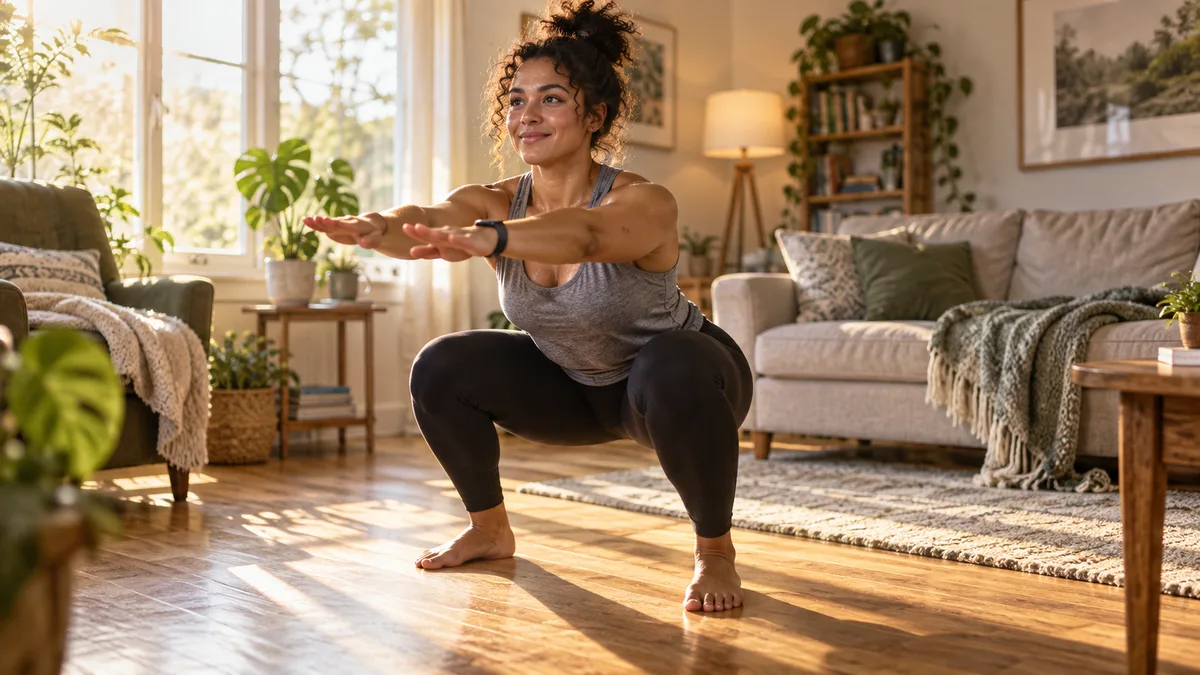
You don’t need a gym membership, fancy equipment, or an Instagram-worthy home gym to get seriously strong. You need your body, a little floor space, and about 30 minutes. That’s it. If you’ve been scrolling through workout videos feeling overwhelmed and slightly intimidated, consider this your permission slip to start exactly where you are.
I remember the first time I tried working out at home. I had zero clue what I was doing, attempted a burpee, nearly knocked over a lamp, and called it a day. But here’s the thing: every strong woman you admire started as a complete beginner. The difference between her and the version of you sitting on the couch? She just started.
This guide walks you through a complete full body workout at home for beginner women, with no equipment, no confusion, and absolutely no judgment.
Why a full body workout makes the most sense for beginners
Here’s what nobody tells you when you’re starting out: you don’t need a complicated split routine. You don’t need “leg day” and “arm day” and “back day.” That stuff works great for intermediate and advanced lifters, but for beginners? A full body approach is genuinely superior.
The science-backed advantages
Research published in the Journal of Strength and Conditioning Research consistently shows that training each muscle group multiple times per week produces better results for beginners than hammering it once and destroying it. Full body workouts let you hit every major muscle group 2-3 times per week without overtraining.
Why does this matter for YOU specifically? Because as a beginner, your muscles recover faster than you think. They’re hungry for stimulus. A full body workout feeds that hunger efficiently, and you build a balanced foundation instead of the dreaded “I only train what I can see in the mirror” physique.
Full body workouts also burn more calories per session, improve coordination faster, and (this is the big one) they’re simpler to stick with. Consistency beats perfection every single time.
Before you start: setting yourself up for success
You don’t need much, but a little preparation goes a long way. Ever tried doing mountain climbers on a slippery hardwood floor in socks? I have. Don’t recommend it.
What you actually need
- A yoga mat or carpeted area to protect your knees and prevent sliding
- Supportive shoes or bare feet (skip the fluffy slippers)
- Water bottle because hydration isn’t optional
- A timer or phone to track rest periods
- About 6×6 feet of clear space (move the coffee table, trust me)
Mindset check
Forget “go hard or go home.” You ARE home, and going too hard on day one guarantees you won’t make it to day three. Your goal for the first two weeks isn’t to crush yourself. Your goal is to learn the movements, build the habit, and finish each workout thinking “I could’ve done a bit more.” That’s the sweet spot.
If you want a deeper breakdown of building strength without equipment, check out our guide on full body workout at home with no equipment, which covers progression strategies you’ll eventually want.
The complete full body workout routine for beginner women
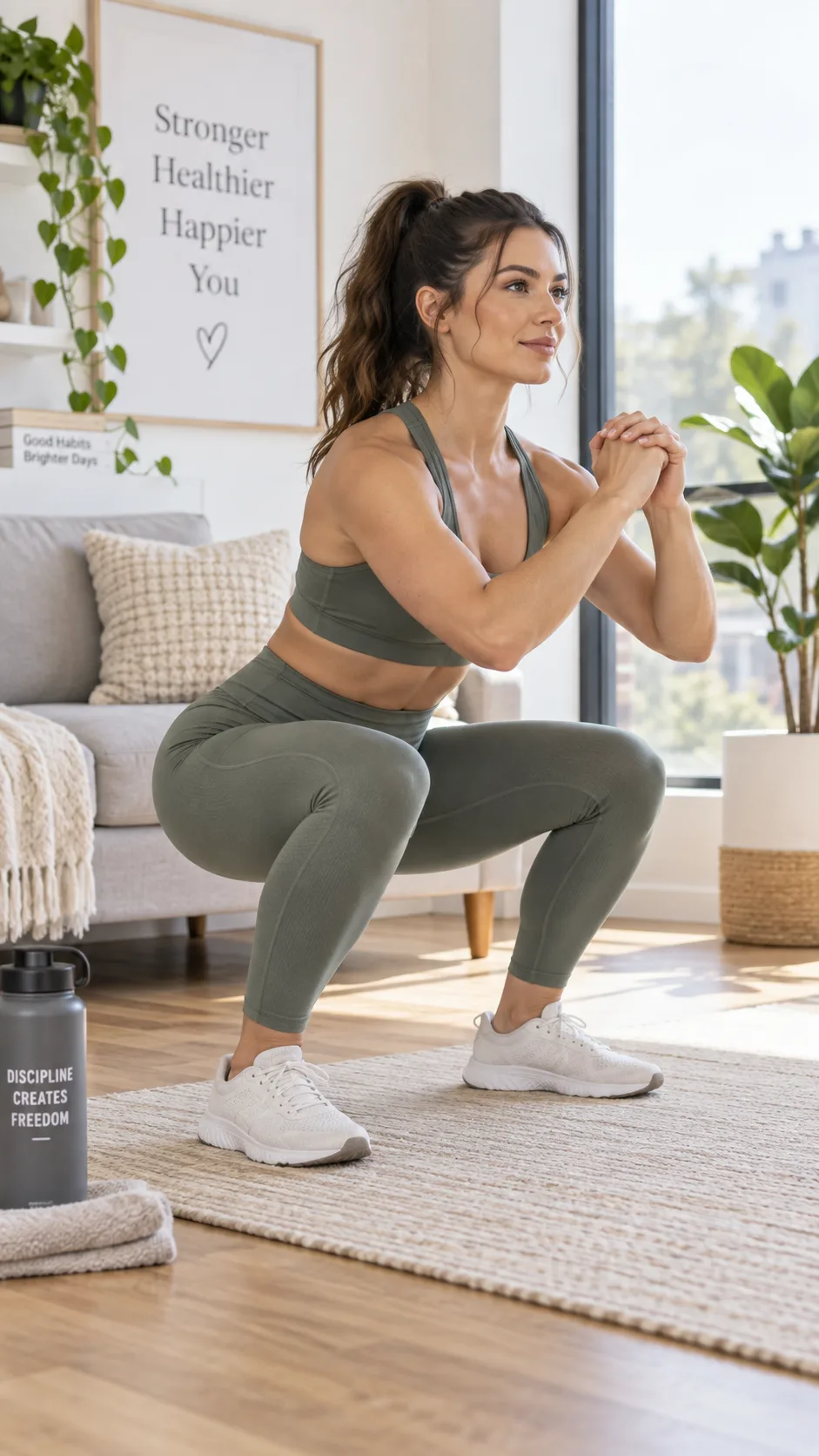
This routine targets every major muscle group: legs, glutes, core, back, chest, shoulders, and arms. You’ll perform it as a circuit, moving from one exercise to the next with minimal rest. The whole thing takes about 25-35 minutes depending on your rest periods.
Structure: Complete 2-3 rounds of the entire circuit. Rest 60-90 seconds between rounds. Rest 15-30 seconds between exercises within a round.
1. Bodyweight squats, 12 reps
Targets: Quads, glutes, hamstrings, core
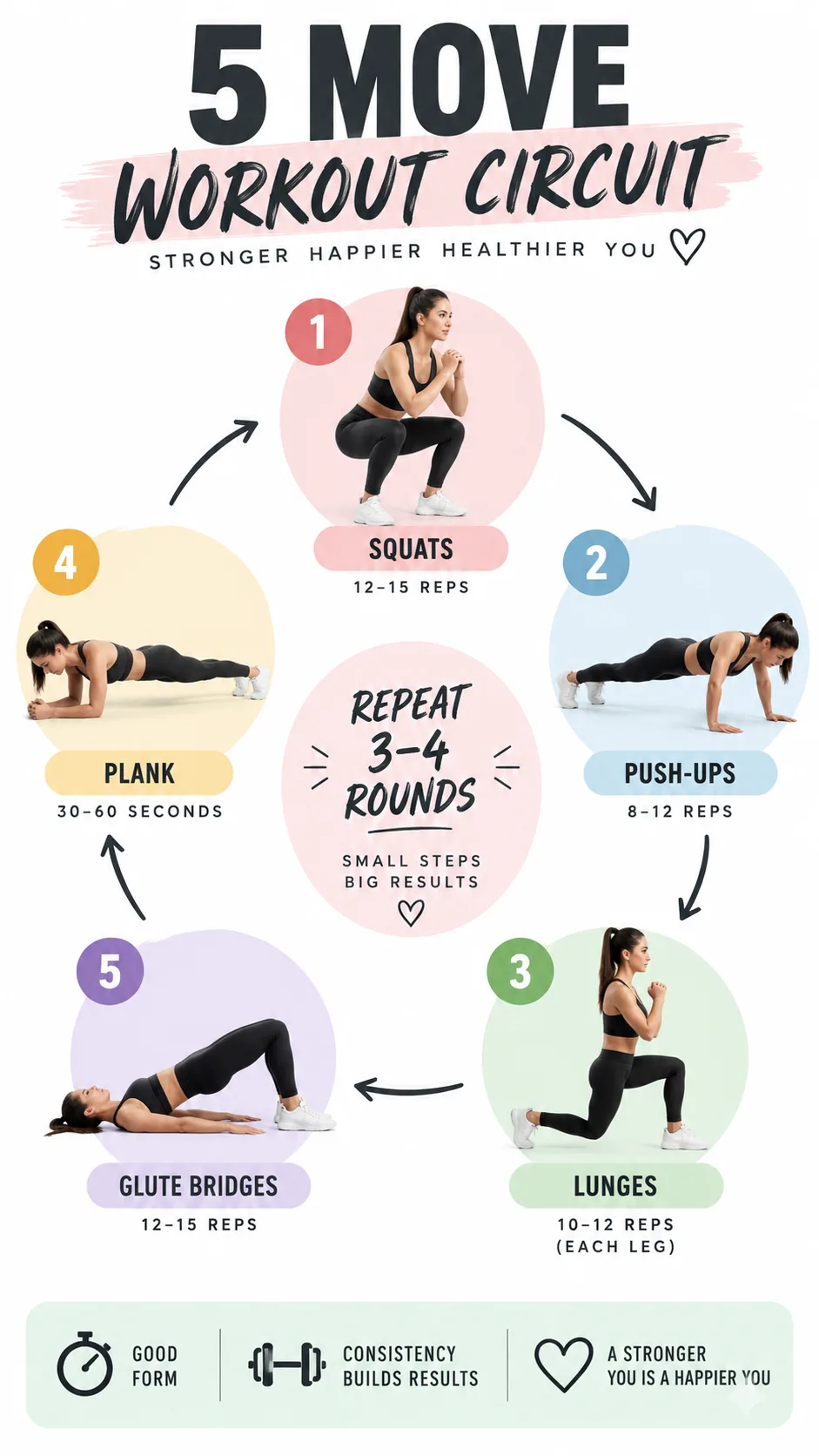
Stand with feet shoulder-width apart, toes slightly turned out. Push your hips back like you’re sitting into an invisible chair. Lower until your thighs reach parallel (or as close as you can get), then drive through your heels to stand back up. Keep your chest proud and your core tight the entire time.
Beginner tip: If balance feels shaky, extend your arms straight in front of you as a counterbalance. No shame in that. It actually helps you squat deeper.
2. Knee push-ups, 8-10 reps
Targets: Chest, shoulders, triceps, core
Place your hands slightly wider than shoulder-width, knees on the ground, ankles crossed behind you. Lower your chest toward the floor while keeping your body in a straight line from your knees to your head. Push back up. DO NOT let your hips sag or pike up. That’s how you cheat yourself out of results and invite back pain to the party.
Can’t do 8? Do 5. Can’t do 5? Do 3. The number matters far less than the form. You’ll build up faster than you expect.
3. Reverse lunges, 10 reps each leg
Targets: Glutes, quads, hamstrings, balance
Stand tall, step one foot backward, and lower your back knee toward the floor. Both knees should bend to roughly 90 degrees. Push through your front heel to return to standing. Alternate legs.
Why reverse instead of forward lunges? They’re significantly easier on your knees and better for beginners who are still developing balance. Your joints will thank you.
4. Plank hold, 20-30 seconds
Targets: Entire core, shoulders, back
Get into a push-up position on your forearms. Create a straight line from your head to your heels. Squeeze your glutes, brace your abs like someone’s about to poke your stomach, and BREATHE. Don’t hold your breath. That’s a rookie mistake that makes the plank feel ten times harder.
Can’t hold 20 seconds? Start with 10. Hold perfect form for 10 seconds rather than sloppy form for 30. Quality always wins.
5. Glute bridges, 15 reps
Targets: Glutes, hamstrings, lower back
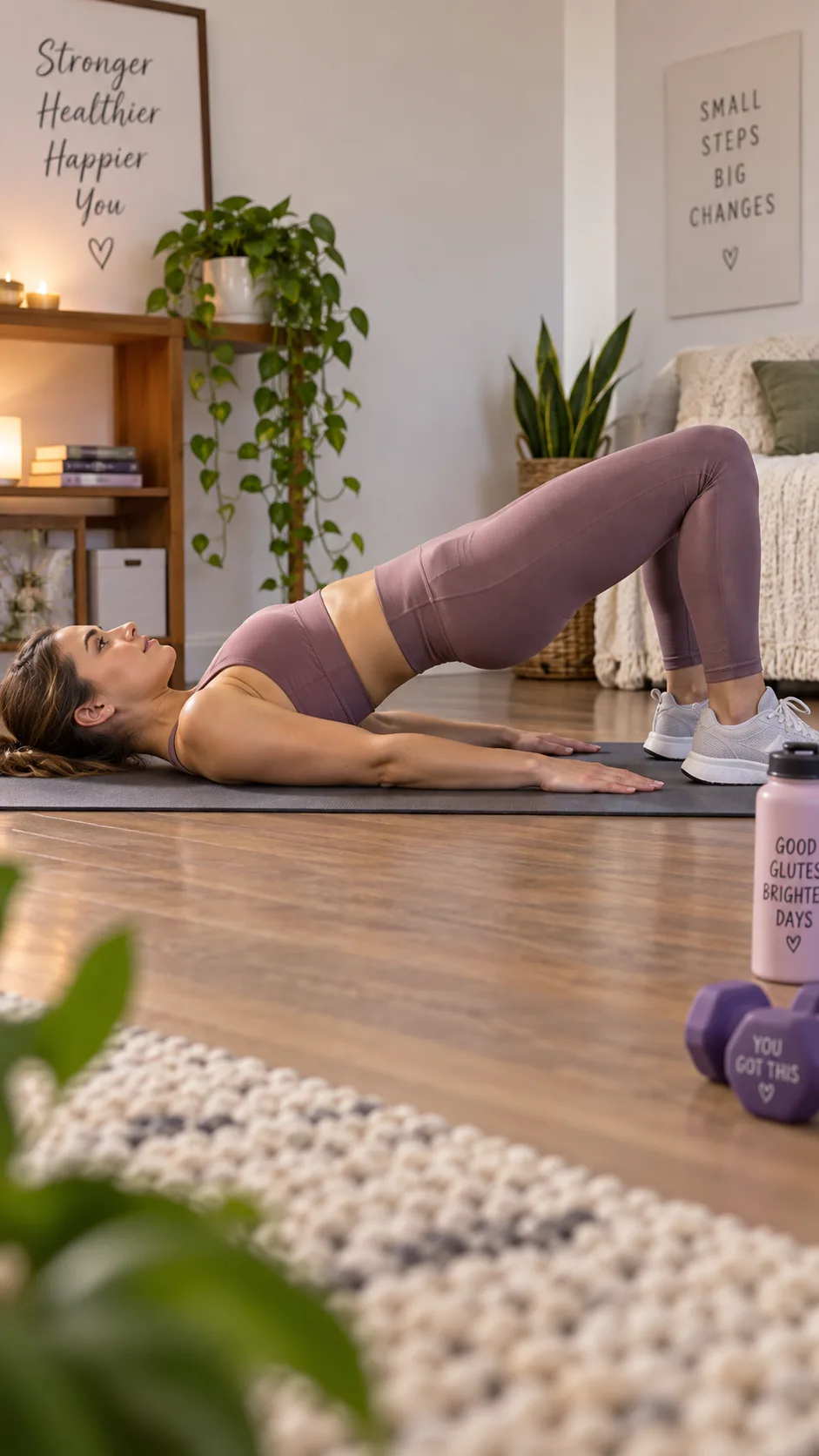
Lie on your back, knees bent, feet flat on the floor hip-width apart. Drive through your heels to lift your hips toward the ceiling. Squeeze your glutes HARD at the top, like you’re trying to crack a walnut between your cheeks (glamorous, I know). Lower slowly and repeat.
This exercise is an absolute game-changer for anyone who sits at a desk all day. Weak glutes cause an absurd number of problems, from lower back pain to poor posture. Don’t skip these.
6. Shoulder taps, 10 each side
Targets: Shoulders, core stability, coordination
Get into a high plank position (hands under shoulders, arms straight). Tap your left shoulder with your right hand, then your right shoulder with your left hand. The goal here is keeping your hips as still as possible. Fight the urge to rock side to side. Imagine you have a glass of water on your lower back.
7. Superman hold, 10 reps (2-second hold each)
Targets: Lower back, glutes, posterior chain
Lie face down, arms extended overhead. Simultaneously lift your arms, chest, and legs off the floor. Hold for 2 seconds, then lower. This one looks easy until you try it. Your back muscles, the ones you probably never think about, will wake up FAST.
8. Standing calf raises, 15 reps
Targets: Calves
Stand with feet hip-width apart. Rise onto your toes as high as possible, squeeze at the top, and lower slowly. For an extra challenge, do these on the edge of a stair. Simple but effective. Your calves play a bigger role in overall leg strength than most people realize.
Watch this routine in action
Sometimes reading about exercises isn’t enough. You need to SEE the movements. This beginner-friendly full body workout video walks you through similar exercises with proper form cues:
Your weekly schedule: how often should you do this?
More isn’t always better, especially when you’re just starting out. Here’s the schedule I recommend for your first month:
- Week 1-2: Perform this workout 2 times per week with at least one rest day between sessions. Complete 2 rounds of the circuit.
- Week 3-4: Increase to 3 times per week. Still 2 rounds, but aim to increase reps by 2-3 on each exercise.
- Week 5-6: Stay at 3 times per week but bump up to 3 full rounds. This is where things get real.
- Week 7+: Start exploring progressions (harder variations, slower tempos, single-leg work).
The American Council on Exercise recommends beginners train 2-3 days per week with full body routines, allowing 48 hours of recovery between sessions. This schedule follows that guideline perfectly.
Want a more structured beginner full body workout plan? We’ve got a detailed breakdown that maps out exactly how to progress week by week.
Common mistakes that stall your progress
I’ve watched hundreds of beginners make the same mistakes. Here are the ones that matter most, and how to dodge them.
Going too fast
Slow. Down. Speed is not your friend during strength training. Each rep should take about 2-3 seconds on the way down and 1-2 seconds on the way up. Momentum steals the work from your muscles, and you’re the one who loses out.
Skipping the warm-up
Five minutes of light movement before your workout (marching in place, arm circles, hip circles, leg swings) makes a MASSIVE difference. Cold muscles are stiff muscles, and stiff muscles get injured. Spend the five minutes. This non-negotiable habit separates people who stick with fitness from people who quit after tweaking something in week two.
Comparing yourself to Instagram
That fitness influencer doing pistol squats with perfect form? She’s been training for years. She also filmed 47 takes before posting. Your only competition is the version of you who didn’t work out yesterday. Period.
Neglecting recovery
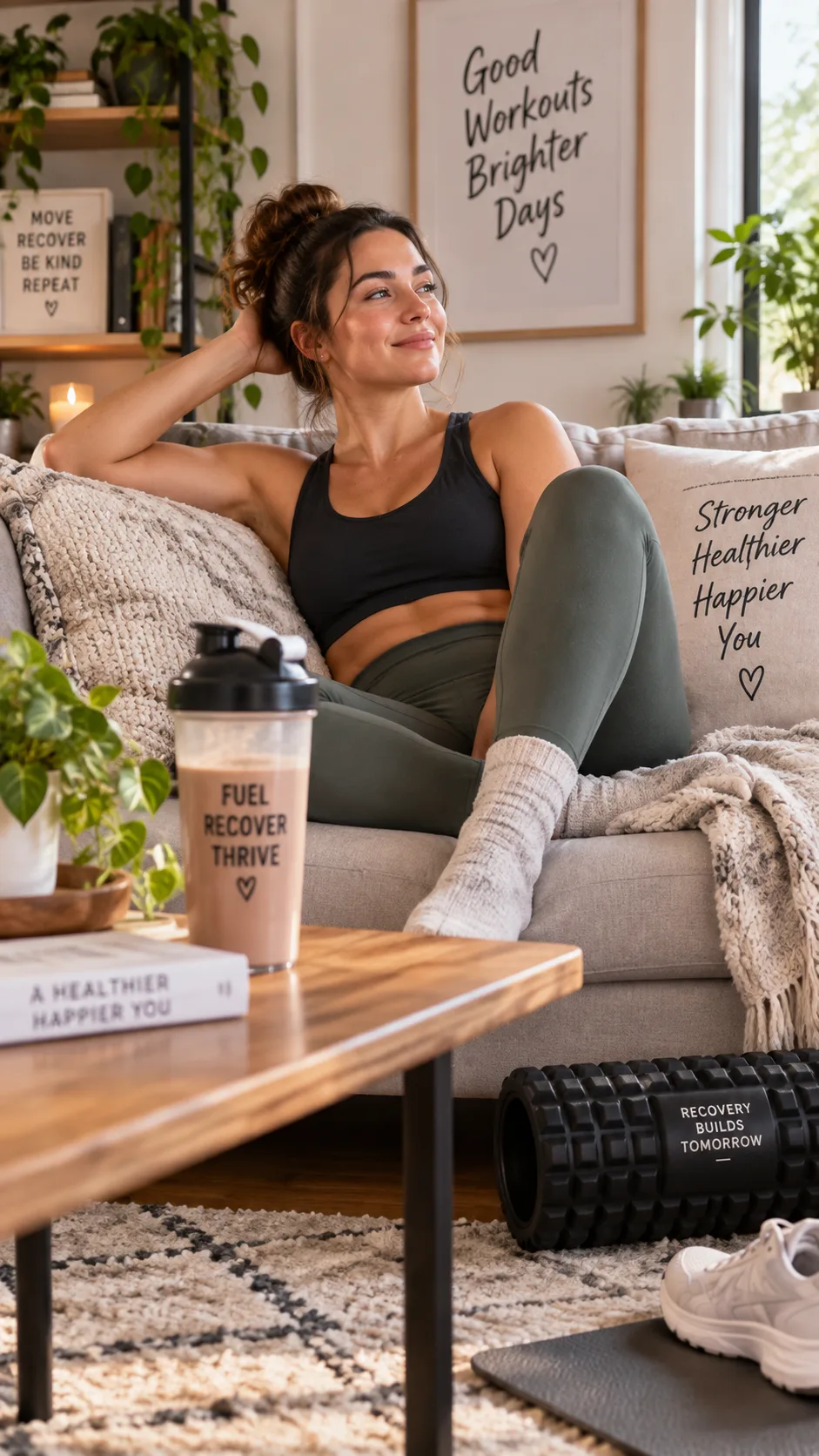
Rest days aren’t lazy days. They’re growth days. Your muscles literally repair and get stronger while you rest. Sleep 7-9 hours. Eat enough protein (roughly 0.7-1 gram per pound of body weight daily). Drink water like it’s your job. According to the National Strength and Conditioning Association, adequate recovery is just as critical as the training stimulus itself.
How to make this workout harder over time
Your body adapts. That’s literally what it’s designed to do. So the workout that challenged you in week one will feel easy by week six. Here’s how to keep progressing without adding equipment:
- Add reps: The simplest progression. Can you do 15 squats instead of 12? Do it.
- Slow the tempo: Take 4 seconds to lower into each squat. Your muscles will scream. You’re welcome.
- Add pauses: Hold the bottom of a lunge for 3 seconds before pushing back up.
- Progress the exercise: Move from knee push-ups to full push-ups. Swap regular squats for jump squats. Replace glute bridges with single-leg glute bridges.
- Reduce rest periods: Cut rest between exercises from 30 seconds to 15. Your cardiovascular system will catch up fast.
- Add a round: Going from 2 rounds to 3 to 4 dramatically increases training volume.
Eventually, you’ll outgrow bodyweight-only training for certain muscle groups, and that’s a GOOD sign. When that happens, our full body workout routine guide covers how to structure your next phase of training.
The confidence factor: why this matters beyond the physical
Here’s something that doesn’t get enough attention. Working out at home as a beginner woman isn’t just about burning calories or building muscle. It’s about proving to yourself that you can commit to something and follow through.
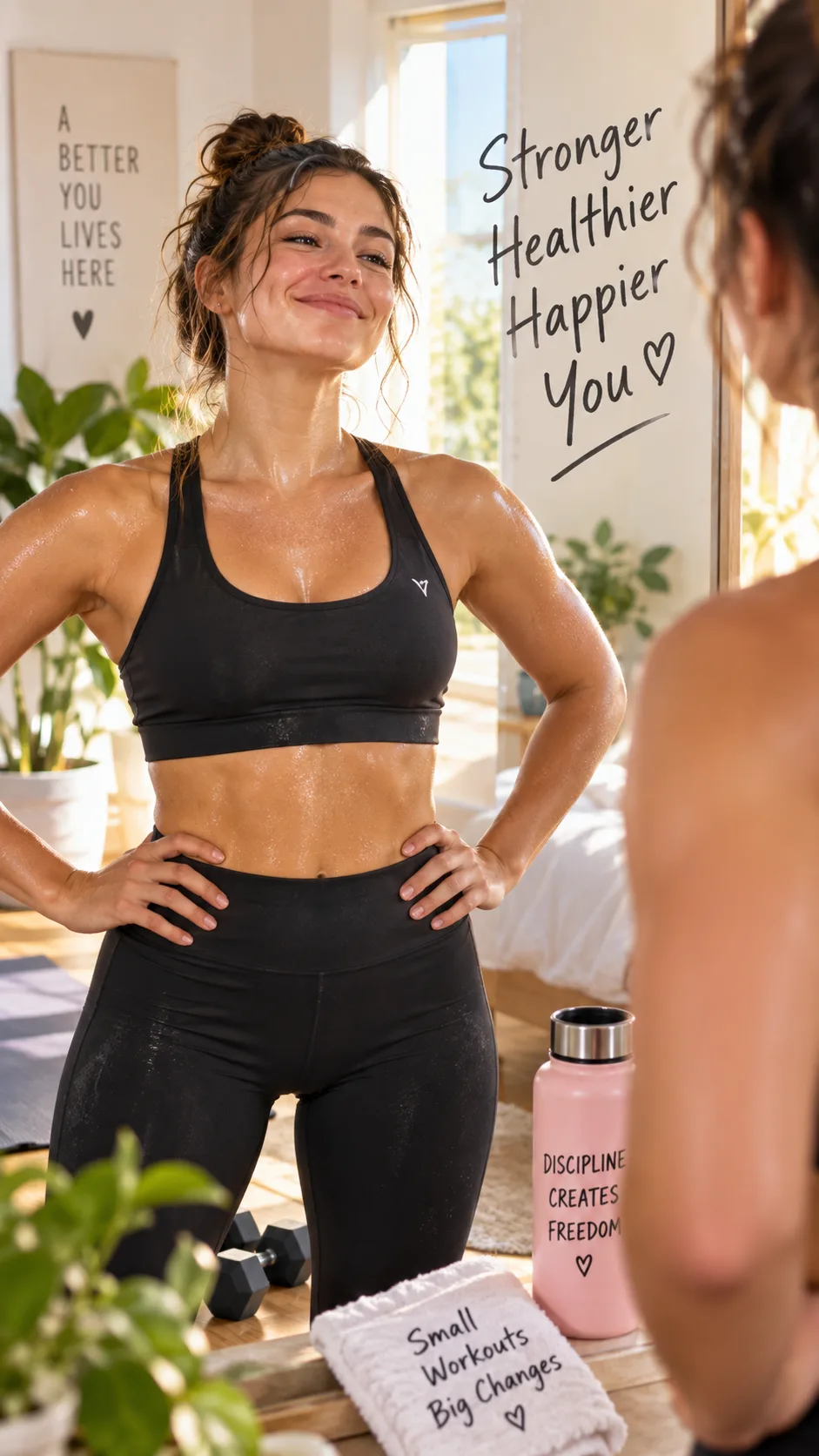
Every single workout you complete deposits into your confidence bank. After a few weeks, you’ll notice something shift. You’ll stand a little taller. You’ll carry groceries without losing your breath. You’ll catch yourself in the mirror and think, “yeah, I look like someone who works out.”
A Harvard Health study found that regular exercise reduces anxiety by 20% and significantly improves self-perception. Not because of how your body changes, but because of the mental discipline you develop. You stop being the person who “should” work out and become the person who DOES.
That transformation bleeds into every area of your life. Work. Relationships. The way you handle stress. It all shifts when you realize your body is capable of more than you gave it credit for.
Quick FAQ for beginner women starting home workouts
Will bodyweight exercises actually build muscle?
Absolutely. For beginners, bodyweight exercises provide MORE than enough resistance to build lean muscle. Your body doesn’t know the difference between a barbell squat and a bodyweight squat. It just knows tension. You have months of productive bodyweight training ahead of you before you’ll need to add external load.
I’m worried about getting “bulky.” Should I be?
No. Women produce roughly 15-20 times less testosterone than men. Building significant muscle mass requires years of progressive training, caloric surplus, and (for the truly massive physiques) often pharmaceutical assistance. You will not accidentally look like a bodybuilder. What you WILL get is toned, defined muscles and a stronger body. That’s the goal.
What if I can’t do a single push-up?
Start with wall push-ups. Stand arm’s length from a wall, place your palms flat, and push yourself away. Progress to incline push-ups on a countertop, then to knee push-ups on the floor. Everyone starts somewhere, and “somewhere” is perfectly fine.
Should I stretch after?
Yes. Spend 5-10 minutes stretching the major muscle groups you just worked. Hold each stretch for 20-30 seconds. Your future self, the one who can still touch her toes at 60, will thank you profusely.
Your first step starts now
You’ve read the whole thing. You know the exercises. You know the schedule. You know the common mistakes to avoid. The only thing standing between you and a stronger version of yourself is actually doing it.
Here’s my challenge to you: do this workout TODAY. Not tomorrow. Not Monday. Not “when things calm down,” because they never will. Clear some floor space, set a timer, and move through the circuit once. Just once. That’s all you need to break the inertia.
A full body workout at home for beginner women doesn’t require perfection. It requires showing up. The confidence, the strength, the energy, all of that builds one rep at a time. You’re already stronger than you think. You just haven’t proven it to yourself yet.
Now go move that coffee table. You’ve got work to do.
