
Let me get one thing straight right now: you will not get bulky from lifting weights. I know someone told you that once. They were wrong. What you will get? Arms that look incredible in tank tops, the strength to carry all your grocery bags in one trip, and the quiet confidence that comes from knowing you can open any jar in the house.
If you’ve been wandering around the gym doing random bicep curls with 5-pound dumbbells and hoping for the best, this guide is your new best friend. I’m going to walk you through a complete arm day workout designed specifically for women who are just getting started. No confusing jargon, no intimidation, just a straightforward routine that actually works.
Why women should absolutely train arms (and stop being afraid of it)
Here’s the thing. Your arms contain some of the most functional muscles in your body. Every time you push a door, lift your kid, or haul a suitcase into an overhead bin, your biceps, triceps, and shoulders do the heavy lifting. Ignoring them means leaving real, everyday strength on the table.
But beyond function, there’s the aesthetic payoff. Lean, defined arms come from targeted resistance training, not from doing 300 reps with a soup can. The American College of Sports Medicine recommends that women strength train all major muscle groups at least twice per week for optimal health and body composition benefits.
And no, you won’t accidentally wake up looking like a bodybuilder. Women produce roughly 15-20 times less testosterone than men, which means building massive muscle is physiologically difficult without years of dedicated effort and very specific nutrition. What you WILL build is shape, tone, and definition. That’s it. That’s the dream.
The muscles you’re actually working on arm day
Before you grab those dumbbells, it helps to know what you’re targeting. Don’t worry, this isn’t an anatomy exam. Just a quick cheat sheet so you understand why each exercise matters.
Biceps (front of the upper arm)
These are the muscles you flex when you want to show off. They handle pulling motions: rows, curls, and anything where you bring weight toward your body. Two main muscles live here, the biceps brachii and the brachialis.
Triceps (back of the upper arm)
Your triceps make up roughly two-thirds of your upper arm mass. Read that again. If you want your arms to look sculpted, you need to prioritize triceps just as much as biceps, maybe even more. They control all pushing motions and straighten your elbow.
Shoulders (deltoids)
While technically not “arms,” your shoulders frame everything. Well-developed deltoids create that gorgeous cap at the top of your arm that makes everything look proportional and strong. We’ll include a couple of shoulder moves in this routine because leaving them out would be a crime.

What you’ll need for this arm day workout
Good news: this routine doesn’t require a PhD in gym equipment. Here’s your short shopping list:
- A set of dumbbells (start with 5-10 lbs. You can always go heavier as you progress.)
- A flat bench or adjustable bench (most gyms have plenty of these.)
- A cable machine (for tricep pushdowns. If your gym doesn’t have one, I’ve got a swap for you below.)
- An EZ curl bar (optional) (easier on the wrists than a straight barbell.)
That’s it. No fancy gadgets. No bosu balls. Just you, some weights, and a willingness to feel a burn you’ll definitely notice tomorrow.
The complete beginner arm day workout for women
Here’s the full routine. I designed it to hit every angle of your arms in about 35-45 minutes. Perform each exercise with control. This isn’t a race. Quality reps beat sloppy speed every single time.
If you’re looking for a broader approach that includes arms as part of a bigger picture, check out this full upper body workout plan designed for women. It complements this arm day beautifully.
1. Dumbbell bicep curls (3 sets x 12 reps)
The classic. Stand with feet hip-width apart, a dumbbell in each hand, palms facing forward. Curl both dumbbells up toward your shoulders, squeeze at the top for one second, then lower slowly. The lowering phase matters just as much as the lifting phase, so don’t let gravity do the work for you.
Pro tip: Keep your elbows glued to your sides. The moment they start drifting forward, you’re using momentum instead of muscle. Nobody’s impressed by swinging dumbbells around, and your biceps certainly aren’t growing from it.
2. Hammer curls (3 sets x 10 reps per arm)
Same starting position, but this time your palms face each other (like you’re holding hammers, hence the name). This variation targets your brachialis and forearms, giving your arms a thicker, more complete look from every angle.
You can alternate arms or curl both simultaneously. I personally prefer alternating because it lets me focus on each side individually and catch any strength imbalances early.
3. Tricep pushdowns, cable machine (3 sets x 12 reps)
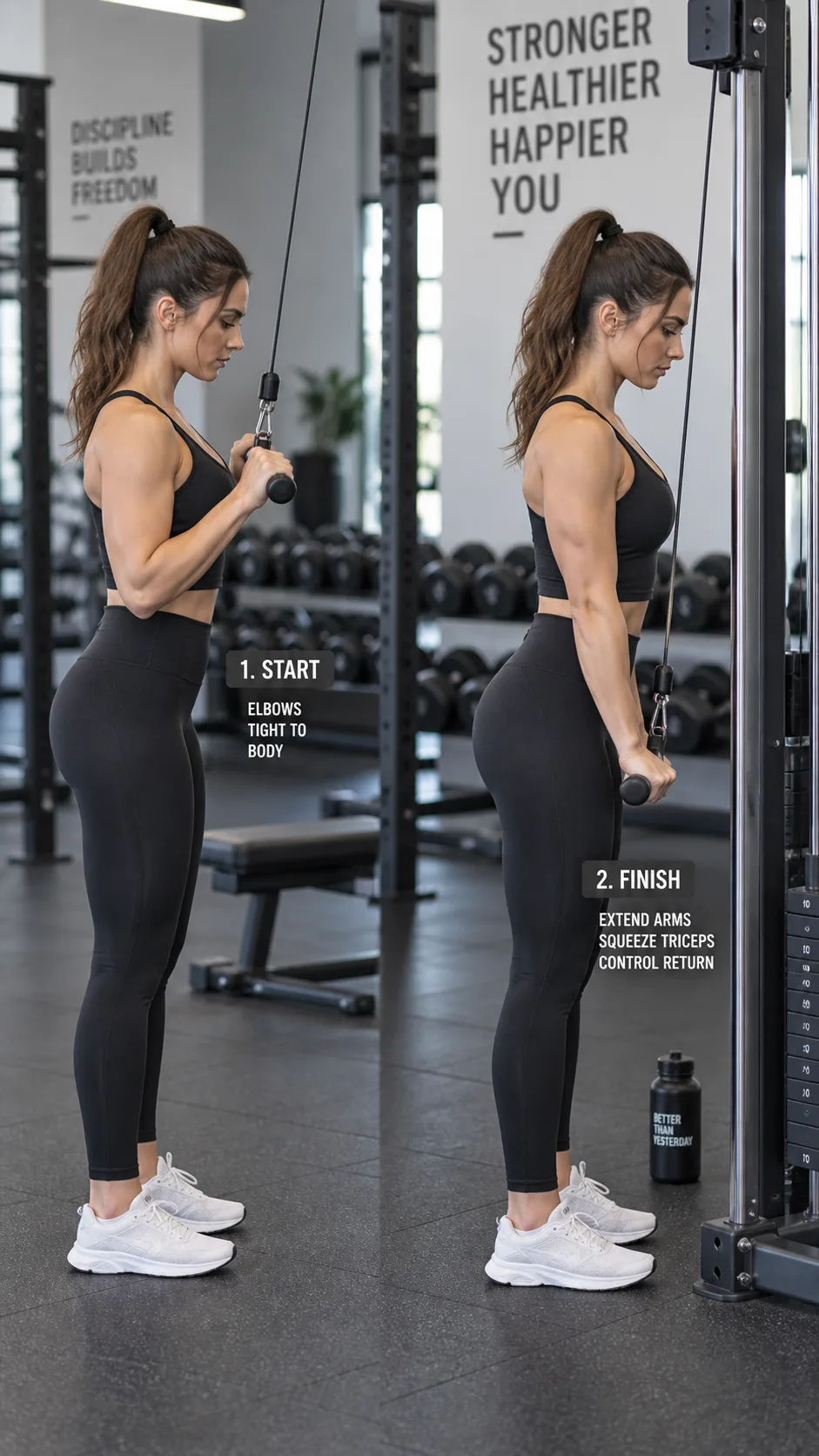
Attach a straight bar or rope to the high pulley of a cable machine. Stand facing the machine, elbows pinned to your sides, and push the bar down until your arms are fully extended. Squeeze your triceps hard at the bottom, then return to the starting position with control.
No cable machine? Swap this for overhead dumbbell tricep extensions. Hold one dumbbell with both hands behind your head and extend upward. Same muscle, different tool.
4. Overhead tricep extension (3 sets x 10 reps)
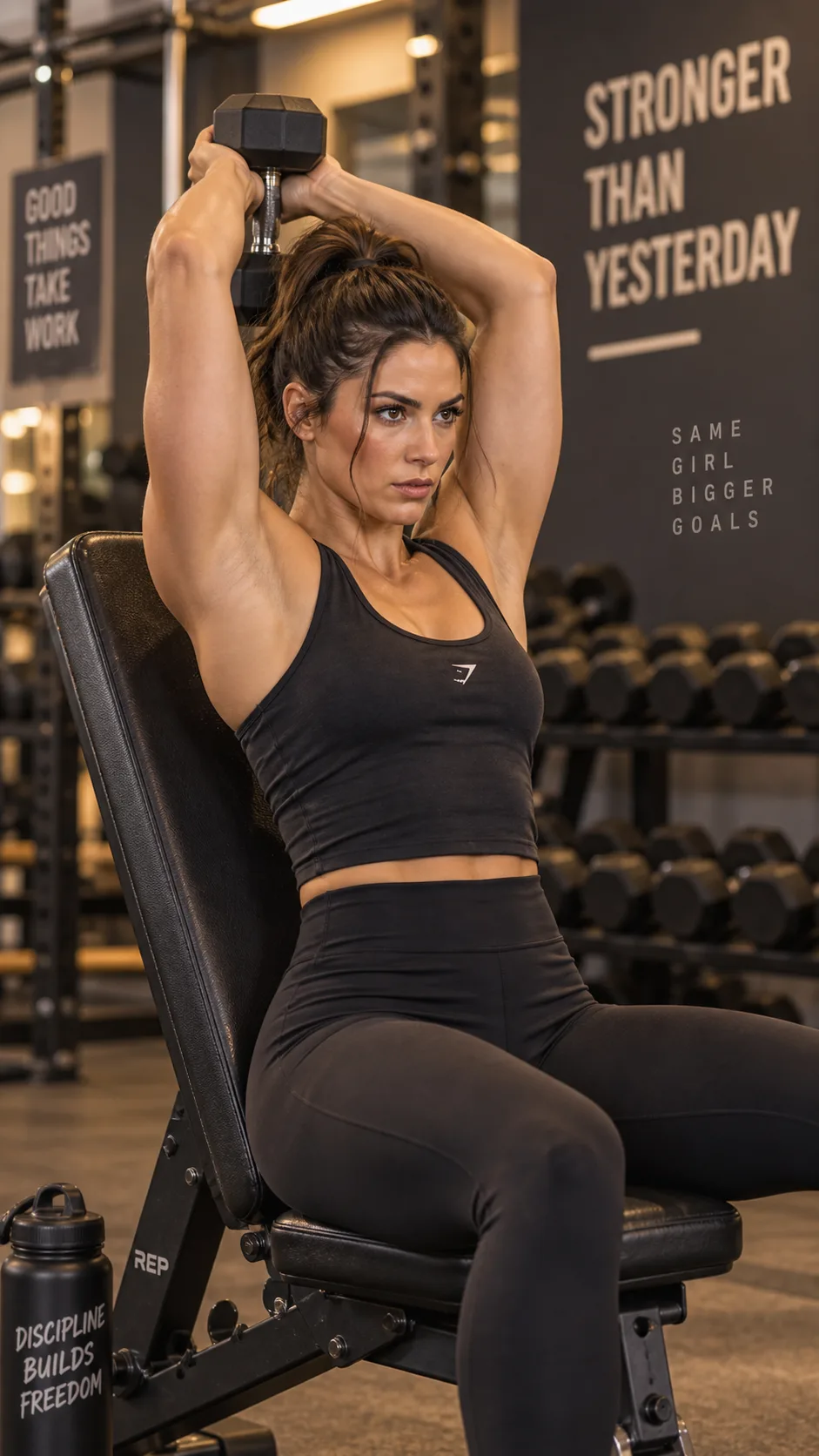
Sit on a bench with back support (or stand if you prefer). Hold one dumbbell with both hands, extend it overhead, then lower it behind your head by bending your elbows. Press it back up. You should feel a deep stretch in your triceps at the bottom. That’s the good stuff.
Keep your core tight here. If your lower back starts arching excessively, the weight is too heavy. Drop down a size. Your ego can handle it.
5. Concentration curls (3 sets x 10 reps per arm)
Sit on the edge of a bench. Rest the back of your upper arm against your inner thigh and curl a single dumbbell up. This exercise isolates the bicep beautifully because your body can’t cheat. No swinging, no momentum, just pure bicep contraction.
Ever wondered why this one burns so much more than regular curls? It’s the isolation. Your bicep has zero backup, and it knows it.
6. Dumbbell lateral raises (3 sets x 12 reps)
Stand with dumbbells at your sides. Raise them out to the sides until your arms are parallel with the floor, then lower slowly. This targets your medial deltoids, the part of the shoulder that creates that rounded cap look.
Go lighter than you think you need to. Seriously. Lateral raises with 8-pound dumbbells done perfectly will crush lateral raises with 15 pounds and terrible form. Your shoulders are small muscles; they don’t need as much weight as your biceps.
7. Dumbbell shoulder press (3 sets x 10 reps)
Sit on a bench with back support. Hold dumbbells at shoulder height with palms facing forward. Press them overhead until your arms are almost fully extended (don’t lock out the elbows), then lower back to shoulder height.
This compound movement hits all three heads of your deltoids plus your triceps. It’s efficient, it’s effective, and it makes you feel strong. What’s not to love?
Quick reference: your arm day workout at a glance
- Dumbbell Bicep Curls, 3 x 12
- Hammer Curls, 3 x 10 per arm
- Tricep Pushdowns, 3 x 12
- Overhead Tricep Extension, 3 x 10
- Concentration Curls, 3 x 10 per arm
- Dumbbell Lateral Raises, 3 x 12
- Dumbbell Shoulder Press, 3 x 10
Rest 60-90 seconds between sets. If you’re feeling fresh after 60 seconds, go. If you need the full 90, take it. Recovery between sets is where your muscles prepare for the next round. It’s not laziness, it’s strategy.
How heavy should you lift? (The weight selection question)
This trips up so many beginners. Here’s the simplest rule I’ve ever learned: pick a weight where the last 2-3 reps of each set feel genuinely challenging, but you can still maintain good form. If you could easily do 5 more reps, go heavier. If you can’t finish the set without your form falling apart, go lighter.
Research published in the Journal of Strength and Conditioning Research consistently shows that progressive overload, gradually increasing weight or reps over time, is the single most important principle for building lean muscle. You don’t need to add weight every session, but you should aim to progress every 1-2 weeks.
Start a simple log in your phone’s notes app. Write down the exercise, weight, and reps. Next week, try to beat it by one rep or 2.5 pounds. That really is the whole secret.

Common mistakes that kill your arm day progress
I’ve spent years watching people in the gym (not in a creepy way, more of an observational, concerned-for-their-rotator-cuffs way). Here are the mistakes I see most often on arm day.
Swinging the weights
If your entire body is rocking back and forth during a curl, you’re not training your biceps. You’re training your ego. Reduce the weight and control the movement. Your arms should do 100% of the work.
Skipping triceps
Remember: triceps make up two-thirds of your upper arm. Women who only train biceps end up with an imbalanced look AND miss out on the “defined arm” aesthetic they actually want. Always dedicate equal or more time to triceps.
Going too light forever
I get it. The 3-pound dumbbells feel safe. But your muscles adapt quickly, and if you never challenge them with heavier loads, they have zero reason to change. Those 3-pounders are great for rehab work, but for building definition, you need to push past comfortable.
Neglecting the negative (eccentric) phase
Lowering the weight slowly (the eccentric phase) creates more muscle damage than lifting it. That’s a GOOD thing, because muscle damage is what triggers growth and repair. Take 2-3 seconds on every lowering phase. Your future arms will thank you.
How often should you train arms?
Once or twice per week is the sweet spot for most beginners. Your muscles need 48-72 hours to recover and rebuild after a challenging session. Training arms every single day doesn’t give them time to grow. It just keeps breaking them down.
A smart weekly split might look something like this:
- Monday: Arm Day (this routine)
- Tuesday: Legs and Glutes
- Wednesday: Rest or light cardio
- Thursday: Upper Body (chest, back, shoulders)
- Friday: Legs and Glutes
- Saturday: Arms (optional second session or active recovery)
- Sunday: Full rest
If you need a solid structure for your entire week, this 7-day workout plan for women takes all the guesswork out of scheduling.
Nutrition: the other half of the equation
You can do every exercise in this routine perfectly, but if your nutrition doesn’t support muscle growth, you’ll plateau fast. Here’s what actually matters, no fad diet nonsense required.
Protein is non-negotiable
Aim for 0.7-1 gram of protein per pound of bodyweight daily. That means a 140-pound woman should target roughly 100-140 grams of protein per day. Chicken, fish, eggs, Greek yogurt, tofu, legumes: pick your favorites and eat them consistently. The USDA’s nutrition resources offer solid guidance on balanced eating if you want to go deeper.
Don’t fear carbs
Carbohydrates fuel your workouts. Without them, your arm day will feel like you’re lifting through quicksand. Whole grains, fruits, sweet potatoes, and oats are all excellent choices. Eat them, enjoy them, and stop letting diet culture make you afraid of bread.
Stay hydrated
Dehydrated muscles perform poorly and recover slowly. Aim for at least half your bodyweight in ounces of water each day, and add more on training days. It’s boring advice, but it works.
Warm-up and cool-down: don’t skip these
I know, I know. Warming up isn’t glamorous. But spending 5 minutes preparing your joints and muscles can mean the difference between a great workout and a pulled bicep that sidelines you for weeks.
Before your workout (5 minutes)
- Arm circles, 30 seconds forward, 30 seconds backward
- Band pull-aparts, 15 reps with a light resistance band
- Bodyweight push-ups (or wall push-ups), 10 reps to activate your triceps and shoulders
- Light dumbbell curls, 10 reps with very light weight to get blood flowing
After your workout (5 minutes)
- Cross-body shoulder stretch, 30 seconds per side
- Overhead tricep stretch, 30 seconds per side
- Wrist flexor and extensor stretches, 20 seconds each direction
- Doorframe bicep stretch, 30 seconds per side
Your cool-down helps reduce soreness and improves flexibility over time. Five minutes. That’s all it takes. You spend longer scrolling Instagram between sets, and we both know it.
Tracking your progress: what to look for
Forget the scale for arm training. The best indicators of progress are strength gains and visual changes, not a number on a bathroom scale. Muscle is denser than fat, so as your arms get more defined, the scale might not budge, or it might even go up slightly. That’s perfectly normal and actually a good sign.
Take progress photos every 4 weeks. Same lighting, same angle, same time of day. You’ll notice changes in your arms that the mirror doesn’t show you daily because you’re used to seeing yourself. Photos don’t lie, and comparing month to month will keep you motivated when the process feels slow.
Also track your weights and reps. When you look back and realize you started with 8-pound curls and now you’re repping 15s? That’s a confidence boost no Instagram like can match.
What to wear (because it actually matters)
This might sound superficial, but wearing workout clothes that make you feel good genuinely impacts your performance. When you feel put together and comfortable, you show up with more confidence and push harder. If you need outfit inspiration that’s practical and cute, here’s a solid guide to workout outfits for women that makes getting dressed the easiest part of your gym routine.
For arm day specifically, opt for a tank top or fitted short-sleeve shirt so you can see your muscles working. Watching your biceps contract during a curl is oddly motivating, and it helps you confirm your form is on point.
When to level up this routine
This beginner routine should serve you well for 8-12 weeks. After that, your muscles will have adapted, and you’ll need new challenges. Here are signs it’s time to progress:
- You can complete all sets and reps without the last few feeling challenging
- You’ve been using the same weights for 3+ weeks without struggle
- The routine feels “easy” (congratulations, that means it worked!)
When you hit that point, add more exercises, increase the weight, try supersets (pairing two exercises back to back with no rest), or explore more advanced variations. For a bench-focused progression, this arm dumbbell workout using a bench is a natural next step.
Final thoughts: your arms are stronger than you think
Starting an arm day routine at the gym doesn’t need to feel overwhelming. You now have seven proven exercises, a clear structure, and the knowledge to execute each move with proper form. That puts you ahead of most people who wander the gym floor without a plan.
Consistency beats perfection every time. Show up twice a week, lift a little heavier when you can, eat enough protein, and give your muscles time to recover. In 8 weeks, you’ll look at your arms and barely recognize them, in the best possible way.
Now go pick up those dumbbells and remind your arms what they’re capable of.
