
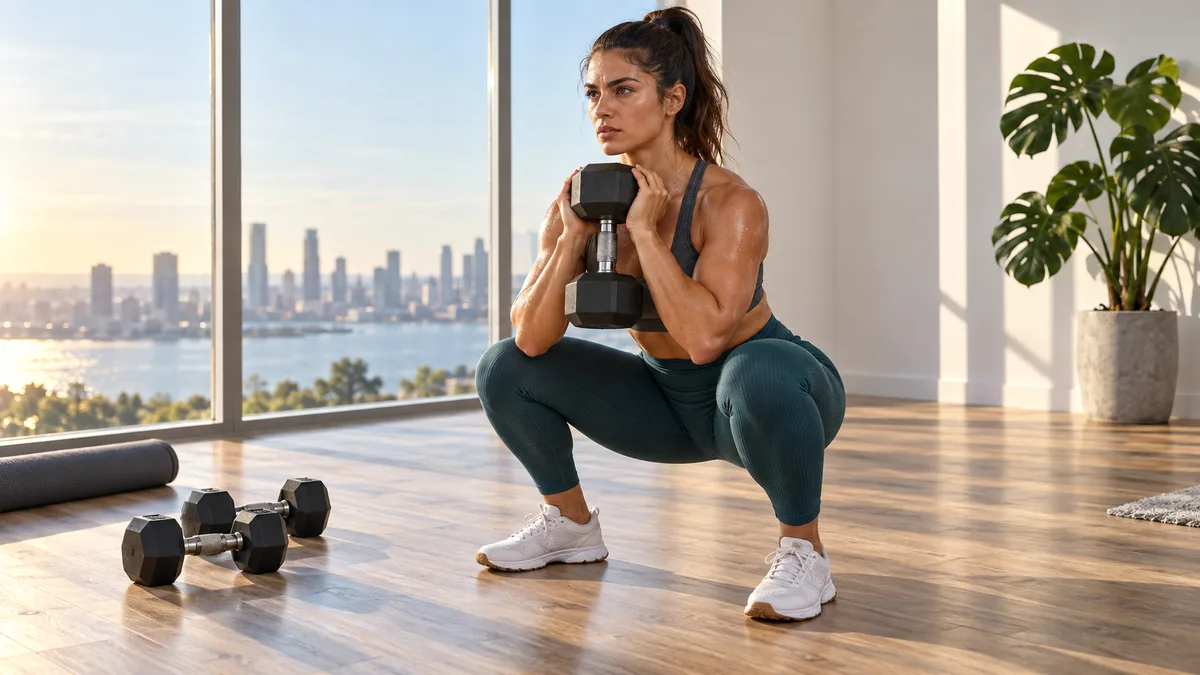
You don’t need a leg press machine or a cable stack to build seriously strong legs. A pair of dumbbells and a bit of floor space? That’s genuinely all it takes. This free weight leg workout covers 8 moves that hit your quads, hamstrings, glutes, and calves. No machines required, no gym membership needed.
IMO, free weight training builds more functional strength than machine work because your stabilizer muscles have to work the whole time. Machines guide your movement. Free weights make you own it. That’s a real difference when it comes to real-world power and injury prevention.
Skip the machine queue and get to work.
Why free weights win for leg training
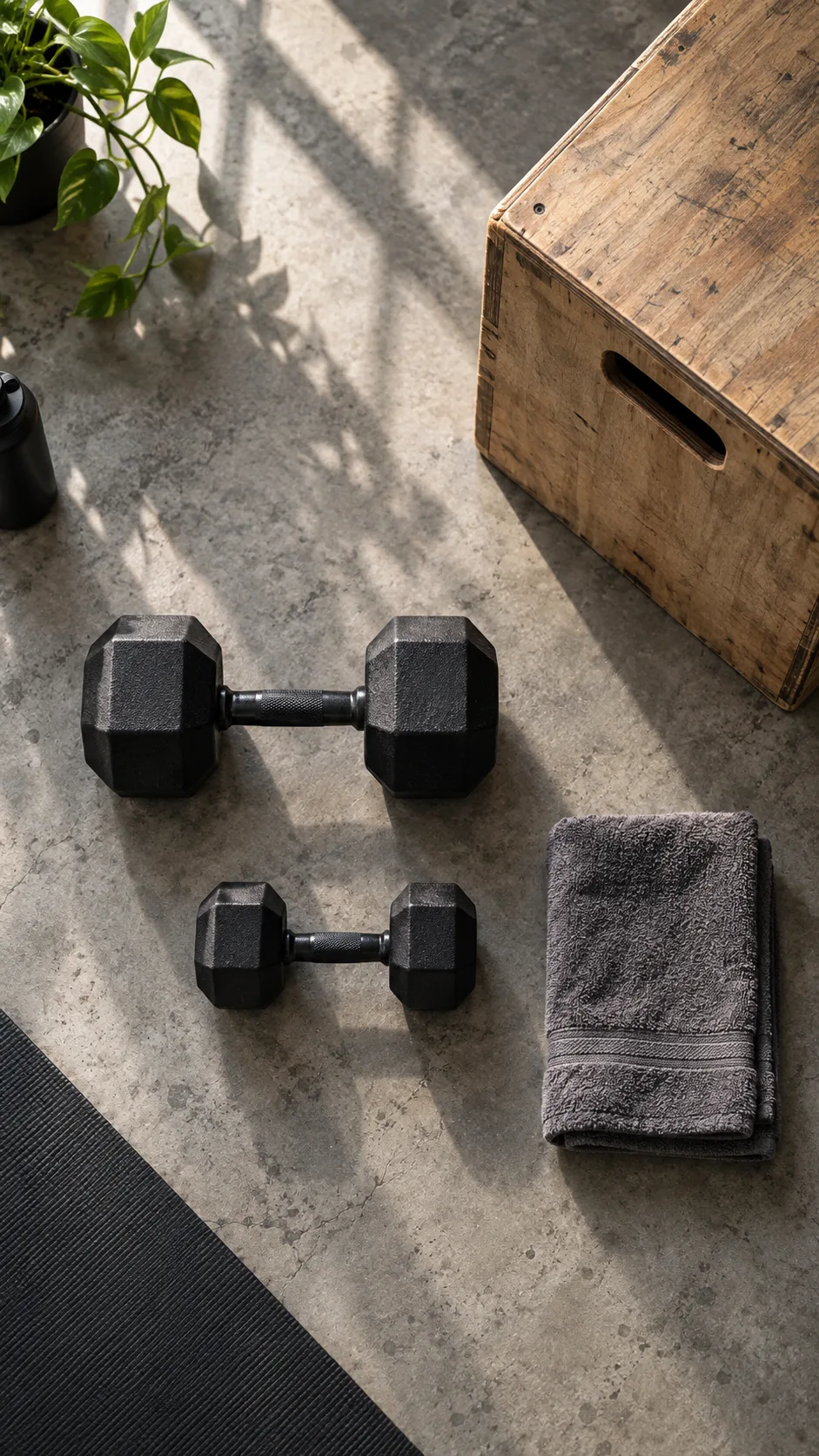
Ever wonder why your legs never quite look or feel the way you want, even after months on the leg press? Machines isolate muscles in a fixed range of motion. That sounds efficient, but it limits how many muscle fibers you recruit during each rep.
Free weights force your body to stabilize, balance, and control the load through a full, natural movement pattern. Your core fires. Your smaller stabilizer muscles activate. Your joints move through ranges that mirror how you use your legs in real life.
Research from the American Council on Exercise consistently shows that compound free weight movements produce higher muscle activation across multiple muscle groups compared to their machine equivalents. The science backs up what experienced lifters already know.
Plus, no waiting for equipment. Ever.
What you need for this workout
- A pair of dumbbells, ideally two sets at different weights (light and moderate)
- A sturdy box or step for step-ups (optional but useful)
- A bench or couch for Bulgarian split squats and hip thrusts
- Enough floor space to take a large step forward
If you only have one set of dumbbells, that’s still enough to start. You can always add reps or slow down the tempo to increase the challenge without adding weight.
FYI, if you want to pair this with upper body work using the same equipment, check out the Full Body Dumbbell Workout Plan. It maps out how to structure a complete program around free weights.
The 8 free weight leg exercises
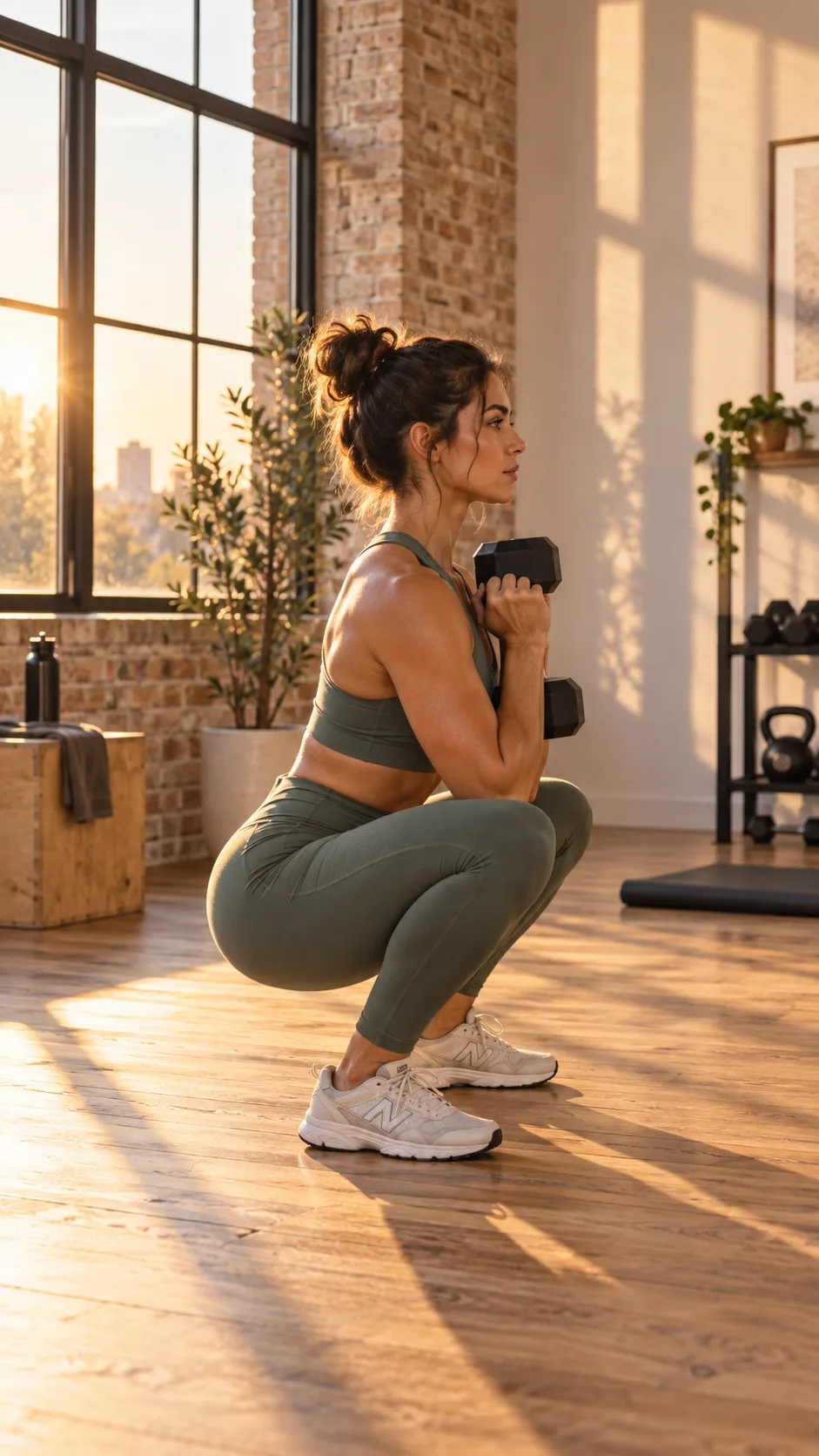
1. Goblet squat
The goblet squat earns its place at the top of every free weight leg workout because it teaches you to squat correctly while loading your quads and glutes hard. Hold one dumbbell vertically at your chest, feet shoulder-width apart, toes slightly out.
How to do it:
- Hold the dumbbell close to your chest, elbows pointing down
- Push your knees out as you lower into a deep squat
- Drive through your heels to stand back up
- Squeeze your glutes at the top
Sets and reps: 3-4 sets of 10-15 reps. Go heavier than you think you need to. This move handles weight well.
2. Romanian deadlift (RDL)
If you want stronger hamstrings and glutes, the Romanian deadlift delivers. Hold a dumbbell in each hand in front of your thighs, feet hip-width apart. This move trains the entire posterior chain: the muscles running up the back of your body.
How to do it:
- Hinge at the hips, sending them back as the weights slide down your legs
- Keep your back flat and your core braced the entire time
- Lower until you feel a deep stretch in your hamstrings
- Drive your hips forward to return to standing
Sets and reps: 3-4 sets of 10-12 reps. Control the descent, because the eccentric phase is where the real work happens.
3. Dumbbell walking lunge
The walking lunge challenges your quads, glutes, and balance all at once. Unlike a static lunge, the walking version adds a coordination element that makes your legs work harder with every step. Hold a dumbbell in each hand at your sides.
How to do it:
- Step forward with one foot and lower your back knee toward the floor
- Push off your front foot and bring your back leg forward into the next lunge
- Keep your torso tall, not leaning forward
- Alternate legs with each step
Sets and reps: 3 sets of 12 reps per leg. If space is limited, do stationary reverse lunges instead.
4. Bulgarian split squat
This one earns its reputation as the most challenging single-leg exercise you can do with free weights. Your rear foot rests on a bench behind you, which shifts almost all the load onto your front leg. Your quads, glutes, and hip flexors have nowhere to hide.
How to do it:
- Place your rear foot on a bench, laces down
- Hold a dumbbell in each hand at your sides
- Lower your back knee toward the floor, keeping your front shin relatively vertical
- Drive through your front heel to stand back up
Sets and reps: 3 sets of 8-10 reps per leg. Start lighter than you expect. This move humbles everyone at first.
5. Dumbbell step-up
Step-ups build unilateral (single-leg) quad and glute strength while keeping the impact low. They also improve hip stability in a way that bilateral exercises simply can’t replicate. Use a sturdy box, bench, or step that brings your knee to about 90 degrees when you place your foot on it.
How to do it:
- Hold a dumbbell in each hand at your sides
- Place one foot fully on the box
- Drive through that heel to step up, without pushing off the trailing leg
- Lower back down with control
Sets and reps: 3 sets of 10-12 reps per leg. Avoid the temptation to bounce off the bottom leg. Make the working leg do all the lifting.
6. Sumo squat
A wider stance and turned-out toes shift the emphasis from the quads toward the inner thighs and glutes. The sumo squat works the parts of your lower body that a standard squat often misses. Hold one heavy dumbbell with both hands between your legs.
How to do it:
- Stand with feet wider than shoulder-width, toes pointing out at 45 degrees
- Hold the dumbbell vertically between your legs
- Lower into a squat, keeping your knees tracking over your toes
- Push through the full foot to stand and squeeze your glutes at the top
Sets and reps: 3-4 sets of 12-15 reps. Going heavier here works well. Use the heaviest dumbbell you have available.
7. Dumbbell hip thrust
The hip thrust is the single best glute-builder in this entire workout. Period. Your upper back rests on a bench, hips drive upward, and the dumbbell sits across your hip crease as resistance. It loads the glutes at peak contraction, exactly where you need it.
How to do it:
- Sit on the floor with your upper back against a bench, knees bent, feet flat
- Place one heavy dumbbell across your hip crease and hold it steady
- Drive your hips upward until your body forms a straight line from knees to shoulders
- Squeeze hard at the top, then lower with control
Sets and reps: 3-4 sets of 12-15 reps. Use a folded towel under the dumbbell if the pressure on your hips is uncomfortable.
8. Single-leg Romanian deadlift
This is the balance and coordination challenge that ties the whole workout together. The single-leg RDL hits your hamstrings and glutes with a deep stretch while forcing your stabilizers to work overtime. It also exposes any strength imbalances between your two sides (which every person has, by the way).
How to do it:
- Hold one dumbbell in your right hand, stand on your left foot
- Hinge forward at the hip, letting the right leg float back as a counterbalance
- Lower the dumbbell toward the floor, keeping your hips square
- Drive through the standing heel to return upright
Sets and reps: 3 sets of 8-10 reps per leg. Go lighter than a standard RDL, because balance is the limiting factor here, not strength.
How to structure the full workout
Don’t throw these 8 exercises together randomly. A smart order makes a real difference in how you feel and perform. This sequence pairs heavy compound moves early with isolation and single-leg work later:
- Goblet Squat — 4 sets x 12 reps
- Romanian Deadlift — 4 sets x 10 reps
- Bulgarian Split Squat — 3 sets x 8-10 reps per leg
- Sumo Squat — 3 sets x 12-15 reps
- Dumbbell Hip Thrust — 4 sets x 12-15 reps
- Dumbbell Step-Up — 3 sets x 10-12 reps per leg
- Walking Lunge — 3 sets x 12 reps per leg
- Single-Leg RDL — 3 sets x 8-10 reps per leg
Rest 60-90 seconds between sets for most exercises. For the heavier compound moves (goblet squat, RDL), take a full 2 minutes if you need it. Quality of movement always beats rushing through reps.
Total workout time runs about 45-60 minutes depending on your rest periods.
Progressive overload: how to keep getting stronger
Doing the same workout with the same weights every week stops producing results fast. Your body adapts quickly, usually within 2-3 weeks, so you need to give it a reason to keep changing. Progressive overload is how you do that.
Practical ways to progress this free weight leg workout over time:
- Add 1-2 reps per set before increasing weight
- Increase dumbbell weight by the smallest increment available (usually 2-4 lbs)
- Slow down the eccentric (lowering) phase to 3-4 seconds per rep
- Reduce rest periods between sets
- Add a pause at the bottom of squats and lunges
According to the National Strength and Conditioning Association, progressive overload is the foundational principle behind all strength and muscle development. Without it, training becomes maintenance rather than improvement.
Common form mistakes to avoid
Strong legs come from doing these moves right, not just doing them often. These are the mistakes that limit results and create injury risk:
- Knees caving inward during squats and lunges: actively push your knees out
- Rounding the lower back in RDL variations: brace your core and keep your spine neutral
- Rushing the eccentric phase: slower lowering produces more muscle activation and better control
- Using momentum in hip thrusts instead of driving through the glutes
- Gripping the floor with your toes in single-leg work: keep the foot relaxed and grip with the whole foot
When your form breaks down, the weight is too heavy. Drop it. Perfect reps with a lighter weight always outperform sloppy reps with a heavier one, both for results and for keeping your joints healthy long-term.
A useful external resource for movement screening and form fundamentals is the ACE IFT Movement Screening guidelines, worth a read if you want to understand the mechanics behind these patterns.
How often should you do this workout?
Twice a week hits the sweet spot for most people. That gives your legs 48-72 hours of recovery between sessions. That’s when the actual adaptation and muscle growth happens, not during the workout itself.
If you train legs three times a week, rotate between heavier sessions (lower reps, heavier weight) and lighter sessions (higher reps, less weight). Your joints will thank you.
For women who want a specific structured approach to frequency and volume, the Best Leg Workout for Women builds out a full weekly plan that layers these principles into a complete lower body program.
Pairing this workout with other training
This free weight leg workout works well as a standalone session or as part of a larger program. If you want to extend the stimulus beyond leg day, the 10 Lower Body Dumbbell Workout Moves gives you additional exercises to rotate in when you need variety.
And if you train the whole body with free weights, not just legs, the approach here scales up cleanly. Programming compound lower body work 2x per week alongside upper body sessions gives you a full-body free weight program without needing a single machine.
Research published through the National Library of Medicine supports training each muscle group at least twice per week for maximal hypertrophy. Structuring your week around consistent leg sessions genuinely moves the needle on strength and muscle development.
The bottom line
Eight exercises. A pair of dumbbells. That’s a complete free weight leg workout that builds real, functional strength from your glutes to your calves. No machines, no gym required.
The goblet squat and Romanian deadlift lay the foundation. The Bulgarian split squat and single-leg RDL build the balance and unilateral strength that machines can never replicate. The hip thrust and sumo squat lock in glute development. And the walking lunge and step-up tie it all together into a session that genuinely earns the soreness you’ll feel tomorrow.
Stay consistent, add load progressively, and keep your form sharp. Your legs will respond, and they’ll get stronger faster than you expect.
