
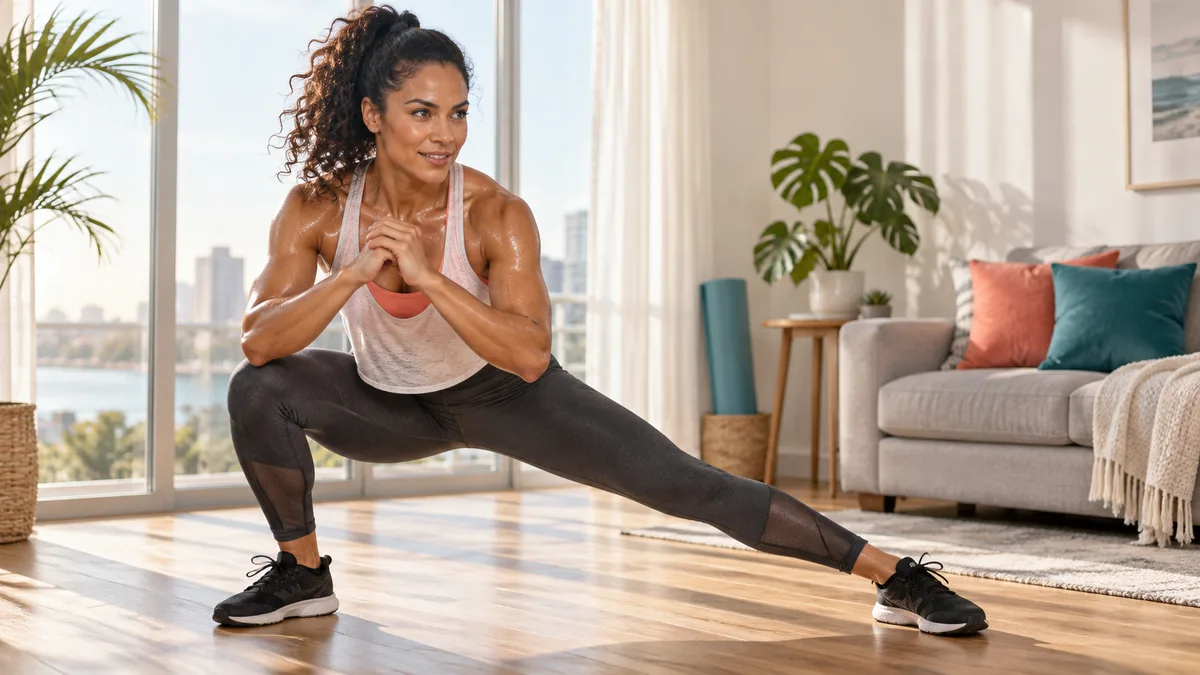
Your knees hurt. Your ankles pop. Your downstairs neighbor already filed a noise complaint. And yet you still want that heart-pounding, sweat-dripping, calorie-torching workout. Sound familiar? Low impact HIIT gives you exactly that, minus the joint destruction and angry neighbors.
I spent years believing that a “real” HIIT workout meant jumping until my shins screamed. Spoiler: it doesn’t. You can absolutely spike your heart rate, burn serious calories, and build functional strength while keeping at least one foot on the ground at all times. Here are two complete routines you can start today.
What exactly is a low impact HIIT workout?
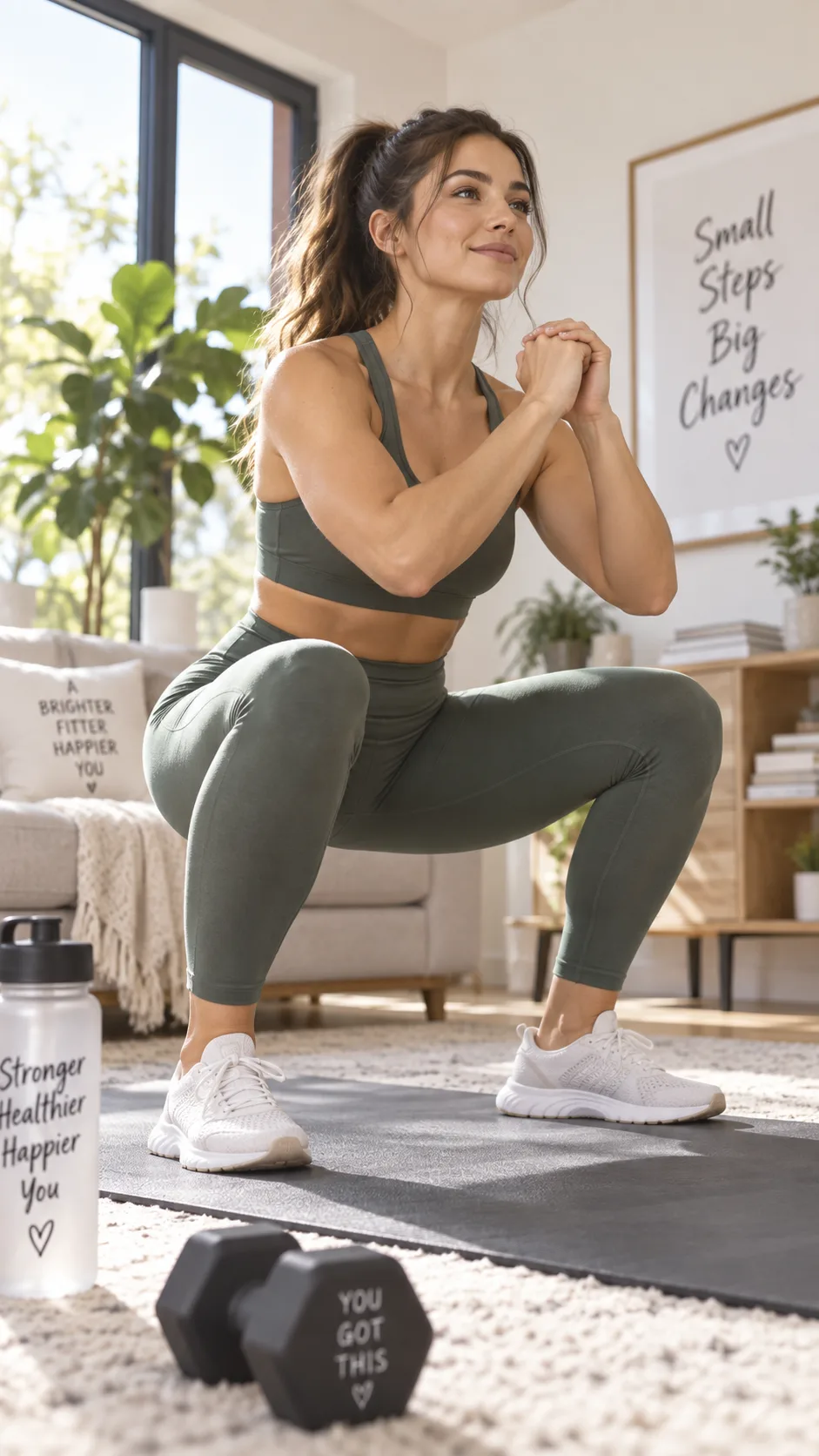
Let’s clear something up right away. “Low impact” does not mean “low intensity.” Impact refers to force, specifically the jarring force your joints absorb every time both feet leave the ground at once. Think box jumps, burpees, and jump squats. Those are high impact.
Low impact HIIT swaps those movements for exercises where at least one foot stays planted. You still push hard during work intervals and recover during rest intervals. Your heart rate still climbs. You still gasp for air. The only difference? Your joints don’t take a beating.
According to the American College of Sports Medicine, HIIT involves alternating between periods of high-intensity effort (typically 80 to 95% of max heart rate) and lower-intensity recovery. Nothing in that definition requires jumping.
Why your joints deserve this approach
Every time you jump and land, your joints absorb forces of 2 to 5 times your body weight. For a 160-pound person, that’s up to 800 pounds of force slamming through your knees and ankles, per rep. Multiply that across a 20-minute session, and you start to see why traditional HIIT chews through cartilage like it owes it money.
Low impact HIIT dramatically reduces those ground-reaction forces while maintaining the metabolic benefits. Research published in the British Journal of Sports Medicine confirms that interval training improves cardiovascular fitness, insulin sensitivity, and body composition regardless of whether the exercises involve impact.
Who needs low impact the most?
- Anyone with knee, hip, or ankle issues (arthritis, past injuries, chronic pain)
- Postpartum women still rebuilding their pelvic floor strength
- Beginners who haven’t built the joint stability for plyometrics yet
- People over 40 whose connective tissue recovers slower than it used to
- Apartment dwellers who’d rather not get evicted
Even elite athletes cycle in low impact HIIT phases to manage training load. This isn’t a “lesser” workout. It’s a smarter one.

The 10-minute low impact HIIT workout
Short on time? Ten minutes is enough to spike your metabolism and leave you breathless. This routine uses a 40 seconds work / 20 seconds rest format. You’ll complete 10 rounds, one exercise per round. No repeats. No boredom.
The exercises
- March in Place with High Knees : Drive your knees toward your chest as fast as you can while staying grounded. Pump your arms hard.
- Squat to Calf Raise : Sink into a squat, then press through your toes at the top. Keep your core tight throughout.
- Standing Oblique Crunches (Right Side) : Bring your right knee to your right elbow. Fast, controlled reps.
- Standing Oblique Crunches (Left Side) : Mirror the previous move on your left side.
- Lateral Step-Out Squats : Step your right foot wide, squat, return. Alternate sides rapidly.
- Speed Skaters (No Jump) : Step laterally, tapping your back foot behind you. Swing your arms for momentum and speed.
- Reverse Lunge to Knee Drive (Right) : Step back into a lunge, then drive your knee forward and up explosively.
- Reverse Lunge to Knee Drive (Left) : Same pattern, opposite leg.
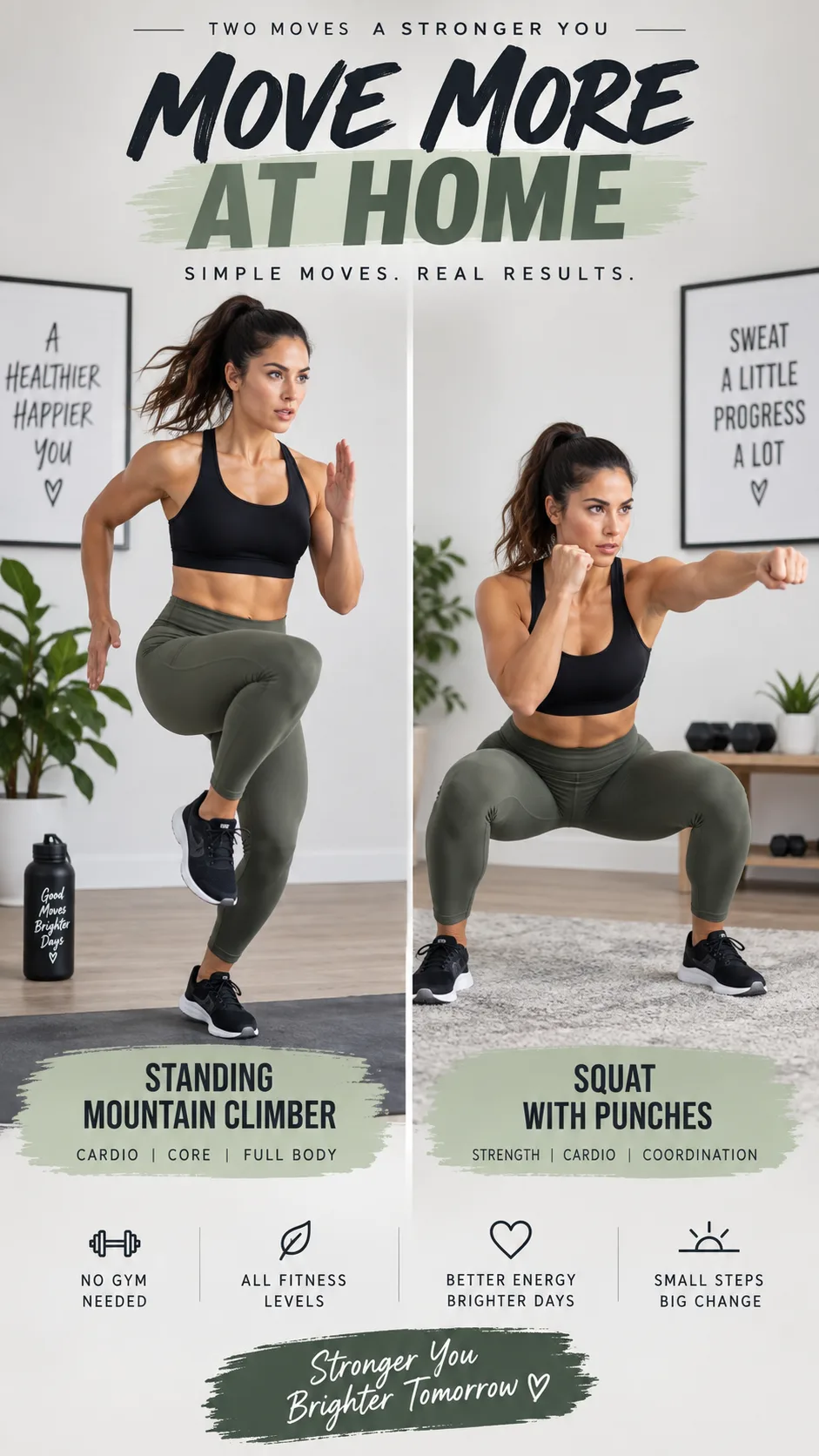
- Standing Mountain Climbers : Alternate driving your knees up as fast as possible while your arms reach overhead and pull down.
- Squat Hold with Punches : Hold a low squat and throw fast, alternating punches forward. Your quads will burn. Embrace it.
Quick tip: The intensity comes from YOUR effort, not from the exercise itself. If you half-heartedly march in place, you’ll get half-hearted results. Push the pace during those 40-second work intervals like someone’s chasing you.
The 20-minute low impact HIIT workout
Got a bit more time? This routine builds on the 10-minute structure and adds a second block with fresh exercises. You’ll perform two blocks of 10 exercises each, using the same 40/20 work-to-rest ratio. Take a 60-second active recovery (light walking or gentle stretching) between blocks.
Block 1 (10 minutes)
- Step Jacks : Like jumping jacks, but you step one foot out at a time instead of jumping. Arms go overhead with full range of motion.
- Sumo Squat with Alternating Heel Raise : Wide stance squat, lift one heel at the bottom, then the other. Fires up your inner thighs and calves.
- Curtsy Lunge (Right) : Step your right foot behind and across your body. Drop low, then return.
- Curtsy Lunge (Left) : Same movement, opposite side.
- Inchworm Walk-Out : Hinge at the hips, walk your hands out to a plank, walk them back, and stand. One of the best total-body moves you can do without impact.
- Standing Side Leg Raises (Right) : Lift your right leg laterally as high as you can. Fast but controlled reps.
- Standing Side Leg Raises (Left) : Switch sides.
- Fast Feet Shuffle : Tiny rapid steps in place, staying low in an athletic stance. Your heart rate will SPIKE here.
- Good Mornings : Hands behind your head, hinge at the hips, squeeze your glutes to stand. Protects and strengthens your lower back.
- Alternating Front Kicks : Kick forward at hip height, alternating legs. Keep your core braced and chest tall.
60-second active recovery: walk it out, shake your arms, catch your breath.
Block 2 (10 minutes)
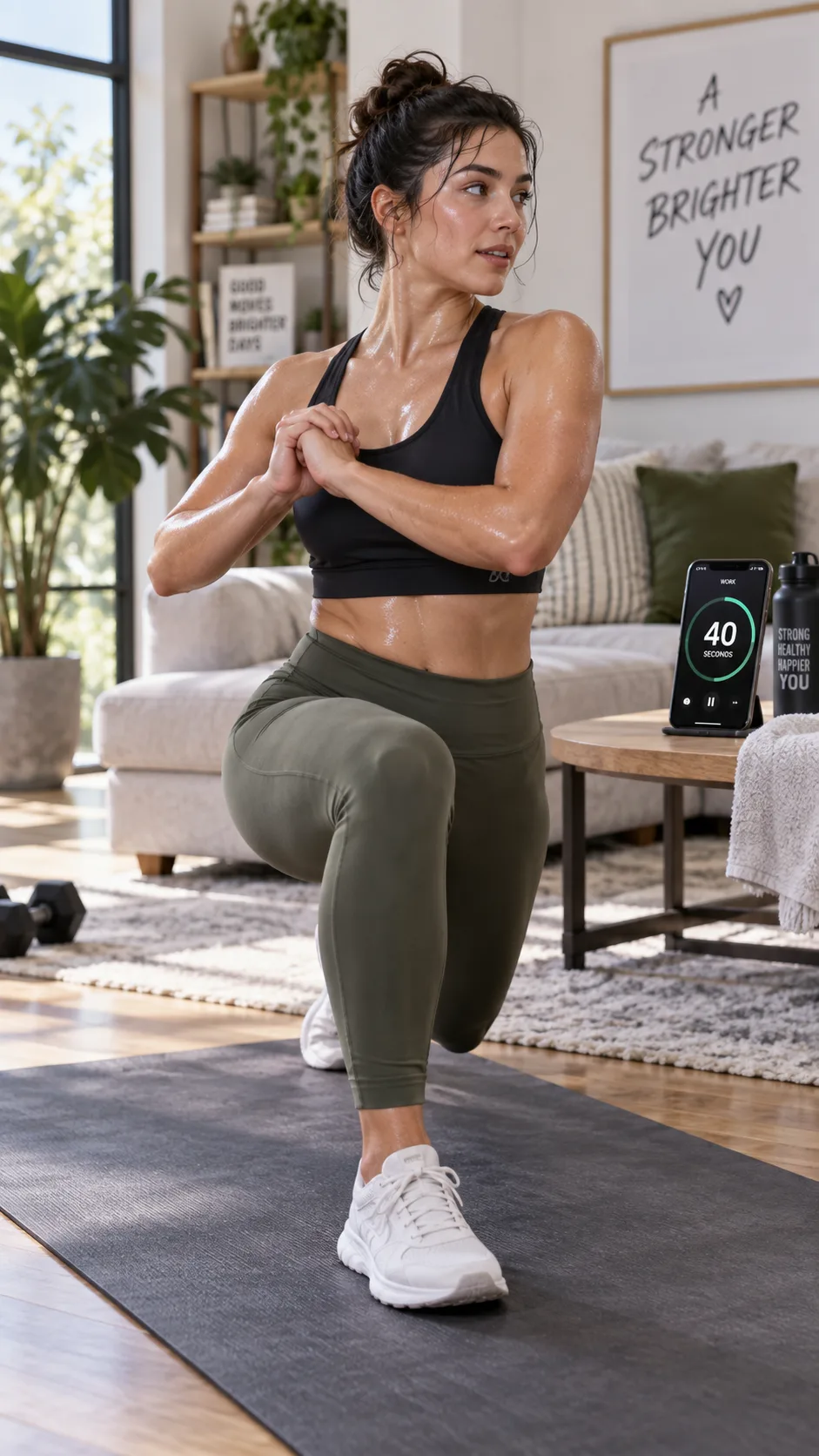
- Reverse Lunge with Torso Twist : Step back into a lunge, then twist your upper body toward the front knee. Works your core and legs simultaneously.
- Push-Up to Shoulder Tap : Perform a push-up (modify on your knees if needed), then tap each shoulder at the top. Anti-rotation core work built right in.
- Lateral Lunge (Alternating) : Step wide to one side, sit your hips back, push off, and repeat on the other side.
- Squat to Front Raise (No Weight Needed) : Squat down, then raise both arms straight in front as you stand. Sounds easy? Try it at speed for 40 seconds.
- Standing Bicycle Crunches : Bring your right elbow to your left knee, then switch. Move fast and squeeze your abs hard on every rep.
- Plank Step-Outs : Hold a plank and step your feet wider, then narrow, wider, then narrow. Keeps your core lit up the entire time.
- Single-Leg Deadlift (Right) : Balance on your right foot, hinge forward, and reach toward the ground. Builds serious stability.
- Single-Leg Deadlift (Left) : Same thing, other side.
- Alternating Reverse Lunges (Speed Round) : Alternating legs as fast as you can while maintaining solid form. This is your final push.
- Squat Pulse Hold : Drop into a squat and pulse slightly up and down for the full 40 seconds. Your quads will beg for mercy. Let them beg.
After 20 minutes, you’ll have accumulated roughly 13+ minutes of high-intensity work across 20 different exercises. That’s more variety than most 45-minute gym sessions, and your joints won’t feel like they just survived a car accident.
How to warm up and cool down (don’t skip this)
I know, I know. You want to jump straight in. But spending 2 to 3 minutes warming up reduces your injury risk and actually improves your workout performance. Ever tried sprinting a car engine from cold? Same concept applies to your body.
Quick warm-up (2 to 3 minutes)
- Arm circles: 30 seconds (15 forward, 15 backward)
- Hip circles: 20 seconds each direction
- Bodyweight squats at moderate tempo: 30 seconds
- Torso twists: 20 seconds
- March in place, gradually increasing speed: 30 seconds
Cool-down (2 to 3 minutes)
- Standing quad stretch: 20 seconds per leg
- Standing hamstring stretch: 20 seconds per leg
- Hip flexor stretch (half-kneeling): 20 seconds per side
- Cross-body shoulder stretch: 15 seconds per arm
- Deep breaths with overhead reach: 30 seconds
This cool-down helps your heart rate return to baseline gradually and prevents blood from pooling in your legs. It also gives your muscles a chance to start recovering before you collapse on the couch, which, let’s be honest, is where we’re all heading after this.
Form mistakes that wreck your joints anyway
Choosing low impact exercises means nothing if your form stinks. Here are the most common mistakes I see people make. I’ve made every single one of them myself, for what it’s worth.
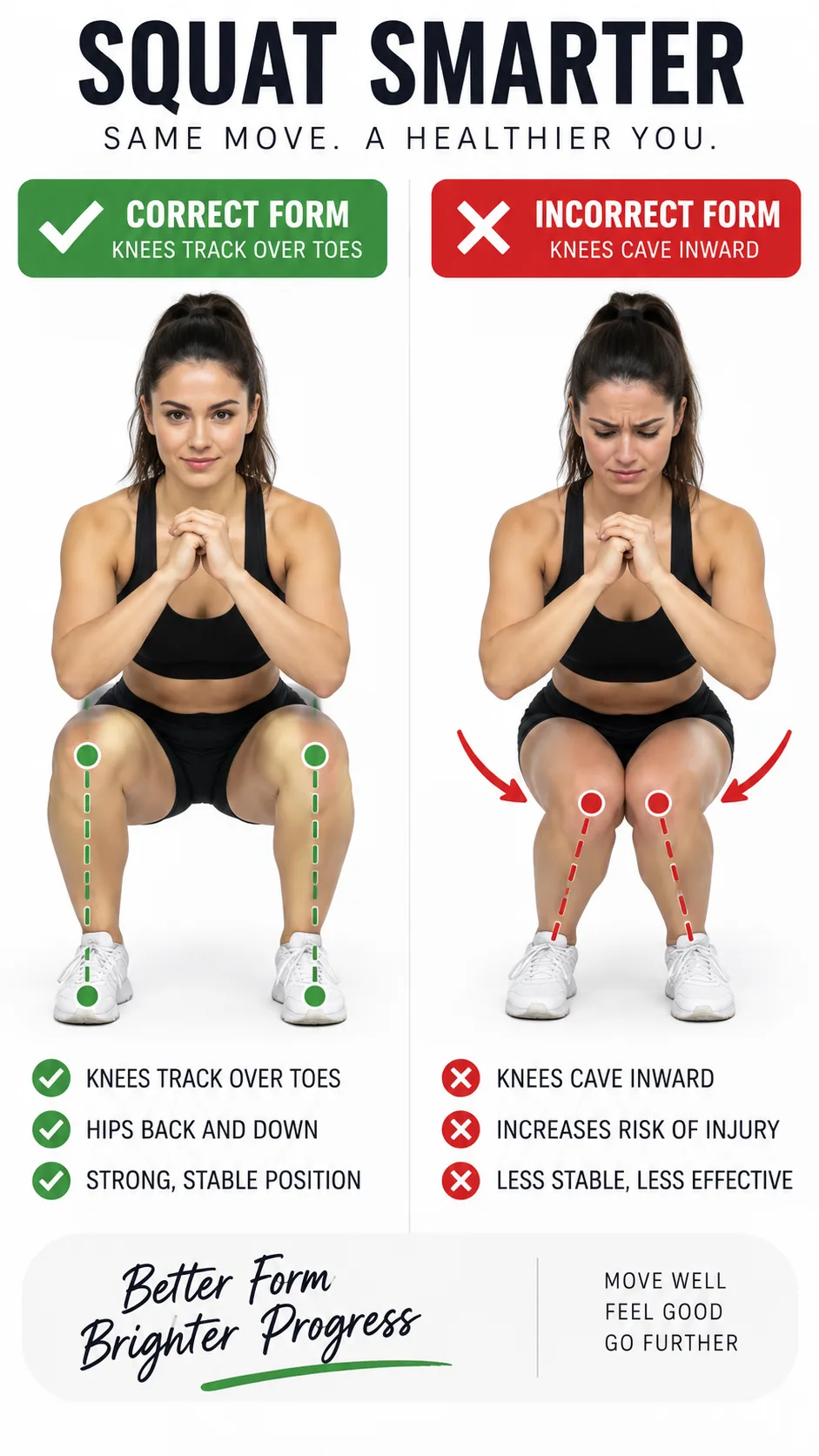
- Letting your knees cave inward during squats and lunges. This puts shearing force on your knee ligaments. Push your knees out over your toes. Always.
- Rounding your lower back during hinges. Good mornings and deadlifts require a flat or slightly arched back. Round it, and your lumbar discs pay the price.
- Locking out your joints at the top of movements. Keep a soft bend in your knees and elbows. Hyperextension stresses your joint capsules unnecessarily.
- Sacrificing form for speed. Yes, you want to push the pace. But sloppy reps performed quickly just train your body to move badly, fast. Prioritize clean movement, then add speed.
- Holding your breath. Exhale during exertion, inhale during the easier phase. Holding your breath spikes your blood pressure and makes you dizzy. Neither is productive.
Want to check your form in real time? Film yourself from the side during one round. You’ll spot issues immediately that you can’t feel while you’re focused on surviving the interval.
How often should you do low impact HIIT?
More isn’t always better. The World Health Organization recommends at least 150 to 300 minutes of moderate-intensity or 75 to 150 minutes of vigorous-intensity exercise per week for adults. HIIT falls firmly in the vigorous category.
Three to four sessions per week hits the sweet spot for most people. On off days, walk, stretch, do yoga, or try a full-body toning workout at a lower intensity. Your muscles need recovery time to adapt and grow stronger. Hammering HIIT every single day leads to overtraining, elevated cortisol, and, ironically, worse results.
Here’s a sample weekly schedule that balances intensity with recovery:
- Monday: 20-minute low impact HIIT
- Tuesday: 30-minute walk + stretching
- Wednesday: 10-minute low impact HIIT + light strength work
- Thursday: Rest or gentle yoga
- Friday: 20-minute low impact HIIT
- Saturday: Active recovery (hike, swim, or play with your kids)
- Sunday: Full rest
How to make low impact HIIT harder (without adding jumps)
After a few weeks, your body adapts. Exercises that once left you gasping start feeling manageable. That’s progress, but it also means you need to level up. Here’s how to increase intensity while keeping things joint-friendly.
- Add light dumbbells. Hold 5 to 10 lb dumbbells during squats, lunges, and marches. The extra load increases muscular demand significantly. If you want more ideas, check out this upper body dumbbell workout plan.
- Shorten your rest intervals. Move from 40/20 to 45/15, or even 50/10 for advanced trainees.
- Increase your range of motion. Squat deeper. Lunge lower. Reach farther during inchworms. Greater ROM means greater muscle activation.
- Add a resistance band. Loop a mini band above your knees during squats and lateral movements. Your glutes will wake up FAST.
- Slow down the eccentric phase. Take 3 seconds to lower into each squat or lunge. This creates more time under tension and forces your muscles to work harder.
Notice how none of these progressions involve leaving the ground? You can build an incredibly challenging workout without ever performing a single jump. Your joints stay happy, and your fitness keeps climbing.
Nutrition matters too (yes, even for a 10-minute workout)
You can’t out-train a terrible diet, even with HIIT. If you want your workouts to actually show results, pair them with solid nutrition. You don’t need anything fancy. Just enough protein to support muscle recovery, enough carbs to fuel your sessions, and enough overall balance to keep you feeling good.
Not sure where to start? A clean eating meal plan for beginners takes the guesswork out of food choices without making you weigh every grain of rice.
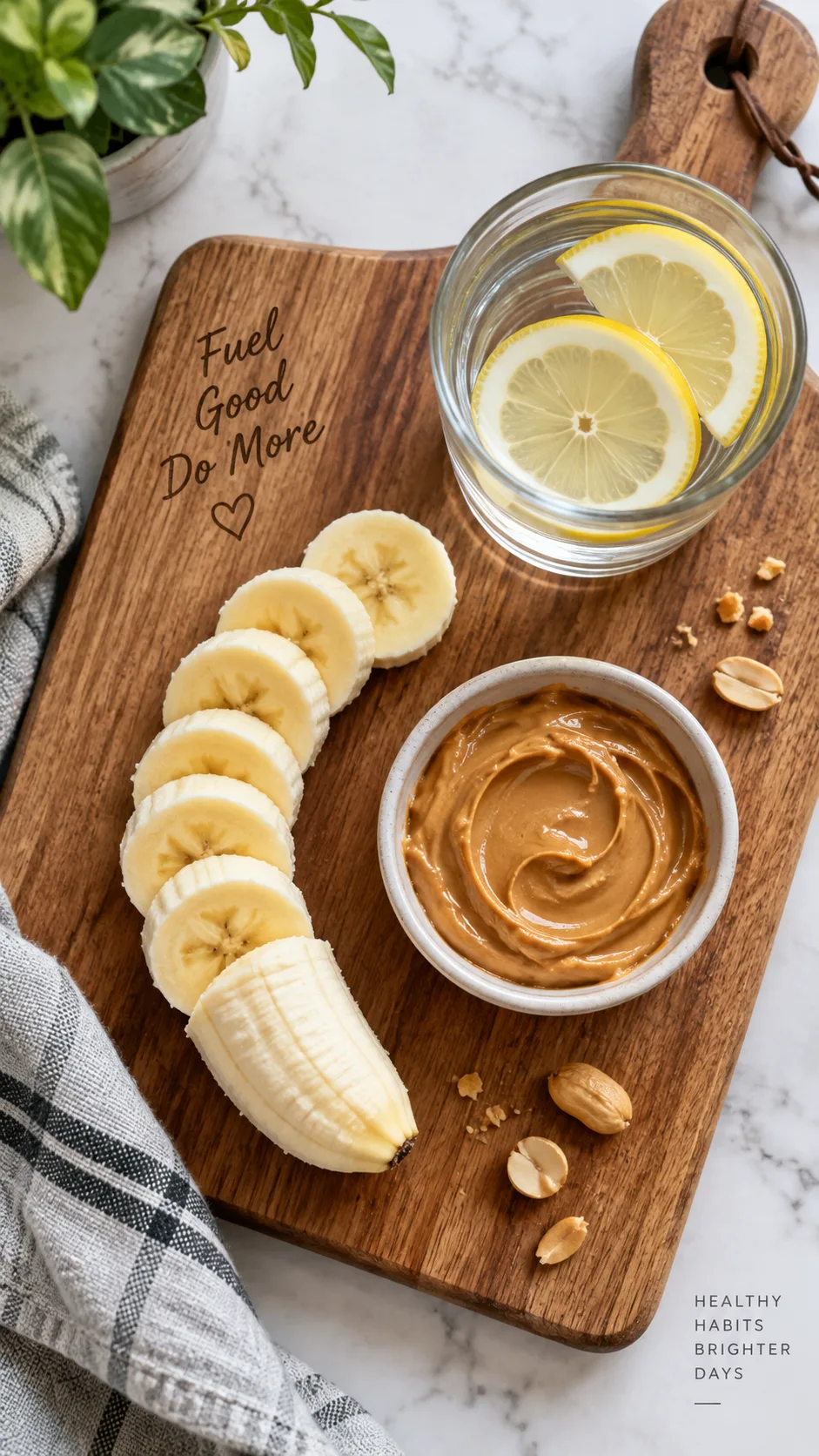
Aim for a small snack 30 to 60 minutes before your workout if you train in the morning, something like a banana with a tablespoon of peanut butter. Post-workout, prioritize protein within two hours. That’s it. No magic supplements required.
The real-world results you can expect
Let’s set realistic expectations. What will consistent low impact HIIT actually do for you over 4 to 8 weeks?
- Better cardiovascular endurance. You’ll notice everyday activities feel easier. Climbing stairs, carrying groceries, chasing your dog: all less winding.
- Better body composition. HIIT boosts your metabolic rate for hours after your workout (called the afterburn effect or EPOC). Combined with good nutrition, you’ll lose fat and preserve muscle.
- Stronger joints, not weaker ones. Low impact movements strengthen the muscles AROUND your joints without overloading the joints themselves. This actually makes your knees and hips more resilient over time.
- Better mood and energy. Exercise triggers endorphin release. A 10-minute HIIT session in the morning can set the tone for your entire day.
- Better sleep quality. Multiple studies link regular vigorous exercise to deeper, more restorative sleep. Just don’t do your HIIT right before bed.
I personally noticed the biggest changes around week three. My resting heart rate dropped, my energy levels throughout the day stabilized, and I stopped dreading the workouts. They became something I genuinely looked forward to, which, if you know me, is a minor miracle.
Final thoughts: protect your joints, not your comfort zone
Low impact HIIT proves that you don’t need to destroy your body to transform it. These 10-minute and 20-minute routines deliver everything traditional HIIT promises (cardiovascular gains, fat loss, better strength) without the pounding that sends people to physical therapy.
Start with the 10-minute routine if you’re new to this. Build consistency first. Then graduate to the 20-minute workout as your fitness improves. Add dumbbells, bands, or tighter rest intervals when you need a fresh challenge.
Your joints carry you through every single day of your life. They deserve workouts that build them up rather than break them down. So press play on that timer, keep your feet grounded, and push harder than you think you can. The results will speak for themselves, and your knees will actually thank you for once.
