
Your arms deserve better than gathering dust between bicep curl sessions at the gym. If you think you need dumbbells, kettlebells, or an entire rack of iron to build sculpted, defined arms, I’m here to happily prove you wrong.
Pilates arms workouts use nothing but your own bodyweight and a mat, and they will absolutely humble you. I’ve watched people bench press impressive numbers and then tremble through two minutes of Pilates arm circles. It’s beautiful, honestly.
This guide breaks down the best mat-based Pilates arm exercises, gives you a ready-to-follow routine, and explains exactly why these deceptively simple moves build real definition. No weights required. No excuses accepted.
Why Pilates arms workouts actually work (without a single dumbbell)
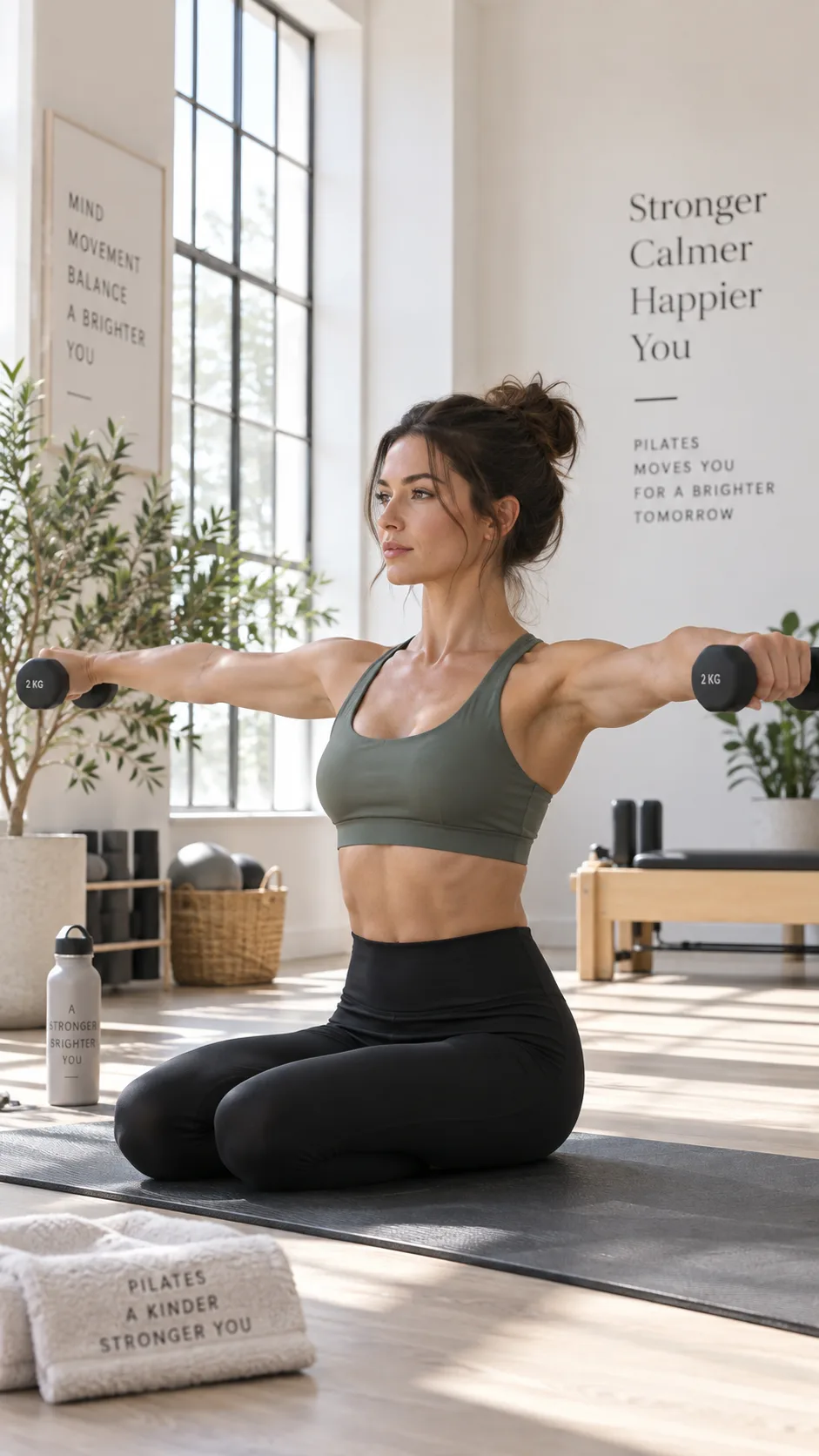
Here’s what most people get wrong about arm training: they assume heavier equals better. But Pilates targets your muscles through sustained tension, controlled movement, and high repetitions, a completely different stimulus than traditional weight lifting. And your muscles don’t care WHERE the resistance comes from. They only care that it exists.
When you hold a plank, press through a push-up, or pulse your arms against gravity for 60 seconds straight, your deltoids, triceps, and biceps fire continuously. There’s no rest at the top of a rep. No momentum to cheat with. Just pure, uninterrupted muscle engagement.
Joseph Pilates himself designed these exercises to build long, lean, functional strength. According to the Pilates Foundation, the method emphasizes control and precision over brute force, which is exactly why it creates that toned, defined look so many people chase.
Ever wondered why dancers and Pilates instructors have incredibly defined arms without ever touching a weight room? Now you know.
The science behind bodyweight arm sculpting
Let’s get a little nerdy for a second (just a second, I promise). Muscle definition comes from two things: building lean muscle and reducing the layer of fat covering it. Pilates arm exercises excel at both.
Isometric and eccentric contractions
Many Pilates moves involve isometric holds (holding a position under tension) and eccentric contractions (slowly lowering or lengthening the muscle). Research published in the Journal of Strength and Conditioning Research shows that eccentric training creates significant muscle adaptation and growth, sometimes even more effectively than concentric (lifting) movements.
Translation? When you slowly lower yourself during a Pilates push-up or resist gravity during arm pulses, you create micro-tears in the muscle fibers that rebuild stronger and more defined. Your arms won’t bulk up like a bodybuilder’s, but they WILL look sculpted and athletic.
Mind-muscle connection
Pilates forces you to focus intensely on the muscle you’re working. You can’t zone out and scroll Instagram while doing precise arm circles (well, you can try, but you’ll look ridiculous and miss the point). This mind-muscle connection increases muscle fiber recruitment, meaning you get more out of every single rep.
If you’re already practicing mat Pilates workouts for your full body, adding dedicated arm sequences slots right into your existing routine seamlessly.
10 best Pilates arms exercises you can do on a mat
Alright, here’s the good stuff. These are the most effective Pilates arm exercises that require zero equipment, just your mat and a willingness to shake. I’ve organized them from beginner-friendly to “why are my arms vibrating.”
1. Arm circles
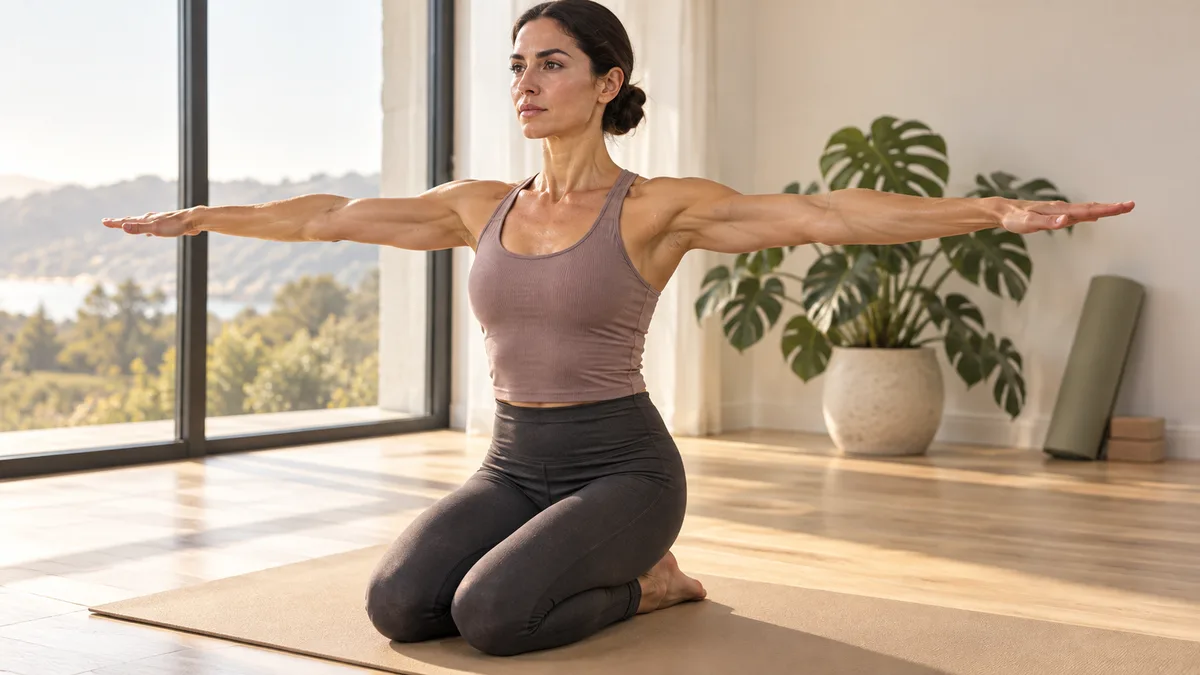
Don’t you dare underestimate arm circles. Stand or kneel with your arms extended straight out to the sides at shoulder height. Make small, controlled circles (20 forward, 20 backward). Keep your shoulders pulled down away from your ears and your core engaged the entire time.
By circle number 15, your deltoids will be screaming. By number 30, you’ll question every life choice that led you here. That’s the magic.
2. Pilates push-up
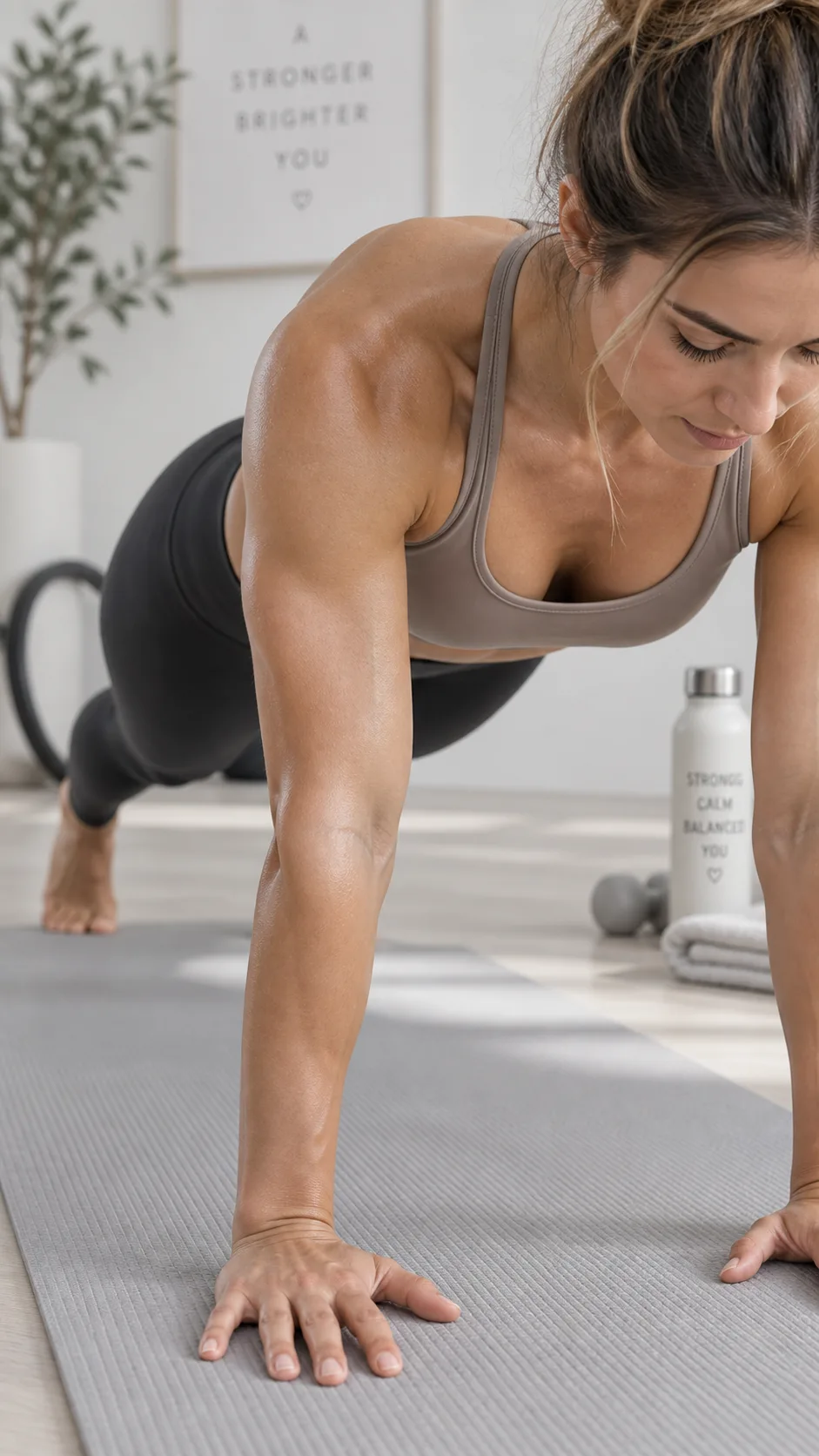
This isn’t your standard gym push-up. Start standing tall, roll down through your spine vertebra by vertebra, walk your hands out to a plank, perform one slow, controlled push-up (elbows tight to your ribs), then walk your hands back and roll up. That’s ONE rep.
The Pilates push-up targets your triceps, chest, shoulders, and core simultaneously. Aim for 5-8 reps with impeccable form. Speed is the enemy here. Slow and steady wins the definition game.
3. Tricep dips (mat version)
Sit on your mat with your knees bent, feet flat, and hands placed behind you with fingers pointing toward your body. Lift your hips off the mat. Now bend your elbows straight back, lowering your body, then press back up. Keep your elbows pointing directly behind you, not flaring out to the sides.
Do 12-15 reps. Your triceps (that stubborn area on the back of your arms) will feel every single one.
4. Prone arm lifts (swimming prep)
Lie face down on your mat with your arms extended overhead. Lift your chest slightly and alternately raise your right arm and left arm off the floor in a controlled swimming motion. Squeeze your shoulder blades together at the top of each lift.
This one torches the backs of your shoulders and your upper back, muscles that play a huge role in making your arms look defined from every angle.
5. Plank shoulder taps
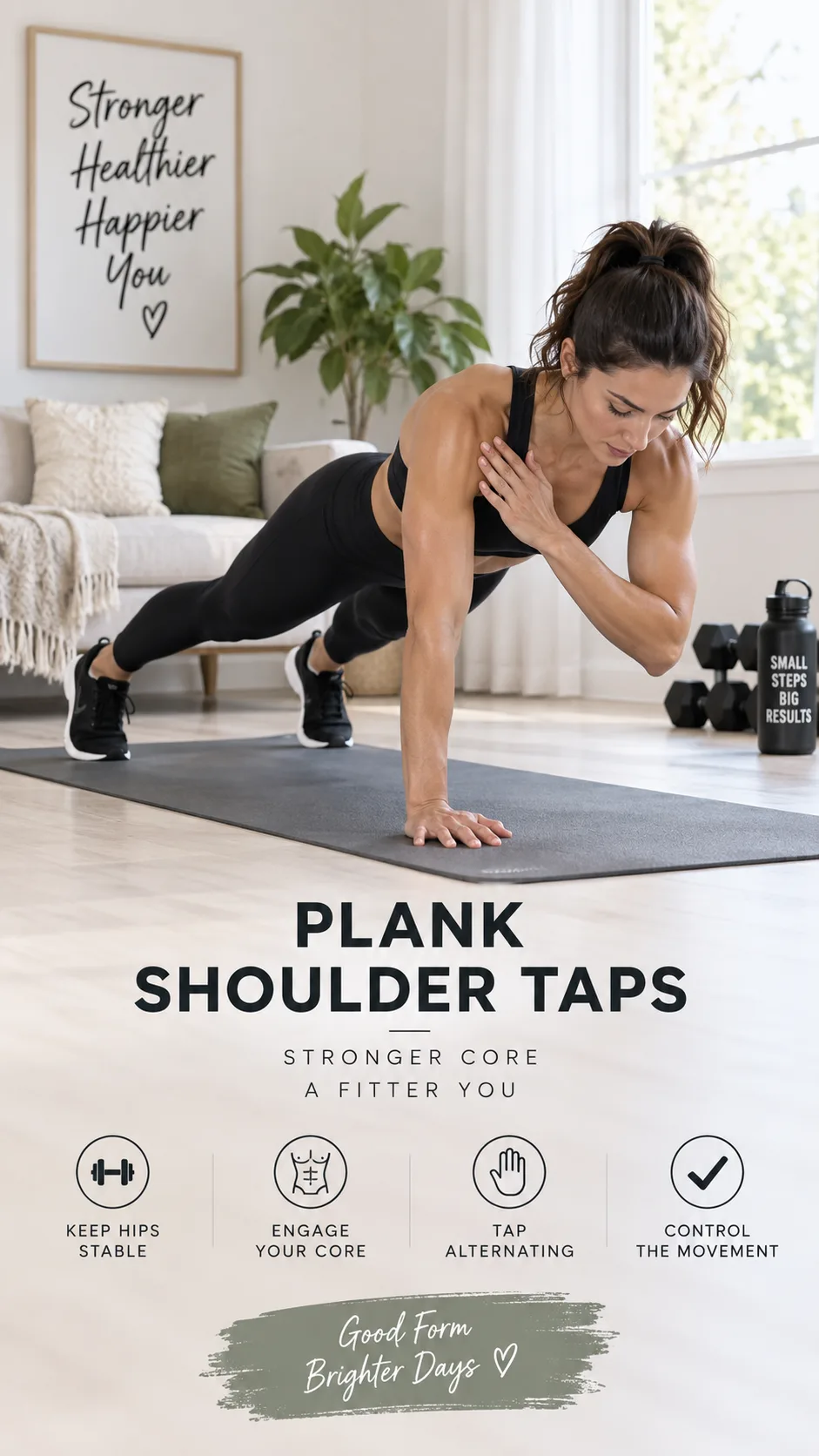
Hold a high plank position. Without rocking your hips (easier said than done), tap your left shoulder with your right hand, then your right shoulder with your left hand. Your core and arms share the workload equally here.
Aim for 20 total taps. Keep your body as still as a board. The slower you go, the harder it hits.
6. Hundred arms
The classic Pilates Hundred isn’t just a core exercise. It’s an arm burner. Lie on your back, lift your head and shoulders, extend your legs to your chosen angle, and pump your straight arms vigorously up and down beside your body. Breathe in for 5 pumps, out for 5 pumps. Repeat for 100 pumps total.
Your arms fight gravity the entire time. By the final set, your shoulders will remind you they exist in ways you didn’t expect.
7. Side plank arm reach
Set up in a side plank on your forearm or hand. Extend your top arm toward the ceiling, then thread it under your body in a controlled rotation before reaching back up. This hits your shoulders, obliques, and the stabilizer muscles in your supporting arm.
Perform 8-10 reps per side. The combination of rotation and stabilization makes this one of the most efficient upper-body Pilates moves you’ll find.
8. Kneeling arm pulses
Kneel on your mat and extend both arms straight behind you, palms facing each other. Pulse your arms upward in tiny, rapid movements (think just one inch of range). Do 30 pulses with palms facing up, then 30 with palms facing down.
The burn is unreal for such a small movement. This exercise isolates the triceps and rear deltoids beautifully. FYI, it looks easy but absolutely isn’t. Fair warning.
9. Tabletop arm extensions
Start in a tabletop position (hands and knees). Extend one arm straight forward, hold for 3 seconds, then switch. Keep your hips level and your core braced so your arm does the heavy lifting without help from momentum.
For an extra challenge, extend the opposite leg simultaneously. This bird-dog variation transforms a simple arm exercise into a full-body stability challenge.
10. Up-down planks
Start in a forearm plank. Press up onto your right hand, then your left hand, into a high plank. Lower back down to your right forearm, then your left. Alternate your leading arm each rep.
This exercise absolutely demolishes your triceps, shoulders, and chest. Aim for 10-16 total reps (5-8 per side). If your arms aren’t shaking by the end, you’re going too fast.
Your 20-minute Pilates arms workout routine
Ready to put these moves together? Here’s a complete 20-minute Pilates arms workout you can follow at home. All you need is a mat and roughly the floor space of a yoga mat. Grab some water too. You’ll want it.
- Arm Circles: 20 forward + 20 backward (2 sets)
- Hundred Arms: 100 pumps total
- Pilates Push-Ups: 6-8 reps
- Kneeling Arm Pulses: 30 palms up + 30 palms down
- Plank Shoulder Taps: 20 total taps
- Tricep Dips (Mat Version): 12-15 reps
- Side Plank Arm Reach: 8 per side
- Prone Arm Lifts: 20 total alternating lifts
- Up-Down Planks: 12-16 total reps
- Tabletop Arm Extensions: 10 per side (hold 3 seconds each)
Rest 15-20 seconds between exercises. Focus on controlled movement throughout. Rushing defeats the entire purpose. If an exercise feels too easy, slow it down even more. That usually fixes the problem immediately 🙂
Common mistakes that kill your results
I’ve watched hundreds of people do Pilates arm work. These mistakes pop up constantly, and they’ll absolutely sabotage your progress if you let them slide.
Shrugging your shoulders
This is the number one mistake, bar none. When your arms fatigue, your shoulders creep up toward your ears. This shifts the work away from the target muscles and into your traps and neck. Hello, tension headaches. Actively press your shoulders DOWN and BACK before every exercise.
Moving too fast
Pilates isn’t a race. When you speed through arm circles or rush your push-ups, momentum does the work instead of your muscles. Slow, deliberate movement creates the time under tension your muscles need to adapt and grow.
Forgetting to breathe
People hold their breath during challenging arm exercises ALL the time. Holding your breath spikes your blood pressure and reduces your performance. Exhale on the effort, inhale on the release. Make it a habit.
Ignoring your core
Every Pilates exercise (including arm work) requires core engagement. If your midsection is slack, your lower back compensates, your form breaks down, and you miss the full benefit. Think of your core as the foundation that makes your arm work effective.
How often should you train your arms with Pilates?
For visible results, aim for 3-4 dedicated Pilates arm sessions per week. Because you’re not lifting heavy weights, your recovery time between sessions stays short. Most people can train their arms on consecutive days without overtraining, especially if they vary the specific exercises.
However, consistency matters more than frequency. Three sessions a week done religiously for eight weeks will transform your arms. Six sessions a week done sporadically for two weeks will give you nothing but frustration.
You’ll typically notice increased muscle tone within 3-4 weeks. Visible definition (the kind other people comment on) usually shows up around weeks 6-8. Pairing your arm training with a nutrition plan that supports your goals accelerates the process. If you’re working on dialing in your eating, a high-protein meal plan can be a game-changer for muscle definition.
Can you really build definition without weights?
Short answer: absolutely yes. Longer answer: your body doesn’t know the difference between a dumbbell and gravity. It only recognizes mechanical tension, metabolic stress, and muscle damage, the three primary drivers of muscle adaptation. Pilates arm exercises deliver all three.
According to research from the American College of Sports Medicine, bodyweight exercises can produce significant improvements in muscular endurance and definition, particularly for individuals who aren’t competitive powerlifters or bodybuilders.
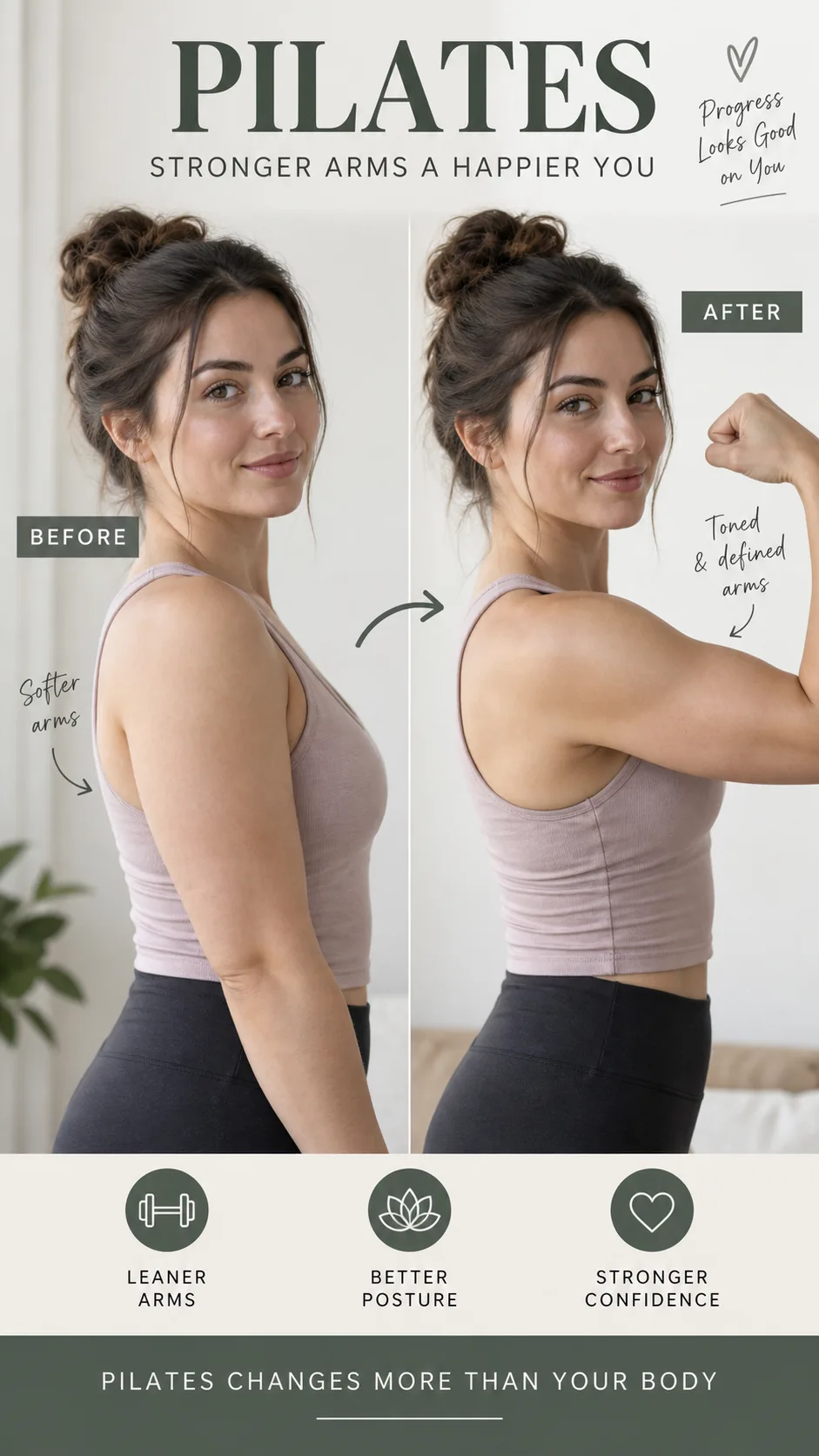
Will Pilates give you 18-inch biceps? No, and it’s not trying to. Will it give you sleek, toned, visibly defined arms that look incredible in tank tops and sleeveless dresses? One hundred percent yes.
IMO, the aesthetic that Pilates arms training produces (lean, elongated, athletic) is what most people want when they say they want “toned arms.” Heavy weights aren’t the only path.
Pro tips to maximize your Pilates arms results
Want to squeeze every ounce of benefit from your mat sessions? These tips separate people who see incredible results from those who wonder why nothing changes.
- Progressive overload still applies. Increase reps, slow your tempo, add holds, or reduce rest periods every 1-2 weeks. Your muscles need new challenges to keep adapting.
- Film yourself. Seriously. A quick phone video reveals form issues you can’t feel in the moment. Fixing one small alignment error can double the effectiveness of an exercise.
- Prioritize protein. Your muscles need amino acids to repair and grow. Aim for at least adequate protein daily, whether you eat animal products or not.
- Stay hydrated. Dehydrated muscles fatigue faster and recover slower. Drink water before, during, and after your session.
- Pair arms with full-body work. Dedicated arm sessions work best alongside complete Pilates routines that challenge your entire body. Balance prevents muscle imbalances.
Who benefits most from Pilates arms training?
Honestly? Almost everyone. But certain groups see particularly impressive results:
- Beginners who find traditional weight training intimidating or inaccessible
- People recovering from injuries who need low-impact strengthening (always check with your doctor first)
- Frequent travelers who need effective workouts without gym access
- Anyone dealing with joint pain: Pilates arm exercises go easy on your wrists, elbows, and shoulders compared to heavy lifting
- People who already lift weights and want a complementary training method that improves control, stability, and muscle endurance
Can you combine Pilates arm work with traditional weight training? Absolutely. Many personal trainers recommend using Pilates as active recovery between heavy lifting days. The two methods complement each other remarkably well.
What about adding resistance later?
Once bodyweight exercises feel manageable, you have options. Light resistance bands, small Pilates balls, or even filled water bottles add just enough extra resistance to keep progressing without abandoning the Pilates philosophy.
A loop resistance band around your wrists during arm circles, for instance, turns a moderate exercise into an absolute shoulder destroyer. You can hold light objects during the Hundred for an arm challenge that borders on cruel.
The principle stays the same: control over weight, precision over power, and quality over quantity. Adding resistance should never compromise your form. The moment your technique suffers, drop the added weight immediately.
Putting it all together
Here’s what you need to remember from everything above:
- Pilates arm exercises build real, visible definition without any weights. Your bodyweight and gravity provide more than enough resistance.
- Slow, controlled movement creates results. Speed and momentum are your enemies.
- Consistency beats intensity. Three focused sessions per week, maintained over 6-8 weeks, produces noticeable changes.
- Form is non-negotiable. Shoulders down, core engaged, breath flowing. These details make or break your results.
- Nutrition supports the process. Protein and hydration fuel muscle repair and reveal the definition you’re building.
You don’t need a gym membership. You don’t need equipment. You don’t need to spend a single dollar. You need a mat, twenty minutes, and the willingness to let your arms shake.
Start with the 20-minute routine above, commit to it three times this week, and pay attention to how your arms feel by Friday. That subtle soreness in muscles you forgot existed? That’s progress introducing itself. Welcome it, stay consistent, and watch your arms transform, one controlled, weight-free rep at a time.
