

You show up to the gym. You do some exercises. You leave. You repeat this cycle for weeks, maybe months, and then one day you stop because you “aren’t seeing results.” Sound familiar? The problem was never your effort. It was your lack of a system.
If you aren’t tracking your workout progress, you’re driving cross-country without a GPS and hoping you end up somewhere good. You won’t. Or at least, you’ll take the longest, most frustrating route possible.
I spent my first two years of training doing exactly this. Random weights, random exercises, zero record of anything. And guess what happened? I stalled, got frustrated, and almost quit entirely. Then I started tracking, and everything changed within weeks. Not because I found some magic program, but because I could finally SEE what was working and what wasn’t.

Why most people never track their workouts (and pay the price)
Tracking feels like homework. Nobody walks into a gym excited to write things down. You want to lift heavy stuff and feel like a beast, not fill out a spreadsheet. I get it. Truly.
But here’s what happens when you skip tracking. You forget what weight you used last week. You can’t remember if you did 3 sets or 4. You default to “whatever feels right,” which usually means doing the exact same thing you did last time. And progressive overload, the single most important driver of muscle growth and strength gains, goes right out the window.
A study published in the Journal of Strength and Conditioning Research confirmed that progressive overload remains the foundational principle for improving muscular strength and hypertrophy. Without a way to measure whether you’re actually progressing, you’re guessing. And guessing doesn’t build muscle.
The “I’ll remember it” trap
You won’t remember it. Full stop. Maybe you’ll recall the big lifts, your bench or squat numbers. But what about your accessory work? Your rest times? Whether your last set was a grinder or smooth? Your memory is not a reliable training partner.
This is exactly why people plateau for months and blame their genetics, their supplements, or their workout split. The real culprit? They have zero data to make smart decisions with.
The simple workout tracking system (no fancy apps required)
I’m about to hand you a system that takes less than 60 seconds per exercise. It requires nothing more than your phone’s notes app or a cheap notebook. If you want to get fancy later, go for it. But start simple, because the best tracking system is the one you’ll actually use.
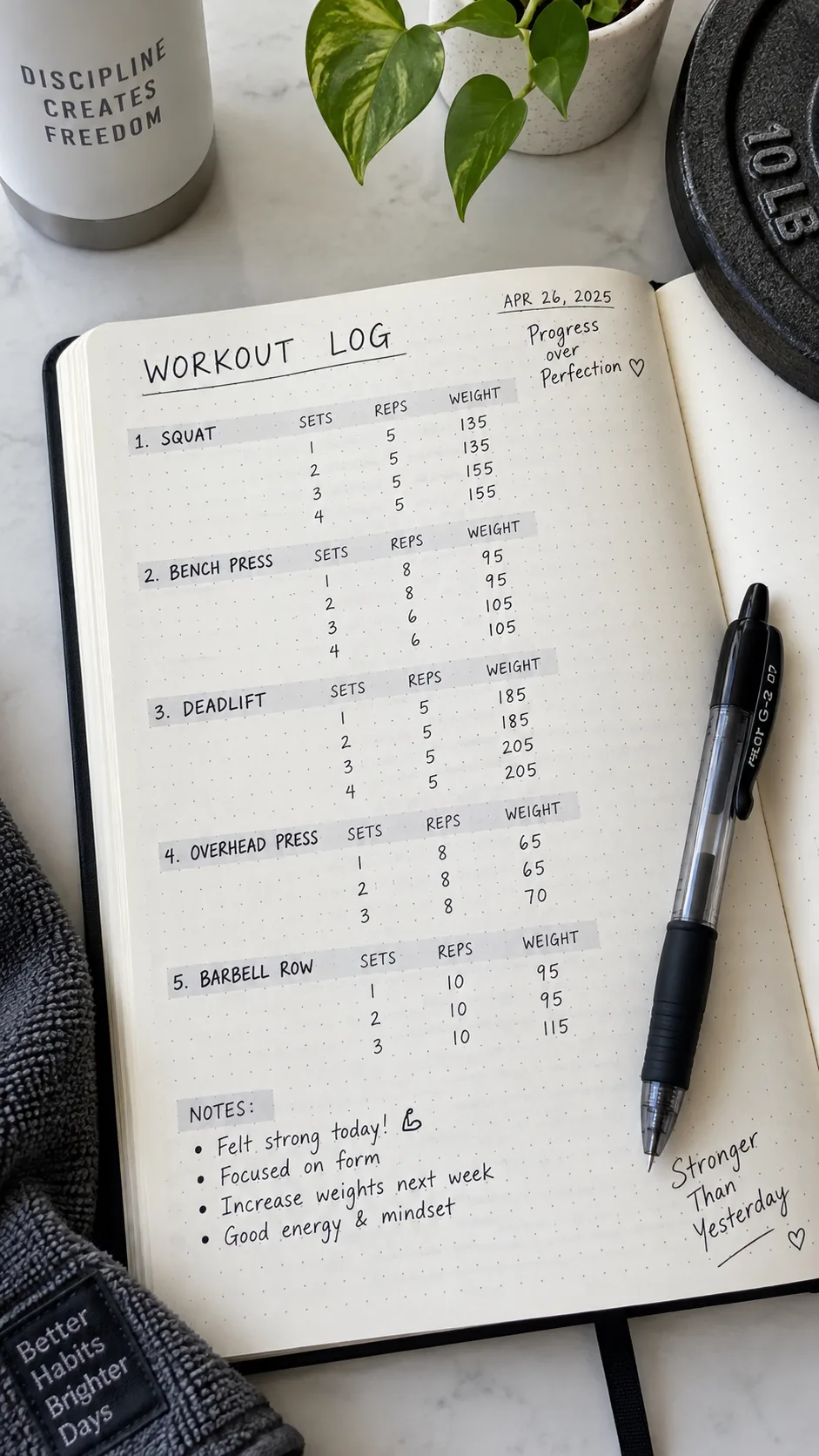
The 4 columns you need
Every workout entry needs exactly four pieces of information. That’s it. No complicated formulas, no color-coded charts (unless you’re into that, no judgment).
- Exercise Name. Write down exactly what you did. “Bench press” not “chest stuff.”
- Weight Used. The exact load for each set. If it varies set to set, record each one.
- Reps Completed. Not your target reps. Your ACTUAL reps. Honesty matters here.
- Notes. This column does the heavy lifting (pun intended). Record how the set felt, any pain, whether you could’ve done more, or if your form broke down.
That’s your entire system. Date it, log it, move on. When you walk into the gym next week, you open your log, look at last week’s numbers, and you know exactly what you need to beat.
Why this works so well
This system works because it removes every ounce of guesswork. You walk in with a target. You either hit it, exceed it, or fall short, and all three outcomes give you useful information. Progress becomes binary: did the numbers go up, or didn’t they?
When the numbers go up, you keep doing what you’re doing. When they stall, you adjust. That feedback loop (track, assess, adjust) turns random gym sessions into a strategic program. And strategic programs produce results that random effort simply cannot match.
What else should you track beyond sets and reps?
The four-column system handles the essentials. But if you want to take your progress tracking from “good” to “ridiculously effective,” a few extra data points make a massive difference.
Body measurements
The scale lies. Well, it doesn’t lie exactly, but it tells a very incomplete story. You could gain 5 pounds of muscle and lose 5 pounds of fat, and the scale would smugly tell you nothing happened. Track chest, waist, hips, arms, and thighs every 2-4 weeks instead.
Use a flexible measuring tape and measure at the same spots, at the same time of day (morning, before eating). Consistency in HOW you measure matters just as much as the measurements themselves.
Progress photos
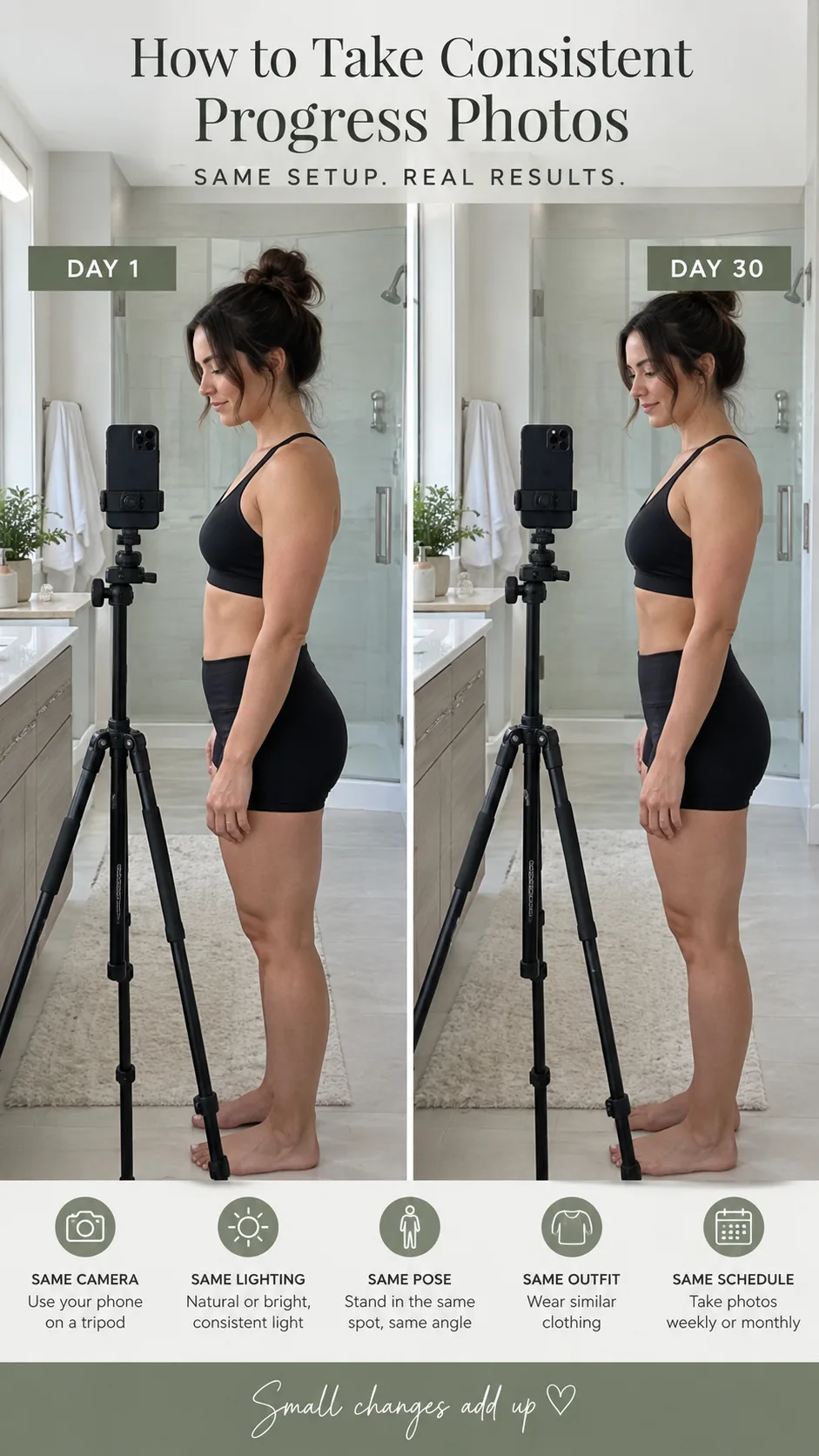
You see yourself every single day, so you literally cannot notice gradual changes. It’s like watching a plant grow. Nothing seems to happen until you compare photos from three months apart and realize the thing doubled in size.
Take front, side, and back photos every 2-4 weeks. Same lighting, same time, same clothing. These photos will become your most motivating asset when you feel like you’re not making progress. Trust me on this one. If you’re following a structured nutrition approach alongside your training, like a high protein low carb meal plan, those photos will tell a compelling story over time.
Bodyweight trends
Notice I said trends, not daily weigh-ins that ruin your morning. Your body weight can fluctuate 2-5 pounds in a single day based on water, sodium, sleep, stress, and whether Mercury is in retrograde. Weigh yourself daily if you want, but only look at the weekly average.
Apps like Happy Scale (iOS) or Libra (Android) smooth out those daily fluctuations and show you the actual trend. They’re free, and they’ll save you from at least a dozen unnecessary panic spirals.
Performance benchmarks
Pick 3-5 lifts and test them every 4-8 weeks. These become your personal benchmarks, objective proof that you’re getting stronger. Some solid choices:
- Barbell squat (or goblet squat)
- Bench press (or dumbbell press)
- Deadlift (or Romanian deadlift)
- Overhead press
- Pull-ups or rows
When your bench goes from 135 to 185 over six months, you KNOW the program works. No ambiguity. No “I think I’m making progress.” Just cold, hard, beautiful numbers.
Choosing your tracking tool
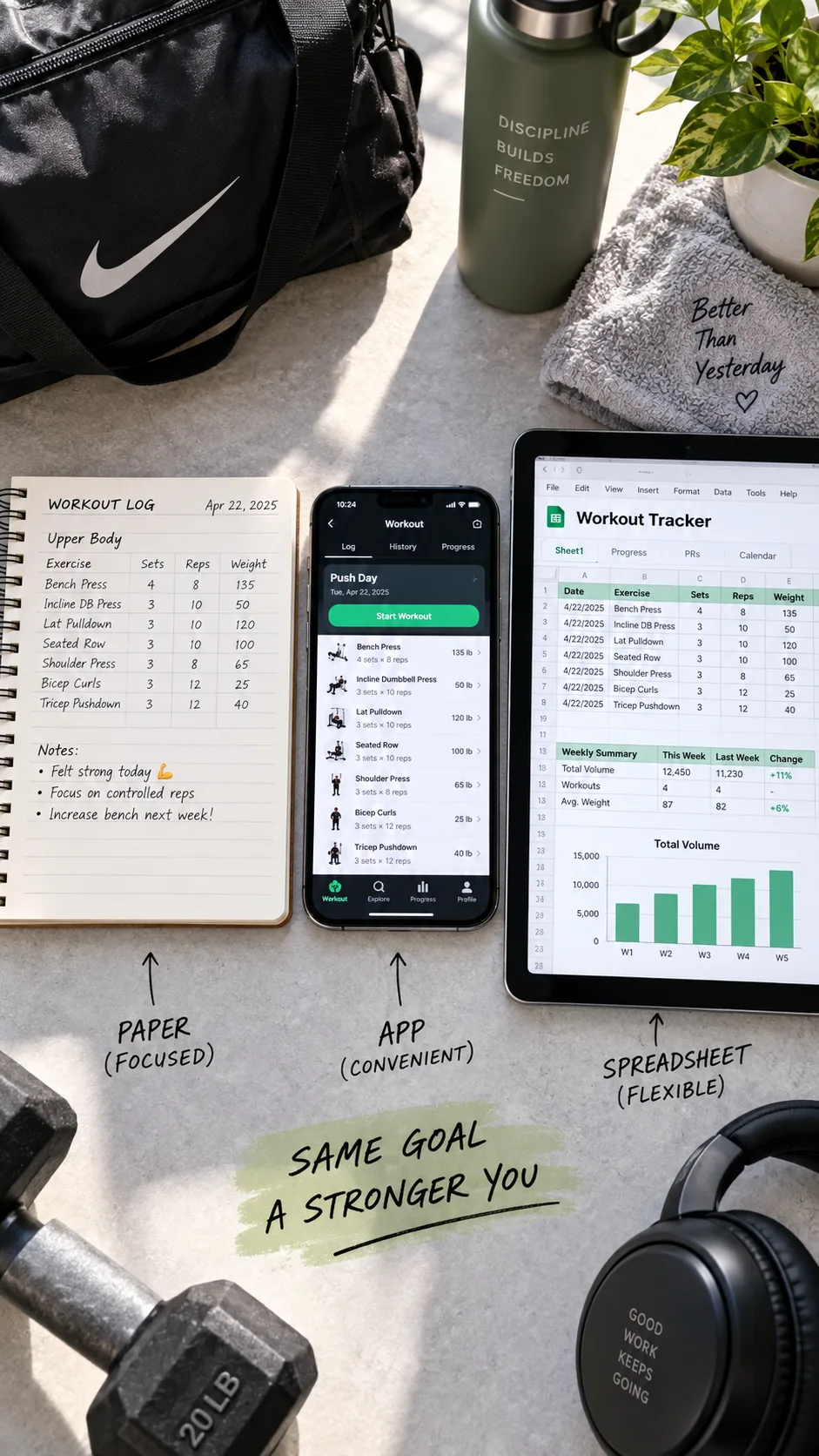
You’ve got options ranging from free to “why does this app cost $15 a month?” Here’s my honest breakdown of what actually works.
The notebook method
On the upside: zero distractions, no notifications pulling you to Instagram mid-set, and something deeply satisfying about physically writing numbers down. On the downside: you can’t easily search old entries, and you’ll eventually run out of pages.
A basic composition notebook from any drugstore works perfectly. Don’t fall for the $30 “fitness journals” with pre-printed templates. They look pretty, but they force you into someone else’s format.
Phone notes app
Your phone is already in your pocket. You can search old entries, copy-paste workout templates, and never worry about forgetting your notebook at home. The downside? The temptation to check social media between sets is real and dangerous.
Dedicated workout apps
If you want charts, graphs, and automatic progress calculations, apps like Strong or JEFIT handle everything for you. They show you your volume over time, flag personal records, and make data visualization effortless.
My recommendation? Start with the simplest option that you’ll actually use consistently. A notebook you write in every session beats a $10/month app you open twice and forget about. Upgrade when, and only when, the simple method feels limiting.
How to actually use your data (the part everyone skips)
Collecting data feels productive. Looking at data and making decisions? That’s where real results come from. And it’s the step most people completely ignore.
The weekly review
Spend 5 minutes every Sunday reviewing your training week. Ask yourself three questions:
- Did any lifts go up in weight or reps? Celebrate that. Seriously. Even one extra rep matters.
- Did anything stall or go backward? Flag it. If it stays flat for 2-3 weeks, something needs to change.
- How did I feel overall? Energy, motivation, joint health, sleep quality. These soft metrics predict hard results.
This review takes less time than scrolling through your feed. And it gives you an actionable game plan for the coming week instead of walking in blind and winging it.
The monthly assessment
Once a month, zoom out. Compare your lifts to where they stood 4 weeks ago. Check your body measurements. Look at your progress photos side by side. This is where the system pays massive dividends because monthly trends reveal patterns that daily or weekly snapshots simply can’t.
Are your strength numbers climbing but your waist isn’t shrinking? Maybe your nutrition needs adjustment. Are your lifts stalling across the board? You might need a deload week. If you’re pairing your training with a specific eating approach, especially if you’re looking at workouts for a flat stomach, this monthly check-in connects the dots between effort and outcome.
Common tracking mistakes that sabotage your progress
Even people who track consistently can undermine their own system. Watch out for these pitfalls. I’ve fallen into every single one of them at some point :/
Mistake #1: Ego logging
Writing down 10 reps when you actually did 8 clean reps and 2 ugly, swinging, momentum-fueled disasters. Your log only helps you if it tells the truth. Those two junk reps don’t count, and pretending they do means you’ll try to “beat” a number you never actually hit.
Mistake #2: Tracking too much
Heart rate variability, grip temperature, moon phase, the color of your pre-workout. Okay I’m exaggerating, but barely. Some people turn tracking into a full-time job and spend more time logging than lifting. Track what matters. Ignore the rest. The four-column system exists for a reason.
Mistake #3: Never looking back at the data
A log you never review is just a diary. A very boring diary about numbers. The entire point of tracking workout progress is to USE the information for decision-making. If you fill notebooks but never flip back through them, you’re doing busywork, not strategy.
Mistake #4: Changing too many variables at once
Your bench stalled, so you switched your grip, changed your rep scheme, added two new accessories, and started training chest three times a week, all in the same week. Now if something works (or doesn’t), you have NO idea which change caused it. Change one variable at a time and give it 2-3 weeks to show results.

Progressive overload: the engine behind your tracking system
Your tracking system exists to serve one master: progressive overload. This principle states that your muscles need increasing stimulus over time to continue adapting and growing. No progressive overload, no progress. Period.
But progressive overload doesn’t just mean “add more weight every session.” That works for beginners, but it’s not sustainable. Here are all the ways you can progressively overload, and your tracking log captures every single one:
- More weight. The obvious one. Add 2.5-5 lbs when you can.
- More reps. Hit 8 reps last week? Aim for 9 this week with the same weight.
- More sets. Add a set to increase total training volume.
- Better form. Doing the same weight with stricter technique IS progress.
- Less rest time. Completing the same work in less time means improved conditioning.
- Greater range of motion. Deeper squats at the same weight equal more work.
According to the American College of Sports Medicine, systematically manipulating these training variables drives continued adaptation. Your tracking log catches ALL of these dimensions, not just the weight on the bar.
Building the tracking habit (because systems only work if you use them)
Knowledge isn’t the bottleneck here. You already understand WHY tracking works. The real challenge? Doing it consistently, session after session, even when you don’t feel like it.
Attach it to an existing habit
Open your tracking app or notebook the moment you walk into the gym, before you even touch a weight. Make it the first thing you do, every single time. This “habit stacking” technique, popularized by James Clear in Atomic Habits, anchors the new behavior to something you already do automatically.
Keep it stupidly simple at first
For your first two weeks, only track your main lifts. Don’t log accessories, warm-ups, or cardio. Just the big stuff. Once the habit feels automatic, expand what you track. Perfection kills consistency. A bare-bones log you maintain beats a comprehensive system you abandon after day three.
Celebrate small wins
Added one rep to your squat? That’s progress. Write it down. Acknowledge it. These micro-wins accumulate into real, visible results over months, and your log captures every single one of them. Looking back through pages of small victories builds the kind of motivation that no pre-workout supplement can match 🙂
If you’re combining your training with a structured approach to nutrition, maybe following a plan outlined in our GLP-1 routines and habits guide, tracking your workouts alongside your meals creates a complete picture of what drives your results.

What your first week of tracking should look like
Let me make this concrete. Here’s exactly how your first week should play out, step by step.
- Day 1: Grab a notebook or open your phone’s notes app. Title the page with today’s date.
- Day 1 (at the gym): Before each exercise, write the name. After each set, record the weight and reps. Add a one-word note if something felt notable (“easy,” “grinder,” “pain”).
- Day 2-3: Repeat for your next sessions. Don’t overthink the format. Messy is fine.
- Day 7 (Sunday): Review your entries. Identify your numbers for each exercise. These become your targets for next week.
- Week 2: Walk into every session knowing EXACTLY what you need to match or beat.
That’s it. By week two, you’ll already feel the difference. You’ll walk into the gym with purpose instead of wandering from machine to machine like a lost tourist in a foreign country.
The bottom line: track or stay stuck
I’m not going to sugarcoat this. If you don’t track your workout progress, you leave your results to chance. And chance is a terrible personal trainer. It doesn’t care about your goals, your timeline, or your beach vacation in August.
The tracking system outlined here takes less than 60 seconds per exercise. It requires nothing expensive. It demands no special knowledge. All it asks is that you write down four things (exercise, weight, reps, and a note) and then actually LOOK at that data before your next session.
The people who get results aren’t genetically gifted or more motivated than you. They simply have systems that make progress visible and adjustments obvious. Now you have that system too. The only question left is whether you’ll use it, starting with your very next workout.
Grab that notebook. Open that app. Write it down. Beat it next week. Repeat forever. That’s the entire game.
