
You walk into the gym, head straight to the leg section, and immediately feel like you’re staring at a spaceship control panel. Sound familiar? You’re not alone, and the good news is that leg machines are one of the most beginner-friendly ways to train your lower body once you know what you’re doing.
This guide breaks down exactly which leg workout gym machines to use, why they work, and how to structure a smart, effective leg day. No wandering. No wasted sets. Just results.
Why gym machines deserve more credit
Free weights get all the glory, but machines are genuinely underrated for leg training. They guide your movement pattern, reduce injury risk, and let you load heavy without needing a spotter. For women who are new to strength training or coming back after a break, that matters a lot.
Machines also isolate specific muscles more effectively. Want to target your hamstrings without your quads taking over? There’s a machine for that. Want to fire up your glutes without your lower back doing all the work? Machine. The control they give you is a feature, not a limitation.
According to ACE Fitness, machine-based resistance training builds strength and muscle just as effectively as free weights, especially for beginners establishing their movement foundation.
The leg muscles you’re targeting
Before you sit down on any machine, it helps to know what you’re working. Your legs aren’t one muscle. They’re a whole team, and training smart means hitting all of them.
- Quadriceps, the four muscles on the front of your thigh. They extend the knee and take the lead on squats and leg presses.
- Hamstrings, the muscles on the back of your thigh. They flex the knee and extend the hip. Most women are quad-dominant and underwork these.
- Glutes, your gluteus maximus, medius, and minimus. Arguably the most important muscles in your lower body for power, posture, and aesthetics.
- Calves, the gastrocnemius and soleus. Often forgotten, always noticeable when trained well.
- Hip abductors and adductors, the muscles that move your legs in and out. Critical for knee stability and hip strength.
The best leg workout gym machines for women
1. Leg press machine
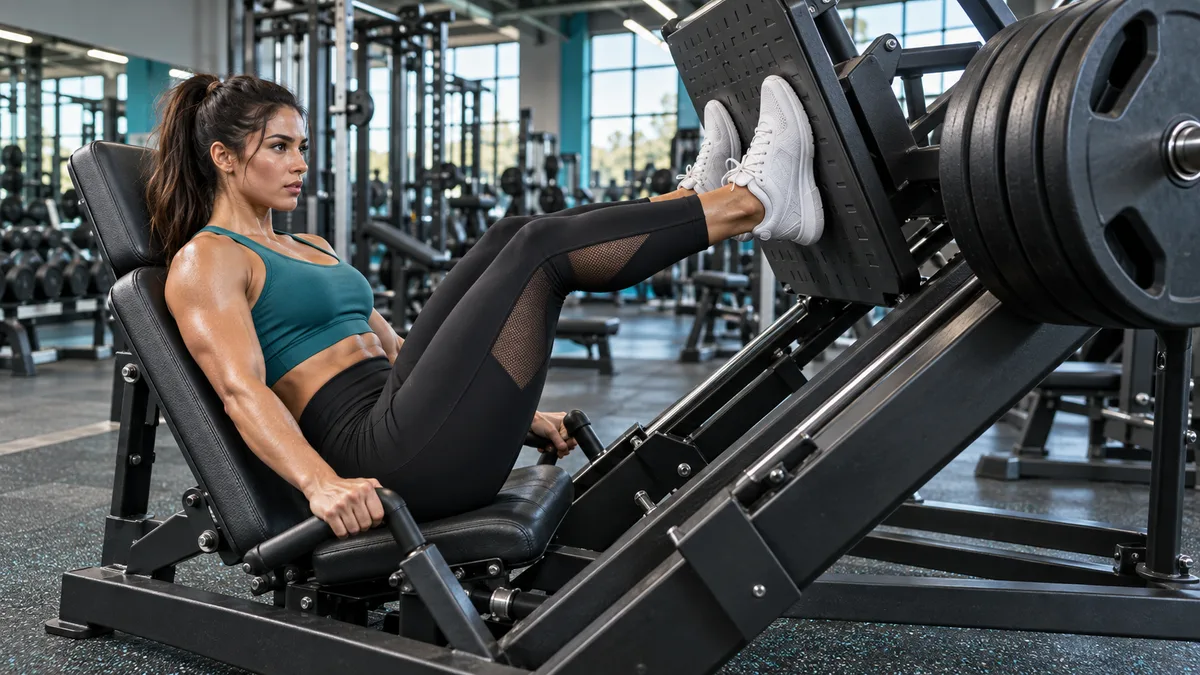
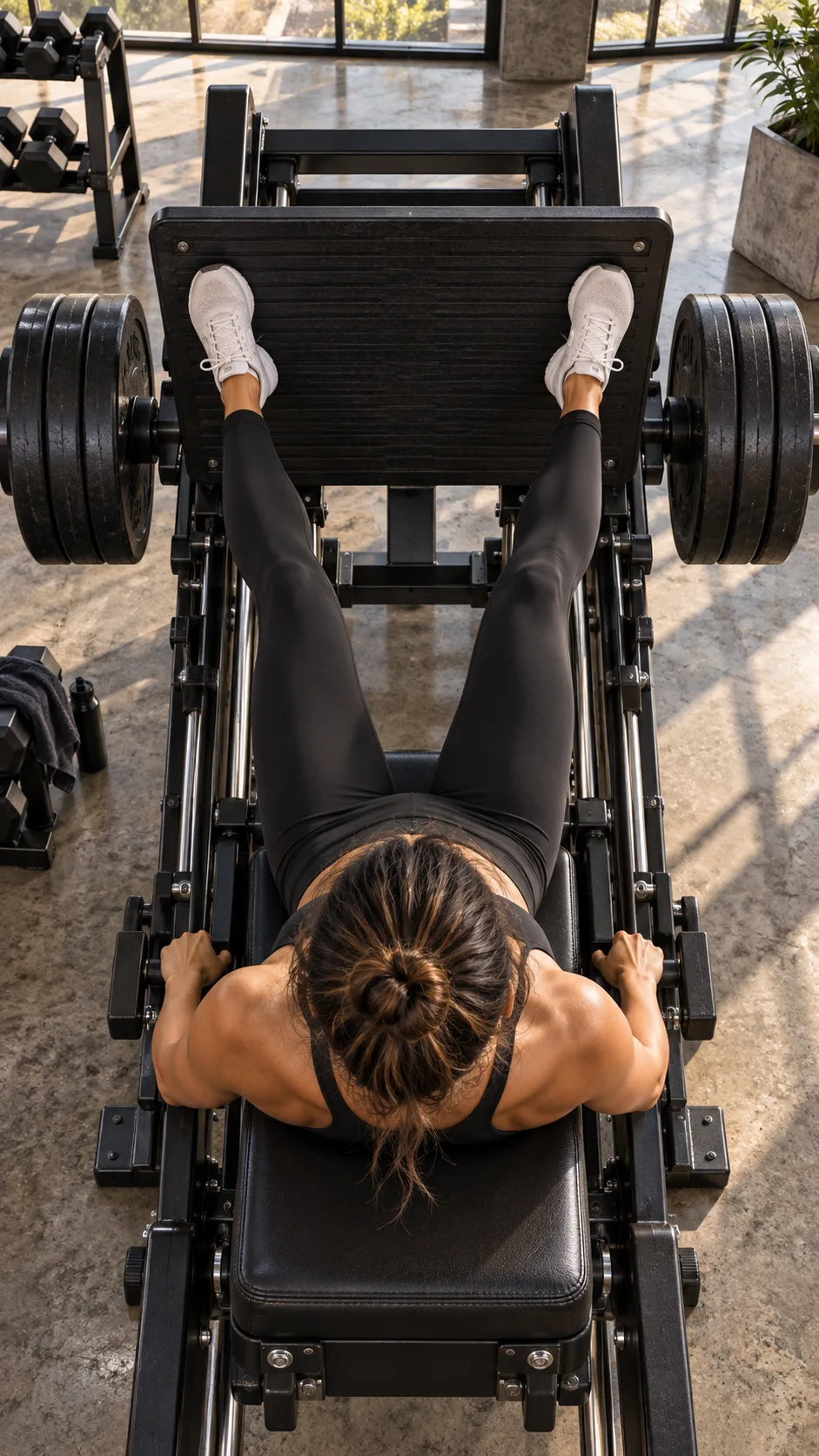
The leg press is the workhorse of leg day. You push a weighted platform away from you with your feet, loading your quads, glutes, and hamstrings all at once. It lets you go heavy without straining your back, which makes it ideal for building serious lower body strength.
Foot placement changes everything here. Higher foot placement = more glute and hamstring activation. Lower foot placement = more quad work. A wider stance hits your inner thighs more. Experiment and see what you feel.
A common mistake? Locking your knees out at the top. Keep a slight bend to protect the joint and maintain tension on the muscle through the whole rep.
2. Leg extension machine
This machine isolates your quadriceps like nothing else. You sit down, hook your feet under the pad, and extend your legs until they’re straight. It burns in the best way. Because it’s an isolation exercise, use it after your compound work (like the leg press), not before.
Control the lowering phase. Dropping the weight quickly just wastes reps. A slow, 2-3 second lowering phase doubles the effectiveness. This is one of the exercises where lighter weight with perfect control will outperform sloppy heavy sets every time.
3. Lying or seated leg curl machine
Most women skip this one. Don’t be most women. The leg curl machine targets your hamstrings, a muscle group that directly affects your glute shape, posture, and knee health. Strong hamstrings mean less knee pain, better hip drive, and a more lifted look from behind.
Whether you use the lying or seated version, the principle stays the same: curl your heels toward your glutes against resistance. Aim for a full range of motion and don’t rush the return. Healthline’s guide to leg curls explains why this exercise is especially important for balanced lower body development.
4. Hip abductor and adductor machine
You’ve definitely seen these machines, the ones where you either push your legs out (abductor) or squeeze them in (adductor). They look deceptively easy. They are not. The hip abductor machine targets your glute medius, which stabilizes your hips and knees with every step you take. A weak glute medius leads to knee cave on squats and a whole chain of problems down the line.
The adductor machine works your inner thigh muscles, an area that rarely gets direct attention in most routines. Together, these two machines create a balance that protects your joints and gives your hips a more defined, sculpted look.
5. Cable machine (for glutes and hamstrings)
The cable machine isn’t just for upper body days. Attach an ankle strap and you can do cable kickbacks, cable hip abductions, and cable Romanian deadlifts, all fantastic glute and hamstring builders. The cable provides constant tension through the full range of motion, which is something most machines can’t match.
If your gym has a cable machine and you’re not using it on leg day, you’re leaving gains on the table. It’s one of the most versatile pieces of equipment in the building.
The smart leg day plan: exactly what to do
Here’s a structured leg workout using gym machines that covers all the major muscles without turning your session into a 2-hour ordeal. This plan works whether you’re a beginner or someone returning to the gym after time away.
Warm up first: 5-10 minutes on the stationary bike or treadmill, plus some bodyweight squats and hip circles. Cold muscles and heavy machines don’t mix well.
- Leg Press Machine, 4 sets of 10-12 reps. Rest 90 seconds between sets. Focus on controlled lowering and driving through your heels.
- Leg Extension Machine, 3 sets of 12-15 reps. Rest 60 seconds. Keep the movement smooth. No bouncing the weight.
- Lying Leg Curl Machine, 3 sets of 12-15 reps. Rest 60 seconds. Full range of motion every rep.
- Hip Abductor Machine, 3 sets of 15-20 reps. Rest 45-60 seconds. Feel the outer glute working, that’s your target.
- Hip Adductor Machine, 3 sets of 15-20 reps. Rest 45-60 seconds. Controlled squeeze at the top of every rep.
- Cable Kickbacks (per leg), 3 sets of 12-15 reps. Rest 60 seconds. Lean slightly forward, kick back with a straight leg, squeeze the glute at the top.
- Seated Calf Raise Machine (if available), 3 sets of 15-20 reps. Full stretch at the bottom, full rise at the top.
Total time: roughly 45-55 minutes depending on rest periods. That’s enough stimulus to build strength and muscle without destroying yourself for the rest of the week.
How often should you train legs?
For most women, 2 leg days per week hits the sweet spot. One session can lean more quad-focused (leg press, leg extensions, lunges if you add them), and the other can shift toward hamstrings and glutes (leg curls, hip thrusts, cable work). That frequency gives you enough stimulus to grow while leaving room for recovery.
Recovery matters as much as training. Your muscles don’t grow during the workout. They grow after it. Protein intake, sleep, and not hammering the same muscles three days in a row all play a role. If you’re building out your nutrition strategy, this high-protein meal plan is a solid place to start.
And if you’re building a full training week beyond just leg day, check out this structured gym routine for women beginners. It lays out exactly how to balance muscle groups across the week without overtraining.
Progressive overload: the real reason some people see results and others don’t
Ever wonder why some people train for years and barely change? They do the same workout, at the same weight, forever. Progressive overload is what separates training from just exercising.
It means gradually increasing the challenge over time. That can look like adding 5 lbs to the leg press every week or two, doing one extra rep per set, reducing rest time, or slowing down the tempo. Your muscles adapt to stress, so you have to keep nudging the stress upward to keep them adapting.
The NASM (National Academy of Sports Medicine) recommends tracking your workouts to make progressive overload intentional rather than accidental. A basic notes app on your phone is all you need. Log your sets, reps, and weights each session.
Mistakes women make on leg machines (and how to fix them)
A lot of leg day frustration comes from form issues that quietly sabotage results. Here are the most common ones:
- Using too much weight too soon. Ego loading on machines leads to compensated movement and zero muscle activation. Start lighter than you think you need to. Feel the muscle, then add weight.
- Skipping the hamstring and glute machines. The leg extension gets all the attention, but the real magic happens when you train the posterior chain. Your glutes and hamstrings are where the shape and strength live.
- Rushing through reps. Speed is the enemy of muscle growth on machines. A controlled 2-second lowering phase (eccentric) builds far more muscle than jerking the weight around.
- Not adjusting the machine to your body. Every machine has adjustment levers and pins. Take 30 seconds to set the seat height and pad position for your body. Misaligned machines put force through joints instead of muscles.
- Holding your breath. Breathe out on the effort (the push or pull), breathe in on the return. It sounds small but it makes a real difference in performance and safety.
Leg day and the bigger picture
Leg day doesn’t exist in a vacuum. Strong legs support everything else you do in the gym, and in life. They improve your posture, protect your spine, and make everyday movement easier. They also burn a significant number of calories during and after training, since your leg muscles are the largest in your body.
If you’re newer to the gym and haven’t quite found your footing yet (pun intended), starting with a beginner full body gym workout before splitting into dedicated leg days is a completely valid approach. Build the base first, then specialize.
And don’t forget, leg day pairs well with upper body training. If you want to round out your weekly plan, this chest and tricep machine plan for women follows the same structured, no-guesswork approach.
According to Mayo Clinic, strength training at least twice a week improves bone density, reduces injury risk, and supports healthy weight management. Lower body work contributes the most due to the sheer volume of muscle mass involved.
Quick tips to get more out of every leg day
- Train legs when you have energy, not at the end of a day when you’re already running on empty.
- Superset antagonist muscles (like leg extensions with leg curls) to save time and increase training density.
- Foam roll your quads, IT band, and glutes before and after training. Your hips will thank you.
- Wear proper footwear. Flat-soled shoes or lifting shoes beat running trainers for stability on leg machines.
- If you’re sore two days after leg day, that’s normal. If you’re still wrecked five days later, reduce volume or rest more.
The bottom line
Leg workout gym machines give you a structured, safe, and highly effective way to build lower body strength, especially when you follow a plan instead of just picking equipment at random. Hit the leg press for overall strength, the leg curl for hamstrings, the abductor machine for hip stability, and the cable machine for glute detail work. Train with intention, add weight over time, and eat enough protein to support the work you’re putting in.
Leg day doesn’t have to be daunting. With the right machines and a clear plan, it becomes one of the most rewarding sessions of your week. Nothing beats that walk out of the gym on shaky legs knowing you absolutely crushed it.
Now go book that leg day. Your future self will feel it, in the best way.
