
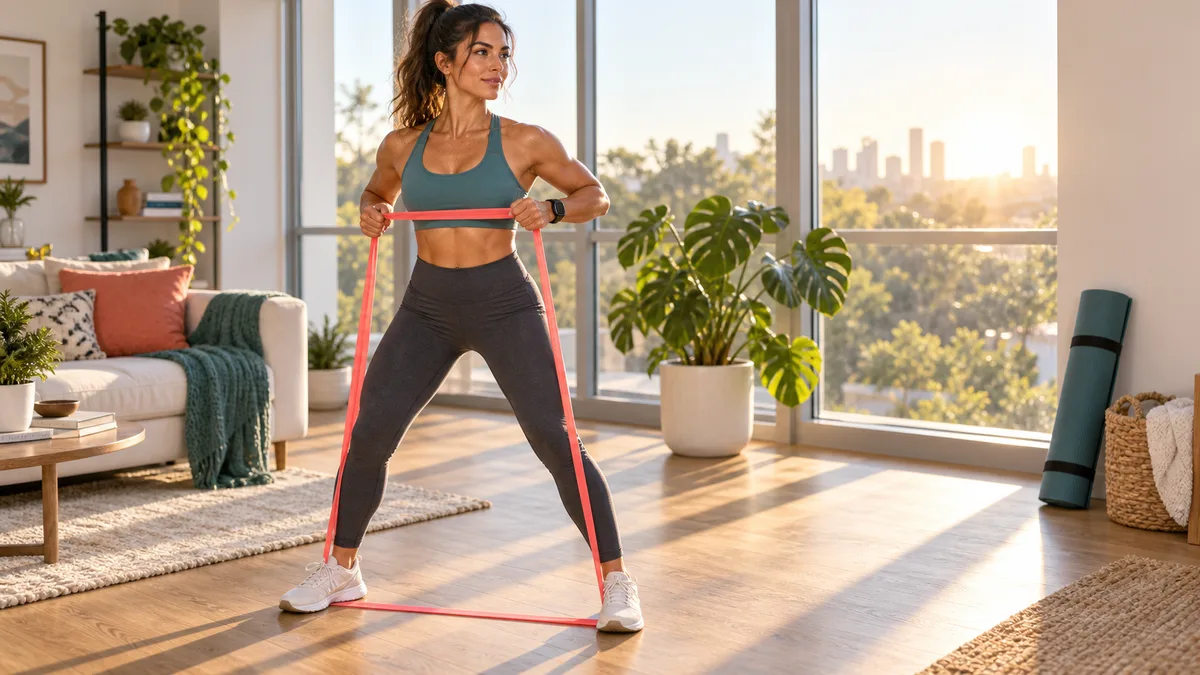
You don’t need a $60/month gym membership to build serious strength. You don’t need a home gym that costs more than your first car, either. What you do need fits inside a ziplock bag and costs about the same as a fancy latte.
Resistance bands are the most underrated piece of fitness equipment on the planet. I spent years ignoring them, thinking they were “beginner stuff” or something you’d only use in physical therapy. I was so wrong. These stretchy little strips of latex have completely changed how I train, especially when I travel or just don’t feel like dragging myself to the gym.
This guide breaks down a complete full body resistance band workout designed specifically for women who want real results without heavy barbells or complicated machines. Whether you’re working out in your living room, a hotel room, or your backyard, this routine has you covered.
Why resistance bands work (and why you should care)
Here’s something most people don’t realize: resistance bands provide variable resistance, meaning the tension increases as you stretch the band further. Your muscles work harder at the top of each movement, exactly where most free weight exercises lose tension. That’s a built-in advantage you won’t get from dumbbells alone.
A study published by the Journal of Strength and Conditioning Research found that resistance band training produces similar strength gains to conventional weight training. So no, you’re not “settling” by using bands. You’re training smart.
Beyond the science, bands offer something dumbbells simply can’t: portability and versatility. They weigh almost nothing, they fit in any bag, and you can modify every single exercise just by adjusting your grip or stance. Ever tried packing a squat rack in your carry-on? Exactly.
Benefits for women
- Joint-friendly resistance, because bands create smooth, controlled tension that’s easier on your knees, shoulders, and wrists
- Progressive overload made simple: just grab a thicker band or double up
- Constant muscle engagement with no momentum cheating allowed (your biceps can’t slack off here)
- Affordable and space-efficient: a full set costs $15 to $40 and fits in a drawer
- Perfect for glute activation, because bands are arguably THE best tool for waking up lazy glutes
Choosing the right resistance bands
Not all bands work the same way, and grabbing a random one from Amazon without knowing what you need is a recipe for frustration. Let me save you that headache.
Types of resistance bands
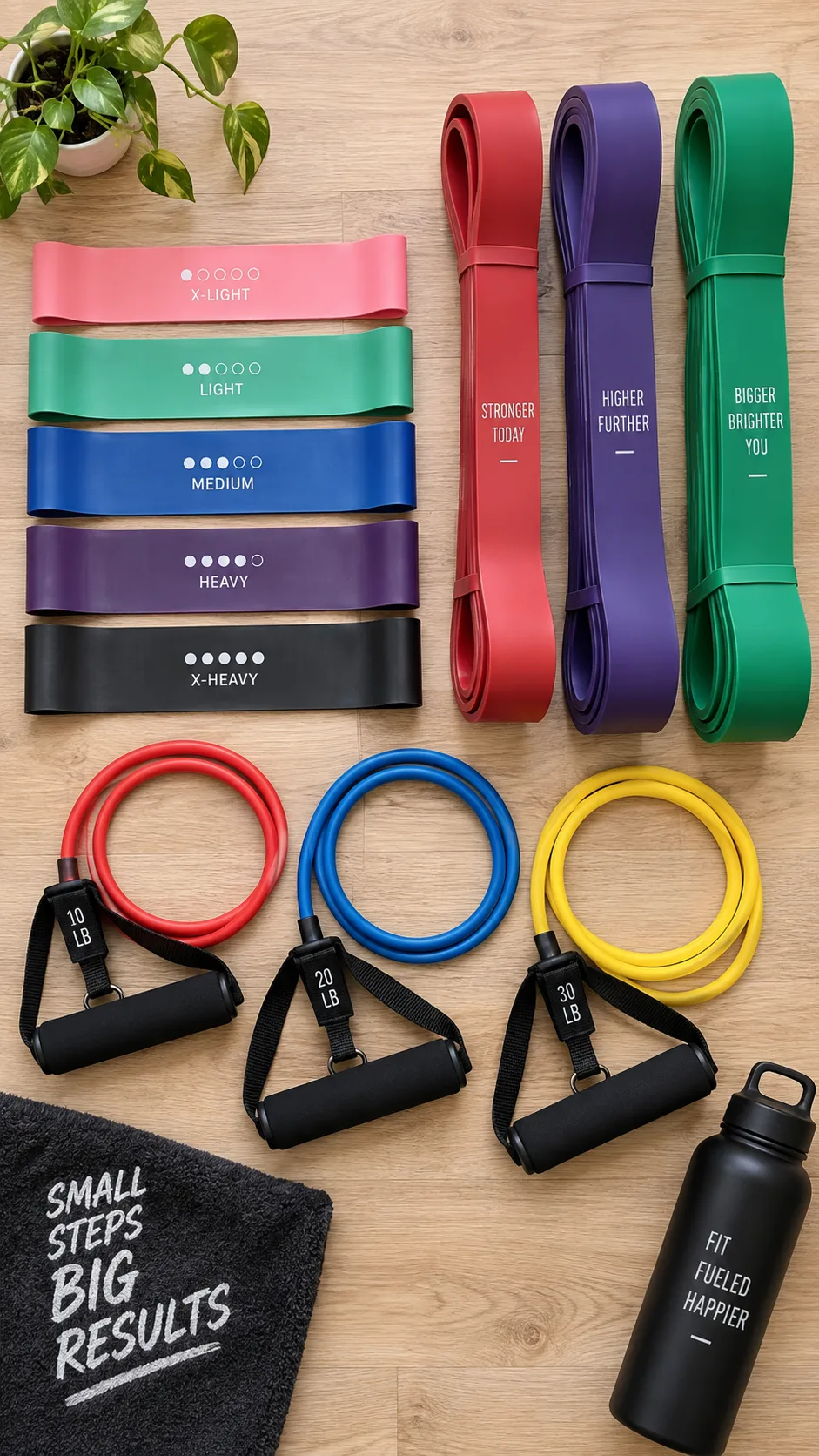
- Loop bands (mini bands): Small, flat circles. Incredible for lower body work, glute activation, and hip exercises. You’ll want these for sure.
- Long loop bands (pull-up bands): Large continuous loops. These handle heavy duty exercises like squats, deadlifts, and assisted pull-ups. Think of them as your “barbell replacement.”
- Tube bands with handles: Rubber tubing with plastic handles on each end. Great for upper body pressing and pulling movements. They mimic cable machine exercises really well.
My recommendation? Get a set that includes at least 3 to 4 resistance levels. Most quality sets include light, medium, heavy, and extra heavy bands. You’ll use different resistances for different muscle groups. Your legs can handle WAY more tension than your shoulders, obviously.
The American Council on Exercise (ACE) recommends starting with a lighter resistance and progressing gradually, especially if you’re new to band training. Solid advice. Your ego doesn’t need to lift heavy on day one.
The full body resistance band workout routine
Alright, here’s the actual workout. I’ve organized this into upper body, lower body, and core sections so you can either do the full routine in one session (about 40 to 50 minutes) or split it across different days. Each exercise targets major muscle groups, and I’ve included the rep ranges that work best for building both strength and muscle tone.
Warm up for 5 minutes first. March in place, do some arm circles, and perform a few bodyweight squats. Your muscles need blood flow before you start loading them. Skipping your warm-up is basically asking for an injury.
Upper body exercises
Women often under-train their upper body, and that’s a shame because a strong upper body changes everything. Your posture, your confidence, the way you carry groceries without feeling like your arms will detach. If you want to complement this routine, check out our guide on the best arm workout for women to get toned arms.
Banded Push-Ups (3 sets x 10 to 15 reps)
Wrap a long loop band across your upper back and hold the ends under your palms. Perform push-ups as normal. The band adds resistance at the top of the movement, where regular push-ups feel easiest. Your chest and triceps will FEEL this one.Standing Band Rows (3 sets x 12 to 15 reps)
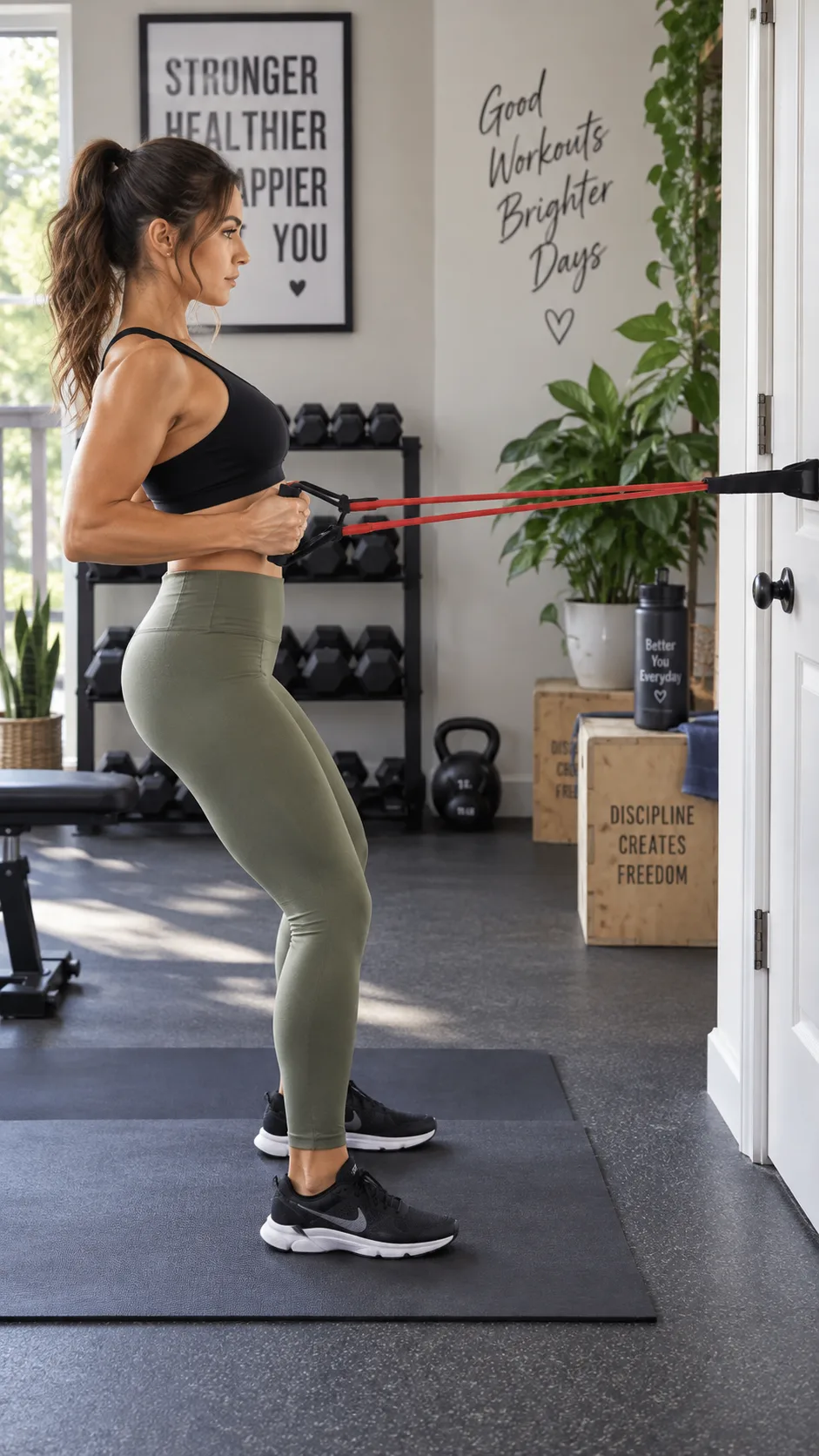
Anchor the band at chest height (a door anchor works perfectly). Pull both handles toward your ribcage, squeezing your shoulder blades together. Hold for a full second at the top. This exercise builds a strong, defined back that looks amazing and keeps your posture in check.Overhead Press (3 sets x 10 to 12 reps)
Stand on the center of a long loop band and press both ends overhead. Keep your core tight and avoid arching your lower back. Strong shoulders make everything from reaching high shelves to carrying a toddler significantly easier.Bicep Curls (3 sets x 12 to 15 reps)
Stand on the band, grab both ends, and curl up. Keep your elbows pinned to your sides, no swinging. The variable resistance makes these curls hit different compared to dumbbell curls. Trust me on that.Tricep Pushdowns (3 sets x 12 to 15 reps)
Anchor the band above your head (a door frame works great). Push both ends down until your arms fully extend. Squeeze at the bottom. Want toned arms? This exercise is your best friend.
Lower body exercises
This is where resistance bands truly shine. The constant tension bands provide during squats, lunges, and hip exercises creates a muscle burn that free weights simply can’t replicate. Your glutes, quads, and hamstrings will thank you. Eventually. First, they’ll hate you 🙂
Banded Squats (3 sets x 15 to 20 reps)
Stand on a long loop band with feet shoulder-width apart. Hold the band at shoulder height and squat deep. The increasing resistance as you stand up forces your glutes to fire harder at the top. Keep your chest up and push your knees out slightly.Lateral Band Walks (3 sets x 15 steps each direction)
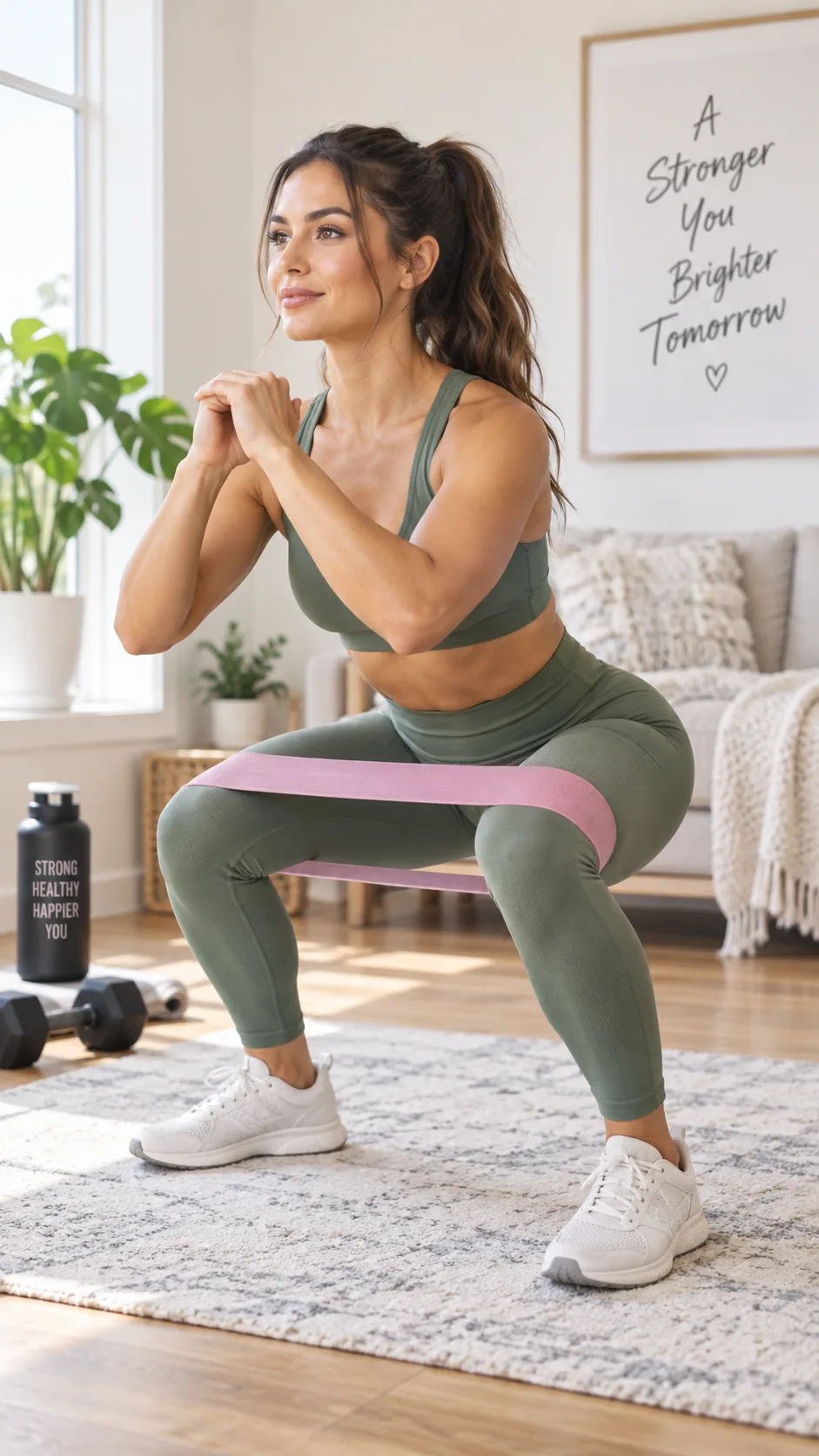
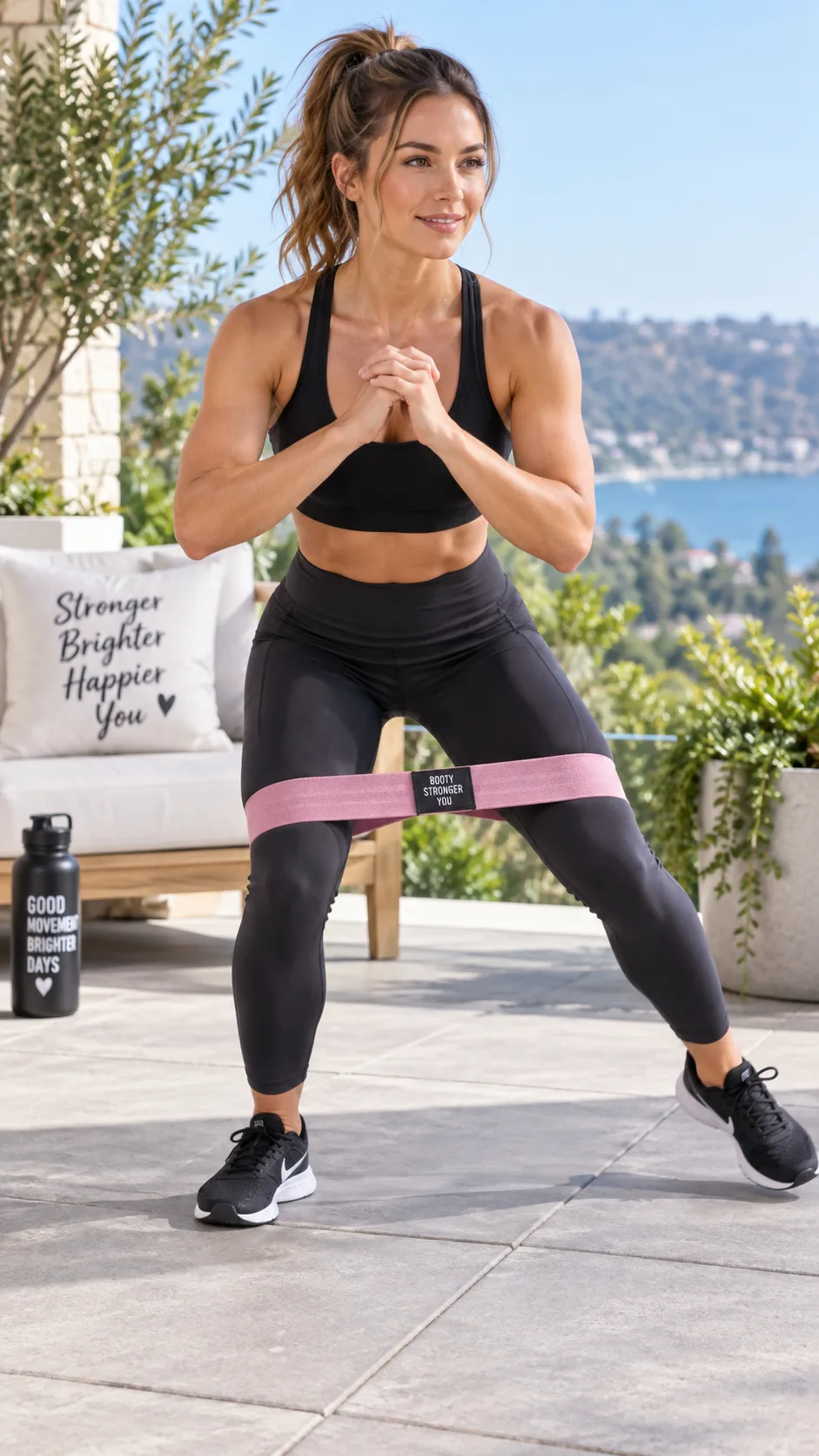
Place a mini loop band just above your knees. Get into a quarter-squat position and walk sideways, keeping tension on the band the entire time. This exercise targets your gluteus medius, the muscle responsible for hip stability and that “side shelf” shape many women want.Romanian Deadlifts (3 sets x 12 to 15 reps)
Stand on the center of a long band and hold both ends. Hinge at the hips, pushing your butt back while keeping your back flat. Drive through your heels to stand tall. Your hamstrings and glutes do ALL the work here, exactly as they should.Banded Glute Bridges (3 sets x 15 to 20 reps)
Lie on your back with a mini band above your knees. Place your feet flat on the floor and drive your hips toward the ceiling. Squeeze your glutes hard at the top and push your knees outward against the band. Hold for 2 seconds before lowering.Standing Kickbacks (3 sets x 12 reps per leg)
Anchor a loop band around one ankle and step on it with the opposite foot. Kick the banded leg straight back, squeezing your glute at full extension. Keep your core braced and avoid arching your back. This isolation movement creates an incredible glute pump.
Core exercises
A strong core isn’t about six-pack abs (although those are a nice bonus). It’s about stability, back health, and functional strength that supports everything else you do. These band-assisted core exercises add resistance your bodyweight alone can’t provide. For more on building that foundational strength, our full back workout for women pairs perfectly with this section.
Pallof Press (3 sets x 10 reps per side)
Anchor the band at chest height to your side. Hold it with both hands at your chest and press straight out. The band tries to rotate you. Resist it. This anti-rotation exercise builds deep core strength that protects your spine during everything from lifting to running.Banded Dead Bugs (3 sets x 10 reps per side)
Lie on your back and loop a band around your feet. Extend opposite arm and leg while keeping your lower back pressed flat against the floor. The band adds tension that makes your abs work overtime to maintain stability.Standing Band Crunches (3 sets x 15 reps)
Anchor the band behind and above you. Hold both ends at your shoulders and crunch downward, driving your ribcage toward your pelvis. This targets your rectus abdominis with constant resistance throughout the full range of motion.
How to structure your resistance band workout week
You have options, and the best schedule depends on YOUR life. Here are two approaches that work extremely well:
Option A: Full body, 3 days per week
Perform this entire routine on Monday, Wednesday, and Friday (or any 3 non-consecutive days). Each session takes about 40 to 50 minutes. This approach works best for women who want efficiency and prefer not to think too hard about programming. Just show up and do the whole thing.
Option B: Upper/lower split, 4 days per week
- Monday: Upper body exercises + core
- Tuesday: Lower body exercises
- Thursday: Upper body exercises + core
- Friday: Lower body exercises
This split gives each muscle group more recovery time and lets you add more volume per session. It’s ideal if you’ve been training consistently for a few months and want to push harder. Both options produce great results. Consistency matters more than the “perfect” program.
Progressive overload: how to keep getting stronger
Here’s where most women stall with resistance bands: they use the same band at the same tension for months and wonder why nothing changes. Sound familiar? Your body adapts fast, so you need to progressively challenge it.
Ways to increase difficulty with bands:
- Move to a thicker/heavier band, the most straightforward approach
- Double up bands by using two at once for more resistance
- Slow down your reps with a 3-second lowering phase on every rep
- Add pauses by holding the hardest position for 2 to 3 seconds
- Increase reps or sets before jumping to a heavier band, and max out your current one first
- Shorten the band by choking up on it to increase starting tension
According to the National Strength and Conditioning Association (NSCA), progressive overload remains the single most important principle for strength gains, regardless of what equipment you use. Bands are no exception.
Common mistakes that kill your progress
I’ve made every single one of these mistakes, so consider this your shortcut past the learning curve.
- Going too fast. Resistance bands reward slow, controlled movement. Snap the band up quickly and momentum does the work instead of your muscles. Take your time. Each rep should feel intentional.
- Using a band that’s too light. If you can breeze through 20 reps without effort, the band is too easy. Your last 3 to 4 reps should feel genuinely challenging. Grab a heavier band and stop selling yourself short.
- Forgetting about nutrition. You can do the best full body resistance band workout on earth, but without proper fuel, your results will plateau. Make sure you’re eating enough protein to support muscle recovery. Our high protein meal plan for women has you covered on that front.
- Neglecting your back. Many women focus heavily on “mirror muscles” (chest, shoulders, abs) and skip pulling exercises. Those standing rows and face pulls MATTER. A balanced physique requires balanced training.
- Not tracking progress. Write down your exercises, band resistance, and reps. Without tracking, you have no idea whether you’re progressing or just going through the motions week after week.

Who is this workout for?
Almost everyone, honestly. But this routine especially suits:
- Beginners who feel intimidated by a weight room full of grunting strangers
- Busy women who need quick, effective home workouts between meetings, school runs, or just life in general
- Frequent travelers who refuse to skip workouts just because they’re in a hotel
- Intermediate lifters who want an accessory tool or a lighter training day option
- Women recovering from injuries who need low impact but effective resistance training (always clear this with your doctor first)
Can resistance bands replace a fully equipped gym forever? For most recreational exercisers, absolutely. For someone training for a powerlifting meet? Probably not. But for building functional strength, toning muscle, and maintaining your fitness anywhere on the planet? Bands deliver. Period.
Quick tips to maximize your band workouts
A few more lessons from years of trial and error:
- Invest in a door anchor. This $5 accessory opens up dozens of exercises you can’t do otherwise. It turns any door in your house into a cable machine.
- Check your bands for wear regularly. Tiny tears or thin spots can cause a band to snap mid-exercise. Replace worn bands immediately, because a snapped band to the face is NOT fun. Ask me how I know.
- Mind your anchor points. Make sure whatever you wrap your band around is solid and won’t move. A wobbly chair leg is a terrible anchor. A sturdy pole or closed door? Perfect.
- Breathe properly. Exhale during the hardest part of each movement (the contraction) and inhale on the way back. This sounds basic, but plenty of people hold their breath and wonder why they feel dizzy.
Also, wear something comfortable that lets you move freely. Nothing kills a workout faster than constantly adjusting clothes. If you need inspiration on that front, our guide to the best resistance bands from SELF magazine also covers gear essentials worth checking out.
Your stronger self is one band away
A full body resistance band workout gives you everything you need to build real, functional strength. No gym, no excuses, no complicated setup. These simple tools provide progressive resistance, joint-friendly tension, and total body training that you can do literally anywhere.
Start with the routine above three times per week. Track your reps. Upgrade your bands as you get stronger. Fuel your body with proper nutrition. That’s the formula. It’s not flashy, it’s not complicated, and it works.
The women who get the strongest aren’t always the ones with the fanciest equipment. They’re the ones who show up consistently and put in the work, even when “the gym” is a hotel room floor and a couple of rubber bands. Now go grab your bands and prove that to yourself.
