
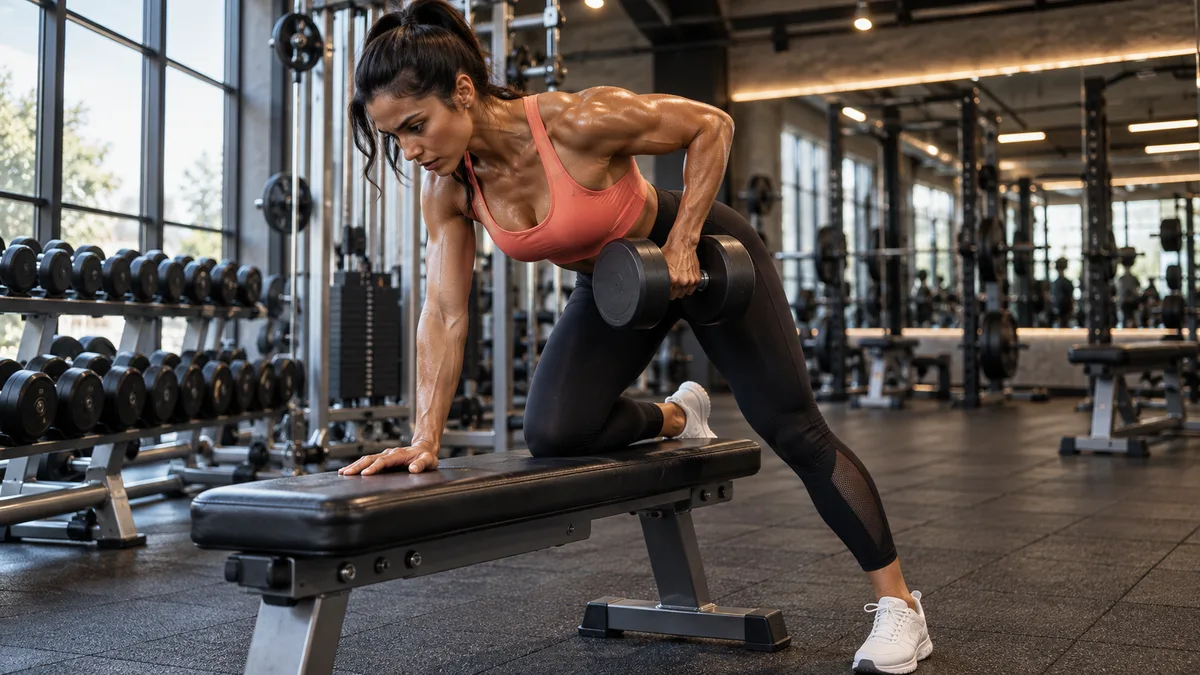
You walk into the gym, look around, and suddenly forget everything you planned to do. Sound familiar? You’re not alone, and that’s exactly why having a solid, structured weekly workout plan changes everything. No more wandering between machines hoping something sticks.
This guide breaks down a practical women’s gym routine built on real training principles. We’re talking about a weekly weight training schedule you can actually follow, one that fits your life and delivers results you can see and feel.
Why women actually need to lift heavy (yes, really)
Time to kill the biggest gym myth right now: lifting heavy weights will not make you bulky. Women produce roughly 10 to 30 times less testosterone than men, which makes that kind of mass-building physiologically very difficult without deliberate, years-long effort. What heavy lifting WILL do is build lean muscle, increase your resting metabolism, and give your body that toned, defined look most women are going after in the first place.
Research from the American Council on Exercise confirms that progressive resistance training is one of the most effective tools for body composition change in women. Not cardio alone. Not endless circuits with 5-pound dumbbells. Actual structured strength work.
Beyond aesthetics, regular weight training helps women maintain bone density (which matters more and more as we age), improves insulin sensitivity, and boosts mood through endorphin and dopamine release. The benefits stack fast once you commit to a consistent plan.
Choosing the right weekly split for your schedule
Before you write anything on a training calendar, figure out how many days per week you can realistically commit to. Not what you hope you can do, but what you will actually show up for. Three quality sessions beat five inconsistent ones every single time.
The 3-day full body split (best for beginners)
Three days a week with rest days between each session. You hit every major muscle group each session, which means high frequency at low per-session volume. This works brilliantly for beginners because the body adapts quickly when it sees a stimulus repeatedly early on.
- Monday: Full body (squat, press, row pattern)
- Wednesday: Full body (hinge, push, pull variation)
- Friday: Full body (lunge, overhead, horizontal pull)
The 4-day upper/lower split (the sweet spot)
This is IMO the best starting point for most women who have a few months of training under their belt. You train upper body twice and lower body twice per week, which gives each muscle group enough volume and recovery time to grow. It also lets you push harder each session since you’re only working half your body at a time.
- Monday: Lower Body (quad-focused)
- Tuesday: Upper Body (push-focused)
- Thursday: Lower Body (hamstring/glute-focused)
- Friday: Upper Body (pull-focused)
The 5-day push/pull/legs split (for the dedicated)
Five days sounds like a lot, but two of those sessions are often shorter. This split separates muscles by their movement function, which means zero overlap and maximum recovery between sessions. It’s a great intermediate-to-advanced option once you understand the basics of progressive overload.
Your complete 4-day women’s gym workout plan
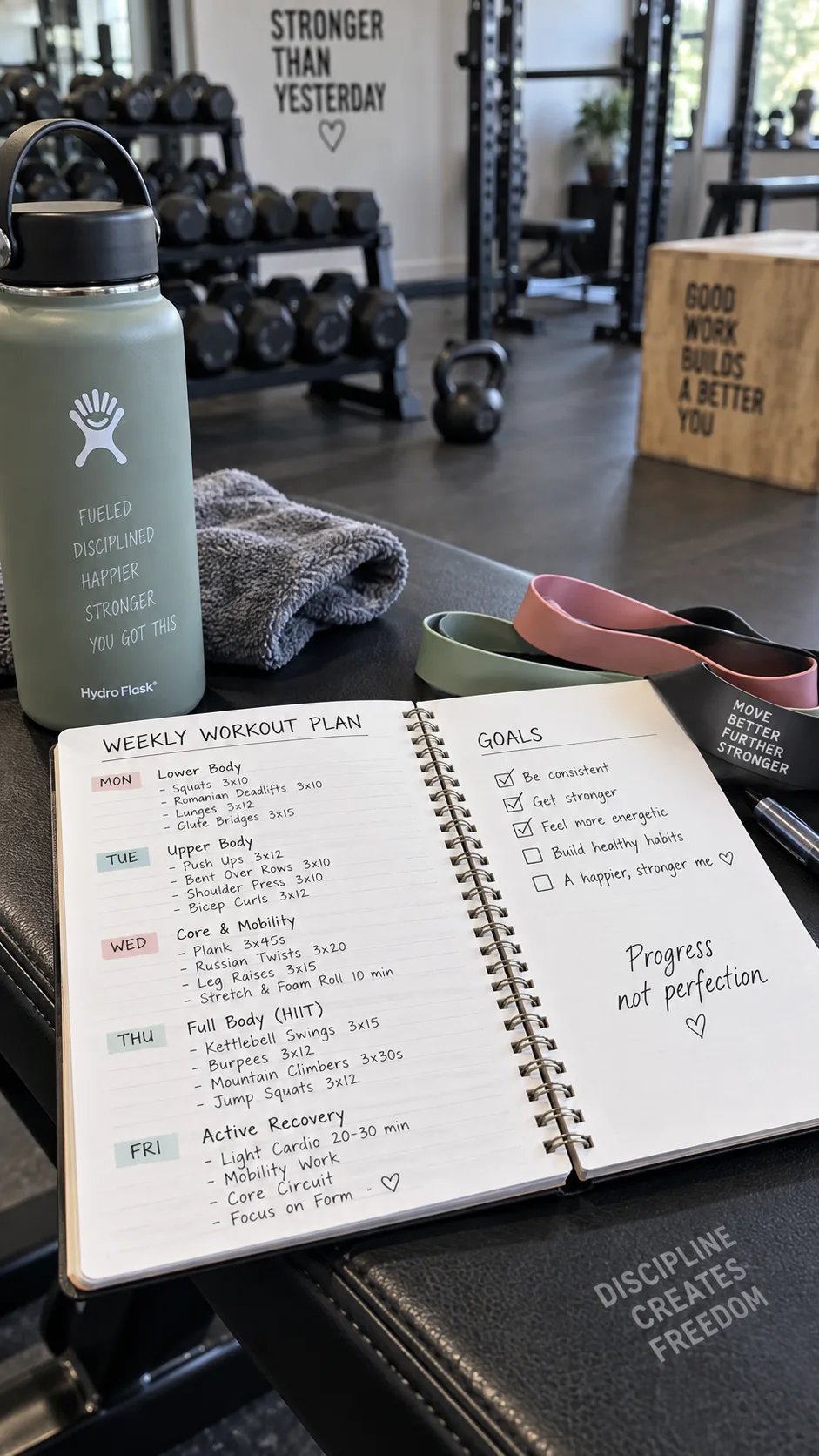
Here’s a practical 4-day weekly weight training schedule you can start this week. Each session takes 45 to 60 minutes. Rest 60 to 90 seconds between sets for hypertrophy work, and up to 3 minutes for heavy compound lifts.
Day 1: Lower body, quad focus
- Barbell Back Squat, 4 sets x 6-8 reps
- Leg Press, 3 sets x 10-12 reps
- Walking Lunges, 3 sets x 12 reps each leg
- Leg Extension, 3 sets x 15 reps
- Standing Calf Raises, 4 sets x 15-20 reps
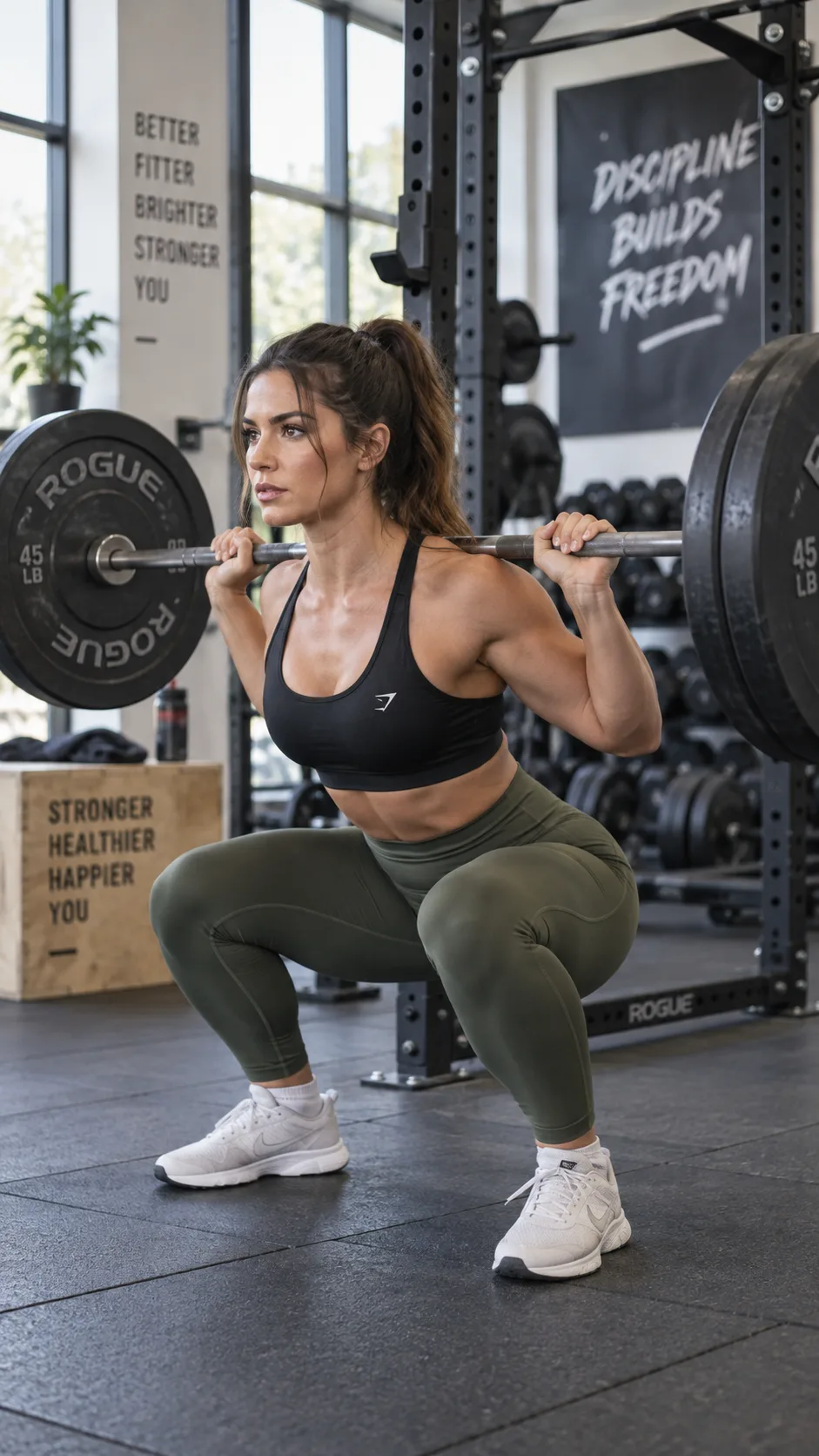
Ever wondered why squats show up in nearly every serious women’s training program? They recruit more total muscle mass than almost any other movement. Glutes, quads, hamstrings, core, and even your upper back all fire to keep you stable under load. That’s hard to replicate with machines alone.
If you want a deeper breakdown of lower body work, check out this guide on the Ultimate Leg Day Workout at the Gym. It covers exercise selection, rep ranges, and how to program progressive overload for your legs specifically.
Day 2: Upper body, push focus
- Dumbbell or Barbell Bench Press, 4 sets x 6-8 reps
- Incline Dumbbell Press, 3 sets x 10-12 reps
- Overhead Dumbbell Press, 3 sets x 10-12 reps
- Lateral Raises, 4 sets x 15 reps
- Tricep Pushdowns, 3 sets x 15 reps
Day 3: Rest or active recovery
Wednesday is your reset day. A 20-minute walk, a yoga session, or light stretching keeps blood flowing and reduces soreness without taxing your nervous system. Active recovery is not optional filler. It’s part of the training process. Muscles grow during rest, not during the workout itself.
Day 4: Lower body, posterior chain focus
- Romanian Deadlift, 4 sets x 6-8 reps
- Hip Thrust or Glute Bridge, 4 sets x 10-12 reps
- Bulgarian Split Squat, 3 sets x 10 reps each leg
- Lying Leg Curl, 3 sets x 12-15 reps
- Abductor Machine, 3 sets x 15-20 reps
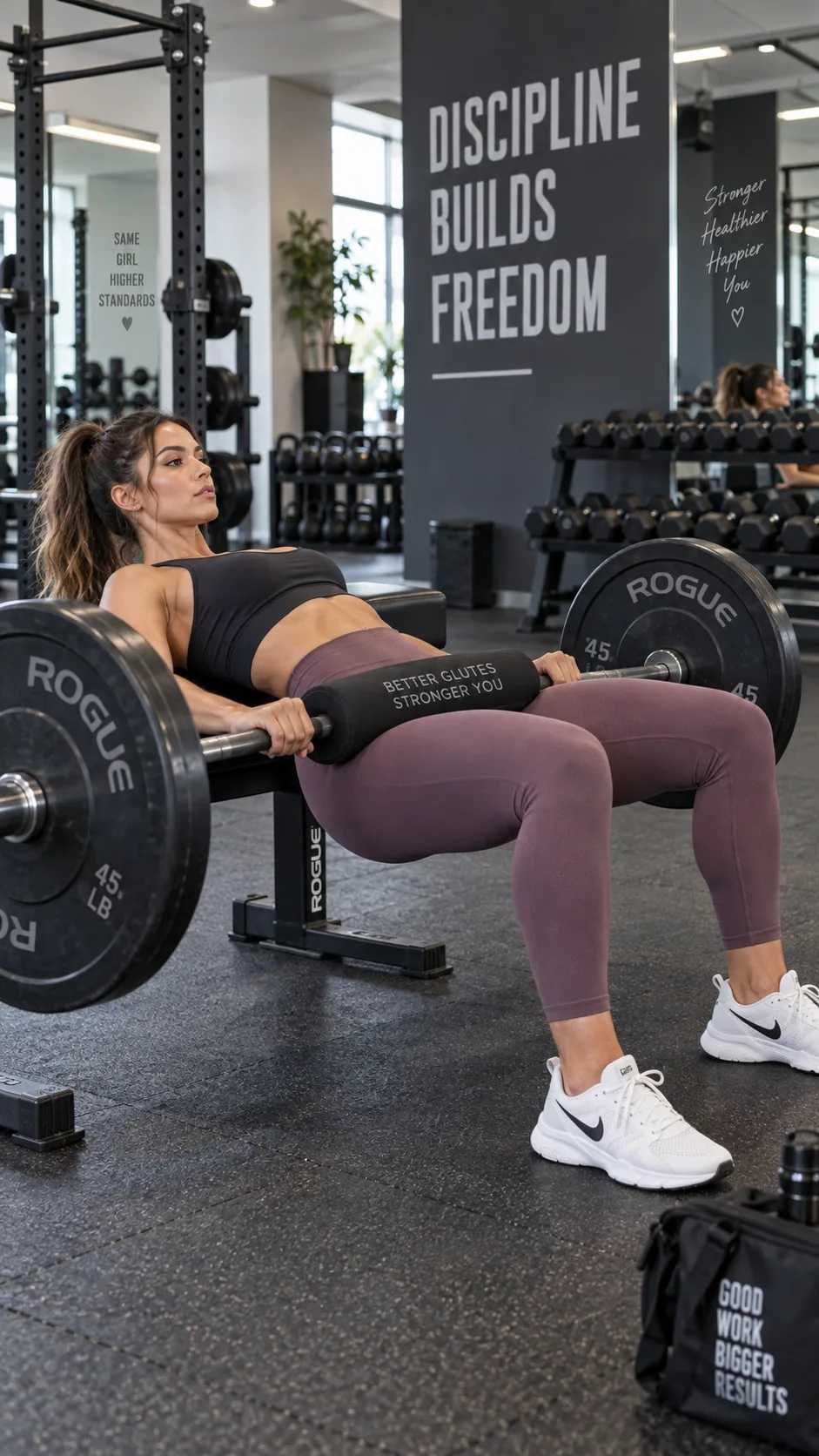
Romanian deadlifts deserve a standing ovation. They load the hamstrings and glutes through a long range of motion, they’re joint-friendly compared to conventional deadlifts for beginners, and they directly target the muscles most women want to develop. Go slow on the way down. That eccentric tempo is where a lot of the muscle damage (the good kind) happens.
Day 5: Upper body, pull focus
- Lat Pulldown, 4 sets x 8-10 reps
- Seated Cable Row, 3 sets x 10-12 reps
- Single-Arm Dumbbell Row, 3 sets x 10-12 reps each arm
- Face Pulls, 3 sets x 15 reps
- Dumbbell Bicep Curls, 3 sets x 12-15 reps
The principles that make this routine work
Following a plan is one thing. Understanding why it works means you can adapt it when life throws a wrench in your schedule. These principles underpin every effective women’s weight training schedule.
Progressive overload
Progressive overload is the single most important concept in strength training. It means consistently making your workouts harder over time: adding weight, reps, sets, or reducing rest time. Your body adapts fast, and if you always lift the same weight for the same reps, you’ll plateau within weeks. Track your lifts every session. A simple notes app works fine.
Compound movements first
Always lead with your big compound lifts (squats, deadlifts, bench press, rows) when your energy is highest. Isolation exercises like curls and lateral raises come last. This structure isn’t arbitrary. Research published in PLOS ONE confirms that compound exercises produce significantly greater hormonal responses and overall muscle recruitment than isolation work alone.
Recovery is part of the program
You build muscle during rest, not during the workout itself. Sleep, nutrition, and stress management directly affect how much you get from your training. Aim for 7 to 9 hours of sleep and take your rest days seriously. Training harder on a chronically under-recovered body leads to injury, not gains.
How long before you see results?
Real talk: you’ll feel results in 2 to 3 weeks and see visible changes in 6 to 8 weeks, assuming you train consistently and eat to support your goals. The first changes are neurological (your brain gets better at recruiting muscle fibers), then structural changes follow. Anyone who promises visible abs in two weeks is selling something.
The American College of Sports Medicine recommends training each muscle group 2 to 3 times per week for optimal hypertrophy in trained individuals. The 4-day split above hits that frequency right where you want it.

Nutrition: What you eat makes or breaks your progress
Training is the stimulus. Food is the raw material your body uses to respond to it. Without enough protein and total calories, your body simply can’t build muscle efficiently. It’s like trying to build a house without enough bricks. You don’t need to obsess over every gram, but you do need a basic structure.
Aim for 0.7 to 1 gram of protein per pound of bodyweight daily when you’re training hard. Distribute it across meals rather than loading it all at dinner. Carbohydrates fuel your workouts, so don’t slash them aggressively unless you have a specific reason. Fats support hormone production, including the hormones that regulate muscle building and recovery.
Want a practical eating framework to complement this training plan? The Ultimate 7 Day High Protein Meal Plan gives you a full week of meals structured around the protein targets that support strength training progress.
And if you want to know exactly where your body stands right now before you start, running your numbers through a BMI & BodyFat Calculator gives you a useful baseline to track change against over the coming months.
Common mistakes women make (and how to skip them)
You’re about to save yourself months of frustration by knowing these upfront. 🙂
- Going too light for too long. If you can bang out 15 reps and it feels easy, the weight is too light. You should reach genuine effort by rep 10 to 12 on most sets.
- Skipping compound lifts. Squats and deadlifts feel scary at first, but they deliver the most return on your time investment. Learn the form, start light, and build up.
- Changing the program every 2 weeks. Your body needs 4 to 6 weeks minimum to adapt to a stimulus. Stick with the plan long enough to judge it properly.
- Doing too much cardio alongside strength training. Some cardio is fine. Hours of it on top of 4 lifting sessions will undermine your recovery and blunt muscle growth.
- Neglecting upper body. Glutes get all the attention (fair), but strong shoulders, back, and arms change how everything looks and improve everyday function.
- Not tracking anything. You cannot know if you’re improving if you don’t record what you did last week. Tracking takes 2 minutes and removes all the guesswork.
How to progress once this gets too easy
After 8 to 12 weeks on this plan, your body will have adapted and you’ll need to add challenge. Here are a few practical ways to keep progressing without overhauling your whole routine:
- Add weight to the bar. Even 2.5 lbs per side every 1 to 2 weeks compounds into significant strength gains over a year.
- Add a set to your main lifts. Going from 3 sets to 4 adds meaningful volume without changing the exercises.
- Reduce rest times. Cutting rest from 90 seconds to 60 seconds increases training density and metabolic stress.
- Add a tempo component. A 3-second lowering phase (eccentric) on squats or press movements dramatically increases time under tension.
- Introduce a 5th training day. Once recovery allows, you can shift toward a push/pull/legs structure for greater volume per muscle group.
Wrapping it up
A solid women’s gym workout plan doesn’t need to be complicated. It needs to be consistent, progressive, and built around your actual schedule, not someone else’s Instagram highlight reel. The 4-day upper/lower split outlined here gives you a proven framework that hits every major muscle group, allows proper recovery, and scales with you as you get stronger.
Show up, track your lifts, eat enough protein, and give the plan at least 8 weeks before judging it. The women who see real results aren’t the ones with the fanciest programs. They’re the ones who turn up consistently and add a little more weight each week. Start there.
