
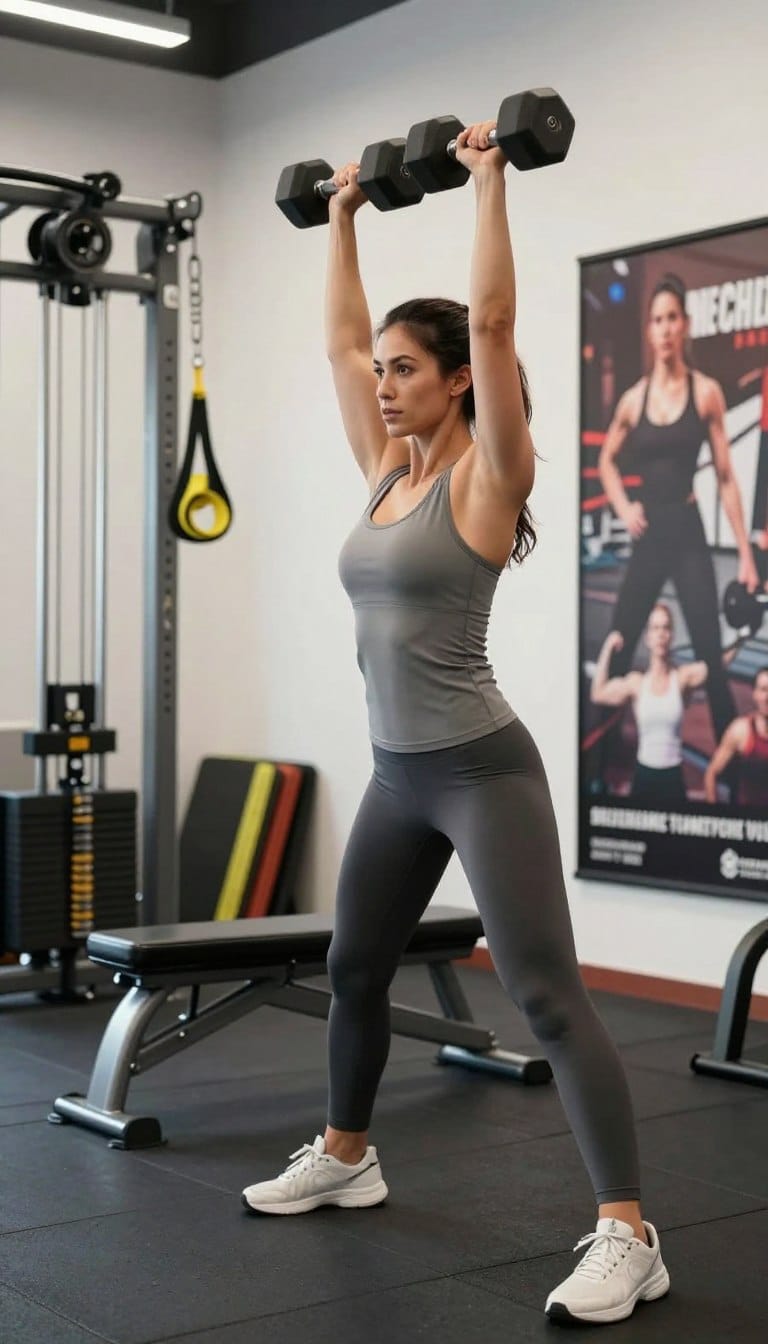
Want to know which moves truly build strength and shape you for real life? This guide shows you a science-backed plan that targets chest, back, shoulders, and arms so your whole body grows balanced power and function.
Start with scalable exercises that let you add weight and reps over time. A meta-analysis in Frontiers in Sports and Active Living highlights that progress comes from picking movements you can safely progress. That means compound presses, rows, and presses with dumbbells or a barbell.
You’ll learn how to protect your lower back and joints while improving stability and range of motion. The routine focuses on form, resistance, and recovery so you gain muscle, improve posture, and lift everyday items with ease.
Key Takeaways
- Choose scalable exercises to support steady strength gains.
- Focus on compound movements to engage multiple muscle groups.
- Prioritize form and recovery to avoid strain and protect your lower back.
- Progress with weight and reps to see measurable results.
- This plan helps improve daily function and long-term fitness.
Why You Should Prioritize Upper Body Training
Strong pressing and pulling skills make everyday chores feel easier and safer.
Prioritizing this work builds practical strength you use for lifting groceries, placing items on shelves, or helping someone up. Consistent sessions also improve posture by balancing chest, back, and shoulder muscles.
Resistance training preserves bone density as you age. Studies show targeted loading helps keep bones and muscle mass healthy. That means better long-term fitness and reduced fracture risk.
Functional Benefits for Daily Life
- Greater ease with pushing and pulling actions.
- Improved stability for balance and carrying tasks.
- Reduced injury risk during lifting and reaching.
Long-term Health and Bone Density
Regular training keeps bones strong and muscles ready for daily demands. A balanced routine prevents imbalances between chest and back and supports lower body strength.
| Benefit | What It Helps | How Often |
|---|---|---|
| Functional strength | Shopping, lifting, transfers | 2–3 times weekly |
| Bone health | Maintains density with resistance | 2 sessions weekly |
| Posture | Balanced chest and back muscles | Included each session |
| Stability | Better balance and injury prevention | Weekly mobility work |
Essential Equipment for Your Gym Sessions
Well-chosen tools let you target key muscles and get consistent strength gains.
Dumbbells, barbells, and cable machines are staples for effective upper body training. They let you progress load and perform compound exercises that hit several muscle groups.
Resistance bands add variety and keep tension through the whole range of motion. They are great for warm-up sets, accessory work, and rehab.
A sturdy bench and proper weight racks matter. A bench makes presses and rows safer, while racks and cable stations let you lift heavier and focus on form.
- Choose dumbbells and a dumbbell set to fix imbalances and increase range of motion.
- Use cable stations for isolation and steady resistance during exercises.
- Carve out a focused space for training so you can move between sets without disruption.
| Equipment | Primary Benefit | Focus |
|---|---|---|
| Dumbbells | Versatility for presses and rows | Muscle balance |
| Barbell & Racks | Load progression for strength | Compound lifts |
| Cable Stations | Consistent resistance | Isolation work |
Tip: Spend time learning each piece safely. Proper setup and technique speed progress and protect your back and joints while you build fitness.
Warming Up for Optimal Performance
Start each session with a short, active warm-up to prime your muscles and joints for heavier lifts.
Why warm up? A quick warm-up raises blood flow and wakes your nervous system. That makes key movements safer and more effective.
Dynamic Stretching Techniques
Spend 5–7 minutes on light cardio or arm swings to boost circulation in the chest, back, and shoulders. Keep the pace easy and controlled.
Include mobility drills like torso rotations and banded pull-aparts. These align your spine, improve shoulder rotation, and enhance core stability.
Use movement patterns that mimic your main exercises. Do a few light rows and presses with minimal resistance to prime the arms and chest.
- Light cardio (5 minutes) — increases heart rate and heat.
- Dynamic stretches — hip hinges, torso twists for spine alignment.
- Movement rehearsal — two light sets of main lifts for neural prep.
| Step | Time | Benefit |
|---|---|---|
| Cardio/arm swings | 3–5 min | Blood flow |
| Dynamic stretches | 2–3 min | Mobility |
| Light rehearsal sets | 1–2 sets | Movement patterning |
Keep this routine consistent. Warming the lower body and upper body together builds a balanced foundation and reduces injury risk during resistance training.
Mastering the Bench Press for Chest Strength
Mastering the bench press gives you a reliable way to build a stronger chest and firmer pressing mechanics.
The bench press is a foundational exercise. It targets your pectoralis major, anterior deltoids, and triceps. This movement also demands a stable core and solid back positioning.
Lie flat with your eyes under the bar and feet planted on the floor. Grip the bar slightly wider than shoulder width and squeeze your shoulder blades together to create a stable base. Keep a neutral spine to protect your lower back.
Lower the bar with control to mid-chest, then press through your triceps until your elbows are fully extended. Aim for 3 to 4 sets of 8–12 reps to maximize muscle growth and strength.
Prefer a greater range? Use dumbbells instead of a barbell to increase motion and isolate chest fibers. For a quick option, try the 20-minute chest workout to slot this press into a high-intensity routine.

| Variation | Primary Benefit | Ideal Sets/Reps |
|---|---|---|
| Barbell bench | Heavier weight, maximal strength | 3–4 sets, 6–10 reps |
| Dumbbell press | Greater range of motion, muscle balance | 3–4 sets, 8–12 reps |
| Paused bench | Improves control and lockout strength | 3 sets, 4–6 reps |
Developing Back Power with Rows
Rows build raw pulling power and help shape a thicker, more resilient back.
Barbell rows are the foundation for back thickness. They target the lats, rhomboids, and biceps while teaching you to handle heavier weight. Hinge at the hips to roughly 45 degrees, keep your back flat, and brace your core for stability.
Barbell Rows for Thickness
Set a solid grip on the bar and pull toward your lower ribs. Drive the motion with your elbows and squeeze the shoulder blades at the top. Keep reps controlled to protect your lower back and to load the intended muscles.
Dumbbell Rows for Balance
Dumbbell rows let you fix side-to-side differences in strength. Support one hand on a bench, hinge from the hips, and pull the weight with the opposite arm.
- Squeeze the scapula each rep so the back does the work, not your arms.
- Keep elbows close to the torso to focus the lats.
- Aim for 3–4 sets of 8–12 reps to build muscle and pulling strength.
| Variation | Primary Benefit | Recommended Sets/Reps |
|---|---|---|
| Barbell row | Thickness, heavier weight handling | 3–4 sets • 8–12 reps |
| Dumbbell row | Corrects imbalances, unilateral control | 3 sets • 8–12 reps per side |
| Single-arm DB row | Core stability and posture | 3 sets • 10 reps per side |
Consistency with rows balances your pressing days. That balance protects shoulders, improves posture, and gives you the back strength needed for other compound movements.
Overhead Pressing for Shoulder Stability
A solid overhead press improves how your shoulders move and how your torso supports heavy loads.
The overhead press is a premier strength builder. It targets the deltoids, triceps, and upper traps while demanding real core stability. A 2020 study in the Journal of Strength and Conditioning Research highlights how this press improves shoulder mechanics and joint health.

Stand with feet hip-width apart and grip the bar with hands just outside shoulder width. Press the bar straight overhead until your elbows lock and the bar sits in line with your chest and head.
Squeeze your glutes and brace the core to keep a neutral back. Lower with control to collarbone level and pause briefly to keep tension and reinforce safe technique.
- This movement permits free shoulder-blade mobility, which supports long-term shoulder health.
- For strength focus, aim for 4–5 sets of 3–6 reps with steady form.
- Use the barbell press to transfer strength into other upper chest and back exercises.
| Focus | Why It Helps | Guideline |
|---|---|---|
| Deltoid and trap strength | Builds pressing power and posture | 4–5 sets • 3–6 reps |
| Core stability | Protects the spine during heavy lifts | Brace and hold through each rep |
| Shoulder mobility | Promotes healthy joint mechanics | Use full, controlled range each rep |
Incorporating Pullups and Chinup Variations
Few moves test your pulling strength and posture like strict pullups and chinups done with clean form.
Grip matters: hang from the bar with an overhand grip for pullups or an underhand grip for chinups. Brace your core and keep the scapula engaged before each rep.
Pull your elbows down toward your ribs until your chin clears the bar. Avoid kipping or using momentum; controlled pulls force the right muscles to work.
If you’re new, use an assisted machine or loop a resistance band around the bar to reduce weight. These tools help you build reps and confidence safely.
Aim for 3 sets of 8 reps as a baseline, with slow, controlled descents to promote muscle growth in the back and biceps. Over time, add weight with a dip belt once you can do multiple clean sets of body reps.
- Benefits: better grip, V-taper shape, and improved shoulder stability.
- Practice regularly to transfer pulling strength into rows and pressing movements.
Using Cable Machines for Targeted Isolation
Cables let you tune the angle of resistance so you can hit chest and shoulders from new lines.
Cable machines provide constant tension through the full range of motion, which makes them ideal for isolating the pectoral and deltoid muscles. You can change height and angle to stress different fibers and refine your shape after heavy compound pressing.
Cable Fly Mechanics
Stand centered between two high-pulley cables and sweep your hands together in a hugging arc. Keep a slight bend in the elbows to protect joints and keep tension on the chest.
- Target: pectoralis major and anterior deltoids with a deep stretch at the bottom and a strong squeeze at the top.
- Sets & reps: aim for 3–4 sets of 10–15 reps to boost hypertrophy and definition.
- Technique tip: control the cables back to the start and feel the full stretch before the next rep.
| Focus | Why | Guideline |
|---|---|---|
| Angle variation | Hits different muscle fibers | Adjust pulley height |
| Elbow position | Joint safety | Keep slight bend |
| Placement in routine | Finish after heavy press | Use as accessory work |
Building Arm Strength with Bicep and Tricep Movements
Strong, balanced arms come from pairing focused curls with solid triceps work. This combination builds both the look and function you need for pressing and pulling movements.
Use an EZ bar for biceps to ease stress on your wrists and elbows while you lift heavier weight. For side-to-side correction, choose dumbbell or single-arm dumbbell curls. Keep your elbows pinned to your sides so the biceps do all the work.
For the back of the arm, prioritize triceps moves like cable pushdowns and overhead extensions. These support heavier bench and bar rows by stabilizing the elbow joint.
- Aim for 3 sets of 10–12 reps per exercise and focus on the squeeze at the top of each rep.
- Alternate bar curls, hammer curls, and unilateral dumbbell curls to address imbalances.
- Finish with triceps isolation to improve pressing strength and arm definition.
| Focus | Why | Guideline |
|---|---|---|
| Biceps (EZ bar) | Less wrist/elbow strain | 3 sets • 10–12 reps |
| Dumbbell curls | Fix imbalances | 3 sets • 10–12 reps per side |
| Triceps (cable) | Supports pressing strength | 3 sets • 10–12 reps |
Designing Your Weekly Upper Body Workout at Gym
A simple split helps you train harder while giving muscles time to recover and grow.

Push Day Focus
On push days you target chest, shoulders, and triceps with pressing movements.
Choose 3–4 main lifts such as barbell bench, overhead press, and dips. Aim for 3–4 sets of 8–12 reps with a challenging weight (around 60–80% of your one-rep max).
Pull Day Focus
Pull sessions develop the back and biceps using rows, pull-ups, and face pulls.
Prioritize controlled reps and scapular control. Follow the same 3–4 sets of 8–12 reps guideline. Rest 48–72 hours before hitting the same area again to support recovery and strength gains.
Split Training Options
An upper/lower split works well if you want to train each muscle group twice weekly while keeping sessions shorter.
- Option A: Push / Pull / Rest / Legs / Push / Pull / Rest.
- Option B: Upper / Lower / Rest / Upper / Lower / Rest / Active recovery.
- Keep a training log to track sets, reps, and weights so you can apply progressive overload.
| Plan | Frequency | Focus |
|---|---|---|
| Push/Pull Split | 2–3 times/week | Pressing and pulling movements, chest, shoulders, back |
| Upper/Lower Split | 4 sessions/week | Train muscle groups twice with shorter sessions |
| Full Upper Sessions | 2–3 sessions/week | Comprehensive routine with emphasis on form and stability |
Always choose form over heavier weights. Good technique protects your joints and improves long-term progress on the barbell, dumbbell, and cable movements.
Strategies for Progressive Overload
Progressive overload means nudging your resistance, reps, or sets forward so muscles must adapt.
Start small and be consistent. If your regular upper body sessions feel easy, add tiny weight increases or one extra rep. Track sets, reps, and the weight so you know when to step up the challenge.
- Increase resistance slowly — 1–5% jumps keep form intact while adding stress.
- Change tempo: control the eccentric motion and pause at the bottom to boost muscle tension.
- Adjust sets and reps over weeks to shift between strength and hypertrophy phases.
- Apply overload to every exercise, from heavy rows to isolation cable flies and curls.
| Goal | Example | When |
|---|---|---|
| Strength | Heavier weight, 3–6 reps | After 2–3 weeks of stable reps |
| Size | Moderate weight, 8–12 reps | Progress when sets feel easy |
| Control | Slower motion, longer time under tension | Use between heavy phases |
Consistency is the engine of progress. Keep good form, track your data, and push a bit more each session. Over time your strength, shape, and confidence in your body will grow.
Common Form Mistakes to Avoid
Small posture mistakes shift load away from target muscles and invite injury. Watch your position before every set so each exercise hits the right place.
Too much arch in the back during presses moves stress off your chest and onto your spine. Keep a neutral spine and a stable core when you bench or press to protect your back and get stronger chest activation.
Pushing mainly with the front delts and skipping rows or face pulls creates imbalances. That leads to rounded shoulders and weak rear muscles. Balance pushing with pulling to keep muscles paired and healthy.
- Don’t use momentum. Slow, controlled reps keep the target muscle working.
- Check your core and shoulder-blade position at the start of each set.
- Progress weight across sets and reps; avoid doing the same load every week.
| Mistake | Effect | Quick Fix |
|---|---|---|
| Excessive arching | Spine stress, poor chest activation | Brace core, reduce arch, lighten the bar |
| Neglecting pulls | Rounded shoulders, weak rear muscles | Add rows and face pulls between pressing sets |
| No progressive overload | Stalled gains across sets and weeks | Track weights and add small increases to reps or load |
| Using momentum | Joints take load, target muscle misses work | Slow tempo, controlled eccentric, full range |
The Role of Nutrition and Recovery
What you eat and how you recover determine whether your sessions turn into lasting strength.
Think of nutrition as fuel: strength training without proper food is like driving with an empty tank. Aim for roughly 1 gram of protein per pound of body weight daily to help repair muscle fibers and support growth.
Recovery is not optional. Your muscles rebuild when you rest, not while you lift. Prioritize 7 to 9 hours of sleep each night so your nervous system and tissues can recover.
Stay hydrated all day to help nutrient transport and muscle function. Choose complex carbs before training for steady energy and lean protein after sessions to aid repair.
- If you feel fatigued or burned out, dial back intensity and check calories, protein, and sleep.
- Small, consistent changes in meals and rest yield better progress than sporadic extremes.
| Topic | Recommendation | Why it matters |
|---|---|---|
| Protein | ~1 g per lb of body weight daily | Supports muscle repair and growth |
| Sleep | 7–9 hours nightly | Hormone balance and tissue recovery |
| Hydration & Carbs | Water throughout the day; complex carbs pre-session | Energy, nutrient transport, and performance |
Fuel your progress with balanced meals and planned rest. Do that, and you’ll see stronger lifts, better recovery, and more energy for daily life.
Conclusion
Building strength takes steady effort and smart choices. Small, consistent steps add up. Focus on the key movements and make progress each week.
Key takeaway, master the foundational exercises, keep technique tidy, and prioritize recovery and nutrition. This combination helps you gain real strength while reducing injury risk.
Use progressive overload and track your training so each session nudges you forward. Pair that with enough protein and sleep, and your workout results will follow.
Stay patient and committed. You now have a clear blueprint to build a stronger, more resilient upper performance that serves daily life.